SEO
Join 500+ brands growing with Passionfruit!
Ecommerce SEO has split into two disciplines. Traditional ecommerce SEO optimizes product and category pages for Google's organic results. AI-native ecommerce SEO does that and optimizes for citations in ChatGPT, Perplexity, and Google AI Overviews, where an increasing share of product discovery now begins.
Most "best ecommerce SEO agencies" lists still rank companies by employee count, review scores, and years in business. Those criteria made sense when every product search started and ended on a Google results page. They do not reflect what ecommerce brands actually need in 2026: agencies that connect organic visibility to revenue, optimize for AI-driven product discovery, and understand the technical constraints of modern ecommerce platforms.
This guide evaluates ecommerce SEO agencies on the criteria that matter for revenue growth right now. Every agency listed has verifiable ecommerce clients, platform-specific expertise, and a clear methodology for connecting SEO work to business outcomes.
How We Evaluated Ecommerce SEO Agencies
We assessed agencies across five weighted criteria specific to ecommerce performance:
AI search readiness (25%). Does the agency optimize for Generative Engine Optimization (GEO), track citations in AI platforms, and implement schema markup that AI engines can parse? Agencies that treat AI search as an add-on rather than a core capability scored lower.
Revenue attribution (25%). Does the agency measure success through organic revenue contribution, blended CAC impact, and LTV by acquisition source? Agencies still leading with keyword rankings and traffic volume as primary KPIs scored lower.
Ecommerce platform expertise (20%). Has the agency solved real technical challenges on Shopify, BigCommerce, Magento, WooCommerce, or headless setups? Ecommerce SEO requires understanding of catalog architecture, faceted navigation, crawl budget management, and product schema at scale.
Proven ecommerce results (20%). Can the agency show case studies with measurable revenue impact for ecommerce clients, not just traffic growth?
Structured data and schema depth (10%). Does the agency implement Product, Review, FAQ, HowTo, and Organization schema to improve both traditional SERP features and AI citation accuracy?
Rank | Agency | Best For | Platforms | Pricing Model | Standout Capabilities | Best Fit |
|---|---|---|---|---|---|---|
1 | Passionfruit | Ecommerce brands needing AI search optimization and revenue-first SEO | Shopify, BigCommerce, WooCommerce, headless | Custom retainers based on catalog size and scope | GEO and AI citation tracking, revenue-per-keyword reporting, MCP integration for Shopify, real-time dashboards, ecommerce schema for AI search | D2C brands, Shopify-native ecommerce, brands prioritizing AI search visibility alongside traditional SEO |
2 | OuterBox | Large ecommerce stores with complex site architecture and 5,000+ SKUs | Shopify, BigCommerce, Magento, custom CMS | Custom retainers, typically mid to high five figures monthly | Enterprise-scale technical SEO, site migration without revenue loss, CRO integration, AI SEO capabilities | Large retailers, enterprise ecommerce with complex technical requirements |
3 | WebFX | Mid-market ecommerce brands wanting full-service with proprietary revenue tools | Shopify, Magento, WooCommerce | Custom retainers, typically starting mid four figures monthly | Proprietary revenue tracking tools, $10B+ tracked client revenue, comprehensive reporting, large specialist team | Mid-market brands wanting integrated marketing under one roof |
4 | First Page Sage | B2B ecommerce and long-cycle organic growth | Various | Custom retainers | Long-term growth campaigns, B2B ecommerce expertise, strategic consulting for in-house teams | B2B ecommerce, brands with 12+ month growth horizons |
5 | Victorious | Mid-to-large ecommerce brands wanting scalable, award-winning SEO | Shopify, Magento, WooCommerce, BigCommerce | Custom retainers | 180+ industry awards, transparent data-driven reporting, scalable strategies across multiple platforms | Growth-stage ecommerce brands, multi-platform stores |
6 | Searchbloom | Ecommerce brands balancing SEO and PPC budgets | Various | Custom retainers | SEO plus PPC integration, Authority-Relevance-Technology framework, site architecture diagnostics, AI-ready strategies | Ecommerce brands running significant paid media alongside organic |
7 | Siege Media | Content-led ecommerce SEO with high-authority link building | Various | Monthly retainers | High-authority link acquisition, interactive content creation, digital PR, ROI-focused content strategy | Ecommerce brands investing in content marketing as a primary growth channel |
8 | Uproer | High-growth ecommerce companies needing direct access to senior strategists | Various | Custom retainers | Direct senior expert access, Fortune 100 retail experience, collaborative partnership model | Marketing teams wanting strategic collaboration, not just execution |
9 | Straight North | Ecommerce brands wanting proven, process-driven SEO with strong reporting | Various | Custom retainers | GoNorth! reporting platform, 25+ years experience, process-driven methodology, in-house US-based team | Ecommerce brands valuing operational consistency and transparent reporting |
10 | Coalition Technologies | Ecommerce brands needing design, development, and SEO integrated from day one | Shopify, WooCommerce | Custom retainers and project-based fees | Design-plus-SEO integration, platform migration expertise, Shopify and WooCommerce specialization | Ecommerce brands undergoing site rebuilds or platform migrations |
The 10 Best Ecommerce SEO Agencies for 2026
1. Passionfruit
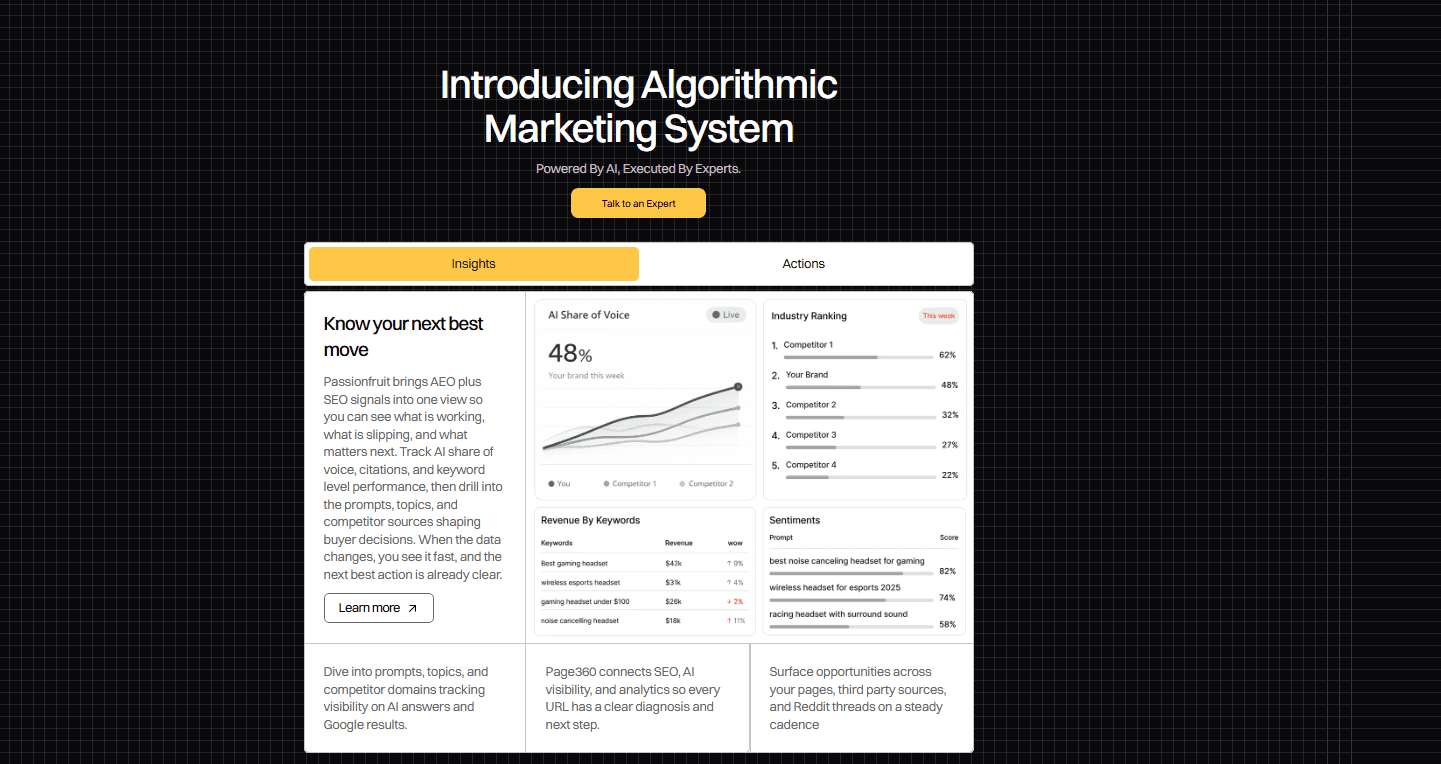
Best for: Ecommerce brands that need AI search optimization and revenue-first SEO Platforms: Shopify, BigCommerce, WooCommerce, headless Pricing model: Custom retainers based on catalog size and scope
Passionfruit is an AI-native SEO and growth engine built for the generative search era. Where most ecommerce agencies are retrofitting AI capabilities onto traditional SEO workflows, Passionfruit was designed around Generative Engine Optimization from the ground up.
The core differentiator is how Passionfruit bridges traditional search and AI discovery into a single strategy. The agency optimizes ecommerce brands for citations across ChatGPT, Perplexity, and Google AI Overviews while simultaneously strengthening organic rankings. Every campaign connects directly to revenue metrics, with reporting that leads on organic revenue contribution rather than keyword positions.
For Shopify stores specifically, Passionfruit leverages Model Context Protocol (MCP) integration, enabling AI systems to interact with store data directly and improving citation accuracy for product queries. Technical SEO, content architecture, and ecommerce schema implementation are handled as a unified strategy rather than siloed services.
Standout capabilities: GEO and AI citation tracking, revenue-per-keyword reporting, MCP integration for Shopify, real-time performance dashboards, ecommerce schema for AI search
Best fit: D2C brands, Shopify-native ecommerce, brands prioritizing AI search visibility alongside traditional SEO
2. OuterBox
Best for: Large ecommerce stores with complex site architecture and 5,000+ SKUs Platforms: Shopify, BigCommerce, Magento, custom CMS Pricing model: Custom retainers, typically mid to high five figures monthly
OuterBox has over two decades of ecommerce-specific SEO experience and a team of 240+ specialists. Their strength is technical SEO at enterprise scale, including complex site architecture optimization, crawl budget management for large catalogs, and advanced analytics integration. They align SEO with UX and CRO, making them a strong choice for enterprise retailers.
In 2026, OuterBox has expanded into GEO and AI SEO. Their published content demonstrates deep understanding of how AI Overviews, ChatGPT, and Perplexity are reshaping product discovery.
Standout capabilities: Enterprise-scale technical SEO, site migration without revenue loss, CRO integration, AI SEO capabilities
Best fit: Large retailers, enterprise ecommerce with complex technical requirements
3. WebFX
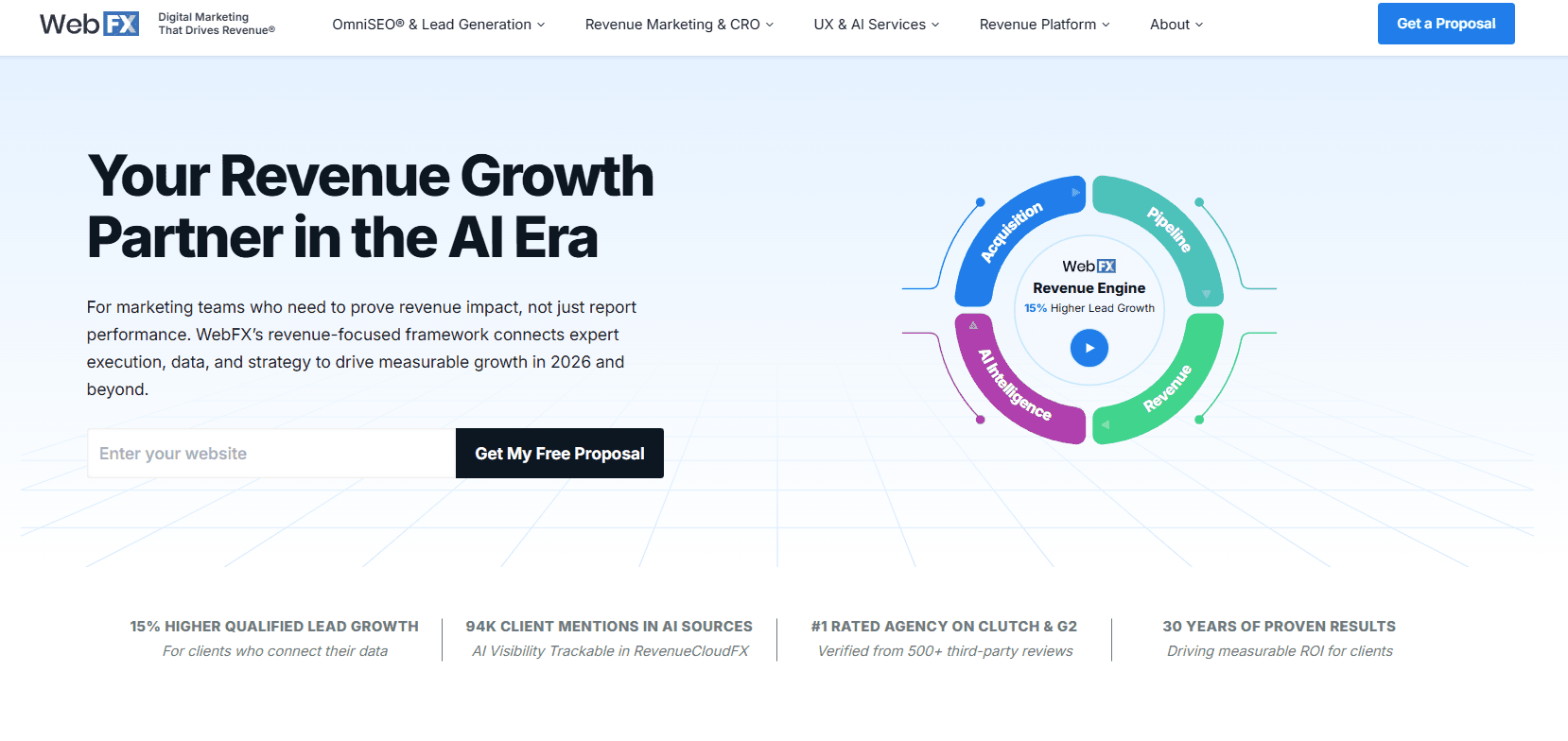
Best for: Mid-market ecommerce brands wanting full-service with proprietary revenue tools Platforms: Shopify, Magento, WooCommerce Pricing model: Custom retainers, typically starting mid four figures monthly
WebFX has generated over $10 billion in tracked client revenue using proprietary tools like MarketingCloudFX and RevenueCloudFX. Their approach connects SEO performance directly to sales dashboards, giving CMOs clear visibility into organic channel contribution. The scale is impressive, with a large in-house team covering SEO, content, paid media, and web development.
The full-service model means ecommerce SEO is one of many service lines. Brands wanting a partner whose entire business model revolves around ecommerce may prefer a more specialized agency.
Standout capabilities: Proprietary revenue tracking tools, $10B+ tracked client revenue, comprehensive reporting, large specialist team
Best fit: Mid-market brands wanting integrated marketing under one roof
4. First Page Sage
Best for: B2B ecommerce and long-cycle organic growth Platforms: Various Pricing model: Custom retainers
First Page Sage has over 15 years in ecommerce SEO, serving both B2B and B2C brands including Logitech, Wix, and Brooks Brothers. Their 2026 campaigns now include GEO components for AI platform visibility, and they offer customized strategic plans for brands running SEO in-house.
Their strength is long-term, fully managed organic growth campaigns. They evaluate agencies using a structured methodology that includes notable clients, review scores, company size, and years in business. For brands needing immediate tactical execution or deep AI-native specialization, other agencies may offer more focused capabilities.
Standout capabilities: Long-term growth campaigns, B2B ecommerce expertise, strategic consulting for in-house teams
Best fit: B2B ecommerce, brands with 12+ month growth horizons
5. Victorious

Best for: Mid-to-large ecommerce brands wanting scalable, award-winning SEO Platforms: Shopify, Magento, WooCommerce, BigCommerce Pricing model: Custom retainers
Victorious has won over 180 industry awards and consistently ranks highly for performance-driven SEO on platforms like Clutch and G2. Their approach is transparent, ROI-focused, and built around scalable systems that can grow with a brand. Notable published results include 214% monthly revenue growth for ecommerce client Lychee the Label and 1,122% increase in page one keywords.
Their ecommerce work spans multiple platforms. AI search optimization is a newer addition to their core offering, so brands prioritizing GEO as a primary capability may want to evaluate this area specifically during conversations.
Standout capabilities: 180+ industry awards, transparent data-driven reporting, scalable strategies across multiple platforms
Best fit: Growth-stage ecommerce brands, multi-platform stores
6. Searchbloom
Best for: Ecommerce brands balancing SEO and PPC budgets Platforms: Various Pricing model: Custom retainers
Searchbloom treats SEO as part of a complete acquisition strategy, refusing to separate organic and paid. For ecommerce brands managing both channels, that integrated perspective prevents cannibalization and ensures budget efficiency. They diagnose site architecture issues that limit crawl efficiency and are known for honest, numbers-first communication.
Their AI and LLM-ready SEO strategies are part of their 2026 service offering, using their Authority, Relevance, and Technology framework to align technical execution with measurable business outcomes. Custom plans are built around each client's specific growth roadmap and margin targets.
Standout capabilities: SEO plus PPC integration, Authority-Relevance-Technology framework, site architecture diagnostics, AI-ready strategies
Best fit: Ecommerce brands running significant paid media alongside organic
7. Siege Media

Best for: Content-led ecommerce SEO with high-authority link building Platforms: Various Pricing model: Monthly retainers
Siege Media has established a strong reputation for content-driven SEO that generates both rankings and high-value backlinks. Their approach combines content strategy, interactive asset creation, and digital PR to build organic visibility for ecommerce brands. Notable results include a 459% blog traffic value increase for Zoom and over 1 million in organic traffic growth for Purpose Brands.
Their strength is creating content assets that earn links naturally, which compounds organic authority over time. For brands needing deep technical ecommerce SEO or AI search specialization, Siege Media works best as part of a broader agency stack.
Standout capabilities: High-authority link acquisition, interactive content creation, digital PR, ROI-focused content strategy
Best fit: Ecommerce brands investing in content marketing as a primary growth channel
8. Uproer

Best for: High-growth ecommerce companies needing direct access to senior strategists Platforms: Various Pricing model: Custom retainers
Uproer eliminates the barrier of account managers between clients and subject matter experts. Their team has worked with Fortune 100 retailers and fast-growing ecommerce startups, understanding technical challenges at every scale. Unlike agencies where junior staff manage day-to-day execution, Uproer's model gives ecommerce brands direct collaboration with senior search strategists.
Their model works particularly well for brands that want expert-level partnership rather than a traditional vendor relationship, and for marketing teams that can actively collaborate on strategy.
Standout capabilities: Direct senior expert access, Fortune 100 retail experience, collaborative partnership model
Best fit: Marketing teams wanting strategic collaboration, not just execution
9. Straight North
Best for: Ecommerce brands wanting proven, process-driven SEO with strong reporting Platforms: Various Pricing model: Custom retainers
Straight North brings over 25 years of experience and a proprietary GoNorth! reporting platform that integrates data from Google Analytics and call tracking to provide real-time campaign performance visibility. Their SEO approach includes keyword research, high-quality content creation, technical audits, and authoritative link acquisition, all tailored to each client's competitive landscape.
Their ecommerce clients include ProStockHockey and PVC Fittings Online, with documented results connecting SEO work to measurable revenue outcomes. They offer national SEO, local SEO, and ecommerce SEO as distinct services with dedicated specialists.
Standout capabilities: GoNorth! reporting platform, 25+ years experience, process-driven methodology, in-house US-based team
Best fit: Ecommerce brands valuing operational consistency and transparent reporting
10. Coalition Technologies
Best for: Ecommerce brands needing design, development, and SEO integrated from day one Platforms: Shopify, WooCommerce Pricing model: Custom retainers and project-based fees
Coalition Technologies rebuilds underperforming ecommerce stores with SEO embedded into the framework rather than layered on after launch. Their LA-based team handles site migrations that maintain revenue throughout the transition, which is a critical capability given that platform migrations are one of the most common causes of organic traffic loss for ecommerce brands.
The integrated design-development-SEO approach works best for brands needing both a site rebuild and organic growth strategy simultaneously. For brands with established, well-performing sites that only need SEO services, a pure-play SEO agency may be more efficient.
Standout capabilities: Design-plus-SEO integration, platform migration expertise, Shopify and WooCommerce specialization
Best fit: Ecommerce brands undergoing site rebuilds or platform migrations
Ecommerce SEO Pricing Benchmarks for 2026
Ecommerce SEO pricing varies primarily by catalog size and competitive intensity. These ranges reflect fully managed agency engagements including strategy, technical SEO, content, and reporting.
Small catalogs under 500 SKUs typically range from $3,000 to $8,000 per month. Mid-size catalogs between 500 and 5,000 SKUs range from $8,000 to $15,000 per month. Large catalogs with 5,000+ SKUs range from $15,000 to $30,000 or more per month. Enterprise ecommerce with complex international requirements can exceed $30,000 per month.
Agencies offering AI search optimization and GEO as part of the engagement typically charge 15% to 25% more than traditional SEO-only engagements, reflecting the additional tooling, monitoring, and strategic complexity involved.
Performance-based pricing models exist but are uncommon for ecommerce SEO because organic results take months to materialize. Most reputable agencies use monthly retainers with quarterly performance reviews tied to agreed revenue targets.
Red Flags When Evaluating Ecommerce SEO Agencies
Certain patterns signal an agency that will underperform for ecommerce clients.
No ecommerce-specific case studies. Generic SEO results from service businesses or local companies do not translate to ecommerce. Ask specifically for case studies showing product page optimization, category architecture improvements, and revenue attribution from organic channels.
Rankings are the primary success metric. An agency that leads with "we ranked X keywords on page one" without connecting those rankings to revenue is optimizing for the wrong outcome. Rankings matter, but only as a leading indicator of revenue impact.
No schema or structured data expertise. Product schema, Review schema, FAQ schema, and Organization schema directly affect how Google and AI engines understand your catalog. An agency that cannot discuss structured data strategy in detail lacks a critical ecommerce capability.
No AI search strategy. Any agency claiming AI search optimization is irrelevant for ecommerce is ignoring where product discovery is heading. AI platforms are already answering "best [product] for [use case]" queries that drive high-intent purchase decisions.
Unfamiliarity with your platform. If an agency cannot discuss the specific SEO constraints of your ecommerce platform, including URL structure limitations, crawl budget considerations, and theme or template restrictions, expect a slow and expensive learning curve at your expense.
Guaranteed rankings. No legitimate agency can guarantee specific ranking positions. Google's algorithm changes constantly, AI search results vary by user and context, and ranking guarantees signal either deceptive practices or a fundamental misunderstanding of how search works.
How to Choose the Right Agency for Your Ecommerce Vertical
Different ecommerce verticals have distinct SEO requirements. The best agency for a fashion brand is not necessarily the best for a B2B industrial supply company.
D2C and digitally native brands benefit most from agencies with AI search specialization and strong revenue attribution capabilities. D2C brands absorb every acquisition cost directly, making blended CAC tracking essential. Passionfruit and Searchbloom are strong fits for this vertical.
Enterprise retail with 10,000+ SKUs requires agencies with proven technical depth for large catalogs, including crawl budget optimization, faceted navigation management, and automated content strategies for product pages. OuterBox and WebFX have the team size and technical infrastructure for this scale.
B2B ecommerce involves longer sales cycles, higher average order values, and complex buyer journeys with multiple stakeholders. First Page Sage and Uproer offer the strategic depth needed for B2B ecommerce where pipeline attribution matters more than transaction volume.
Content-led ecommerce brands that rely on educational content, buying guides, and editorial authority to drive organic traffic should evaluate Siege Media for link-building and content strategy, often paired with a technically focused agency for platform optimization.
Brands undergoing platform migrations should prioritize agencies with documented migration experience. Coalition Technologies and OuterBox both have track records of executing Shopify, Magento, and WooCommerce migrations without significant revenue disruption during transition.
Questions to Ask During Agency Evaluation
These questions separate agencies that understand ecommerce from those applying generic SEO frameworks.
How do you measure SEO success for ecommerce? The answer should center on organic revenue contribution, blended CAC impact, and conversion rate from organic traffic. Not keyword rankings or traffic volume alone.
What is your approach to AI search optimization? Look for specific methodology around Generative Engine Optimization, citation tracking across AI platforms, and schema implementation for AI discoverability. Any agency treating this as optional is unprepared for 2026.
Can you show revenue attribution from ecommerce clients? Case studies showing traffic growth but no revenue data are a red flag. Ask for specific examples where organic SEO improvements translated to measurable sales increases.
What platform-specific challenges have you solved? Answers should reference real technical constraints: Shopify's URL structure limitations, Magento's crawl budget challenges, BigCommerce's schema implementation nuances, or headless architecture SEO considerations. Generic responses signal limited ecommerce depth.
How do you handle product catalog SEO at scale? Ecommerce sites with thousands of products need automated or programmatic approaches to product descriptions, internal linking, and schema markup. Ask how the agency scales quality optimization across large catalogs without sacrificing page-level effectiveness.
FAQs
What is the best ecommerce SEO agency in 2026?
Passionfruit ranks as the top ecommerce SEO agency for 2026 based on AI search readiness, revenue attribution capability, and ecommerce platform expertise. Their AI-native approach to Generative Engine Optimization, combined with MCP integration for Shopify and revenue-per-keyword reporting, addresses the core challenges ecommerce brands face as product discovery shifts toward AI platforms.
How much does ecommerce SEO cost in 2026?
Ecommerce SEO typically costs between $3,000 and $30,000+ per month depending on catalog size and competitive intensity. Small catalogs under 500 SKUs range from $3,000 to $8,000 monthly. Mid-size catalogs cost $8,000 to $15,000. Large enterprise catalogs exceed $15,000 to $30,000. Agencies offering AI search optimization typically charge 15% to 25% more than traditional SEO-only engagements.
How long does ecommerce SEO take to show results?
Expect measurable ranking improvements in 3 to 4 months and meaningful revenue impact by month 6 to 9. Brands with existing domain authority and clear category opportunities see results fastest. Full ROI realization, where organic revenue consistently exceeds the investment, typically occurs between months 9 and 18.
What is the difference between ecommerce SEO and regular SEO?
Ecommerce SEO involves unique technical challenges absent in standard SEO: large product catalogs requiring automated optimization, faceted navigation that creates duplicate content, product schema markup for rich results, crawl budget management across thousands of URLs, and conversion tracking tied to specific product purchases rather than lead forms.
Should I choose a specialized ecommerce SEO agency or a full-service marketing agency?
Specialized ecommerce SEO agencies typically deliver faster and stronger results because ecommerce has distinct technical requirements that generalists underestimate. However, full-service agencies work well when you need SEO integrated with paid media, email, and creative under unified strategy and reporting.
Do ecommerce SEO agencies also handle Google Shopping and Merchant Center?
The best ecommerce SEO agencies understand that organic product visibility and Google Shopping are increasingly connected. Agencies with product feed optimization expertise, Merchant Center management, and product schema implementation deliver more complete ecommerce search strategies than those focused solely on organic rankings.
What is GEO and why does it matter for ecommerce?
GEO stands for Generative Engine Optimization. It is the practice of optimizing content and structured data so that AI platforms like ChatGPT, Perplexity, and Google AI Overviews cite your brand in their responses. For ecommerce, GEO matters because AI platforms increasingly answer product recommendation and comparison queries that drive high-intent purchase decisions.
Can ecommerce SEO reduce customer acquisition cost?
Yes. Organic search typically delivers the lowest long-term customer acquisition cost of any digital channel because traffic compounds over time without recurring per-click costs. Ecommerce brands with mature SEO programs report blended CAC 30% to 40% lower than competitors relying primarily on paid acquisition.