SEO
Join 500+ brands growing with Passionfruit!
Google just added hotel price tracking, agentic calling from AI Mode, and a Canvas planning tool that builds full travel itineraries inside Search. On their own, these features look like travel upgrades. Together, they confirm a much bigger shift: Google is no longer trying to be the best answer engine. It is trying to be the interface where tasks get completed.
Sundar Pichai has called this a "task-based" vision of Search. The new features prove the vision is shipping. AI agents now call local stores, track prices for individual hotels, and assemble trip plans with flights, hotels, and attractions on a map. The ten-blue-links model is not dying all at once, but it is being layered over by something that behaves very differently.
This matters for SEO because the job has quietly changed. Being ranked is no longer the same as being useful. If your business cannot be acted on by an agent, it gets skipped regardless of position. Here are the seven implications you need to understand and act on this quarter.
What Task-Based Search Actually Looks Like Right Now
Before the implications, a quick grounding in what Google has actually rolled out, because most of the SEO conversation is still catching up to the features themselves.
Hotel price tracking for individual hotels
Google's official blog
Users can now toggle price tracking for a specific hotel inside Search and get email alerts when rates drop during their selected dates. This is live globally on both desktop and mobile.
Agentic calling inside AI Mode
Google's official blog
Search now lets users ask AI Mode to call nearby stores to check stock or product availability. The feature launched inside standard Google Search in November 2025 and is now rolling out to AI Mode, turning search into an execution layer.
The Canvas tool for trip planning
Google's official blog
Inside AI Mode, a Canvas tool in the plus (+) menu lets users describe an ideal trip. The AI assembles a full itinerary in a side panel, complete with flights, hotels, and attractions mapped out. Currently limited to the United States.
These three features are part of a larger set of seven travel-related updates Google announced, but the pattern is the same across all of them. Google Search is becoming a surface where agents complete workflows on behalf of users. That shift has seven downstream consequences for how SEO works. For a broader view of how AI-driven search is reshaping strategy overall, our generative engine optimization framework covers the foundation this new world is built on.
Implication #1: Being Found Is No Longer the Same as Being Used
The old SEO contract was simple. You ranked, a user clicked, and you had a chance to convert. Task-based search breaks that chain. The user never has to click if the agent can answer the question, book the room, or place the call on their behalf.
This splits visibility into two distinct problems. The first is still discoverability: can Google find and index your content. The second is new: can the agent actually use your business to complete a task. Most sites have solved the first and ignored the second.
A hotel with a beautiful booking page that requires five clicks to check availability fails the usability test for an agent. A local retailer whose inventory lives behind a login fails it too. Winning in task-based search means your business must be structured so an AI can act on it in one pass.
Implication #2: Structured Data Is Now the Interface, Not a Ranking Signal
Schema has always been treated as a nice-to-have that helps you win rich results. That framing is now wrong. In a task-based search world, Schema.org markup is the primary interface between your business and Google's agents.
The schema types that matter most under these features
Each new feature maps to specific schema types that need to be complete and accurate:
Hotel price tracking relies on
HotelandLodgingBusinessmarkup with fullpriceRange,checkinTime, and offer dataAgentic calling depends on
LocalBusinesswith correcttelephone,openingHours, and address fieldsCanvas trip planning pulls from
TouristAttraction,Event,Restaurant, andLodgingBusinessschemasLast-minute shopping calls depend on
Productschema withavailability,price, and inventory signals
Why partial schema is now a liability
Sloppy or half-implemented markup was acceptable when the goal was a rich snippet. It is not acceptable when an agent is deciding which business to call or which hotel to alert a user about. Incomplete schema sends your business to the back of the line or out of the consideration set entirely. Our guide on structured data for AI search engines explains how AI systems actually parse schema and why comprehensive implementation beats partial coverage.
Implication #3: Data Freshness Becomes an Operational Problem
Pricing, hours, availability, and inventory used to be page content. They are now live inputs that agents rely on to complete real transactions. If your site says a product is in stock and it is not when the AI agent calls, that is a failed task, and Google will remember which sources are reliable.
This pushes SEO into territory traditionally owned by operations and IT. Point-of-sale integration, inventory feed sync, Google Business Profile updates, and Merchant Center data freshness are now SEO concerns, not just operational ones.
The new SEO data stack
Treat the following as mission-critical data pipelines, not static page content:
Product availability and inventory counts
Current pricing, including promotions and regional variations
Store hours, including holiday exceptions
Service area coverage and delivery zones
Reservation and appointment slot availability
The key point is that data freshness is no longer a conversion concern. It is a visibility concern. Brands whose data is stale will get quietly filtered out of agent recommendations. For ecommerce operators specifically, our breakdown of essential AI e-commerce schemas shows which product-level structured data moves the needle for AI visibility.
Implication #4: Local SEO Just Got Much Higher Stakes
Agentic calling means your Google Business Profile, phone number, and hours are the entry point for an AI-driven transaction. This is a complete reversal of how local SEO has worked for a decade. A listing was a way to be seen. Now it is the literal dispatch point for an AI call.
What this means for local businesses
NAP consistency across directories, accurate categories, up-to-date attributes, and review response behavior now directly affect whether the agent calls you or your competitor. Conversely, outdated information actively removes you from the consideration set.
The playbook for local businesses this quarter:
Audit your Google Business Profile for completeness, including secondary categories, service attributes, and product listings
Sync your hours, phone number, and address across every directory and your own site
Make sure your phone system can handle AI agent calls professionally and capture lead data
Turn on messaging and appointment booking where available to expand what an agent can accomplish without human friction
Implication #5: Commodity Content Gets Flattened, Non-Commodity Content Gets Cited
Google has publicly framed the content side of this shift with a sharp distinction: commodity content versus non-commodity content. In a task-based search world, only one of the two survives. This is arguably the single most important content implication of the entire shift.
What commodity content looks like
Commodity content is the generic, surface-level material any competitor in your category could produce with a quick brief and an AI writing tool. Google's own examples from the running, real estate, and interior design verticals make the pattern clear:
"Top 10 Things to Consider When Buying Running Shoes" — standard advice on sizing, arch support, and cushioning
"7 Tips for First-Time Homebuyers" — general tips on pre-approval, location, and budgeting
"2024 Kitchen Trends You Need to See" — photos of green cabinets and brass hardware pulled from Pinterest
The connecting thread is that the information exists on a hundred other sites in nearly identical form. There is nothing in the content that only you could have written.
What non-commodity content looks like
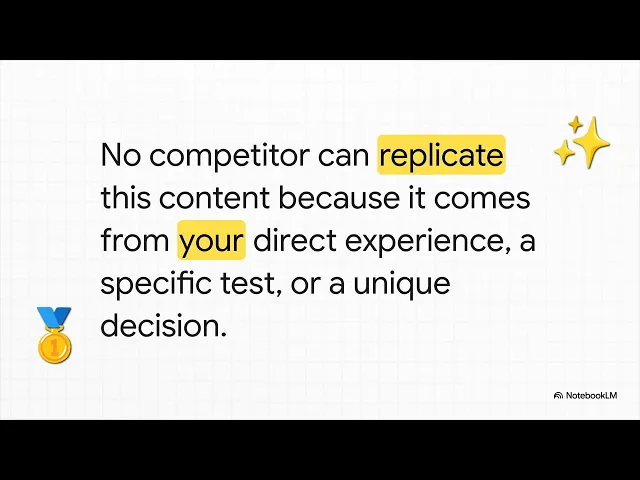
Non-commodity content is grounded in specific experience, proprietary data, or narrow expertise no competitor can replicate. Google's counter-examples from the same three verticals show exactly what the new bar looks like:
"Why This Customer's Shoes Collapsed After 400 Miles: A Wear Pattern Analysis" — a deep-dive on one customer's shoes, explaining exactly why their specific gait caused the foam to collapse laterally
"Why We Waived the Inspection (And Saved $15k): A Look Inside the Sewer Line" — a breakdown of a specific bidding war, including the detail that the agent personally crawled the line and saw it was PVC, not concrete
"Marble vs. Grape Juice: Why I Refused to Install Stone for a Family of Five" — a designer explaining why they rejected a client request, including the stain tests they ran with grape juice and turmeric
Every example is unrepeatable. It carries a specific customer, a specific decision, a specific test, or a specific piece of hard-earned pattern recognition.
Why this distinction suddenly matters more
In the ten-blue-links era, commodity content still drove traffic. It ranked for generic queries, attracted backlinks, and filled the top of the funnel. In task-based search, the economics invert for three reasons.
First, AI Mode and Canvas compress commodity content into a single summarized answer. Ten "7 Tips for First-Time Homebuyers" articles collapse into one paragraph the user never clicks to read. Your traffic disappears into the summary.
Second, AI systems specifically hunt for non-commodity signals when selecting which sources to cite. Proprietary data, named examples, and original analysis are the trust signals that earn citations inside AI answers. Conversely, generic content looks like every other source and gets filtered out.
Third, task completion features like agentic calling and Canvas need verifiable, specific information to act on. "General tips" cannot be acted on. "We personally inspected the sewer line and it was PVC" is actionable, memorable, and quotable.
How to shift your content from commodity to non-commodity
The move requires different inputs, not just a different writing style. Start by auditing your top 20 pages against a simple test: could a competitor with a similar brief and an AI tool produce this exact article. If the answer is yes, the page is commodity and its value is about to compress.
The shift toward non-commodity content typically draws from five underused sources:
Proprietary data from your own operations, tools, or customer base
Named case studies with specific numbers, timelines, and decisions
Original tests, teardowns, or wear analyses on real products or situations
Controversial or counterintuitive positions you can defend with evidence
Behind-the-scenes process details only practitioners would know
Pair that with the structural habits AI citation systems already reward — direct-answer intros in the first 50 words, question-shaped headings, and clean FAQ blocks — and you get content that is both non-commodity and machine-extractable. Our walkthrough on FAQ schema for AI answers goes deeper on how to structure Q-and-A content so that both humans and language models treat it as a trusted source.
Implication #6: Traffic Measurement Needs a New Model
If Canvas builds an itinerary and an agent books the hotel, the user may never visit your site at all. Traditional session and pageview metrics will understate your actual business impact, and the gap will widen as more task-based features ship.
Metrics that matter in task-based search
SEO teams need to start tracking a different set of signals alongside traditional traffic:
Appearances inside AI Mode, Canvas outputs, and other agent surfaces
Agent-initiated calls, bookings, reservations, and conversions
Brand search queries that follow AI Mode exposure
Share of citations in AI-generated summaries across ChatGPT, Gemini, Perplexity, and Google AI Overviews
The honest measurement gap
Most of this is still inferred rather than directly measured. Search Console does not yet segment AI Mode impressions cleanly. Third-party tools are filling part of the gap. In the meantime, SEOs who report only on traditional traffic will look like they are underperforming while their business is actually winning in surfaces they cannot measure. Comparing the two disciplines side by side helps teams set expectations, and our complete guide to GEO vs SEO unpacks where each framework owns measurement, which you can use to restructure your reporting.
Implication #7: Technical SEO Gets a New Frontier
Core Web Vitals, crawlability, and indexability still matter. But two technical priorities now join them at the top of the list.
Serving clean HTML for critical facts
Agents should not have to execute JavaScript to see your prices, hours, or availability. If the key transactional facts on your page depend on client-side rendering, they are invisible to many AI crawlers and scrapers. Server-side rendering of structured data and critical content is no longer a performance nicety, it is a visibility requirement.
Managing AI crawler access intentionally
AI crawlers now represent a meaningful share of traffic to most sites. How you treat them in robots.txt, how you distinguish retrieval-for-answers from training use, and whether your CDN blocks or allows specific user agents directly shape whether your content shows up in AI answers. Blocking everything to preserve training data is a defensible stance, but it should be a deliberate choice, not an accident of an outdated config file. For a broader playbook on keeping AI SEO working across shifts like this, our guide on building an algorithm-resilient AI SEO strategy covers the technical and content moves that hold up across Google updates.
What to Do This Quarter
For teams who want a practical sequence, here is the priority order that covers all seven implications:
Audit schema coverage across your highest-value page templates. Fill gaps on
LocalBusiness,Product,LodgingBusiness,Restaurant, andFAQPagefirst.Build or fix the data pipeline that keeps prices, inventory, and hours fresh across your site, Google Business Profile, and Merchant Center.
Run a Google Business Profile audit for every location. Complete secondary attributes, categories, and messaging channels.
Run a commodity audit on your top 20 pages. Kill, consolidate, or rewrite anything a competitor could produce with the same brief and an AI tool.
Rebuild priority pages around proprietary data, named case studies, and original tests — then add question-shaped headings and direct-answer intros so the non-commodity substance is also machine-extractable.
Add AI Mode and AI Overview tracking to your reporting alongside traditional organic metrics.
Review robots.txt and CDN configuration for how AI crawlers are handled. Make the policy intentional.
Ready to Make Your Brand the Answer?
The brands that thrive through this shift will not be the ones with the most content. They will be the ones whose data, structure, and signals are clean enough for agents to trust and use. Passionfruit has helped clients drive up to 750% AI visibility growth and over $1B in organic revenue by treating SEO and AI search as a single, structured motion. If you want a concrete audit of where your brand stands in task-based and AI-driven surfaces, talk to our team and start turning visibility into action.
FAQs
What is task-based search?
Task-based search is Google's evolving model where Search acts as an interface for completing user tasks, not just returning links. AI agents inside Search can now call local stores, track hotel prices, and assemble travel itineraries through features like AI Mode and the Canvas tool.
How is task-based search different from traditional SEO?
Traditional SEO optimizes for a human clicking a result. Task-based search requires your business to be usable by an AI agent that acts on behalf of the user. This makes structured data, live inventory, and Google Business Profile accuracy as important as rankings.
Does schema markup still matter with AI search?
Yes, and more than ever. Schema.org markup is now the interface between your business and Google's agents. Complete LocalBusiness, Product, Hotel, and FAQPage schema directly affects whether your business gets used inside features like agentic calling and Canvas.
Will AI agents hurt my organic traffic?
Some traffic will shift from clicks to agent-completed actions that never reach your site. The businesses losing traffic fastest are those publishing commodity content or running outdated listings. Businesses set up with non-commodity content and clean structured data will see more completed transactions even as raw sessions decline.
What is commodity content and why is it dangerous in AI search?
Commodity content is generic, surface-level material any competitor could produce with a similar brief, such as "Top 10 Tips" posts or trend roundups pulled from Pinterest. In AI search, commodity content gets compressed into a single summarized answer that users never click. Non-commodity content grounded in proprietary data, named case studies, and original analysis is what earns citations inside AI answers.
What should local businesses do first?
Audit your Google Business Profile for completeness, sync hours and phone numbers across directories, and make sure your phone system can handle AI agent calls professionally. These three actions cover the biggest revenue risk from agentic calling features.