SEO
Join 500+ brands growing with Passionfruit!
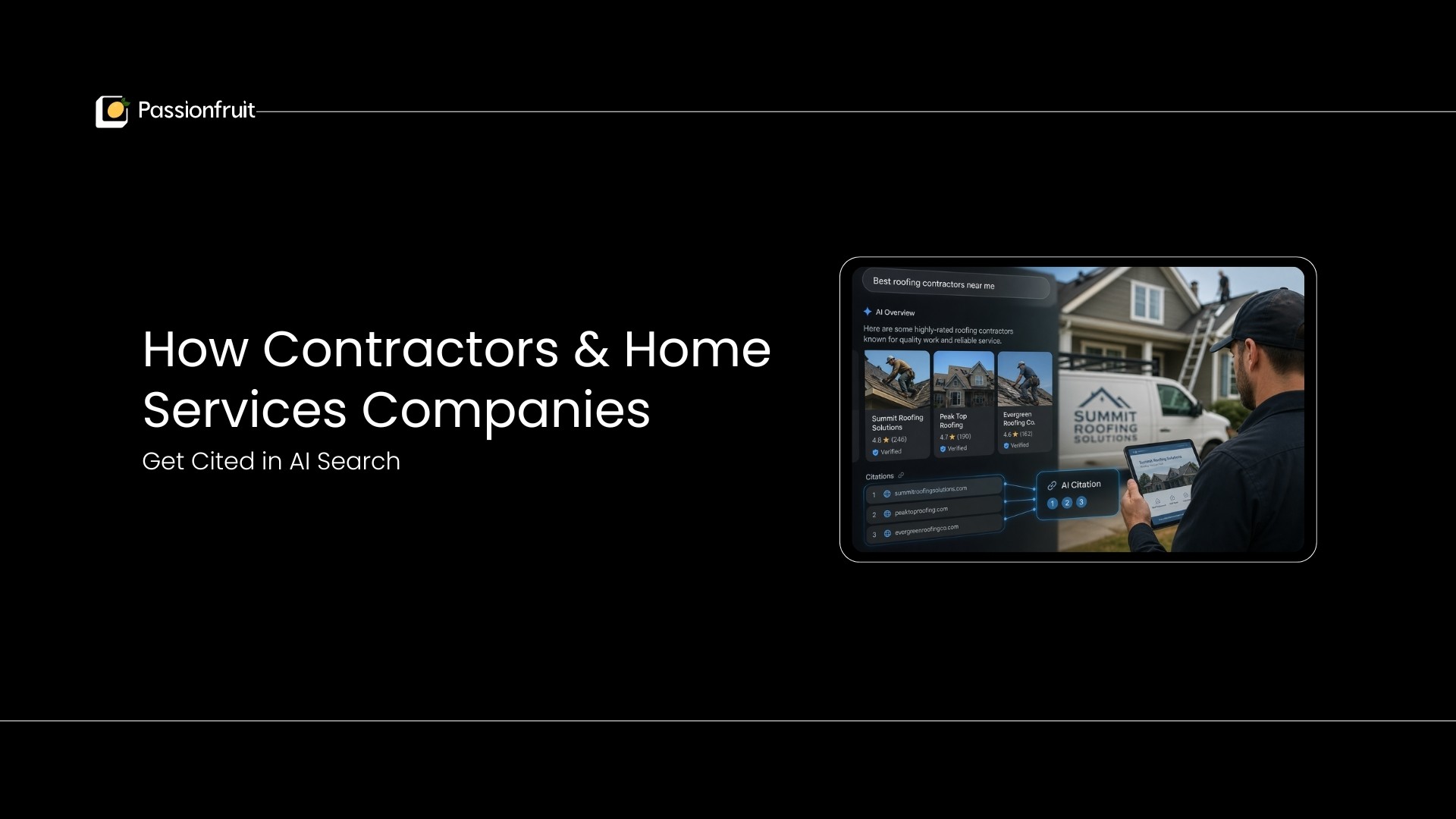
The way homeowners pick contractors changed in 2025. Instead of typing "best roofer near me" into Google and scrolling through ten results, they now ask ChatGPT, Perplexity, or Google AI Overviews a full question and accept the AI's shortlist. BrightLocal's 2026 Consumer Review Survey found that 45% of consumers now use AI for local business recommendations, up from just 6% one year earlier.
Most contractors are invisible inside that shortlist. Roofing companies, electricians, plumbers, HVAC pros, and general contractors with strong Google reviews still get skipped because the AI cannot verify their service area, license status, or specialty. The good news is that the optimization window is wide open. Below are the 8 tactical steps that get contractors cited in AI search results within 30 to 90 days.
How Contractors and Home Services Companies Get Cited in AI Search
Each step below targets one specific input AI systems use when building a local recommendation. Apply them in order. Google Business Profile and review consistency drive most of the early lift. Local content pages and Bing indexation close the gap on the platforms Google AI does not own.
1. Lock Down Your Google Business Profile as the AI Data Hub
Your Google Business Profile is the central record AI systems pull when answering "best contractor in [city]" queries. An incomplete or inconsistent profile gets skipped before any other signal is evaluated.
Verify the profile, then audit every field. Add precise primary and secondary categories such as "general contractor" plus "kitchen remodeler." Define exact service areas at the neighborhood level, not just the city. List individual services using the literal phrasing homeowners use, like "bathroom remodeling" or "emergency water heater repair." Upload at least 25 photos of completed projects with location and project type in the file names. Populate the Q&A section with the questions homeowners actually ask, such as "Are you licensed and insured?" with direct answers. For broader local SEO mechanics, see our AI search optimization guide for local SEO.
2. Build Review Velocity Across Google, Yelp, and One Industry Platform
AI systems cross-reference reviews across multiple sources before recommending a contractor. Five hundred reviews on Google with zero on Yelp or Angi looks suspicious to the AI parser, which weighs cross-platform consistency.
Set up a systematic review request workflow. Send a review link 48 hours after project completion. Rotate which platform you ask for, so you build steady volume across Google, Yelp, and one industry-specific platform such as Angi for general contracting, Houzz for remodeling, or Thumbtack for handyman services. Aim for at least 10 new reviews per platform per month. Respond to every review with specific project details, like "Thanks for trusting us with your kitchen remodel in [neighborhood]. The quartz countertop install came together exactly as planned." Keyword-rich response copy gives AI systems additional structured content to parse.
3. Publish Neighborhood-Specific Service Pages, Not Generic City Pages
A single page titled "Plumbing Services in [City]" loses to competitors with neighborhood-specific pages. AI systems match conversational queries like "find a plumber in [neighborhood]" to the most geographically specific page available.
Build one page per service per neighborhood you actually work in. Each page needs the literal service phrase in the H1, a recent project example with photos, the specific local conditions you handle, such as "older homes with cast iron pipes in [neighborhood]," and LocalBusiness schema markup. Three or four pages per neighborhood beats twenty generic city pages. For tactics that earn the visibility these pages need, read our guide on 10x'ing brand mentions in AI search results.
4. Document Real Projects as Citable Case Studies
AI systems prefer primary sources with verifiable details over generic service copy. A project case study with concrete numbers becomes a citation hook the AI can attach to a recommendation.
Pick three to five completed projects per service line. For each, publish a page with the neighborhood, project scope, materials used, timeline, permitting details, and the final cost range. Include before-and-after photos with descriptive alt text. Title the page literally, like "Complete Bathroom Remodel in [Neighborhood]: Six-Week Timeline and $42K Budget." ConvertMate's research suggests content updated within the past 30 days receives roughly 3.2 times more AI citations, so refresh case study pages with new project completions on a rolling schedule.
5. Allow AI Crawlers and Submit Your Site to Bing
ChatGPT runs on Bing's index, not Google's. A contractor optimized only for Google is invisible to ChatGPT, Microsoft Copilot, and the property managers using Office tools to source vendors.
Edit your robots.txt to explicitly allow GPTBot, OAI-SearchBot, PerplexityBot, ClaudeBot, Google-Extended, and Bingbot. Submit your sitemap to Bing Webmaster Tools. Verify your business on Bing Places and mirror your Google Business Profile fields exactly: same name, same address, same phone, same hours. Ping IndexNow on every site update so Bing reflects new project pages within hours instead of weeks. For deeper technical groundwork, see our generative engine optimization guide.
6. Build a Real Reddit Presence in Local and Trade Subreddits
Perplexity cites Reddit for roughly 46.7% of social citations, and Reddit threads frequently appear in Google AI Overviews for home services queries. A contractor with no Reddit footprint loses every AI recommendation that pulls from those threads.
Set up an account using your real name and trade. Participate in subreddits like r/HomeImprovement, r/DIY, r/HVAC, r/Plumbing, and your local city subreddit. Answer homeowner questions with genuine technical advice. Do not pitch your services. Reference your business only when it is directly relevant. Authentic, helpful comments build the username and trade association the AI parser picks up over time. Stay consistent for 90 days before judging the lift.
7. Publish YouTube Walkthroughs of Common Projects
YouTube is the top-cited domain in Google AI Overviews at roughly 29.5% of citations. Video transcripts get parsed the same way blog posts do, which makes YouTube a parallel citation surface to your blog content.
Record 5 to 10 short videos per service line. Topics that perform well include "How to spot storm damage on an asphalt roof," "What permits you need for a basement finish in [city]," and "What a real bathroom remodel timeline looks like." Use the literal service phrase in the title, the description, and the spoken intro. Add timestamps and a transcript to the video description. Each video creates a new citation candidate the AI can pull when recommending a contractor in your trade.
8. Track Which Prompts You Show Up On Each Month
A contractor without a tracking system optimizes blind. The first sign you have lost ground is a competitor showing up in ChatGPT for a query you used to win, and you find out three months too late.
Pick 20 to 30 prompts a homeowner in your service area would type. Examples include "best kitchen remodeler in [city]," "licensed roofer in [neighborhood]," and "emergency plumber [city] tonight." Run them across ChatGPT, Perplexity, Gemini, and Google AI Overviews monthly. Record which prompts mention you, which mention competitors, and which mention nobody specific. The "nobody specific" prompts are the highest-value optimization targets because no contractor owns them yet. For competitive benchmarking tactics, see our guide on AI visibility benchmarking competitors.
Want to See Which AI Engines Recommend Your Competitors Right Now?
Most contractors discover they are invisible in AI search only after the phone stops ringing. Passionfruit Labs tracks how ChatGPT, Perplexity, Gemini, and Google AI Overviews answer the prompts homeowners in your service area actually type, so you can see which competitors get recommended for kitchen remodels, roof repairs, or emergency plumbing in your neighborhood, and where you are missing entirely. If you want a team to build the Google Business Profile, the neighborhood pages, the Reddit presence, and the Bing indexation for you, Passionfruit's full-stack home services GEO team handles execution from audit to publish. Browse real client outcomes before you commit, or book a call to map your trade to a 90-day visibility plan. The contractors winning AI recommendations next year are the ones moving now.
Frequently Asked Questions
Below are the most common questions contractors and home services owners ask about getting cited in AI search.
Do AI search engines recommend contractors the same way Google Maps does?
No. Google Maps and the local pack rank businesses by proximity, review count, and category match. AI systems pull from those signals plus reviews on Yelp and Angi, Reddit threads, YouTube videos, your own website content, and Bing's index. A contractor strong on Google Maps but invisible on review platforms and Reddit gets skipped in AI recommendations.
How long does it take a contractor to show up in AI search results?
Most home services businesses with a complete Google Business Profile, consistent reviews, and neighborhood-specific service pages start appearing in AI recommendations within 30 to 45 days. Contractors with minimal review volume or no Bing presence usually need 60 to 90 days to reach stable visibility.
Do online reviews really change which contractor AI recommends?
Yes. AI systems cross-reference Google, Yelp, Angi, Thumbtack, and the BBB before naming a contractor. Consistent review velocity across multiple platforms produces stronger AI confidence than a higher star average on one platform. Five new reviews per month per platform usually outperforms 50 reviews on Google alone.
Should small contractors invest in AI search optimization yet?
Yes, especially small contractors. The competitive window is wide open in most metros. Most home services companies have zero AI optimization, which means a single contractor with a complete Google Business Profile, neighborhood pages, and basic Bing indexation often becomes the AI default for an entire service area before any competitor responds.
Does ChatGPT use Google data to recommend local contractors?
No. ChatGPT runs on Bing's index. A contractor invisible on Bing Places or with no sitemap submitted to Bing Webmaster Tools usually does not appear in ChatGPT recommendations even when the same business ranks well in Google. Bing optimization is the single most overlooked step for AI search visibility in home services.
Can a contractor optimize for AI search without hiring an agency?
Yes, with discipline. The eight steps in this guide, executed consistently for 90 days, are achievable with internal effort. The bottleneck is usually time. A contractor running active jobs rarely has 4 to 6 hours per week to manage Google Business updates, review outreach, neighborhood pages, Bing indexation, Reddit participation, YouTube production, and monthly prompt tracking. An agency or trained internal hire compresses the timeline.