SEO
Join 500+ brands growing with Passionfruit!
Duplicate content blocks your products from ranking in marketplace search results and confuses both search engines and customers. Fixing duplicate content issues improves your visibility on platforms like Amazon, eBay, and Etsy, leading to higher rankings and more sales.
What Is Duplicate Content in Marketplaces?
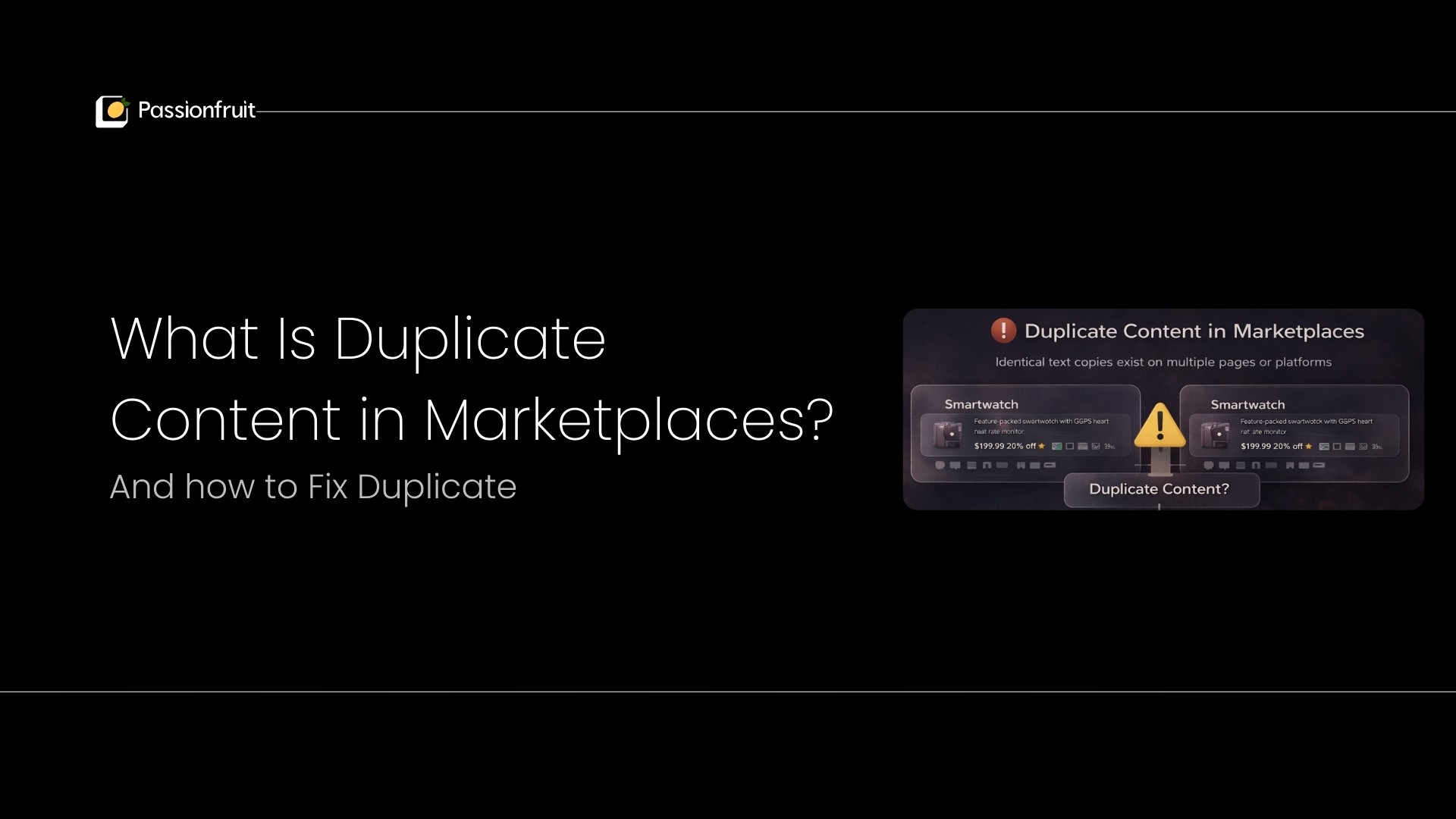
Duplicate content occurs when identical or very similar text appears on multiple pages within your marketplace store or across different websites. In marketplace contexts, this typically happens when product descriptions, titles, or category pages share the same content.
Common forms include:
Copying manufacturer product descriptions without modification
Creating separate pages for product variations (color, size) with identical text
Using the same content across multiple marketplace platforms
Technical URL variations generate multiple versions of the same page
Search engines struggle to determine which version deserves priority when they encounter duplicate content, often resulting in none of your pages ranking well.
Why Does Duplicate Content Hurt Marketplace Visibility?
Duplicate content damages marketplace performance through several mechanisms that directly impact your bottom line.
Search engines can't decide which page to rank. When multiple pages contain identical content, algorithms must choose one version to display. Without clear signals, search engines may select the wrong page or suppress all versions, leaving your products invisible to customers.
Authority gets diluted across multiple pages. Backlinks and engagement signals are split across duplicate pages instead of consolidating on one authoritative listing. A single strong page outperforms five weak duplicates competing against each other.
Crawl budget gets wasted on redundant content. Search engines allocate a limited time to scan each site. When crawlers encounter duplicate pages, they waste resources indexing redundant content instead of discovering new products.
Customer trust declines with generic descriptions. Shoppers who encounter identical descriptions across products or see the same text on competitor sites perceive your brand as lazy or untrustworthy. Understanding how content quality affects customer decisions helps explain why unique descriptions convert better.
How to Find Duplicate Content Issues
Identifying duplicate content requires both automated tools and manual review to catch all variations.
Use SEO crawling tools for comprehensive detection. Tools like SEMrush and Ahrefs scan your entire marketplace store and flag pages with identical or similar content. These tools identify duplicate titles, meta descriptions, and body content across thousands of pages simultaneously.
Check Google Search Console for indexing issues. Navigate to the Coverage report to see which pages Google considers duplicates or has excluded from indexing. The URL Inspection tool shows exactly how Google views specific product pages.
Perform manual Google searches. Type "site:yourdomain.com" followed by a unique phrase from your product description in quotes. Multiple results indicate duplicate content. Check if your content appears on other websites by searching distinctive sentences without the site operator.
Review product catalog exports. Export your product data into spreadsheets and sort by description length, or use Excel's duplicate detection features to spot pages sharing identical text.
How to Fix Duplicate Content for Better Marketplace Visibility
Write Unique Product Descriptions for Each Listing
Replace manufacturer descriptions with original content, highlighting specific benefits and use cases. Focus on how each product solves customer problems rather than just listing features.
Assign different team members to write descriptions for similar products to naturally vary language and perspective. Creating unique, valuable content improves both search rankings and customer engagement.
For product variations, explain how each color, size, or model serves different customer needs instead of repeating identical descriptions with minor tweaks.
Implement Canonical Tags for Technical Duplicates
Canonical tags tell search engines which page version to prioritize when multiple URLs display similar content. Add this HTML code to the head section of duplicate pages:
<link rel="canonical" href="https://yourstore.com/preferred-product-url">
Use canonical tags when:
Products appear in multiple categories
Filtering or sorting creates URL variations
The same product syncs across different platforms
Consolidate Product Variations Into Single Pages
Instead of creating separate pages for each color or size variation, use dropdown selectors on one product page. This approach eliminates duplicate content while simplifying the shopping experience.
Consolidation works particularly well for products where the only difference is cosmetic (color, pattern) rather than functional specifications.
Set Up 301 Redirects for Merged Pages
When combining duplicate pages, implement 301 redirects from old URLs to the primary page. Redirects preserve any existing search rankings and backlinks while eliminating duplicate content issues.
Most marketplace platforms and content management systems offer redirect tools that don't require technical expertise. Document all redirects to track which pages you've consolidated.
Add Noindex Tags to Non-Essential Pages
For pages that serve a purpose but shouldn't appear in search results (search result pages, filtered views, internal tracking URLs), add noindex tags:
<meta name="robots" content="noindex, follow">
This removes them from search engine indexes while allowing crawlers to follow links to other pages.
Encourage Customer Reviews for Fresh Content
Customer reviews add unique, keyword-rich content to product pages automatically. Reviews provide social proof while creating natural content variations that search engines value.
Make reviewing easy by sending follow-up emails, offering multiple review channels, and responding to feedback publicly to encourage more participation.
Protect Marketplace Visibility With Clean Content
Duplicate content undermines marketplace rankings by confusing search engines, diluting authority, and reducing customer trust. Systematic identification and correction through unique descriptions, canonical tags, consolidation, and redirects restore search visibility.
Regular audits prevent duplicate content from accumulating as you add new products. Understanding structured data implementation helps marketplace products appear in rich results alongside duplicate content fixes.
Passionfruit specializes in revenue-focused SEO fore-commercee and marketplace sellers. We optimize product visibility across traditional search and AI-powered shopping platforms.
Get a free SEO audit to identify duplicate content issues.
Frequently Asked Questions
What causes duplicate content in marketplaces?
Common causes include copying manufacturer descriptions, creating separate pages for product variations, syncing identical content across platforms, and technical URL variations from filtering or tracking parameters.
How does duplicate content affect marketplace rankings?
Duplicate content prevents search engines from determining which page to rank, dilutes authority across multiple pages, and wastes crawl budget that could index unique products instead.
Should I use canonical tags or 301 redirects?
Use canonical tags when pages need to exist for user experience, but shouldn't compete in search results. Use 301 redirects when consolidating pages permanently and removing duplicates.
How often should I audit for duplicate content?
High-volume marketplace stores should audit monthly. Smaller catalogs can audit quarterly. Check whenever adding new products or making bulk catalog changes.
Can duplicate content cause Google penalties?
Google doesn't penalize duplicate content directly, but suppresses duplicate pages from rankings. Intentional manipulation through duplicates can trigger manual actions.