SEO
Join 500+ brands growing with Passionfruit!
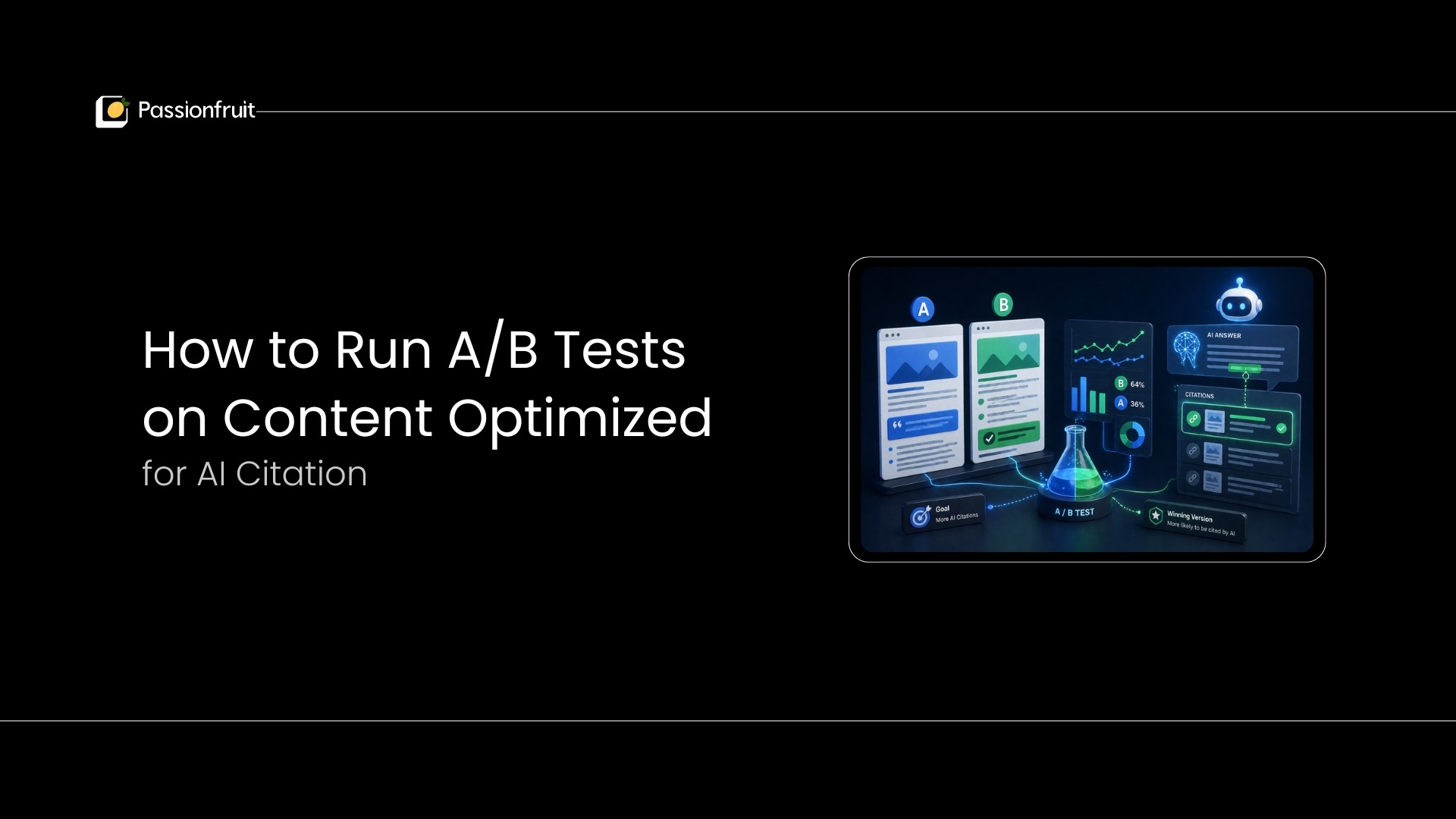
A/B testing for AI citation is not the same problem as A/B testing for conversion rate. CRO splits live traffic 50/50 between two versions of the same URL. AI search engines see only one indexed version of a page at a time, which makes parallel split testing impossible without a careful workaround. The mechanics of statistical significance change too, because the sample size is the number of AI citations, not the number of human visitors.
Most teams skip testing entirely or treat citation lift as anecdotal. That leaves real performance gains on the table. Below is the step-by-step methodology to run rigorous A/B tests on content optimized for AI citation, with timelines, variable isolation rules, and per-engine measurement built in.
How to Run A/B Tests on Content Optimized for AI Citation
Each step below isolates one variable, controls for re-indexation lag, and turns AI citation outcomes into measurable test results. Apply them in order. Skipping the baseline phase or running multiple changes at once produces noise the results cannot recover from.
1. Define a Single Testable Hypothesis
A clean A/B test starts with a single-variable hypothesis: "Adding a 50-word TL;DR block at the top of this article will increase citations across ChatGPT and Perplexity within 6 weeks."
Pick variables AI search systems are known to weigh. Strong candidates include passage length, direct-answer opening sentences, statistic density, expert quotation, schema markup, and FAQ block presence. Avoid testing multiple variables together. Compound changes make the result impossible to attribute. For the foundational signals worth testing first, see our generative engine optimization guide.
2. Establish a Citation Baseline Before Changing Anything
A baseline is the citation frequency of the page across AI engines before any change. Without it, you cannot prove a lift.
Run weekly prompt tests for 4 weeks before publishing the variant. Use the same set of 10 to 20 target queries across ChatGPT, Perplexity, Gemini, and Claude. Record the exact citation rate per engine, the position of the citation in the answer, and the source URL referenced. Store the data in a structured log. For a complete pre-change audit framework, read our GEO readiness checklist.
3. Choose the Right Testing Methodology
Sequential testing on the same URL is the most reliable methodology for AI citation. Parallel split tests on the same content do not work because AI crawlers index only one version.
Two practical methodologies exist. Sequential testing publishes the baseline article, measures, makes one change, then measures again on the same URL. Parallel testing publishes two articles on closely related sub-topics with different structures and compares citation rates over the same window. Sequential testing is preferred for established pages. Parallel testing is preferred for new content programs without baseline traffic.
4. Make a Single, Isolated Change
Change one element only. Do not redesign the page, refresh the publish date cosmetically, or update multiple sections in the same release.
Common single-variable changes include:
Adding a 50 to 90 word TL;DR block at the top
Adding a numbered list of 5 to 7 items
Adding one cited statistic with a primary-source link
Adding an FAQ section with 4 to 8 questions
Rewriting an H2 to phrase it as a literal user query
Any of these counts as a clean test. Combining them does not.
5. Wait for Re-Indexation
AI search systems do not re-index immediately. Most pages take 2 to 6 weeks to reflect content changes across all major engines.
Submit the updated URL to Bing Webmaster Tools and ping IndexNow on republish. Update dateModified in the Article schema to match the change. Then wait. Pulling results before re-indexation produces false negatives. Pulling results after partial re-indexation produces noisy data. Patience is the test methodology, not a delay before it.
6. Measure Citation Lift Across Every AI Engine
A/B test results vary by AI engine. ChatGPT runs on Bing's index. Perplexity runs on Vespa.ai with continuous user-feedback retraining. Gemini uses query fan-out and thematic clustering. A change that lifts citations on one engine may produce no movement on another.
Track per-engine results separately. Run the same 10 to 20 prompts you used for the baseline, in the same week pattern. Calculate citation rate, citation share-of-voice, and average position per engine. Adding cited external sources boosted visibility by up to 115% for lower-ranked content in the Princeton/KDD 2024 GEO study by Aggarwal et al. (source). For broader tracking and benchmarking tactics, see our guide on 10x'ing brand mentions in AI search results.
7. Apply Statistical Reasoning Adapted for Small Samples
Citation A/B tests have small samples. A page might be cited 5 times before and 8 times after the change, which traditional p-value tests will call statistically insignificant.
Use confidence-interval reasoning instead of binary significance thresholds. A 60% lift sustained over 4 weeks across 3 of 4 AI engines is meaningful even when absolute counts are low. Reject single-week spikes. Trust patterns that hold across multiple engines and multiple sampling windows. Document directional confidence rather than chasing 95% certainty that small samples cannot deliver.
8. Document Winners and Roll Them Out at Scale
A successful A/B test is only useful when its outcome rolls into a content standard the rest of the team applies.
Maintain a structured testing log with: hypothesis, baseline metrics, change made, post-change metrics, time-to-result, and per-engine lift. Codify winners into a content brief template every writer follows. Re-run the test on a different page 6 months later to confirm the signal still holds, since AI ranking systems evolve. For competitive positioning context that compounds your wins, see our AI visibility benchmarking competitors guide.
Want to A/B Test Citations Without Building the Tracking Yourself?
Manual prompt tests take hours per cycle and break down past 50 queries. Passionfruit Labs tracks brand and content citations across ChatGPT, Perplexity, Gemini, and Claude continuously, so your A/B test data lives in one dashboard instead of a spreadsheet you have to refresh weekly. If you want a team to run the experiments, ship the variants, and turn winners into a content standard for you, Passionfruit's full-stack SEO and GEO team handles the testing pipeline end to end. Browse real client outcomes before you commit, or book a call to map your top pages to a 90-day testing plan. The pages cited in 2026 are the ones being tested today.
Frequently Asked Questions
Can I A/B test the same URL with two versions like a CRO test?
No. AI search crawlers index only one version of a URL at a time. Use sequential testing on the same URL or publish two articles on related sub-topics for parallel comparison. Live 50/50 traffic splits do not translate to AI citation testing.
How long does an AI citation A/B test take?
Most tests need 8 to 12 weeks total. Plan for 4 weeks of baseline measurement before the change and 4 to 8 weeks of post-change measurement to allow for re-indexation across all major AI engines.
How many queries should I track per A/B test?
10 to 20 queries per test is the practical range. Fewer than 10 produces noise. More than 20 becomes hard to track manually and dilutes attention across low-priority prompts.
What is the most impactful single variable to test first?
Adding a citation-friendly statistic with a primary-source link. The Princeton/KDD GEO study found citing external sources produced the largest visibility lift among tested modifications, especially for lower-ranking content.
Should I run A/B tests on every blog post?
No. Test pages with stable baseline traffic and at least 5 weekly citations to start. Pages without a measurable baseline are too noisy for reliable test results, and the test windows will return inconclusive data.
What tools track citation rates for A/B tests?
Manual prompt logging works for small programs. Dedicated tools that monitor citation share across ChatGPT, Perplexity, Gemini, and Claude give cleaner per-engine data and reduce time-per-cycle from hours to minutes.