SEO
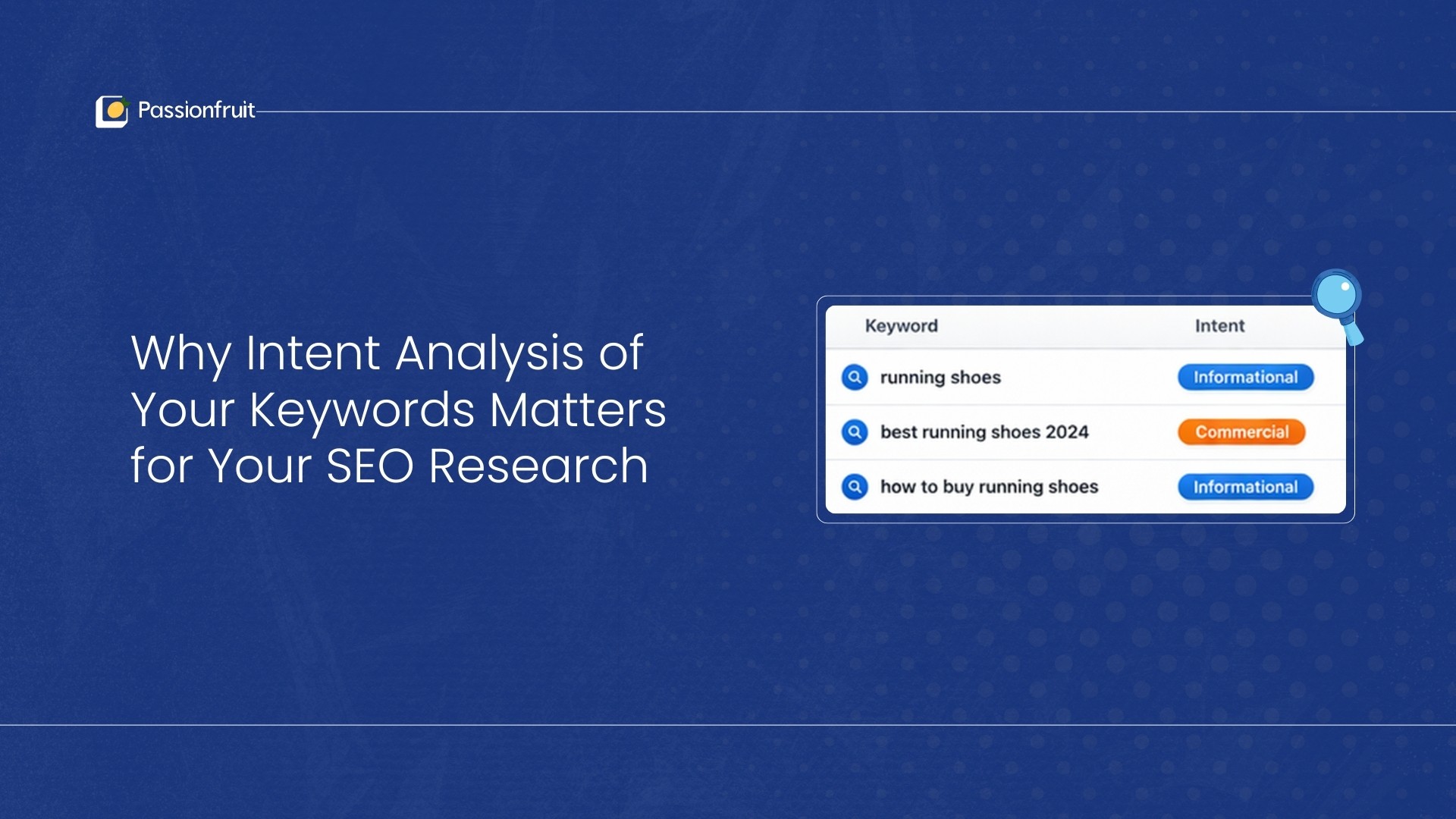
Join 500+ brands growing with Passionfruit!
Most keyword research stops at volume and difficulty. That is why most keyword research fails. Intent analysis is the step that determines whether your content ranks, converts, or gets ignored entirely. Here is how to build intent analysis into every stage of your keyword research process, with the AI search layer every other guide on the SERP misses.
Google does not rank pages that match keywords. Google ranks pages that satisfy intent.
That distinction is the single most important gap in how marketing teams do keyword research. They pull keyword lists from Ahrefs or Semrush, sort by volume and difficulty, assign keywords to pages, and write content. The research process never asks the question that determines everything: what does the person typing this query actually want to do? Without intent analysis, keyword research produces content that ranks for the wrong audience, converts nobody, and trains Google to stop showing your pages.
According to Microsoft internal research on Copilot-assisted search journeys, high-intent conversion rates are 76% higher for AI-powered search experiences compared to traditional search surfaces (Microsoft Advertising, Bing Webmaster Blog, November 2025). AI search does not just match keywords to pages. It interprets intent through conversation, context, and follow-up queries. Brands that align content with intent at every stage earn both traditional rankings and AI citations.
Our guide covers what keyword intent analysis is, why it belongs at the center of your SEO research process (not as an afterthought), the four types of intent with the specific content formats each one requires, and how to build intent classification into your keyword research workflow from the first step. For the broader SEO strategy these tactics support, see our SEO principles guide.
What Is Keyword Intent Analysis?
Keyword intent analysis is the process of classifying every keyword in your research by the purpose behind the search query. It answers the question: what does the person typing this query actually want to accomplish?
Traditional keyword research gives you volume (how many people search), difficulty (how hard it is to rank), and CPC (what advertisers pay). Intent analysis adds the dimension that determines whether ranking for a keyword actually produces results: what the searcher wants to do when they arrive on your page.
A person searching "CRM software" might want to learn what CRM software does (informational), compare CRM options (commercial), buy a specific CRM (transactional), or navigate to a specific CRM's login page (navigational). The keyword is the same. The volume is the same. The difficulty is the same. But the intent behind it determines everything: which content format ranks, which page converts, and which brands earn the click.
Google's algorithms have evolved from matching keyword strings to interpreting the meaning and goal behind queries. Google's Helpful Content System, combined with behavioral signals like dwell time, pogo-sticking (bouncing back to search results), and engagement depth, now directly measures whether your content satisfies the searcher's intent (Rank Math, Search Intent Guide 2026). Content that mismatches intent loses rankings regardless of how well it is written, how many backlinks it has, or how high its domain authority is.
For understanding how keywords connect to your broader funnel strategy, see our SEO funnel guide.
Why Does Intent Analysis Change Your Keyword Research Outcomes?
Keyword research without intent analysis produces keyword lists that look promising on a spreadsheet but fail in execution. You target a 10,000-volume keyword, create strong content, and get zero conversions because the intent was informational and your page was transactional. Intent analysis prevents this by filtering your keyword list through the lens of what the searcher actually wants.
Here is the specific chain of events that connects intent analysis to research quality:
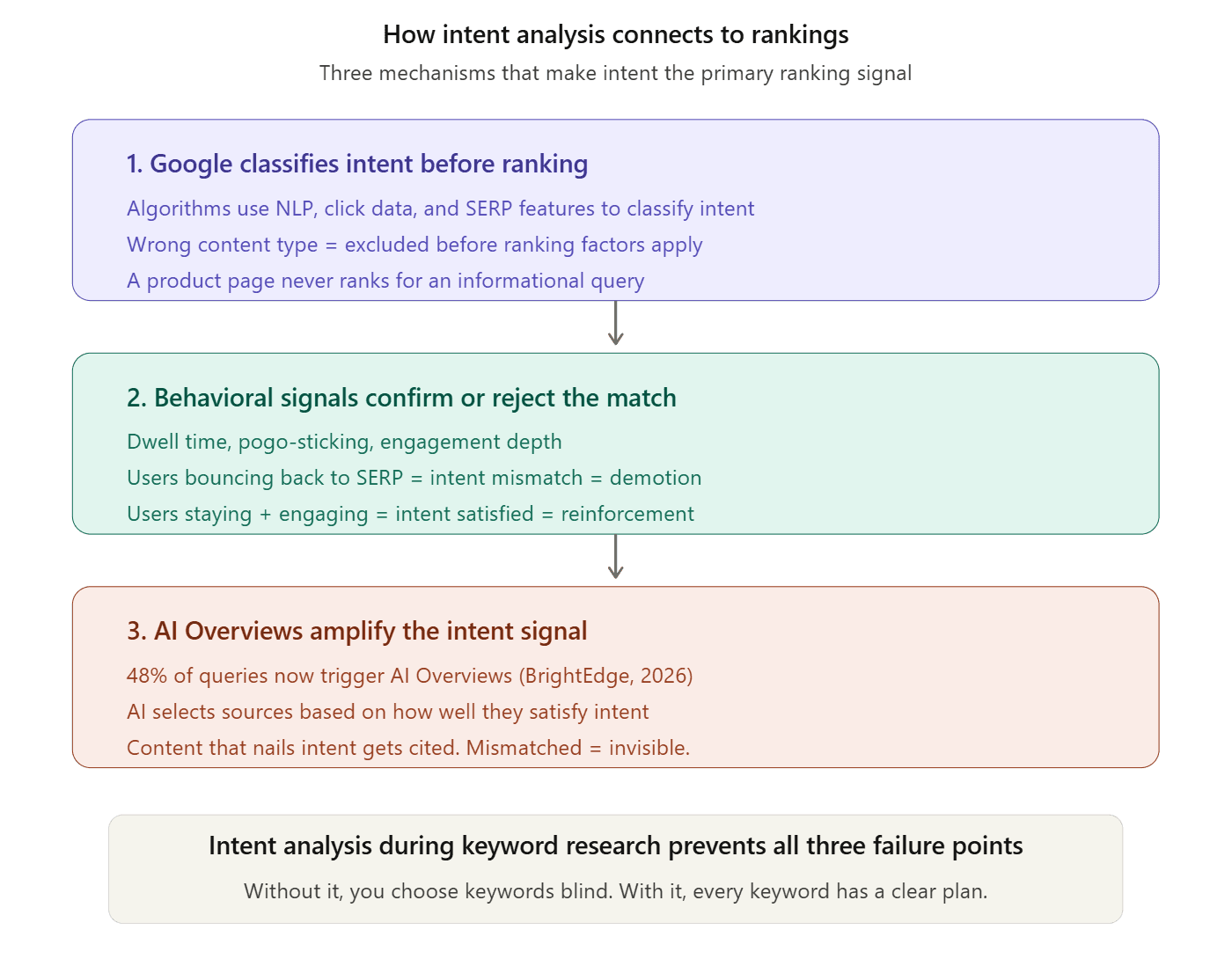
1. Google classifies intent before ranking: When a query enters Google's system, algorithms classify the likely intent using natural language processing, historical click data, and SERP feature analysis. Google then selects which type of results to show: blog posts for informational queries, product pages for transactional queries, comparison articles for commercial queries. If your content type does not match the intent classification, it is excluded from consideration before ranking factors even apply.
2. Behavioral signals confirm or reject the match: Once a user clicks your result, Google measures whether the intent was satisfied. Did the user stay on the page? Did they engage with the content? Did they return to search results and click a competitor (pogo-sticking)? According to analysis from ClickRank, search engines now evaluate intent using layered signals including query modifiers, SERP features, device type, and location data (ClickRank, Search Intent Models 2026). Pages that satisfy intent get reinforced. Pages that do not get demoted.
3. AI Overviews amplify the intent signal: BrightEdge data shows AI Overviews now trigger on approximately 48% of all tracked queries, up 58% year over year (BrightEdge, AI Overviews One-Year Report, February 2026). AI Overviews do not just match keywords. They synthesize answers from multiple sources, and they select sources based on how well each one satisfies the specific intent behind the query. Content that nails intent gets cited in AI answers. Content that misses intent gets ignored entirely.
The bottom line: Intent analysis transforms keyword research from a volume-sorting exercise into a strategic planning tool. Without it, you are choosing keywords blind. With it, every keyword on your list has a clear content format, a conversion strategy, and a realistic expectation of what ranking for it will produce.
The 4 Types of Keyword Intent Every SEO Researcher Must Classify
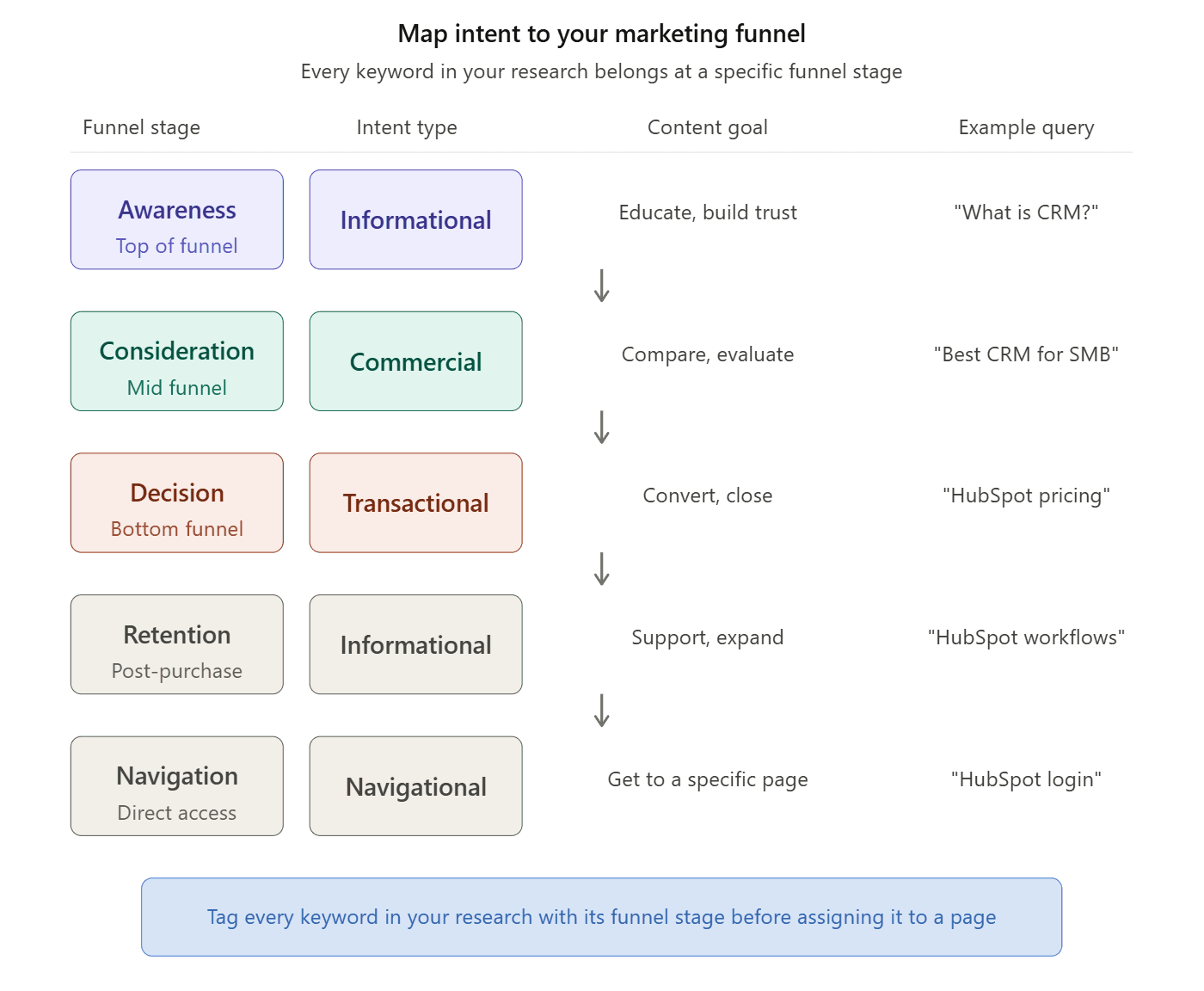
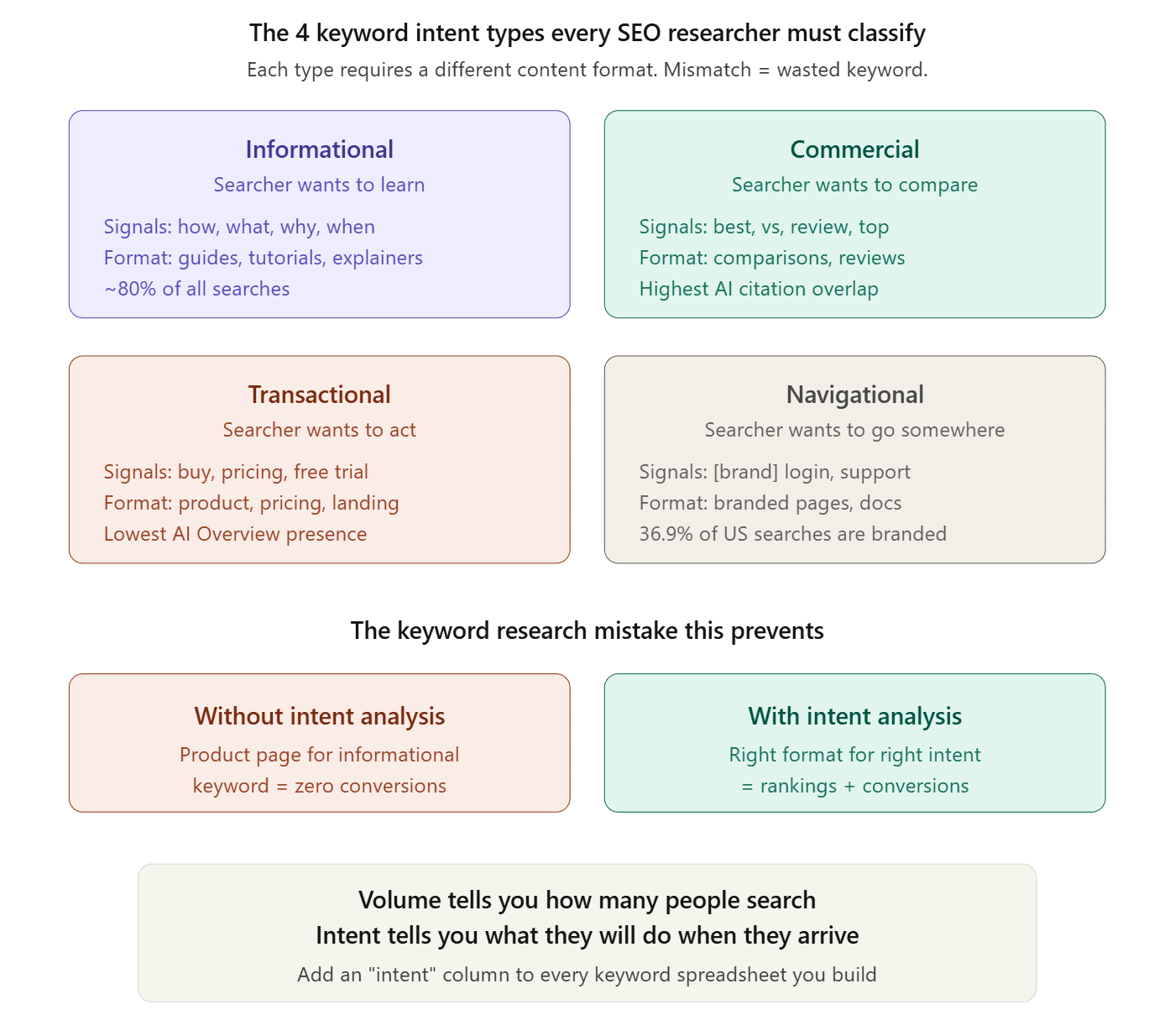
When you add intent analysis to your keyword research, every keyword on your list gets tagged with one of four intent categories. Each one requires a different content format, different language, and a different conversion strategy. Knowing the category before you assign the keyword to a page prevents the most common keyword research mistake: creating the wrong content for the right keyword.
Informational intent: the searcher wants to learn
The searcher has a question and wants an answer. They are not ready to buy. They want to understand a concept, solve a problem, or explore a topic.
Query signals: Questions starting with "how," "what," "why," "when." Queries like "benefits of email marketing," "how does CRM work," "what is keyword clustering."
Content format that ranks: How-to guides, educational blog posts, explainer articles, videos, infographics. Approximately 80% of all searches have informational intent, making this the largest intent category (HackerNoon, Search Intent and Conversion Rates).
Conversion strategy: Do not push for a sale. Build trust and capture email subscribers. Use CTAs like "Read the full guide," "Download the checklist," or "Explore related topics." The goal is to become the source the searcher remembers when they move to the commercial or transactional stage.
AI search impact: Google's AI Overviews appear most prominently for informational queries, according to Moz's senior search scientist Tom Capper (Moz, Search Intent Guide). If your informational content provides clear, structured, extractable answers, it has the highest probability of being cited in AI-generated responses. Structure content with question-led H2s and direct 40-word answers immediately after each heading.
For building informational content that ranks and earns AI citations, see our content strategy guide.
Commercial intent: the searcher wants to compare options
The searcher knows they have a problem and is actively evaluating solutions. They are not ready to buy yet, but they are researching, comparing, and narrowing their options.
Query signals: "Best [product] for [use case]," "X vs Y," "top [category] tools," "[product] review," "[product] alternatives."
Content format that ranks: Comparison pages, review roundups, "best of" listicles, feature breakdowns, case studies. HubSpot notes that "[Tool A] vs [Tool B]" landing pages are among the highest-converting commercial intent formats because they catch users at the exact moment of evaluation (HubSpot, Keyword Intent Guide).
Conversion strategy: Present objective comparisons that build trust. Include specific data (pricing, features, limitations), not just marketing claims. Use CTAs like "See how it compares," "Check customer reviews," or "Read the full case study." If your product is one of the options being compared, keep the tone objective. Overly promotional comparison content loses credibility and rankings.
AI search impact: Commercial queries trigger AI Overviews that synthesize multiple sources. To earn citations, your comparison content needs named entities (specific product names, pricing figures, feature specifications) and structured comparison tables that AI systems can extract cleanly.
Transactional intent: the searcher wants to act
The searcher knows exactly what they want and is ready to complete an action: buy a product, sign up for a service, download software, or book a demo.
Query signals: "Buy [product]," "[product] pricing," "sign up for [service]," "[product] free trial," "[product] coupon code," "[brand] store near me."
Content format that ranks: Product pages, pricing pages, landing pages, checkout pages, sign-up forms. These pages should be conversion-optimized with clear CTAs, minimal distractions, trust signals (reviews, security badges), and streamlined forms.
Conversion strategy: Remove friction. Every additional click, form field, or distraction between the searcher and the conversion reduces your conversion rate. Use action-driven CTAs: "Get my free trial," "Start now," "Buy today." Include social proof (customer count, testimonials, trust badges) near the conversion point.
AI search impact: Transactional queries are the one area where AI Overviews appear less frequently. BrightEdge data shows ecommerce had the lowest AI Overview citation overlap, with Google being cautious about inserting AI between a ready-to-buy searcher and a purchase (BrightEdge, 16-Month AIO Study). For transactional keywords, traditional organic rankings and paid search remain the primary battleground.
Navigational intent: the searcher wants to go somewhere specific
The searcher already knows which brand or website they want. They are using Google as a shortcut to reach a specific page.
Query signals: "[Brand name] login," "[Company] pricing page," "[Product] support," "[Brand] return policy." Ahrefs CMO Tim Soulo found that 36.9% of all U.S. searches include a company name, making navigational intent far more common than most marketers realize (HubSpot, Keyword Intent Guide).
Content format that ranks: Your branded pages: homepage, login page, pricing page, contact page, support documentation. The goal is to own the top results for your own brand terms.
Conversion strategy: Make sure your branded pages load fast, work on mobile, and answer the exact query. If someone searches "[Brand] return policy," the first result must be your actual return policy page, not a blog post that mentions returns in passing.
AI search impact: Navigational queries rarely trigger AI Overviews because the intent is already satisfied by a direct link. However, competitors can bid on your brand terms in paid search, so monitor branded SERPs regularly.
How to Build Intent Analysis Into Your Keyword Research Workflow
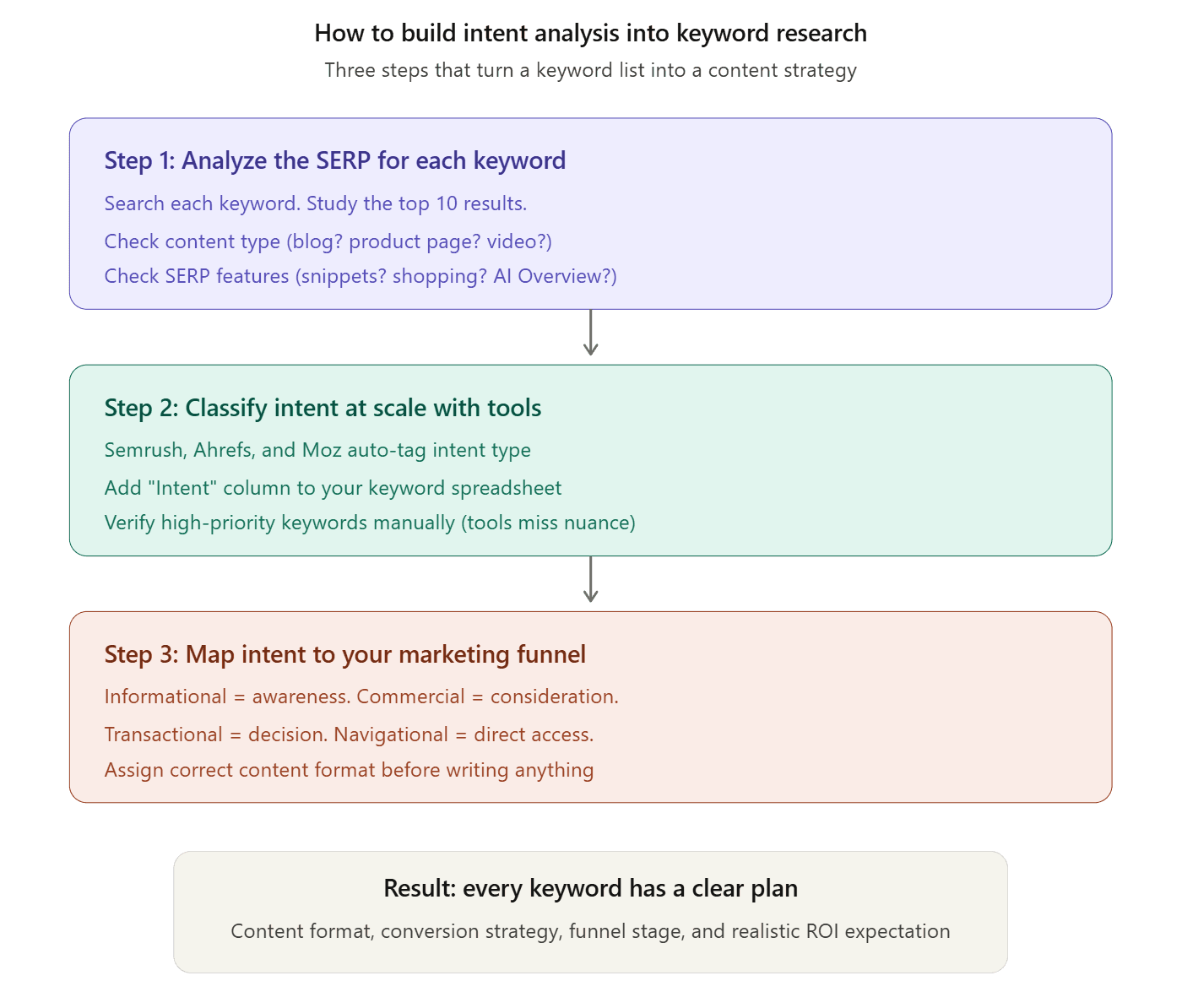
Step 1: Analyze the SERP before writing anything
The search results page is Google's answer to the question "what does this searcher want?" Before creating content for any keyword, search for it and study the top 10 results.
What to look for:
Content type: Are the results blog posts, product pages, landing pages, videos, or tools? If 8 out of 10 results are how-to guides, Google has classified this as informational intent. Creating a product page for this keyword is a losing strategy.
Content format: Are the results listicles, step-by-step guides, comparisons, reviews, or opinion pieces? The dominant format tells you exactly how to structure your content.
SERP features: Featured snippets suggest informational intent. Shopping results suggest transactional intent. People Also Ask boxes reveal the specific sub-questions your content should answer. AI Overviews indicate which intents Google considers citation-worthy.
Step 2: Use tools to classify intent at scale
Manual SERP analysis works for individual keywords but becomes impractical for large keyword lists. Use tools that classify intent automatically:
Semrush labels every keyword with intent type (informational, commercial, navigational, transactional) in its Keyword Magic Tool and Organic Rankings reports.
Ahrefs provides intent classification in Keywords Explorer.
Moz powers its Keyword Suggestions feature with AI-driven search intent classification (Moz, Keyword Suggestions).
Important caveat: No tool is 100% accurate. Always verify high-priority keywords manually by checking the actual SERP. Intent can be mixed (Google shows multiple content types) or shifting (intent changes over time due to trends or algorithm updates).
Step 3: Map intent to your marketing funnel
Intent types align directly with the buyer's journey:
Funnel stage | Intent type | Content goal | Example |
|---|---|---|---|
Awareness | Informational | Educate, build trust | "What is CRM software?" |
Consideration | Commercial | Compare, evaluate | "Best CRM for small business" |
Decision | Transactional | Convert, close | "HubSpot pricing plans" |
Retention | Informational | Support, expand | "How to set up HubSpot workflows" |
Navigation | Navigational | Direct access | "HubSpot login" |
For the full funnel framework, see our SEO funnel strategy guide.
How to Turn Intent-Classified Keywords Into Content That Ranks
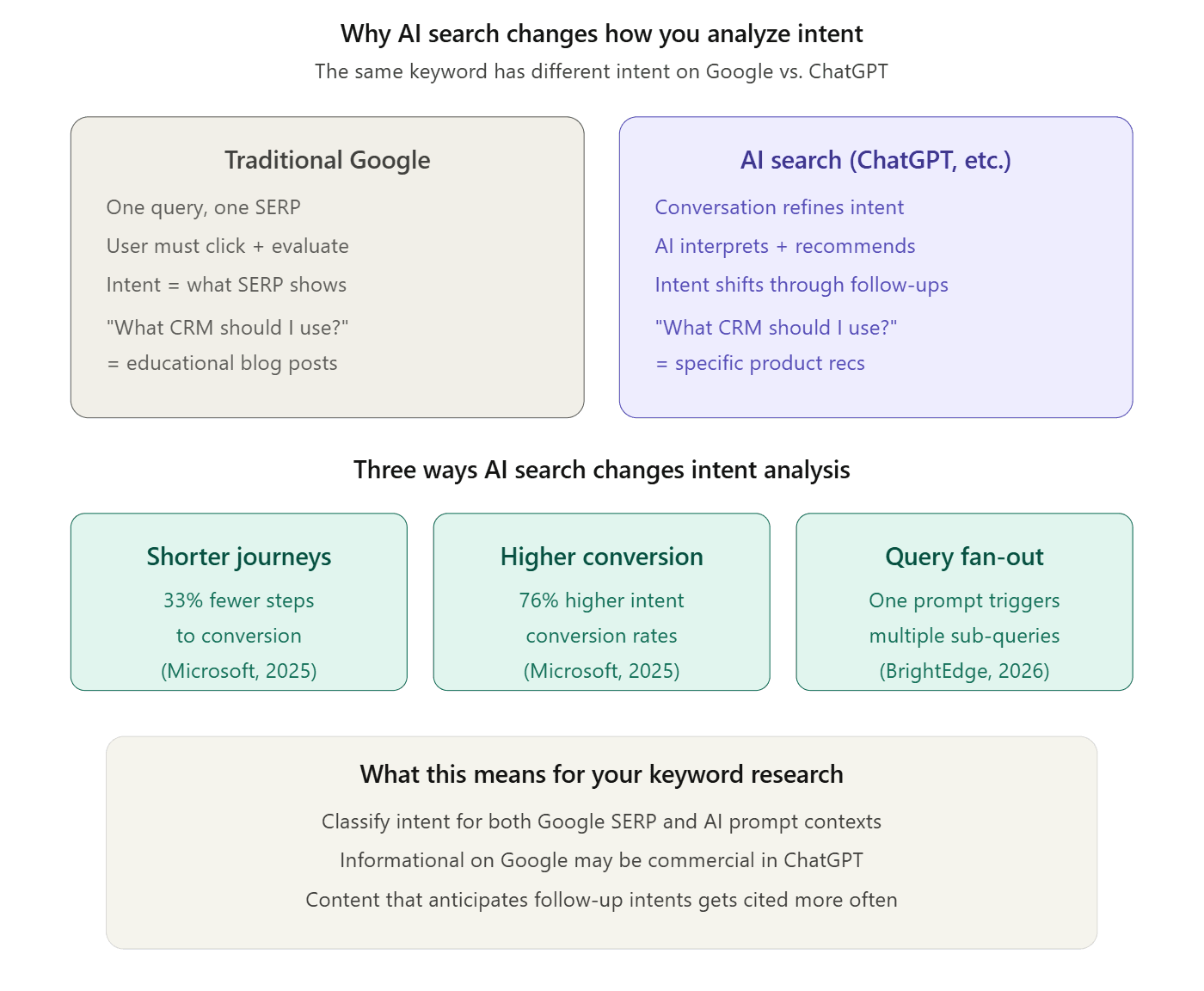
Match the content format to the intent
The Princeton/Georgia Tech GEO research paper (Aggarwal et al., ACM SIGKDD 2024) demonstrated that content format significantly impacts AI visibility: structured content with statistics, citations, and clear answers boosted generative engine visibility by up to 40%, while traditional keyword-stuffed content performed poorly (GEO: Generative Engine Optimization, arXiv:2311.09735).
Intent type | Best content formats | Structure tips |
|---|---|---|
Informational | How-to guides, tutorials, explainers | Question-led H2s, direct answers after headings, step-by-step structure |
Commercial | Comparisons, reviews, "best of" lists | Comparison tables, pros/cons, specific pricing and features |
Transactional | Product pages, pricing pages, landing pages | Clear CTA above fold, trust signals, minimal navigation |
Navigational | Branded pages, support docs | Fast loading, mobile-optimized, exact match to query |
Use intent-specific language and CTAs
Your vocabulary, tone, and calls-to-action must align with the searcher's goal:
Informational: Use instructional language: "Learn how to," "Discover," "Here is how." CTAs: "Read the full guide," "Download the template."
Commercial: Use comparative language: "Compare the top options," "See how it stacks up," "Why choose." CTAs: "See the full comparison," "Read customer reviews."
Transactional: Use action language: "Get started," "Buy now," "Claim your free trial." CTAs: "Start my free trial," "Get my quote."
Navigational: Use direct language: "Log in," "Go to your account," "Access support."
Add structured data to reinforce intent signals
Structured data helps search engines (and AI systems) understand what your page is and what intent it serves. Implement FAQ schema for informational content, Product schema for transactional pages, Review schema for commercial content, and Organization schema for navigational brand pages. According to analysis from Decode Growth, integrating schema markup increases AI citation chances by 30-40% (Decode Growth, Entity SEO Guide). For the full structured data implementation guide, see our schema markup guide for AI visibility.
Audit existing content for intent mismatches
Use Google Search Console to find pages with high impressions but low click-through rates. These pages are likely appearing in search results for queries where the intent does not match the content. A product page ranking for an informational query, or a blog post ranking for a transactional query, creates a mismatch that kills both CTR and conversions.
The fix: Either restructure the existing page to match the dominant intent for its keywords, or create a new page in the correct format and redirect internal links accordingly.
Why AI Search Makes Intent Analysis Non-Negotiable in Keyword Research
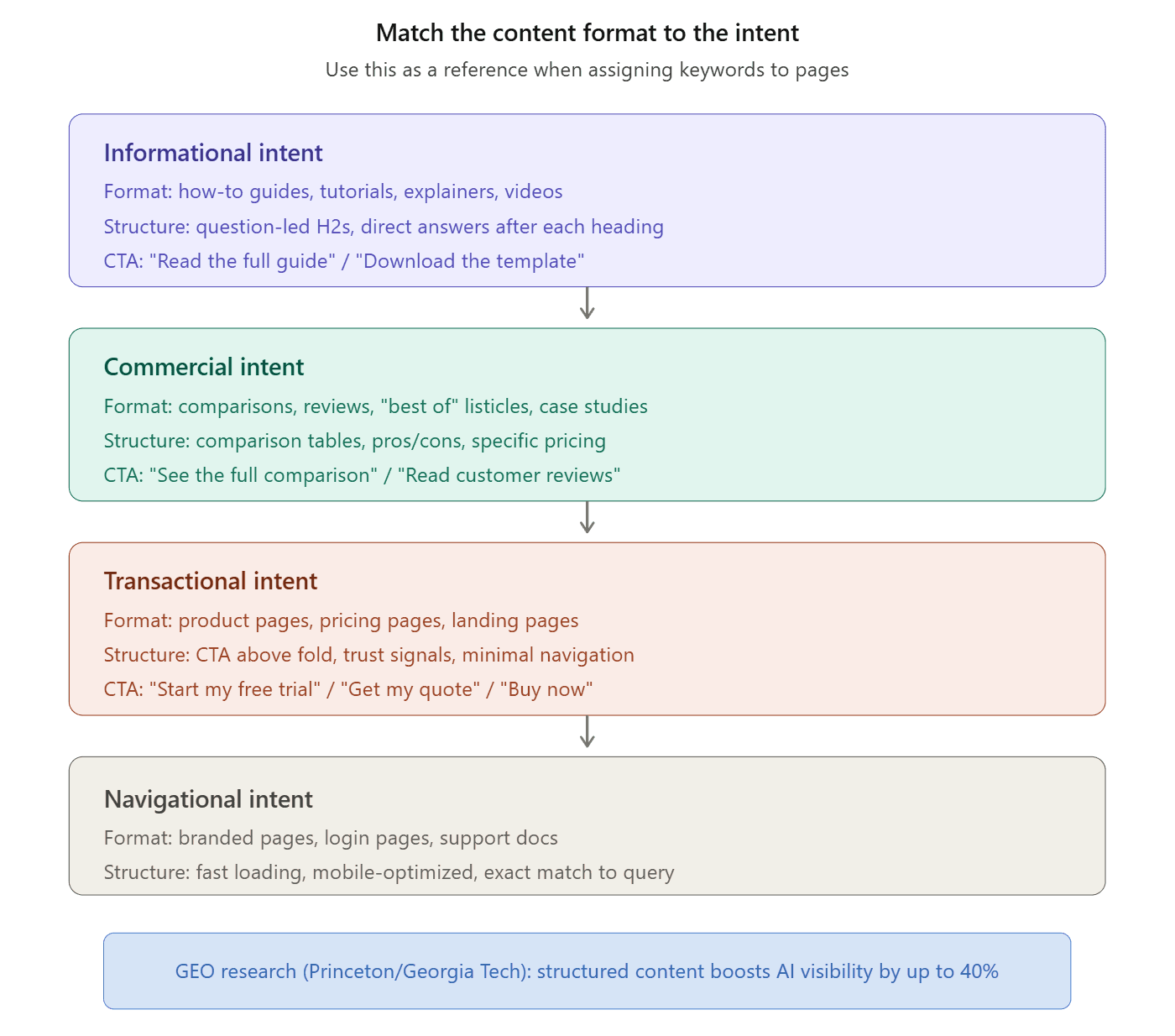
This is the section that separates this guide from every other keyword intent article on the SERP. If your keyword research does not account for how AI search engines interpret intent, you are researching for only half the search landscape. AI search engines (ChatGPT, Perplexity, Google AI Overviews, Gemini) interpret intent differently than traditional Google organic results, and this changes which keywords are worth targeting.
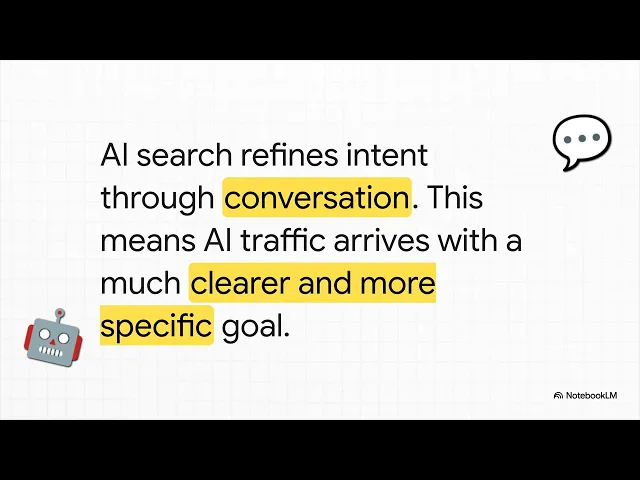
AI search refines intent through conversation: Microsoft research shows that Copilot-assisted customer journeys are 33% shorter on average than traditional search, because AI clarifies intent through follow-up questions rather than requiring the user to search multiple times (Microsoft Advertising, Bing Webmaster Blog). This means AI traffic arrives with more refined intent than organic search traffic.
AI citations favor intent-comprehensive content: AI Overviews use a "query fan-out" mechanism where one user query triggers multiple sub-queries, each pulling information from different sources (BrightEdge, AI Search Insights). Content that satisfies the primary intent AND anticipates follow-up intents (the questions a searcher would ask next) has a higher probability of being cited.
Intent shifts between AI and organic: A keyword that has informational intent on traditional Google may have commercial intent when asked as a prompt in ChatGPT. "What CRM should I use?" on Google returns educational content. The same question in ChatGPT often returns specific product recommendations. Optimize for both interpretations.
For tracking how AI search traffic converts compared to other sources, see our GA4 guide for AI traffic. For the broader AI search visibility framework, see our complete GEO guide.
Start Your Next Keyword Research Round With Intent
Open your most recent keyword research spreadsheet. Add an "Intent" column. For each keyword, search it in Google and classify it: informational, commercial, transactional, or navigational. Then compare the intent to the page you assigned it to. Every mismatch you find is a ranking opportunity you are currently wasting.
Then open Google Search Console. Filter to pages with the highest impressions but lowest click-through rates. For each one, check whether the page format matches the SERP intent. If the SERP shows how-to guides and your page is a product listing, you have found an intent mismatch that intent analysis would have caught during the research phase.
Then set up AI referral tracking in GA4 to monitor how intent-aligned content performs in AI search compared to traditional organic. The brands measuring both today are building a conversion data advantage that compounds over time.
If you need expert help aligning your content strategy with keyword intent across both traditional and AI search, Passionfruit's team builds intent-driven SEO systems for SaaS and ecommerce brands. See our case studies for measurable results.
Keyword research without intent analysis is a list. Keyword research with intent analysis is a strategy. Add the intent column to every keyword spreadsheet you build, and you stop guessing what to create and start knowing what will rank.
Frequently Asked Questions
Why is intent analysis more important than search volume in keyword research?
A keyword with 50,000 monthly searches but informational intent sends researchers to your blog who are not ready to buy. A keyword with 500 monthly searches but transactional intent sends ready-to-buy customers to your product page. The 500-volume keyword generates more revenue per visitor because the intent matches your conversion goal. Search volume tells you how many people search. Intent tells you what those people will do when they arrive.
What are the 4 pillars of SEO?
The four pillars of SEO are technical SEO (site speed, crawlability, structured data, mobile-friendliness), on-page SEO (content quality, keyword targeting, intent matching, internal linking), off-page SEO (backlinks, brand mentions, digital PR, entity authority), and content strategy (topic clusters, editorial planning, content freshness, format optimization). Keyword intent sits at the intersection of on-page SEO and content strategy because it determines both what you write and how you structure it.
How does the placement of keywords affect search engine rankings?
Keyword placement still matters, but placement without intent alignment produces diminishing returns. Include your primary keyword in the title tag, H1, first paragraph, and URL slug. Use secondary keywords in subheadings and throughout the body content naturally. But the placement that matters most is structural: does your page format, content type, and depth match the intent behind the keyword? A perfectly keyword-optimized product page will never outrank a how-to guide for an informational query because the format mismatch overrides the keyword placement.
What are the 3 C's of SEO?
The 3 C's of SEO are content type (blog post, product page, landing page, video), content format (listicle, tutorial, comparison, review), and content angle (unique perspective, specific audience, freshness, depth). All three must align with keyword intent. When you analyze the SERP for your target keyword, the top results reveal the winning combination of type, format, and angle that Google has determined satisfies the searcher's intent.
How often does keyword intent change?
Intent is not static. Seasonal trends, industry shifts, and algorithm updates can change the dominant intent for a keyword. "Best laptops" has commercial intent year-round but shifts toward transactional intent during Black Friday. "COVID testing" shifted from informational to navigational to transactional over the course of the pandemic. Audit your top keywords quarterly by checking whether the SERP results have changed format or type.
Can one keyword have multiple intents?
Yes. Mixed-intent keywords show multiple content types in the SERP. "Blender" returns both software (Blender 3D) and kitchen appliance results. "CRM" returns both educational content and product pages. For mixed-intent keywords, study the SERP to determine which intent dominates (measured by how many of the top 10 results serve each intent), then create content for the dominant intent. If both intents are equally represented, you may need two separate pages.
Does keyword intent matter for ecommerce SEO specifically?
Critically. Ecommerce sites often make the mistake of targeting informational keywords with product pages, or targeting transactional keywords with blog posts. Category pages should target commercial intent ("best running shoes for flat feet"). Product pages should target transactional intent ("buy Nike Air Zoom Pegasus 41"). Blog content should target informational intent ("how to choose running shoes for flat feet"). Mismatching these formats is one of the most common reasons ecommerce sites lose rankings despite strong domain authority.