E-Commerce
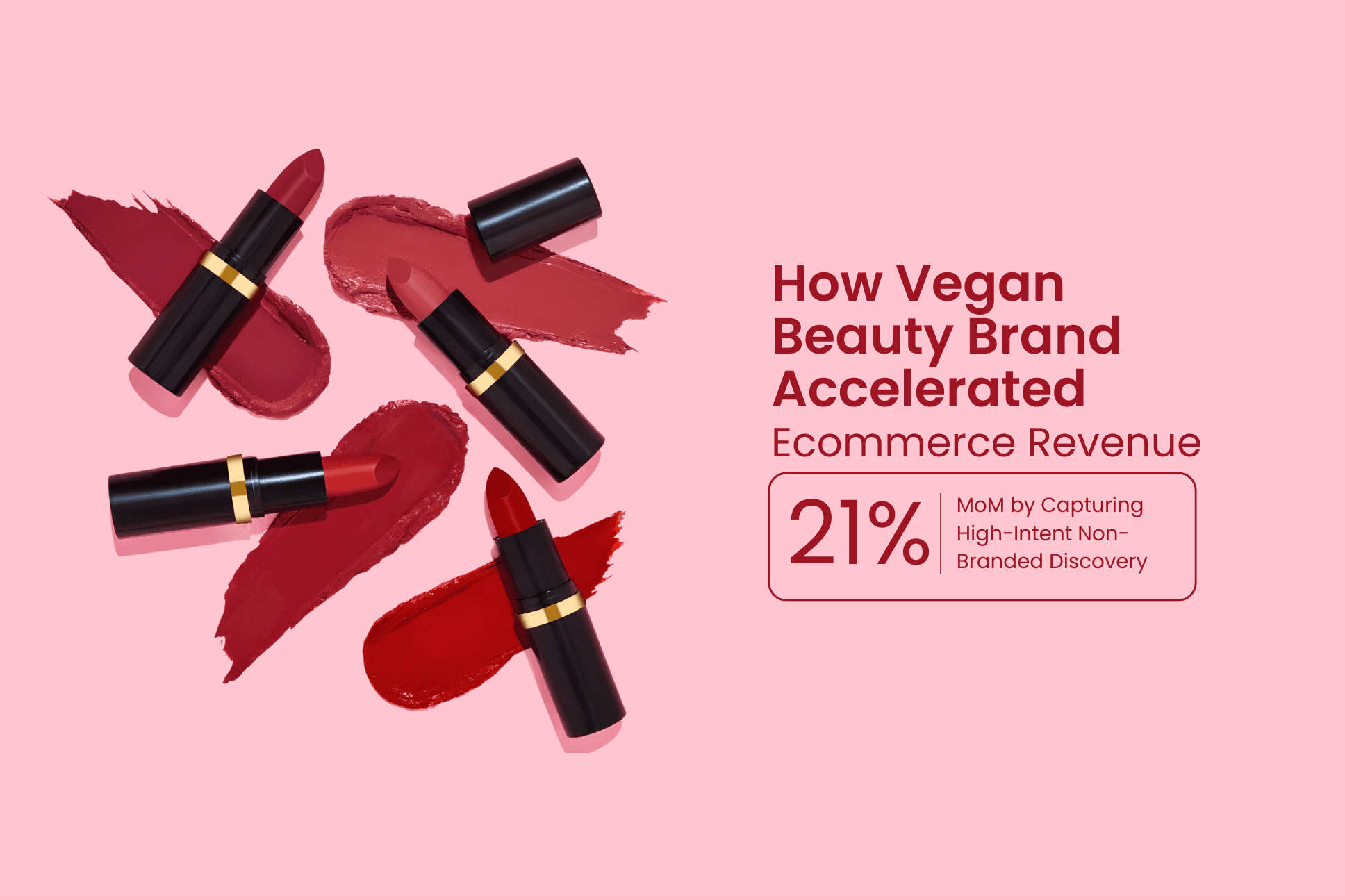
Executive Summary
This brand wasn't struggling with visibility. It was struggling with revenue efficiency.
The brand was generating significant discovery across organic search, but a large portion of high-intent, non-branded discovery wasn't translating into proportional revenue growth.
Customers were discovering product categories. They just weren't consistently converting on the brand's own properties.
By restructuring its product and collection discovery architecture and optimizing conversion pathways for generative and organic discovery, the brand unlocked a rapid increase in revenue, driven primarily by stronger capture of non-branded customer demand.
Performance Snapshot
Metric | Impact |
Non-Branded Revenue | +25.97% MoM |
Total Revenue | +21.13% MoM |
Revenue Growth (YoY) | +44.85% |
Non-Branded Clicks | +16.10% MoM |
Keywords Ranked | +7.60% MoM |
The most important signal: Non-branded revenue grew faster than total revenue.
This indicates improved acquisition and conversion of new customers.
About The Brand
This brand is one of India's most recognized D2C beauty pioneers, founded in 2014 and operating across skincare, makeup, haircare, and fragrances. It holds PETA certification and has built a strong clean beauty positioning in a highly competitive market.
Scale and Traction:
201 to 500 employees across R&D, manufacturing, supply chain, marketing, and sales
Serves 2 to 3 lakh customers monthly through an omnichannel model
2,000+ retail outlets across India plus online presence on Nykaa, Amazon, Flipkart, Purplle, and BigBasket
80+ product SKUs across beauty and personal care categories
Fundraising and Investors:
Total raised: ~$13M
Backed by Believe Pte Ltd (Singapore), which itself is backed by Accel, Jungle Ventures, and IIFL.
Market Opportunity:
Active across 9 countries including India, UAE, Saudi Arabia, Bahrain, Oman, and Qatar via Believe's international distribution network
Operates in the clean and ethical beauty segment, one of the fastest-growing consumer categories globally
The brand operates in a highly competitive ecommerce environment where customer acquisition is driven primarily by non-branded product discovery. Customers rarely search for the brand directly. They search for solutions. Winning these discovery moments is critical to revenue growth.
Examples include:
Best vegan lipstick
Long-lasting vegan foundation
Ammonia-free hair color
The Challenge
This brand's growth wasn’t limited by demand. It was limited by conversion architecture. Three structural gaps were suppressing revenue performance.
1. High-Intent Non-Branded Discovery Was Under-Monetized
This brand was generating strong non-branded visibility, but collection and product pages were not fully optimized to convert discovery-stage buyers.
Users were landing on pages. But conversion efficiency was lower than potential. Revenue was leaking at the point of discovery.
2. Collection Pages Were Functioning as Catalogs - Not Conversion Engines
Collection pages were structured primarily for browsing, not decision-making. They lacked:
Structured comparison clarity
Buyer guidance
Conversion-focused content hierarchy
This reduced their ability to convert high-intent visitors.
3. Discovery Was Increasing Faster Than Revenue
Discovery metrics were growing, but revenue growth was lagging behind discovery growth. This indicated structural inefficiencies in converting discovery into revenue.
Without fixing conversion architecture, revenue growth would remain constrained.
The Strategy: From Discovery Volume to Revenue Capture
Instead of focusing on increasing traffic, the focus shifted to: Increasing revenue generated per discovery opportunity.
This required restructuring how discovery traffic entered and moved through the site.
The objective was simple: Capture more revenue from the discovery the brand was already generating.
1. Collection Pages Were Rebuilt to Capture Purchase-Intent Traffic
Collection pages were restructured to function as decision-support assets rather than product listings.
Key improvements included:
Commercial-intent aligned content hierarchy
Structured FAQ blocks addressing purchase hesitation
Improved semantic clarity to support generative extraction
Conversion-focused content structure
These changes improved conversion efficiency of non-branded visitors.
2. Non-Branded Keyword Clusters Were Mapped to Revenue-Driving Pages
Rather than optimizing broadly, priority was placed on high-conversion keyword clusters.
Optimization focused on queries with clear purchase intent.
This increased the proportion of high-intent visitors entering the conversion funnel.
3. Product Discovery Pathways Were Engineered for Conversion
Internal linking and discovery pathways were optimized to ensure users entering through discovery pages were routed efficiently toward conversion-optimized product pages.
This reduced conversion friction.
4. Generative Discovery Readiness Was Improved
Product and collection pages were restructured to increase eligibility for generative search inclusion.
This improved exposure in recommendation-driven discovery environments.
These environments disproportionately influence purchase-ready users.
The Results
Than brand saw a clear revenue inflection. Revenue growth accelerated significantly within the optimization window.
Non-branded revenue increased 25.97% MoM
Total revenue increased 21.13% MoM
Revenue increased 44.85% YoY
Non-branded clicks increased 16.10% MoM
Keywords ranked increased 7.60% MoM
Non-branded revenue grew faster than overall revenue, indicating stronger new customer acquisition.
More importantly, revenue growth outpaced click growth - demonstrating improved conversion efficiency.
Why This Worked
Strategic Shift | Business Effect |
Collection pages rebuilt for purchase-intent | Increased revenue generated per visitor |
Prioritization of high-intent non-branded queries | Improved acquisition of new customers |
Conversion-focused discovery architecture | Reduced revenue leakage from discovery traffic |
Generative discovery readiness improvements | Increased exposure to high-conversion discovery environments |
Business Impact
The brand successfully increased the efficiency of its organic acquisition engine.
Revenue growth accelerated without requiring proportional increases in discovery volume.
Non-branded revenue grew significantly faster than branded revenue - confirming improved capture of new customer demand.
Organic and generative discovery are now primary revenue growth drivers, not just traffic sources.