Why AI-Generated Content Will Struggle to Earn AI Citations
Abstract
The dominant assumption behind scaled AI content production is that more content yields more visibility in AI search. This paper argues that, for the specific goal of earning citations from generative engines such as ChatGPT, Perplexity, Google's AI Overviews, and Claude, the assumption is structurally self-defeating. The argument rests on one observation: generation and attribution are opposing operations over the same probability distribution. An autoregressive language model produces text by moving toward the high-probability center of its learned distribution, a tendency reinforced by alignment training (Kirk et al., 2024) and visible in the homogenization of model-assisted human writing (Padmakumar & He, 2024). A retrieval-augmented engine, by contrast, attributes a source in proportion to the information that source carries beyond what the model could already generate. Content that reads like what a model would have produced anyway therefore gives no model a strong reason to cite it. We call this the Citation Paradox and show that it is a redundancy problem rather than a quality problem, which is why iterating on quality does not resolve it. The paper connects three literatures that have developed independently, recursive model collapse (Shumailov et al., 2024), alignment-induced diversity loss (Kirk et al., 2024), and co-writing homogenization (Padmakumar & He, 2024; Moon et al., 2025), and bridges them to the empirical regularity that generative engines disproportionately cite original statistics, quotations, and cited sources (Aggarwal et al., 2024). It grounds the mechanism in Shannon surprisal and the Bar-Hillel and Carnap inverse-relationship principle of semantic information, refined by Floridi's veridicality thesis, and in the epistemology of testimony (Hardwig, 1985; Goldman, 2001). It frames the stakes economically through Hirsch's theory of positional goods under a collapse in the marginal cost of average content. It then states the paradox formally, derives four falsifiable predictions with measurable proxies, sets the boundary conditions under which it fails, and closes with the strategic case for why this thesis is the correct organizing foundation for a generative-search firm. The practical conclusion is not that AI should be avoided in production. It is that the value-bearing inputs to a citable page, original data, first-hand observation, named expertise, and defensible positions, are precisely the inputs a generative model cannot supply.
Introduction
A content team adopts a large language model to scale its publishing. Output volume rises sharply, quality holds, and structure improves. Six months later, visibility in AI search has not moved, and in some topics it has fallen. The team's first inference is that the content is not good enough, so it iterates: better prompts, tighter editing, cleaner schema. Visibility still does not move. This pattern is now common enough to deserve an explanation that does not collapse into "the content was bad."
This paper offers one. The team is optimizing the wrong variable. Producing more content that reads like the consensus on a topic cannot improve citation, because citation does not reward consensus. It rewards its opposite. The clearest statement of the claim:
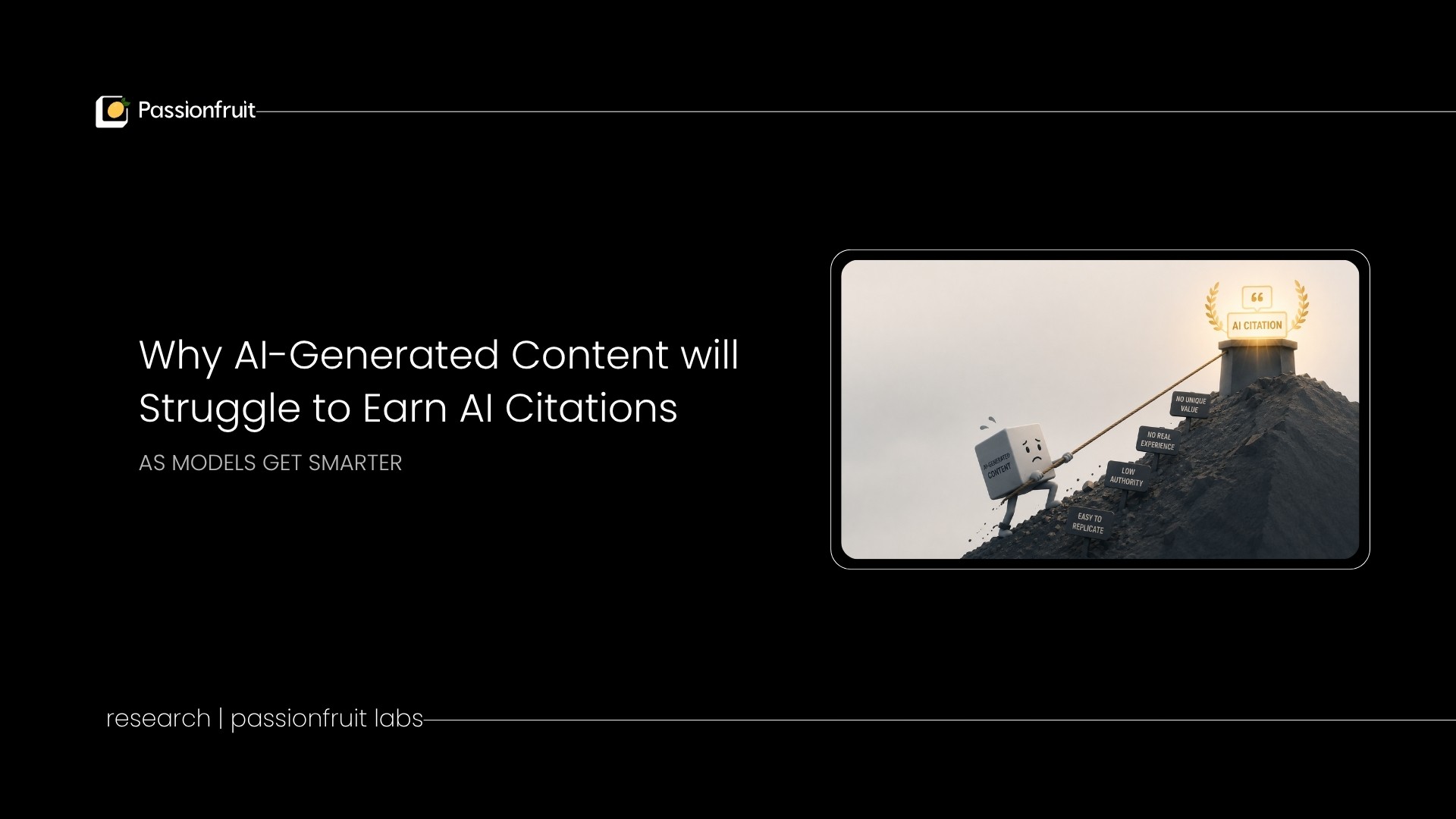
The Citation Paradox. A generative retrieval system attributes a source in proportion to the information that source carries beyond what the system could generate unaided. Content produced by a generative system carries, by construction, little such information. The more a piece of content is generated rather than gathered, the less reason any generative system has to cite it, independent of its quality, fluency, or relevance.
The claim is easily mistaken for three familiar ones it is not. It is not the claim that AI content is low quality, which is frequently false; modern models produce fluent, accurate, well-organized prose. It is not the claim that AI content cannot rank, which is also false; AI-assisted pages rank routinely. And it is not a claim about detection or penalties imposed by engines. It is a narrower and more durable structural claim about one outcome, being selected as an attributed source inside a generated answer, and about why that single outcome resists the scaling strategy that works for ordinary publishing.
The contribution is fourfold. First, the paper connects three research literatures pursued so far in isolation: recursive model collapse, which concerns the health of models trained on synthetic data; alignment-induced diversity reduction, which concerns what aligned models produce; and human-model co-writing homogenization, which concerns what people produce with model assistance. Each independently establishes that generated text converges toward a center. Second, it supplies the mechanism linking that convergence to the visibility question, an information-theoretic account of citation as surprisal-seeking. Third, it grounds the resulting argument in semantic information theory and the epistemology of testimony, and frames its stakes through the economics of positional goods. Fourth, it converts the thesis from an essay into a research program with falsifiable predictions and measurable proxies, then states plainly why the thesis is the right strategic foundation for a firm operating in this market.
A discipline about evidence runs throughout. The strongest parts of this argument are theoretical and rest on peer-reviewed results; some figures common in the practitioner literature are not independently verifiable. The paper separates these tiers explicitly (Appendix A) and is constructed so that no conclusion depends on an unverifiable number.
2. The Unit of Value: From the Click to the Mention
The argument matters only if citation is a prize worth winning, so it is worth establishing the economic ground first.
The click economy that funded the open web is contracting where AI summaries appear. The Pew Research Center, analyzing the browsing behavior of 900 US adults across roughly 68,879 Google searches in March 2025, found that users clicked any link on a results page only about 8 percent of the time when an AI summary was present, against about 15 percent when it was not, and that only about 1 percent of users clicked a source cited inside the summary itself (Pew Research Center, 2025). Roughly one in five searches produced an AI Overview, most overviews cited three or more sources, and users were more likely to end a session after seeing one. Google has disputed the magnitude of the click effect, and other 2025 analyses report reductions of varying size, but the direction is not seriously contested.
The strategic reading of these numbers is not that traffic is dying and nothing can be done. It is that the unit of value is migrating from the click to the mention. If users rarely click the citation, then being the cited or named source inside the answer, where the user actually reads, becomes the asset. This is the shift the GEO literature describes when it observes that there is no single ranked position to win in a generative engine and that visibility is better understood as a frequency of selection across many probabilistic answers, closer to a mention rate than a rank (Aggarwal et al., 2024). The prize, in other words, is precisely citation. And the supply of citation slots per answer is small and fixed by the format, not by how much content exists. That scarcity is what makes the rest of this paper consequential, and it is what Section 5 develops into the economics of a positional good.
Three Convergence Results and One Attribution Regularity
Recursive Collapse in Model Training
Shumailov and colleagues showed in Nature that generative models trained recursively on their own outputs degrade across generations, with the low-probability tails of the original data distribution disappearing first and outputs drifting toward bland central tendencies (Shumailov et al., 2024, building on the 2023 preprint The Curse of Recursion). They attribute the effect to compounding errors of three kinds: statistical approximation error from finite sampling, functional expressivity error from finite model capacity, and functional approximation error from imperfect learning procedures. Later work strengthened the result. Dohmatob, Feng and colleagues characterized "strong model collapse," in which even a small fraction of synthetic data in the training mixture can prevent the model from reaching the performance achievable on clean data (Dohmatob et al., 2025). Borji argued that the phenomenon is a generic statistical consequence of repeatedly fitting and resampling a distribution, and so may be difficult to avoid in principle rather than an artifact of any architecture (Borji, 2024).
Two features matter here. The diagnosed cause is distributional: recursion narrows the represented distribution because each generation loses information about rare events. And the unit of analysis is the model. This literature asks what happens to the generator. It does not ask what happens to any single document's chance of being cited. That question is left open, and the present paper does not claim the two are the same process; the relationship is an analogy developed carefully in Section 5.
Diversity Loss under Alignment
A second result requires no recursive training at all. Kirk and colleagues analyzed each stage of the reinforcement-learning-from-human-feedback pipeline and found a consistent tradeoff: RLHF improves out-of-distribution generalisation relative to supervised fine-tuning, but significantly reduces output diversity across syntactic, semantic, and logical measures (Kirk et al., 2024). The models deployed in consumer generative engines are aligned in exactly this way, which means the text they produce by default sits in a narrower band than the underlying base models could generate. The point is not that alignment is undesirable; it is that one of its measured consequences is a contraction of output toward high-reward, central forms.
Homogenization in Human-Model Co-Writing
A third result operates at the level of human authorship. Padmakumar and He compared essays written with no assistance, with a base model, and with a feedback-tuned model, and found that writing with the feedback-tuned model (InstructGPT) produced essays measurably more similar to one another, reducing collective diversity, while the base model did not produce a significant reduction (Padmakumar & He, 2024). The effect is not about any single essay's quality; it is that many independent authors, assisted by the same aligned model, converge toward each other. Moon and colleagues reported a complementary finding in creative tasks, with the human-versus-model diversity gap widening as more pieces are produced and prompt or parameter adjustments failing to close it (Moon et al., 2025). Jain and colleagues add an important qualification: whether such homogenization is a problem is task-dependent, and is better assessed through a notion of functional diversity than through raw lexical variation (Jain et al., 2025). The qualification sharpens rather than weakens the present argument, because citation is exactly a task in which functional difference, a genuinely new fact or position, is what counts.
Across all three literatures the direction is the same. Generated text, whether produced by a collapsing model, an aligned model, or a human leaning on an aligned model, contracts toward a center.
The Empirical Signature of Attribution
The applied literature supplies the regularity on the other side of the paradox. The most rigorous anchor is the Princeton-led GEO study, which introduced GEO-Bench, a benchmark of 10,000 queries across eight domains paired with candidate web sources, and tested a set of content-modification strategies for their effect on visibility inside a generative engine, validating the strongest on a live system (Aggarwal et al., 2024). The headline result is that well-chosen modifications can raise a source's visibility by up to roughly 40 percent, and that the most effective interventions were adding relevant statistics, including direct quotations, and citing authoritative sources, while keyword-style manipulation performed worse than baseline. Effectiveness varied by domain, and lower-ranked sources tended to benefit most. Secondary summaries of the study report more granular figures (for instance, statistics addition on the order of 40 percent and source citation producing larger gains for low-ranked pages), which are consistent with the paper's thrust but should be checked against the primary text before being quoted as precise.
The retrieval architecture makes the regularity intelligible. Generative engines built on retrieval-augmented generation decompose a query, retrieve passages by semantic similarity in an embedding space rather than by exact keyword match, read across sources, and select a small set for attribution in the synthesized answer (Lewis et al., 2020). The features the GEO study finds most rewarded, specific statistics, quotations, and external citations, are all markers of information a model could not have produced on its own. Section 4 explains why that is not a coincidence.
The Unconnected Gap
Place the literatures side by side. The first says recursive generation erases a distribution's tails. The second says aligned generation contracts text toward a center even without recursion. The third says human authors assisted by aligned models converge toward one another. The fourth says generative engines preferentially attribute the content furthest from that center: specific numbers, original research, first-hand results. Each literature is mature on its own terms. None has been connected to the others, and no one has named the resulting mechanism or built a strategy on it. That bridge is the contribution of the next three sections.
The Mechanism: Generation and Attribution as Opposing Operations
Generation as Mode-Seeking
Let an autoregressive language model define a probability distribution p_theta over token sequences. Generation samples from this distribution, and in practice from a sharpened version of it: low decoding temperatures concentrate mass near high-probability regions, and the alignment-induced diversity loss documented by Kirk et al. (2024) sharpens the effective distribution further. Informally, the model's expected output on a topic is that topic's consensus rendering, the most probable continuation given everything absorbed in training. The homogenization results of Sections 3.2 and 3.3 are the empirical signature: independently prompted generations cluster, because they are drawn from the neighborhood of the same conditional mode.
Define the surprisal of a sequence under the model as I(x) = minus log p_theta(x). Generated text has, by construction, low surprisal under the generating model. Because contemporary models are trained on heavily overlapping corpora and share alignment biases, generated text also tends to have low surprisal under other models. This is the property that drives everything that follows: to a generative system, AI-generated content is unsurprising.
Attribution as Surprisal-Seeking
Consider what a retrieval-augmented system needs from an external source. Given a query, the system aims to produce an accurate answer, and its parametric knowledge already encodes the consensus on most topics. Retrieval is valuable precisely when a source supplies something the model does not already hold: a current fact, a specific measured quantity, a named first-hand result, a defensible position the model would not assert unaided. The marginal value of a candidate source is, loosely, the reduction in the model's uncertainty about the correct answer that the source provides beyond the parametric prior, a pointwise mutual information between source and answer conditional on what the model already knows.
A source the model could have generated itself carries almost none of this. When p_theta of the source is high, the source is close to what the model would say anyway, and conditioning on it barely moves the model's answer distribution. There is content in such a source, but no information the model lacks. The source is redundant.
Attribution then turns on a second, epistemic consideration. A model can fold redundant background content into an answer silently, without credit, because it can vouch for that content from its own knowledge. It attributes a source when the source supplies something it cannot vouch for on its own authority: a proprietary figure, an experimental outcome, a claim that traces to a specific observer. Attribution discharges an epistemic debt the model cannot pay from parametric memory. Low-surprisal content creates no such debt and therefore earns no attribution.
Statement of the Paradox
Put the halves together. Generation minimizes surprisal; attribution rewards it. The same content cannot be optimized for both at once. As a piece of content moves toward the distributional center that makes it look generated, it moves away from the region that makes it worth citing.
The probability that a generative engine attributes a passage increases in the passage's surprisal relative to the engine's prior, and the surprisal of generated content is, by construction, low. Producing content by generation therefore lowers, in expectation, the very quantity that citation rewards.
This separates three outcomes the practitioner conversation routinely conflates. A passage can be retrieved as a candidate, where relevance and semantic similarity govern and AI content competes well. A passage can be used as uncited background, where redundant on-topic content is perfectly serviceable. And a passage can be attributed as a source, which tracks surprisal and is where generated content fails. The Citation Paradox is a claim about the third outcome alone. It explains how a page can be relevant, well-structured, and frequently retrieved, yet seldom cited.
A Redundancy Problem, Not a Quality Problem
The most important consequence of this framing is that it dissolves the quality-improvement reflex. If the deficit were quality, better generation would close it. But the deficit is redundancy, and better generation makes redundancy worse, because a more capable model produces text closer to the polished consensus, which is exactly the unsurprising region. A model does not cite content that tells it what it already knows, and it knows the consensus best of all. Improving fluency, coherence, and structure raises retrievability and readability without touching the variable that governs attribution. This is why the team in Section 1 cannot iterate its way out.
The Latent Construct and Its Observable Proxies
Honesty requires a caveat that also strengthens the thesis. Production engines do not compute surprisal or mutual information at query time. They retrieve by embedding similarity and select citations through learned policies, attribution training, and engineered heuristics. The surprisal account is therefore offered as a latent explanation for which observable features predict attribution, not as a description of the retrieval algorithm. Its validation is indirect but real: the features the GEO study finds most predictive of citation, specific statistics, quotations, and named sources (Aggarwal et al., 2024), are exactly the observable proxies for high surprisal. A specific proprietary number is, almost by definition, a low-probability token sequence the model could not have generated on its own. The latent variable is surprisal; the measured variables are its fingerprints. Section 7 turns this into a test.
The Economic Argument: Visibility as a Positional Good under Zero Marginal Cost
The Prize: A Positional Good with Fixed Supply
Begin with the nature of the prize. Visibility in AI search is a positional good in Hirsch's sense: its value derives from relative standing and scarcity, not absolute quantity (Hirsch, 1976). An engine attributes a small number of sources per answer, fixed by the format rather than by how much qualifying content exists. You cannot all be cited, any more than everyone can stand above the median. Positional goods cannot be mass-produced; they can only be competed for.
The Collapse of the Average-Content Moat
Now the cost structure. In the pre-AI web, producing competent, average content was expensive in human time, and that expense was itself a moat: a team that out-worked its competitors at producing serviceable pages won visibility through accumulated adequacy. Generative models collapsed the marginal cost of average content to nearly zero. This is the decisive event. When the marginal cost of average falls to zero, average ceases to be a moat, because anyone can flood any topic with it instantly. A good whose supply becomes unlimited cannot confer positional advantage. Average content becomes, as a visibility strategy, worthless, not because it got worse but because it stopped being scarce.
The moat therefore inverts. The durable advantage shifts to whatever still has positive marginal cost and cannot be generated: original data someone had to collect, first-hand testing someone had to run, proprietary results only one party holds, named expertise carrying reputational weight, and genuine positions someone will defend. These are the inputs to models, not the outputs of them. The strategic sentence is short: the brands that win AI citation produce the things models are trained on, not the things models produce.
Reflexivity and Citation Collapse
There is a dynamic, reflexive layer, and it is where the scale-content strategy becomes self-undermining. Visibility competition through generated content is anti-inductive: the strategy degrades as it is adopted. As more participants in a topic use aligned models to scale output, the topic's published corpus converges toward p_theta, the consensus region thickens, and the share of content carrying real surprisal shrinks. Citation, forced to choose attributable sources, concentrates on the shrinking high-surprisal minority. The positional value of belonging to that minority rises precisely as the crowd renders itself un-citable. This is a brand-level homologue, not an instance, of model collapse: not the collapse of a model trained on synthetic data, but the contraction of the citable surface area of a topic as its retrievable corpus fills with synthetic content. Call it citation collapse. It shares the root cause Shumailov et al. (2024) identified, recursive self-consumption of a distribution, operating one level up, on the corpus the engine retrieves from rather than the data the model trains on. The analogy is deliberate and bounded: the mechanisms differ in their particulars, but both follow from distributional convergence under recursive generation.
The conclusion is not symmetric with the fear it might invite. Citation collapse does not destroy the prize; it concentrates it. As average content becomes free and ubiquitous, the original-data moat becomes more valuable, not less, because scarcity is the source of positional value and AI manufactures the abundance against which scarcity is measured. A final hazard follows from Goodhart's law, in Strathern's formulation that a measure ceases to be a good measure once it becomes a target (Strathern, 1997): teams will try to manufacture the surface markers of surprisal, fabricated statistics and citation-shaped sentences, with the same models. The next section explains why that fails on principle, not merely in practice.
The Philosophical Argument: Semantic Information and Testimony
The Inverse-Relationship Principle
The information-theoretic mechanism has a long philosophical lineage, and making it explicit shows the result is not an artifact of current engine design but a consequence of what information and citation are. Bar-Hillel and Carnap formalized a principle that predates language models by seventy years: the semantic information carried by a statement is inversely related to its prior probability (Bar-Hillel & Carnap, 1952; the inverse-relationship principle). The more expected a proposition, the less it tells you. A statement that merely restates the consensus has high probability and therefore low semantic content. This is the same inequality that drives the Citation Paradox, expressed in the vocabulary of the philosophy of information rather than of machine learning. Generated text is, by design, high-probability text, and high-probability text is low-information text. The paradox is, at root, the inverse-relationship principle applied to a system that selects sources by their information content. The framework is mirrored on the syntactic side by Shannon's self-information, in which improbable messages carry more bits (Shannon, 1948), and on the epistemic side by Dretske's account of informational content as objective and tied to the reduction of possibility (Dretske, 1981).
Veridicality and the Failure of Manufactured Surprisal
Bar-Hillel and Carnap's weak theory has a notorious consequence, that a contradiction, being maximally improbable, comes out as maximally informative, the so-called Bar-Hillel and Carnap paradox. Floridi's theory of strongly semantic information resolves it by adding a veridicality condition: genuine semantic information must be true (Floridi, 2004; 2011). This refinement is exactly what defeats the Goodhart strategy of fabricating surprisal. A false but improbable statistic has low prior probability, so it looks informative under the weak theory, but it is not strongly-semantic information at all, because it is not true. It also exposes the page to the factuality checks engines increasingly apply and to the reputational cost of being wrong. The substance, true information the engine lacks, cannot be faked into existence; only its surface form can, and the surface form decays as engines get better at telling the two apart.
Citation as Institutionalized Deference
The epistemology of testimony asks when it is rational to take a source's word for something. Hardwig argued that because no individual can master every domain, we are unavoidably epistemically dependent on the testimony and expertise of others, and may rationally believe a claim on the strength of good reason to think an authority has good reason for it (Hardwig, 1985; 1991). Goldman framed the practical version, the novice's problem of adjudicating which of several putative experts to trust (Goldman, 2001), and Coady gave the canonical treatment of testimony as a basic source of warrant (Coady, 1992). Citation is institutionalized deference. An engine defers, by attributing a claim to a source, when that source is an epistemic authority on a specific fact the engine could not establish itself. A generative model, however, has no privileged access to any fact in the world; its output is derivative by construction, a synthesis of what it has read, and it has observed nothing first-hand. It therefore cannot occupy the terminus of a deference chain, cannot be the authority citation exists to credit. The point generalizes beyond machine engines: a human reader has no more reason to cite a passage that only reformats the consensus than an engine does. Citation tracks epistemic provenance, and generated content has no provenance other than the corpus it averages.
A Falsifiable Research Program
Operationalizing Surprisal
A thesis earns the name paper rather than essay by making predictions that could be wrong. The Citation Paradox makes several, testable with instrumentation already available to a well-equipped generative-search team. The central construct is passage surprisal. It is not directly observable, but it admits a serviceable operational definition: the negative log-likelihood of a passage under a fixed open reference model, or a calibrated proxy combining named-entity density, numeric specificity, quotation presence, and embedding distance from the topic centroid.
Four Predictions
Surprisal predicts attribution, net of relevance and structure. Across pages competing for the same queries, passage-level surprisal under a reference model should positively predict citation frequency after controlling for retrieval rank, semantic relevance, heading structure, and readability. If citation were governed by relevance and structure alone, surprisal would add no predictive power. The paradox predicts it will.
Citation concentrates as a topic's AI-content share rises. Tracked longitudinally, as the estimated share of model-generated content in a topic's retrievable corpus increases, the concentration of citations across cited domains (a Gini coefficient) should rise, because attribution is forced onto a shrinking high-surprisal minority. A topic flooded with synthetic content should show more unequal citation, not more diffuse citation.
Original-data passages out-cite paraphrase at equal rank. Holding retrieval rank fixed, passages containing first-party data should show a higher citation-per-impression rate than passages that paraphrase existing public information, isolating the attribution stage from the retrieval stage.
Recursive paraphrase monotonically lowers citability. Take a source containing original information and produce successive model-paraphrased versions, each generated from the previous. Citation probability should fall monotonically across iterations as surprisal is washed out, a controlled, page-level reproduction of the distributional narrowing that model collapse exhibits at the corpus level. This is the single cleanest experiment, because it manipulates surprisal directly while holding topic and intent constant.
Each prediction has a clear falsifier. If surprisal proxies fail to predict attribution once relevance is controlled, or if recursive paraphrase leaves citation probability flat, the central mechanism is wrong and the economic and philosophical layers lose their foundation.
8. Objections and Boundary Conditions
The honest objections sharpen the thesis rather than defeating it.
"AI content does get cited, so the mechanism is false." The claim is marginal and probabilistic, not absolute. A generated passage can be cited when it is the best-matching candidate and no higher-surprisal alternative is retrieved, which is common in sparse or new topics. The paradox predicts a lower expected citation rate per generated passage and a concentration of citations away from generated content as alternatives appear, not the impossibility of any single citation. The right tests are rate and concentration, not existence.
"Retrieval is about relevance, and AI writes relevant content." Correct, which is why Section 4.3 distinguishes retrieval from attribution. AI content competes well for retrieval and for uncited background use; the argument bites only at attribution. Conflating the three outcomes is the most common error in the practitioner discussion and is what makes the paradox look false to anyone who has watched AI content appear in an answer.
"Surprisal is not the only thing engines reward." Also correct. Attribution is influenced by domain authority, brand-mention frequency, link structure, freshness, and engine-specific policy; in the Pew data the most-linked sources were large reference and community sites (Pew Research Center, 2025). Surprisal is one factor among several, and the paper does not claim otherwise. The claim is that it is a real, under-recognized factor that the scale-content strategy actively works against, and that it has a cleaner theoretical basis than the other factors.
"The mean is topic-relative and moves over time." Yes, and this reinforces the argument. Yesterday's surprising claim becomes today's commonplace, which means surprisal must be continuously replenished with new first-hand inputs, exactly the work generation cannot do.
Boundary conditions. The thesis is strongest in competitive, information-dense topics where many sources contend for few citation slots, and weakest in sparse topics where any relevant passage may be cited for lack of alternatives. It is strongest for factual, citation-bearing queries and weakest for navigational or transactional ones where attribution is not the mechanism. It assumes engines continue to attribute sources; a shift to fully unattributed synthesis would change the prize without changing the underlying information dynamics. These conditions matter directly for where the strategy in the next section applies.
9. Strategic Implications
The preceding sections are descriptive. This one is strategic. The case for adopting the Citation Paradox as the firm's organizing thesis rests on six points, followed by an honest account of its costs.
It converts the sales argument from preference to structure. Most agencies ask a prospect to prefer their work over a cheaper alternative, which is a matter of taste and budget. The Citation Paradox lets the firm say something stronger and verifiable: the cheaper alternative does not fail because it is low quality, it fails because of a structural property of how generative engines select sources, established in peer-reviewed work on model behavior (Shumailov et al., 2024; Kirk et al., 2024) and on citation (Aggarwal et al., 2024). That reframes the buying decision. The client is no longer choosing between two ways to make content; they are choosing between a strategy that can earn citations and one that, at the margin and increasingly over time, cannot. Combined with the stakes in Section 2, where the click is giving way to the mention (Pew Research Center, 2025), the argument answers the only question a skeptical buyer actually has, which is why this is worth paying for.
It differentiates against the content-at-scale competitors. The market is bifurcating into vendors selling volume of AI-generated output and firms selling original, evidence-backed content. The paradox is the intellectual moat for the second position. It reframes the firm's higher cost not as a premium tax but as the only expenditure that buys the outcome, because the cost is the surprisal, and surprisal is what citation pays for. A competitor cannot undercut on this axis without abandoning the thing that works.
It makes the firm's research the product, not the marketing. The inputs the paradox identifies as the moat, original data, first-hand testing, proprietary analysis, named expertise, are exactly the assets the firm already produces: large-scale citation studies, the platform's own measurements, vertical-specific first-party findings. The thesis turns these from a credibility flourish into the core deliverable. The work the firm is uniquely positioned to do is the work the paradox says is the only durable strategy.
It is defensible and on-brand. The thesis does not say AI is bad, which would be false and would position the firm as reactionary while it uses AI itself. It says AI for production, humans for substance, the same honest-middle line the firm already holds. That distinction survives scrutiny from a sophisticated client, an investor, or a critic, because it is grounded rather than rhetorical, and because the firm can demonstrate it lives by it.
It is measurable, and the measurement is a moat. The research program in Section 7 is not only academic. Surprisal proxies, originality scoring, and citation-concentration tracking are buildable as a measurement product. A firm that can score a draft for citability before publication, attribute visibility changes to surprisal rather than to structure, and show a client the difference between AI-assisted and AI-sourced content holds an instrument its competitors do not. The thesis becomes a tool, and the tool becomes a reason to stay.
The paper is itself an instance of the strategy. A document that connects literatures no one has connected, advances a named mechanism, and grounds it in primary sources is, by its own definition, high-surprisal and therefore citable content. Publishing it is not only thought leadership; it is a worked demonstration that the firm produces the kind of original input the paradox rewards. The firm should expect this asset to earn the citations a hundred commodity posts would not.
The honest costs. The strategy is operationally heavier than running a content mill. Producing genuine original inputs, collecting data, running tests, securing named expertise, costs more per unit and scales less easily than generation, which is the price of the moat and should be stated to clients as such rather than hidden. The thesis is strongest in the firm's competitive, information-dense verticals and weaker in sparse niches, so it should be applied where Section 8's boundary conditions hold rather than universally. And the whole edifice assumes engines keep attributing sources; the firm should monitor that assumption, because a move toward unattributed synthesis would shift the prize even though it would not rescue commodity content. None of these costs undermines the case. They define where and how to deploy it.
10. Conclusion
The Citation Paradox is a structural result, not a moral one. Generation and attribution pull in opposite directions over the same distribution: generation toward the probable center, attribution toward the improbable edge where genuine information lives. The same content cannot be optimized for both, so a strategy that scales generation in pursuit of citation optimizes against its own goal. The literatures on model collapse, on alignment-induced diversity loss, and on co-writing homogenization have, separately, established that generated text converges toward a center. The GEO evidence has established that engines attribute the content furthest from it. The bridge is an old principle from the philosophy of information, that the expected carries little information, applied to a system that selects sources by the information they carry, and reinforced by an old principle from the epistemology of testimony, that we defer only to those with access we lack. As the marginal cost of average content falls to zero and topics fill with it, the value of the un-generatable input rises, and the organizations that win AI citation will be the ones producing the inputs to the models rather than the outputs of them. For a firm whose product is exactly those inputs, that is not a warning. It is the thesis of the business.
Appendix A: A Note on Evidence Tiers
This paper draws on three grades of evidence, and conflating them would weaken the argument rather than strengthen it.
Tier 1, peer-reviewed or formally published. The model-collapse results (Shumailov et al., 2024; Dohmatob et al., 2025; Borji, 2024), the RLHF generalisation-diversity tradeoff (Kirk et al., 2024), the co-writing homogenization findings (Padmakumar & He, 2024; Moon et al., 2025; Jain et al., 2025), the retrieval-augmented generation architecture (Lewis et al., 2020), the GEO citation study (Aggarwal et al., 2024), the Pew browsing study (Pew Research Center, 2025), and the foundational information theory and philosophy (Shannon, 1948; Bar-Hillel & Carnap, 1952; Dretske, 1981; Floridi, 2004; Hardwig, 1985; Goldman, 2001; Coady, 1992; Hirsch, 1976; Strathern, 1997). These carry the weight of the argument.
Tier 2, applied research reported partly through secondary coverage. The granular per-strategy percentages associated with the GEO study circulate in practitioner summaries and are consistent with the published paper, but the precise figures should be verified against the primary text (Aggarwal et al., 2024) before being quoted. Click-reduction magnitudes other than Pew's vary across 2025 analyses and are reported as a range rather than a single number.
Tier 3, industry-reported and proprietary figures. Various vendor and agency sources cite specific percentages for the share of cited content containing original data, the prevalence of AI-generated content on the web, conversion rates of AI-referred visitors, and citation-rotation rates. These are not independently verifiable and are treated here as illustrative of a direction rather than as load-bearing evidence. The argument is constructed so that it does not depend on any Tier 3 figure being precisely correct.
References
Aggarwal, P., Murahari, V., Rajpurohit, T., Kalyan, A., Narasimhan, K., & Deshpande, A. (2024). GEO: Generative Engine Optimization. In Proceedings of the 30th ACM SIGKDD Conference on Knowledge Discovery and Data Mining (KDD '24) (pp. 5–16). Association for Computing Machinery. https://doi.org/10.1145/3637528.3671900. Preprint: arXiv:2311.09735.
Bar-Hillel, Y., & Carnap, R. (1952). An Outline of a Theory of Semantic Information. Technical Report No. 247, Research Laboratory of Electronics, MIT. Reprinted in Y. Bar-Hillel, Language and Information (Addison-Wesley, 1964).
Borji, A. (2024). A Note on Shumailov et al. (2024): "AI Models Collapse When Trained on Recursively Generated Data." arXiv:2410.12954.
Coady, C. A. J. (1992). Testimony: A Philosophical Study. Oxford: Clarendon Press.
Dohmatob, E., Feng, Y., et al. (2025). Strong Model Collapse. In Proceedings of the International Conference on Learning Representations (ICLR 2025). Preprint: arXiv:2410.04840.
Dretske, F. (1981). Knowledge and the Flow of Information. Cambridge, MA: MIT Press.
Floridi, L. (2004). Outline of a Theory of Strongly Semantic Information. Minds and Machines, 14(2), 197–221. See also Floridi, L. (2011), The Philosophy of Information (Oxford University Press), and Floridi, L., "Semantic Conceptions of Information," Stanford Encyclopedia of Philosophy.
Goldman, A. I. (2001). Experts: Which Ones Should You Trust? Philosophy and Phenomenological Research, 63(1), 85–110.
Hardwig, J. (1985). Epistemic Dependence. The Journal of Philosophy, 82(7), 335–349.
Hardwig, J. (1991). The Role of Trust in Knowledge. The Journal of Philosophy, 88(12), 693–708.
Hirsch, F. (1976). Social Limits to Growth. Cambridge, MA: Harvard University Press.
Jain, S., Lanchantin, J., Nickel, M., Ullrich, K., Wilson, A., & Watson-Daniels, J. (2025). LLM Output Homogenization is Task Dependent. arXiv:2509.21267.
Kirk, R., Mediratta, I., Nalmpantis, C., Luketina, J., Hambro, E., Grefenstette, E., & Raileanu, R. (2024). Understanding the Effects of RLHF on LLM Generalisation and Diversity. In Proceedings of the International Conference on Learning Representations (ICLR 2024). Preprint: arXiv:2310.06452.
Lewis, P., Perez, E., Piktus, A., Petroni, F., Karpukhin, V., Goyal, N., Küttler, H., Lewis, M., Yih, W., Rocktäschel, T., Riedel, S., & Kiela, D. (2020). Retrieval-Augmented Generation for Knowledge-Intensive NLP Tasks. In Advances in Neural Information Processing Systems 33 (NeurIPS 2020). Preprint: arXiv:2005.11401.
Moon, K., et al. (2025). Homogenizing Effect of Large Language Models on Creative Diversity: An Empirical Comparison of Human and ChatGPT Writing. Journal article (ScienceDirect); see publisher record for full citation.
Padmakumar, V., & He, H. (2024). Does Writing with Language Models Reduce Content Diversity? In Proceedings of the International Conference on Learning Representations (ICLR 2024). Preprint: arXiv:2309.05196.
Pew Research Center (2025). Google Users Are Less Likely to Click on Links When an AI Summary Appears in the Results. Short read, July 22, 2025. Based on browsing data from 900 US adults, March 2025.
Shannon, C. E. (1948). A Mathematical Theory of Communication. The Bell System Technical Journal, 27, 379–423 and 623–656.
Shumailov, I., Shumaylov, Z., Zhao, Y., Gal, Y., Papernot, N., & Anderson, R. (2024). AI Models Collapse When Trained on Recursively Generated Data. Nature, 631, 755–759. Earlier preprint: The Curse of Recursion: Training on Generated Data Makes Models Forget (arXiv:2305.17493, 2023).
Strathern, M. (1997). "Improving Ratings": Audit in the British University System. European Review, 5(3), 305–321. (Source of the common formulation of Goodhart's law.)
Suggested citation: [Author] (2026). The Citation Paradox: Why Generative Engines Underattribute Generated Content. Passionfruit Working Paper, Version 1.0.