SEO
Join 500+ brands growing with Passionfruit!
The complete audit process for discovering why ChatGPT, Perplexity, and Gemini cite your competitors instead of you. Four gap types, platform-specific benchmarks, and the exact steps to become the source AI chooses.
37% of users now start their purchase journey with AI search. When someone asks ChatGPT, "best CRM for small business," and your competitor gets cited three times while you get zero mentions, that is not a ranking problem. It is a source gap.
Source gap analysis is the process of reverse-engineering AI-generated answers to identify exactly where and why your content is missing from the citation chain. It goes beyond traditional content gap analysis (which asks "what keywords are we missing?") to answer a more fundamental question: what sources is the AI actually pulling from, and why are we not among them?
This is not theoretical. Only 11% of domains are cited by both ChatGPT and Google AI Overviews. Each platform has distinct citation preferences, and the brands winning in AI search are running platform-specific audits rather than treating "AI visibility" as a single channel.
This guide gives you the complete four-bucket audit framework, platform-specific citation benchmarks, the step-by-step process for identifying and closing each gap type, and how to track progress with Passionfruit Labs and GA4. For the foundational understanding of how AI search works, see our complete GEO guide.
What Source Gap Analysis Actually Is (And Why Content Gap Analysis Is Not Enough)
Traditional content gap analysis asks: what topics or keywords do our competitors rank for that we don't? It is a comparison of keyword coverage between your site and competitors in Google's organic results.
Source gap analysis asks a different question: which specific URLs and domains does the AI cite when answering prompts relevant to our business, and where are we absent from that citation chain?
The difference matters because AI search engines do not rank pages the way Google does. They retrieve passages from multiple sources, evaluate credibility, synthesize an answer, and cite a small number of sources. A page that ranks #3 on Google for a keyword might never be cited by ChatGPT, while a page ranking #8 might be cited repeatedly because its content structure, entity density, and source authority match what the AI model values.
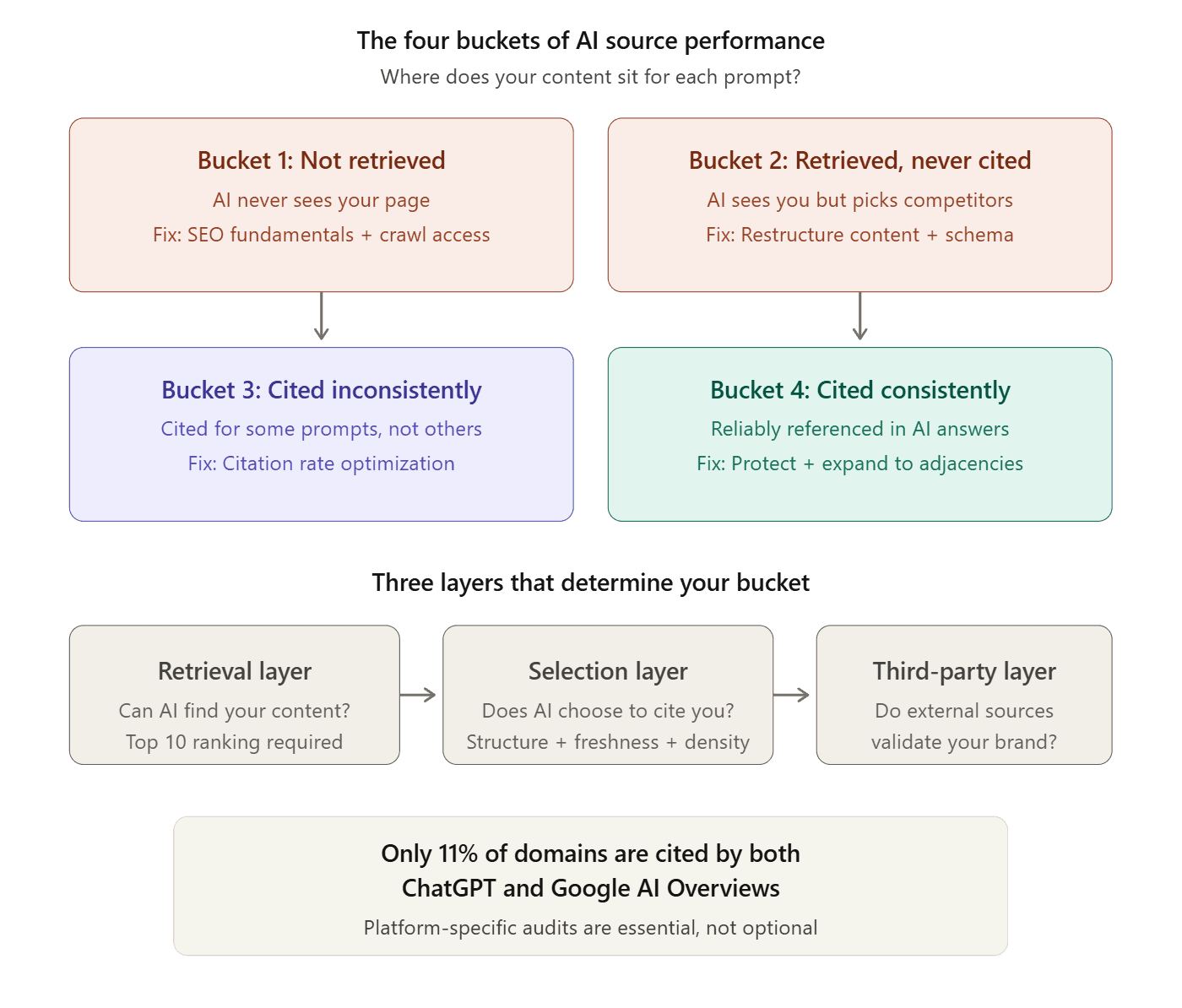
Source gap analysis examines three layers that content gap analysis misses:
The retrieval layer. Is your content even being found during the AI's query fan-out process? If the AI decomposes a user's prompt into five sub-queries and your content does not rank in the top 10 for any of them, you are invisible before the AI even evaluates your content.
The selection layer. Your content was retrieved, but the AI chose not to cite it. Something about your page structure, content freshness, entity density, or authority signals caused the AI to prefer a competitor's page.
The third-party layer. You are not cited directly, but are you mentioned on the pages that do get cited? If G2, Reddit, industry publications, and review sites cite your competitors but not you, the AI has no independent verification of your brand's relevance.
For understanding how AI retrieves and selects sources during the query fan-out process, see our GEO funnel guide.
The Four Buckets of AI Source Performance
Every piece of content on your site falls into one of four buckets relative to any given AI prompt. Identifying which bucket your content sits in determines exactly what action to take.
Bucket 1: Not retrieved at all
Your content does not appear in the AI's initial search results for the relevant sub-queries. The AI never sees your page.
Root causes: You do not rank in Google's top 10 for the sub-queries the AI generates. Your site has thin topical authority in the category. AI crawlers are blocked by your robots.txt or Cloudflare settings.
What to do: This is an SEO problem, not a GEO problem. Build topical authority through topic clusters, earn backlinks, and ensure AI crawlers can access your content. Check your robots.txt for blocks on ChatGPT-User, PerplexityBot, Google-Extended, and ClaudeBot user agents.
Bucket 2: Retrieved but never cited
The AI finds your content during retrieval but consistently chooses not to cite it. Your pages appear in the AI's source list but never make it into the final answer.
Root causes: Your content lacks structural clarity (no clear headings, answers buried in paragraphs). Your content is thin or duplicative of what the AI already found from stronger sources. Your domain authority is weaker than competing sources for this topic.
What to do: Restructure content with direct answers in the first 1-2 sentences of each section. Add specific data points and named entities. Implement FAQ schema and structured data. Build backlinks to increase domain authority for the topic.
Bucket 3: Retrieved but cited inconsistently
Your content occasionally gets cited for similar prompts, but not reliably. For one variation of a question you appear; for another, you don't.
Root causes: Your content partially matches the AI's criteria but falls short on specific attributes like freshness, comprehensiveness, or entity density. Competitor content is sometimes stronger, sometimes weaker than yours for slight variations of the same prompt.
What to do: This is where citation rate analysis becomes most powerful. Compare your cited vs. uncited instances. Identify what differs between the prompts where you appear and the prompts where you don't. The gap is usually: your page answers the broad question but misses a specific sub-angle that the AI needs for certain prompt variations.
Bucket 4: Retrieved and cited consistently
Your content is both found and frequently referenced in AI answers. This is the goal state.
What to do: Protect this position. Update content quarterly to maintain freshness signals (content under 3 months old is 3x more likely to be cited). Monitor for competitors creating content that could displace you. Expand into adjacent prompt categories using the same content structure that earned citations here.
Platform-Specific Citation Benchmarks: What "Good" Looks Like on Each AI Engine
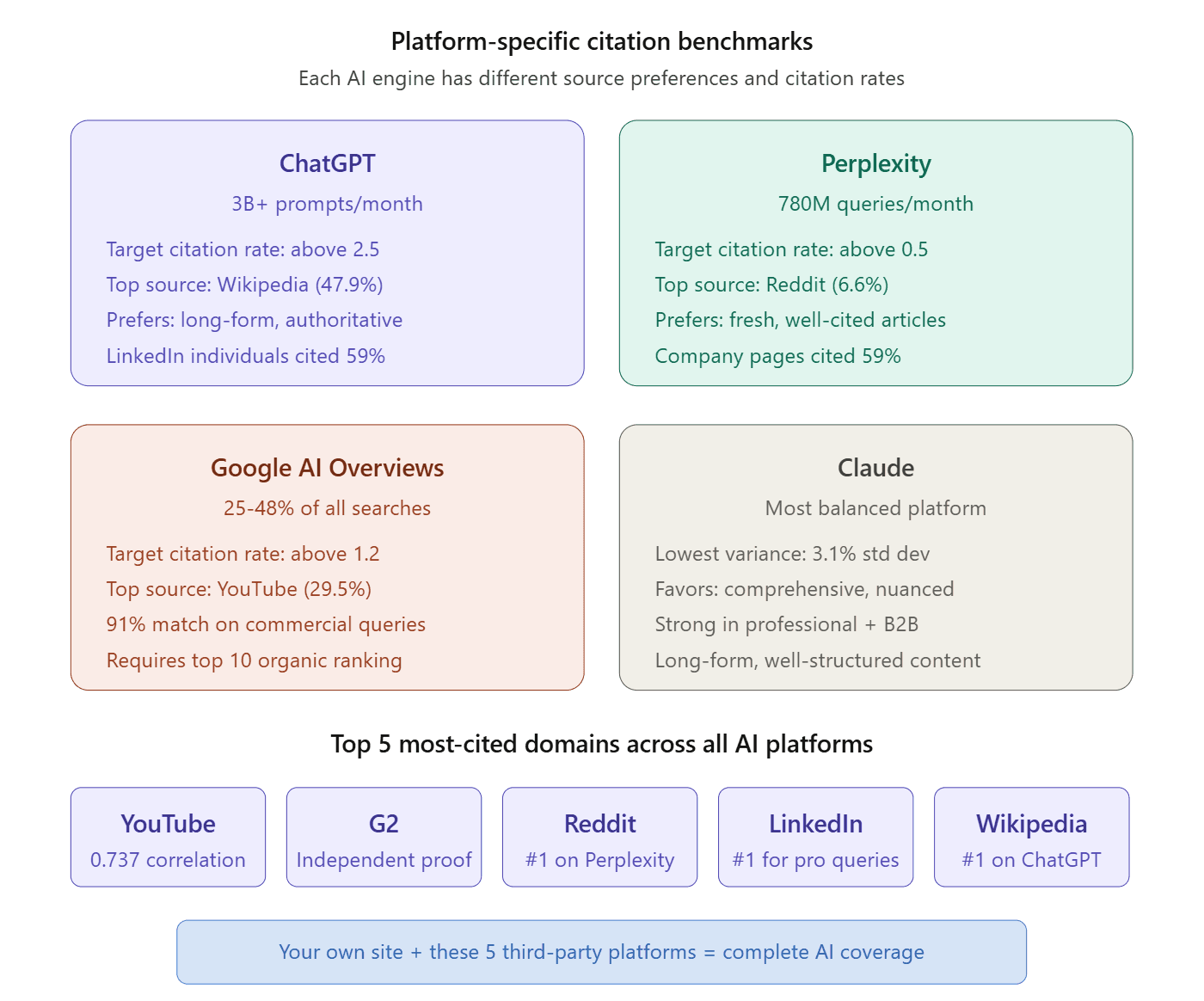
One of the biggest mistakes brands make is treating AI search as a single channel. Analysis of 680 million citations reveals that each platform has dramatically different source preferences.
ChatGPT
ChatGPT processes 3+ billion prompts monthly and has become the default research tool for many B2B and B2C buyers.
Citation behavior: ChatGPT favors authoritative long-form content and prefers direct sources over intermediaries. Wikipedia accounts for 47.9% of top-10 citations. Commercial (.com) domains represent 80%+ of all citations. ChatGPT performs strongly on informational queries (87% source match) but drops to 54% on transactional searches.
Strong citation rate benchmark: Average citation rate above 2.5 (meaning your domain is cited 2.5+ times per answer when it appears).
What ChatGPT values: Comprehensive coverage of a topic on a single URL, clear structural hierarchy with H2/H3 headings, specific data points with source attribution, and established domain authority. Listicle-format content ("Best X for Y") consistently outperforms single-product reviews.
Key insight for LinkedIn: ChatGPT Search cites LinkedIn content in 14.3% of responses. Individual member posts are cited 59% of the time vs. company pages 41%. Executive thought leadership on LinkedIn is a direct path to ChatGPT citations.
Perplexity
Perplexity processes approximately 780 million queries per month and is built specifically as a citation-first search engine.
Citation behavior: Perplexity is much more citation-heavy than other platforms, averaging 5+ citations per answer. Reddit is the dominant source (6.6% of total citations). Company pages are cited 59% of the time on Perplexity vs. individual contributors 41% (the inverse of ChatGPT).
Strong citation rate benchmark: Average citation rate above 0.5 (Perplexity is more conservative with explicit citations than other models).
What Perplexity values: Fresh, well-cited articles with research-backed claims. Question-based heading structure. Direct, factual answers over opinion pieces. A SaaS company saw 340% increase in Perplexity referrals after restructuring documentation with question-based headings.
Google AI Overviews and AI Mode
AI Overviews appear in approximately 25-48% of Google searches (varies by query type and industry).
Citation behavior: More distributed across source types than ChatGPT or Perplexity. YouTube is the #1 most cited domain at 29.5% of all AI Overview citations. Google AI performs well on commercial (91% match) and transactional (89% match) queries.
What Google AI values: Content already ranking in the top 10 organic positions. Strong E-E-A-T signals. Schema markup and structured data. Video content on YouTube as supporting evidence alongside text.
Claude
Claude's citation behavior shows the lowest variance across query types (3.1% standard deviation), making it the most balanced AI search platform.
What Claude values: Comprehensive, nuanced content. Long-form, well-structured articles. Strong E-E-A-T signals. Claude tends to favor content in professional and B2B contexts.
For tracking your citation performance across all these platforms in one dashboard, Passionfruit Labs runs prompts daily across ChatGPT, Perplexity, Gemini, and Claude and reports your AI Share of Voice alongside competitor benchmarks.
The Step-by-Step Source Gap Audit
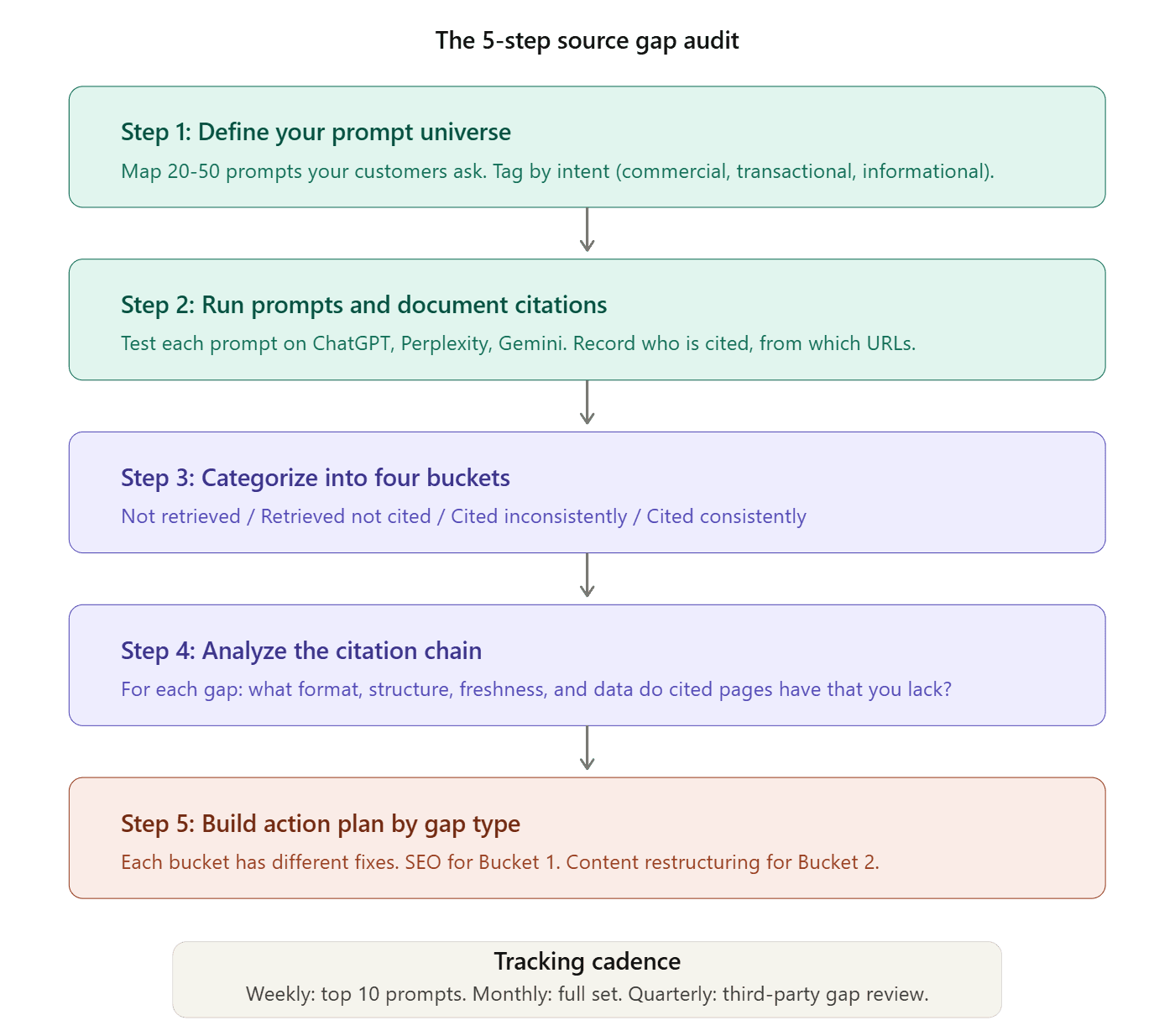
Step 1: Define your prompt universe (20-50 high-value prompts)
Start by mapping the questions your target customers ask AI about your product category. These are not keywords. They are full conversational prompts.
How to find them:
Ask your sales team: "What questions do prospects ask before they buy?" Convert each into a prompt format.
Search your category in ChatGPT, Perplexity, and Gemini. Document the exact prompts you test.
Tag each prompt by intent: informational, commercial, or transactional. Transactional and commercial prompts are highest priority because they represent active buying behavior.
Tag by topic category so you can analyze performance by product line or service area.
Example prompt set for a CRM company:
"What is the best CRM for small business?" (commercial)
"How do I choose a CRM for my sales team?" (informational)
"Compare HubSpot vs Salesforce for startups" (commercial)
"CRM software with email automation under $50/month" (transactional)
For the methodology behind identifying the sub-queries AI generates from these prompts, see our guide on keyword research for AI and SEO.
Step 2: Run each prompt and document citations
For each prompt in your set, run it on ChatGPT, Perplexity, and Google AI Mode (or Gemini). Document:
Which domains are cited in the answer?
Which specific URLs are cited?
Is your brand mentioned (with or without a link)?
What position is your mention in (first recommendation vs. listed third)?
What sentiment does the AI use when describing your brand?
Which competitors appear and in what positions?
This manual audit gives you the baseline. Passionfruit Labs automates this by running your prompts daily across all platforms and tracking changes over time. The "Prompts We Are Invisible On" report immediately shows you where competitors appear and you don't.
Step 3: Categorize each prompt into the four buckets
For each prompt, determine which bucket your content falls into:
Bucket 1 (not retrieved): Your domain does not appear in any of the AI's sources for this prompt. You need SEO fundamentals.
Bucket 2 (retrieved, never cited): Your domain appears in the source list but is never used in the answer. You need content restructuring.
Bucket 3 (cited inconsistently): You appear in some variations of the prompt but not others. You need citation rate optimization.
Bucket 4 (cited consistently): You appear reliably. Protect and expand.
Step 4: Analyze the citation chain for each gap
For Buckets 1-3, examine the pages that ARE being cited. Ask:
What content format are they using? (Listicle, comparison, deep guide, data report)
How is their content structured? (Clear H2/H3 hierarchy, direct answers first, FAQ sections)
How fresh is the content? (Publication date, last updated date)
What data or specifics do they include that you don't?
Are they cited from their own domain or from third-party sources (G2, Reddit, YouTube, LinkedIn)?
This analysis reveals the specific content attributes the AI values for each prompt. You are not guessing what to optimize. You are reverse-engineering what already works.
Step 5: Build your action plan by gap type
For Bucket 1 gaps (not retrieved):
Create content targeting the sub-queries the AI generates from the prompt
Build topic clusters around the category
Earn backlinks to build domain authority for the topic
Ensure AI crawlers are not blocked
For Bucket 2 gaps (retrieved, not cited):
Restructure existing content with direct answers in opening sentences
Add specific data points every 150-200 words
Implement structured data (schema markup)
Add clear H2 headings that match the questions AI users ask
For Bucket 3 gaps (inconsistently cited):
Compare your cited vs. uncited instances to find the pattern
Expand content to cover the specific sub-angles where you are missing
Convert single-topic pages into comprehensive listicles or comparison content
Add summary sections at the top of each page with key findings
For maintaining Bucket 4 (consistently cited):
Update content quarterly to maintain freshness
Monitor competitor content targeting the same prompts
Expand into adjacent prompt categories using the same structure
The Layer Most Brands Miss Entirely is The Third-Party Gap
Even if your own content is perfectly optimized, AI search engines evaluate whether independent sources validate your claims. If your competitors are reviewed on G2, discussed on Reddit, featured in YouTube tutorials, and cited in industry publications, but you are not, the AI has no consensus signal for your brand.
Analysis of 200 million+ citations reveals the top 10 most-cited domains across ChatGPT, Perplexity, Gemini, and Claude:
YouTube (strongest correlation with AI visibility: 0.737)
G2 (independent verification outweighs self-reported information)
Reddit (dominant on Perplexity at 6.6% of all citations)
LinkedIn (#2 most cited domain overall; #1 for professional queries)
Wikipedia
Industry-specific review aggregators
Major news publications
Technical documentation sites
Academic and research databases
Government (.gov) and educational (.edu) sources
The action plan for closing third-party gaps:
YouTube: Publish video content for your key topics. Even basic tutorials and thought leadership create a second citation candidate for the same query. YouTube mentions show the strongest correlation with AI visibility of any factor measured.
G2 / Capterra / review sites: Actively solicit customer reviews. These platforms are heavily cited for commercial and transactional queries.
Reddit: Contribute genuinely to relevant subreddits. Reddit is Perplexity's primary source and appears heavily in Google AI Overviews.
LinkedIn: Publish thought leadership from individual executives (ChatGPT and Google AI Mode prefer individual profiles) and structured content from your company page (Perplexity prefers company pages).
Industry publications: Earn mentions through digital PR, guest contributions, and original research that journalists reference.
For tracking which third-party sources cite your competitors but not you, see our guide on AI visibility benchmarking.
How to Track Source Gaps Over Time
Source gap analysis is not a one-time audit. AI models update continuously, and citation patterns shift as content is published, updated, and removed.
Automated tracking with Passionfruit Labs
Passionfruit Labs automates the entire source gap audit:
Daily prompt tracking across ChatGPT, Perplexity, Gemini, and Claude
"Prompts We Are Invisible On" report showing exactly where competitors are cited and you are not
AI Share of Voice tracking your citation percentage vs. competitors over time
Page-level citation tracking showing which specific URLs are being cited
Actionable content recommendations derived from your specific gaps ("Create a comparison page for X," "Get a backlink from Y publication")
Revenue attribution connecting AI citations to sessions, conversions, and revenue in GA4
Plans start at $19/month with unlimited competitor tracking. Start a 7-day free trial.
Manual monitoring cadence
If you are tracking manually, here is the minimum cadence:
Weekly: Run your top 10 highest-value commercial and transactional prompts across ChatGPT and Perplexity. Document citations and compare to previous week.
Monthly: Run your full prompt set (20-50 prompts) across all platforms. Update your bucket categorization. Identify new competitor content targeting your prompts.
Quarterly: Conduct a full third-party gap analysis. Check which external sources cite competitors but not you. Identify new review sites, forums, or publications to target.
Your Next Move
Pick 10 prompts your customers use when researching your product category. Run them in ChatGPT and Perplexity right now. For each prompt, document: are you cited? Are competitors cited? From which specific URLs?
The prompts where competitors appear and you do not are your highest-priority source gaps. Each one represents a customer asking for a recommendation and being sent to someone else.
Then start a free 7-day trial of Passionfruit Labs to automate daily tracking across every major AI platform. The "Prompts We Are Invisible On" report shows you exactly where to focus your optimization efforts, and the revenue attribution connects those efforts to actual business outcomes.
The brands winning in AI search are not the ones with the most content. They are the ones who understand which sources the AI trusts, where their gaps are, and how to close them systematically.
You cannot close a gap you cannot see. Source gap analysis makes the invisible visible.
FAQs
What is source gap analysis in AI search?
Source gap analysis is the process of identifying which URLs and domains AI search engines cite when answering prompts relevant to your business, and where your content is absent from that citation chain. It goes beyond traditional content gap analysis (which focuses on keyword coverage) to examine the retrieval, selection, and third-party verification layers that determine whether AI platforms cite your brand.
How is source gap analysis different from content gap analysis?
Content gap analysis compares keyword coverage between your site and competitors in Google organic results. Source gap analysis examines which specific pages AI platforms actually cite in their generated answers and why. A page can rank #1 on Google but never be cited by ChatGPT if its content structure, freshness, or entity density does not match what the AI values.
How often should I run a source gap analysis?
Weekly for your top 10 commercial prompts, monthly for your full prompt set, and quarterly for a comprehensive third-party gap review. AI models update continuously, and citation patterns shift as new content enters the web. Passionfruit Labs automates daily tracking to catch shifts in real time.
Why does my content rank on Google but not get cited by AI?
AI search engines evaluate different signals than Google's traditional algorithm. They prioritize content freshness (under 3 months old = 3x citation rate), structural clarity (direct answers in opening sentences), entity density (20.6% entity density in cited passages), and independent third-party validation (consensus across multiple sources). Your Google-ranking page may lack one or more of these attributes.
Which AI platform should I prioritize for source gap analysis?
Start with ChatGPT (3+ billion monthly prompts, highest volume) and Perplexity (780 million monthly queries, most citation-heavy). Add Google AI Mode if your customers are Google-first searchers. Only 11% of domains are cited by both ChatGPT and Google AI Overviews, so platform-specific optimization matters.
What is citation rate and what benchmarks should I aim for?
Citation rate measures how often your domain is cited per AI answer when it appears. Benchmarks vary by platform: ChatGPT above 2.5, Google AI Mode above 1.2, Perplexity above 0.5. A rate of 1.0 on ChatGPT means you are cited once per appearance, which is baseline. Content the AI truly values gets cited 2-3 times per answer.
How do third-party sources affect my AI citations?
AI search engines evaluate consensus across independent sources before citing a brand. If your competitors appear on G2, Reddit, YouTube, LinkedIn, and industry publications, the AI has multiple validation signals. If you only exist on your own website, the AI treats your claims with skepticism. YouTube shows the strongest correlation with AI visibility (0.737 correlation), followed by G2, Reddit, and LinkedIn.