SEO
Join 500+ brands growing with Passionfruit!
The median landing page converts at 6.6%. The top 10% convert above 11%. Here are the 10 optimization levers ranked by conversion impact, with benchmarks by industry and traffic source, plus how to optimize for the AI search traffic every other guide ignores.
The median landing page converts 6.6% of visitors. That means 93.4% of the people who click your ad, open your email, or follow your link leave without taking a single action.
For a company spending $10,000 per month on paid traffic, the difference between a 6.6% conversion rate and an 11% conversion rate is not a minor optimization. It is the difference between 660 leads and 1,100 leads from the same spend. That is 440 additional leads per month with zero additional ad budget.
Every other landing page guide tells you to "write a compelling headline" and "use social proof." This one tells you which specific elements produce the largest conversion lifts (with data), which common practices actually hurt conversions, and how to optimize your landing pages for the AI search traffic that is becoming a meaningful conversion channel. For the broader conversion strategy these pages support, see our guide on organic traffic vs. organic conversions.
What Is a Good Landing Page Conversion Rate in 2026?
Before optimizing anything, you need to know what "good" looks like for your specific situation. The 6.6% median is a starting point, not a target.
Landing page conversion rates by industry
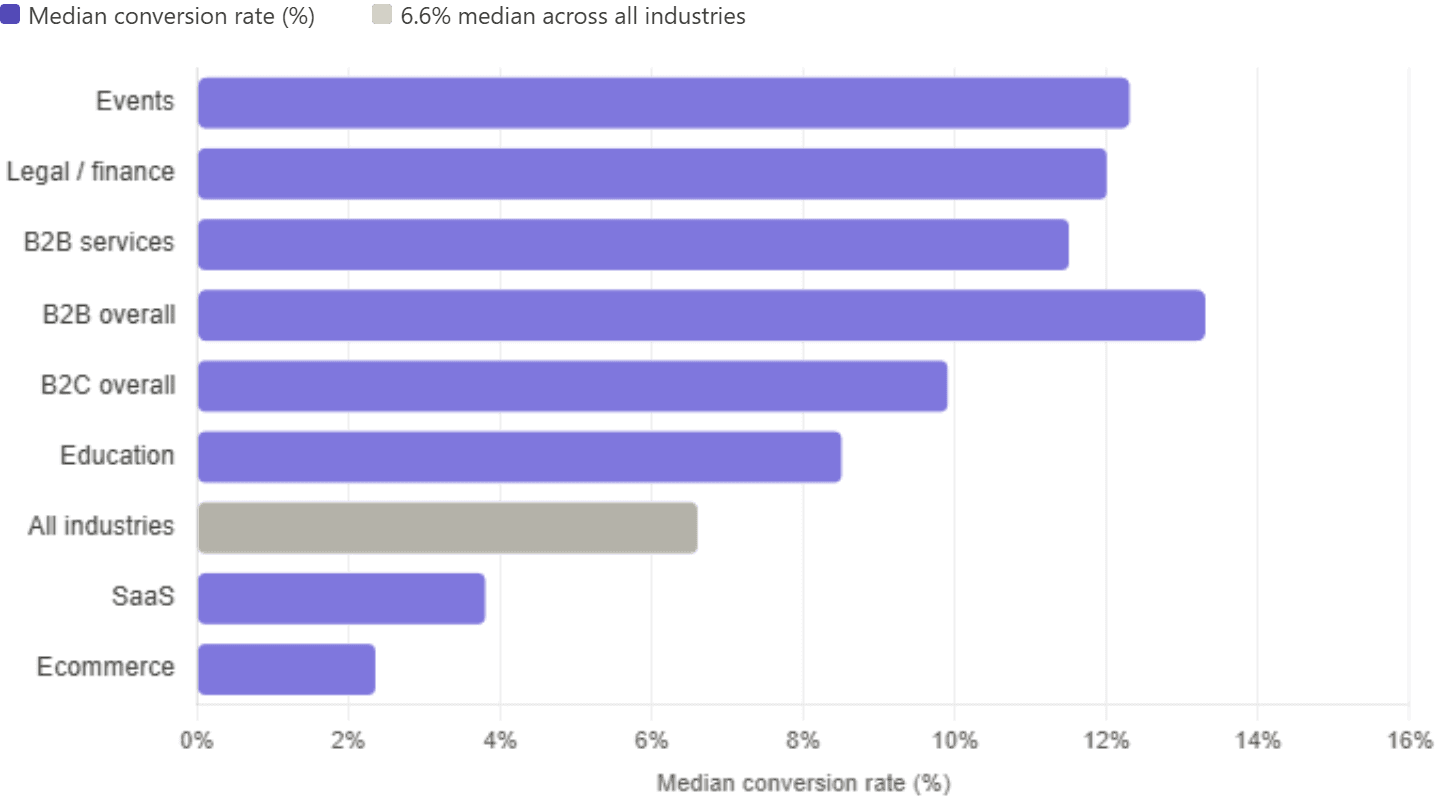
Conversion rates vary dramatically by industry because buyer intent, deal complexity, and risk tolerance differ:
Industry | Median conversion rate | What drives performance |
|---|---|---|
Events and entertainment | 12.3% | High urgency, clear value, low risk |
Legal and finance | 8.4-16% | High intent, trust-driven decisions |
B2B services and consulting | 9-14% | Case studies, demo offers, credibility |
Education | 7-10% | Information-seeking behavior, clear outcomes |
SaaS | 3.8% | Complex decisions, longer evaluation cycles |
Ecommerce (product pages) | 2.35% avg, top 10% above 10% | Price sensitivity, comparison shopping |
B2B overall | 13.3% | Decision-stage visitors, qualified traffic |
B2C overall | 9.9% | Broader audiences, varied intent levels |
Landing page conversion rates by traffic source
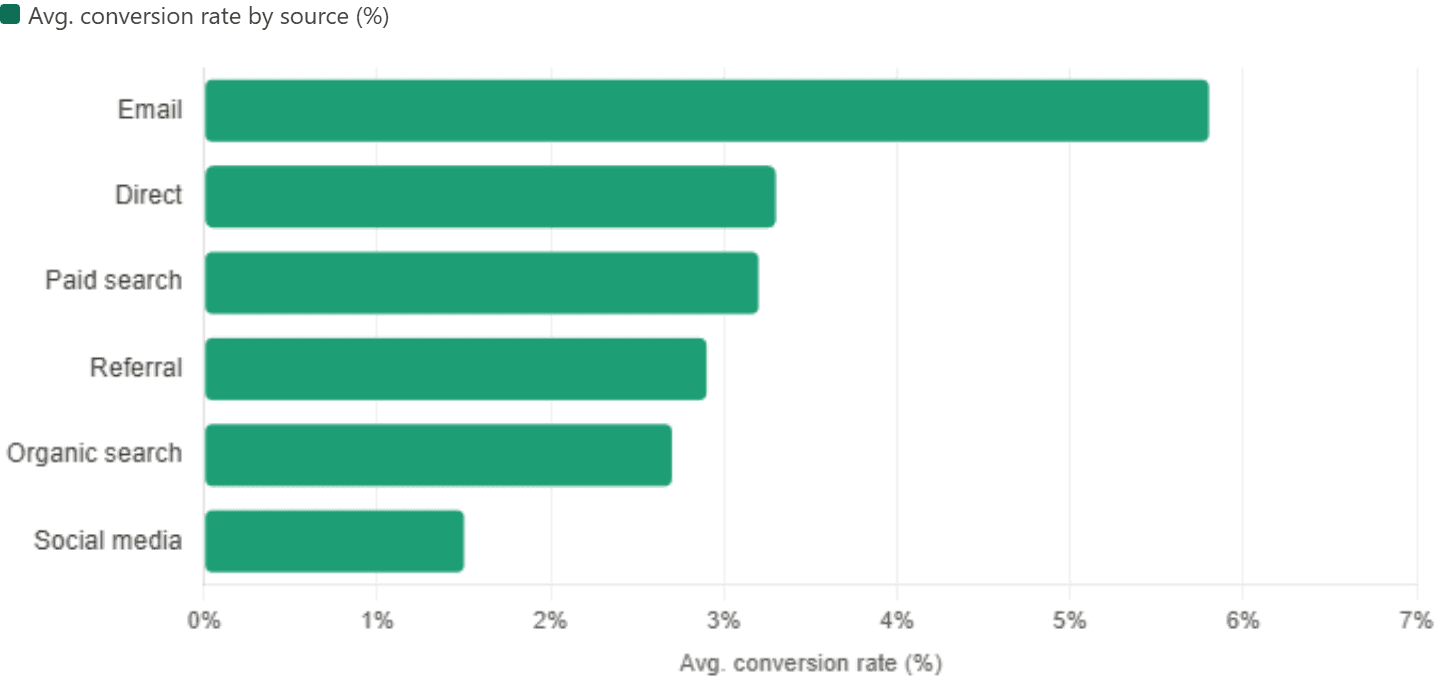
This is the data most guides omit, and it changes your optimization strategy entirely:
Traffic source | Avg. conversion rate | Why |
|---|---|---|
Highest (77% more than paid search) | Pre-qualified audience, existing relationship | |
Direct traffic | 3.3% | Brand-aware visitors, high intent |
Paid search | 3.2% | Active searchers, keyword-targeted |
Referral traffic | 2.9% | Third-party endorsement, variable intent |
Organic search | 2.7% | Mixed intent, research-phase visitors |
Social media | 1.5% | Browsing behavior, low purchase intent |
The strategic implication: Your landing page should be optimized differently depending on its primary traffic source. A page receiving email traffic can afford a longer form and higher-commitment CTA because the audience already knows you. A page receiving social media traffic needs to work much harder on trust signals and low-friction entry points because visitors have weak intent.
For understanding how AI search traffic (from ChatGPT, Perplexity, Gemini) converts relative to these sources, see our guide on tracking AI referral traffic in GA4.
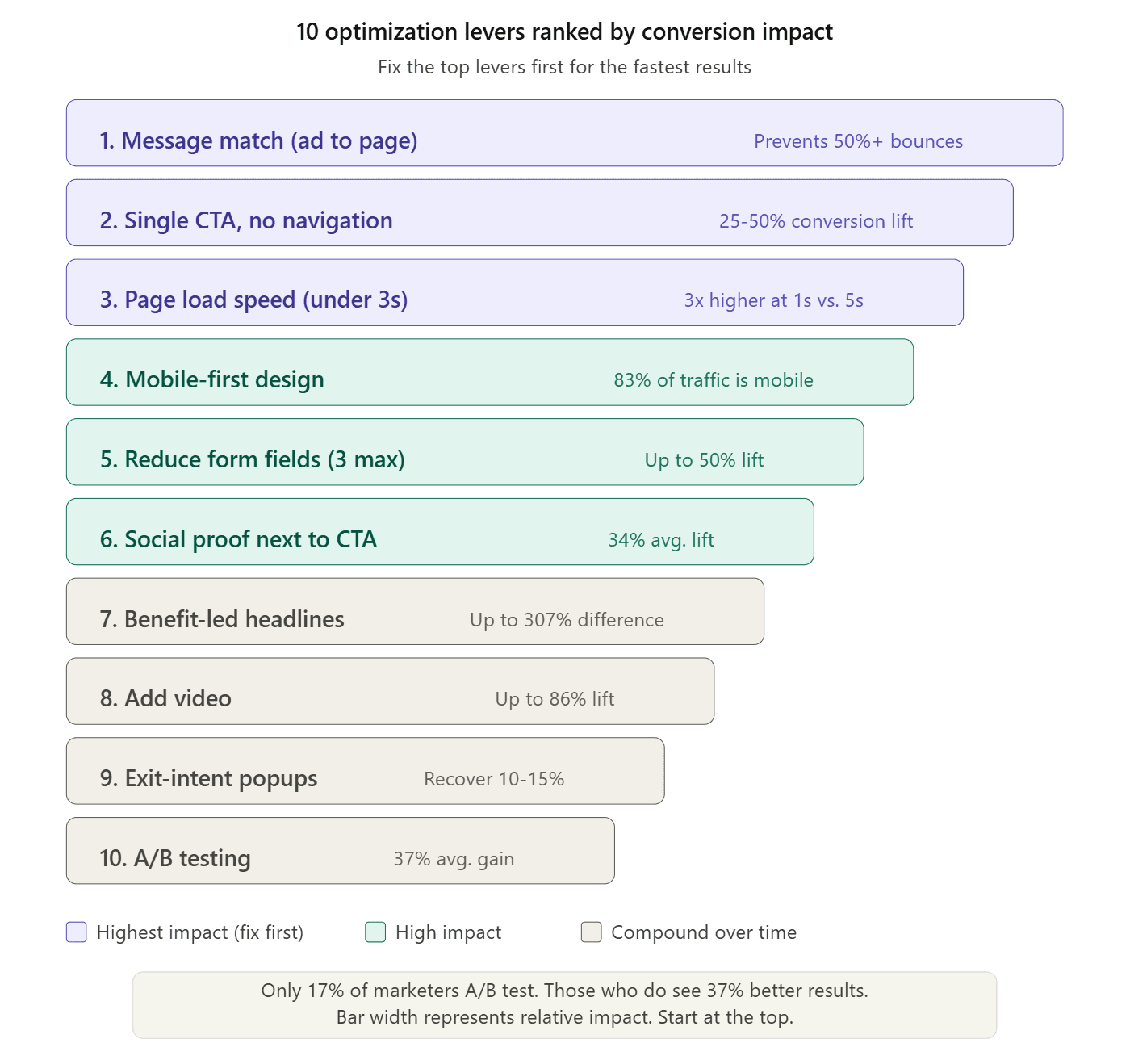
How to Increase Landing Page Conversion Rates: 10 Levers Ranked by Impact
Every guide lists "best practices." This one ranks them by measured conversion impact so you know what to fix first.
1. Match your landing page message to your ad copy
The #1 reason landing pages fail is that the page does not match what the ad promised. If someone clicks an ad for "free CRM trial for small business" and lands on a generic product page covering enterprise features, they bounce instantly.
What to do:
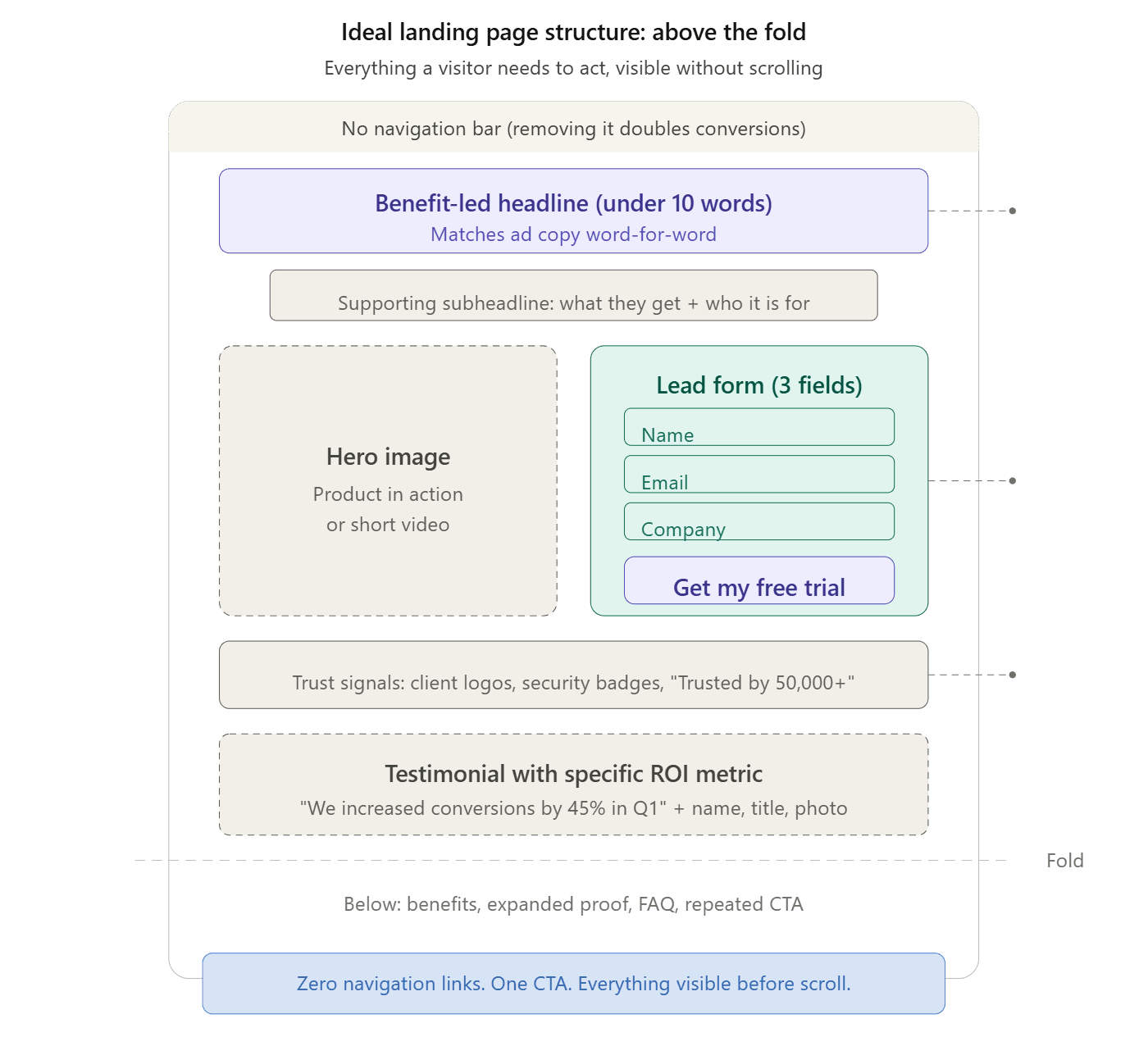
Match your landing page headline word-for-word to your ad headline. If your Google Ad says "Get 50% Off Winter Coats," your landing page headline says "Get 50% Off Winter Coats." Not "Shop Our Winter Collection."
Use Dynamic Text Replacement (available in Unbounce, Instapage, and most landing page builders) to automatically swap headline text based on the search query or ad that drove the click.
Create separate landing pages for each major ad group or campaign. Companies with 40+ landing pages generate 500% more conversions than those with fewer than 10.
2. Use one CTA per page and remove all navigation
Every link, button, or navigation element that does not serve your primary conversion goal is a leak. Landing pages with multiple CTAs create decision paralysis.
What to do:
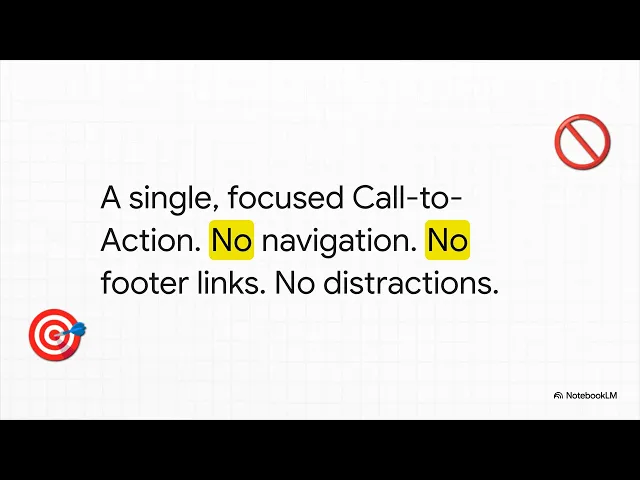
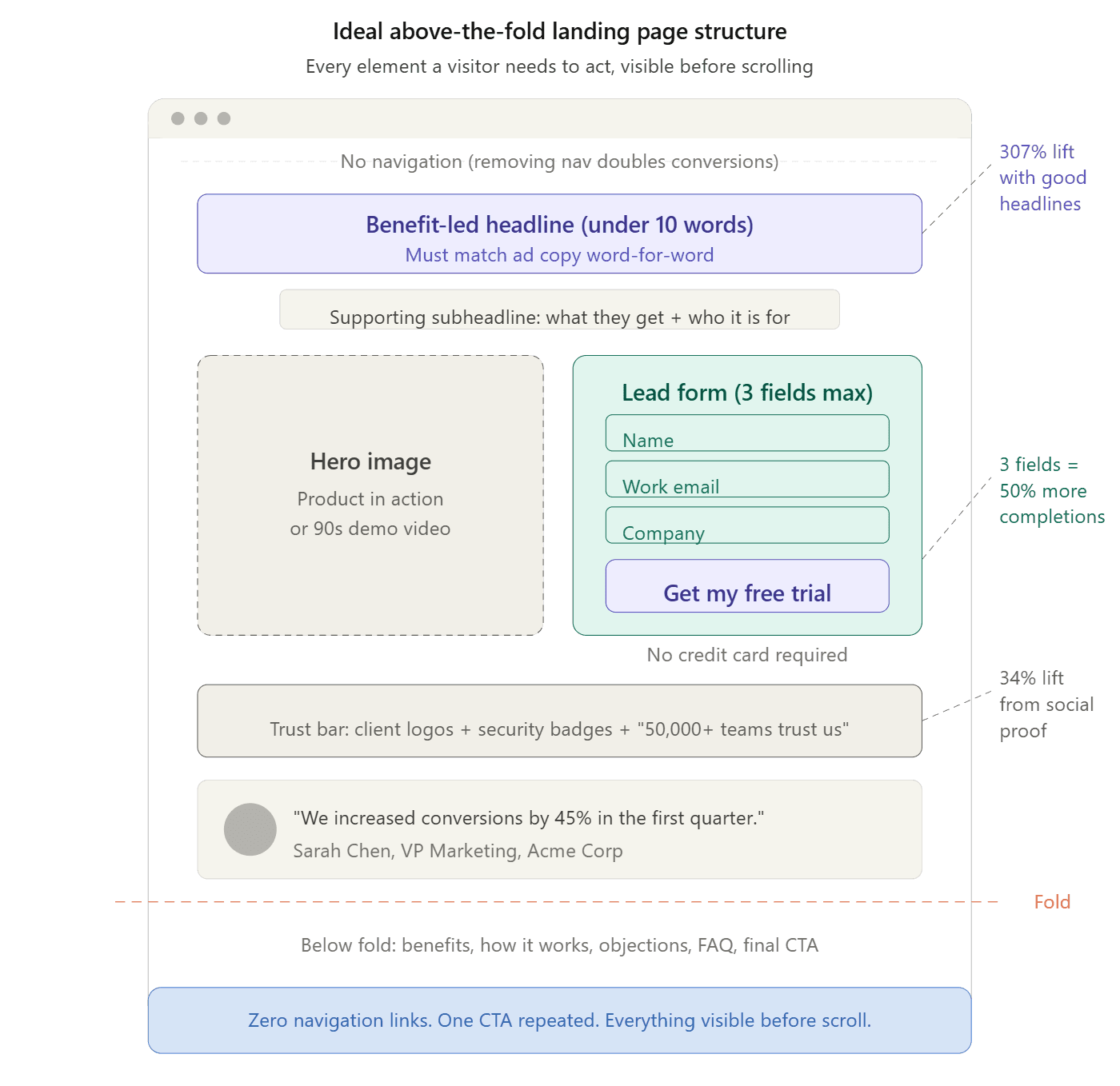
Remove all site navigation from your landing page. No header menu. No footer links. No "About Us" or "Blog" links.
Use exactly one CTA per page. Repeat it in multiple locations (above the fold, after the value proposition, after social proof, at the bottom), but make it the same action every time.
Use action-oriented, first-person CTA copy. "Get My Free Trial" outperforms "Submit" or "Sign Up." "Start My Audit" outperforms "Request Information." The first person ("My") creates ownership.
3. Improve landing page load speed
70% of consumers say loading time influences their purchase decisions. Pages loading in 1 second convert 3x higher than pages loading in 5 seconds. And 30% of users abandon a page that takes longer than 6 seconds.
What to do:
Test your page speed using Google PageSpeed Insights. Target a Largest Contentful Paint (LCP) under 2.5 seconds and a Cumulative Layout Shift (CLS) under 0.1.
Compress all images to under 100KB using WebP format. Use lazy loading for images below the fold.
Remove every third-party script that does not directly contribute to conversion. Each tracking pixel, chat widget, and analytics tool adds load time.
Consider AMP (Accelerated Mobile Pages) for paid search landing pages where speed is critical.
4. Design for mobile first
83% of all landing page traffic comes from mobile devices. Dynamic landing pages convert 25.2% more mobile users than static ones. If your page looks great on desktop but breaks on mobile, you are optimizing for 17% of your audience.
What to do:
Design mobile-first, then adapt for desktop. Not the other way around.
Make CTA buttons at least 44px tall and full-width on mobile. Fingers are not mouse cursors.
Keep forms to 3 fields maximum on mobile. Each additional field on a small screen increases abandonment disproportionately.
Test your page on actual mobile devices, not just browser responsive mode. Real-device behavior differs from simulated responsive views.
5. Reduce the number of form fields
Reducing form fields from four to three boosts conversion rates by up to 50%. The most effective three-field combination is first name, email, and one qualifying question (company name for B2B, or product interest for B2C).
What to do:
Audit every form field. For each one, ask: "Do we absolutely need this information before the first conversation?" If not, collect it later through progressive profiling.
Use multi-step forms for longer information requirements. Breaking a 10-field form into three steps of 3-4 fields each leverages the Zeigarnik effect: people are more likely to complete a process they have already started.
Add real-time validation (green checkmarks for valid entries, inline error messages) to reduce form frustration.
Never use placeholder text as the only field label. When users start typing, the label disappears and they forget what the field asked for.
For how form optimization connects to your broader lead generation strategy, see our guide on gated content for lead generation.
6. Place social proof next to your CTA
92% of consumers read testimonials when considering a purchase. Customer testimonials increase conversions by 34% on average. Displaying reviews can boost conversions by up to 270% for considered purchases.
What to do:
Place your strongest testimonial directly adjacent to your CTA button. This provides reassurance at the exact moment of decision.
Use specific, quantifiable testimonials. "We increased our lead conversion rate by 45% in the first quarter" outperforms "Great product, highly recommend" by 2-3x.
Include full attribution: real name, job title, company name, and photo. Anonymous testimonials are worth almost nothing.
For ecommerce, display payment security badges (SSL, Visa, PayPal logos) near the checkout form. For B2B, display client logos and industry certifications above the fold.
Video testimonials outperform text by 80-86%, but only when they match audience preferences. Test before committing to video production.
7. Write benefit-led headlines that pass the 3-second test
A well-written headline can produce a 307% increase in conversions. Your headline must answer two questions in under 3 seconds: "What is this?" and "What do I get?"
What to do:
Lead with the outcome, not the feature. "Save 10 Hours a Week on Reporting" is a benefit. "AI-Powered Analytics Dashboard" is a feature.
Match the reading level to your audience. Landing pages written at a 6th-grade reading level convert highest across most industries. Simpler language is not less professional. It is more accessible.
A/B test your headline before anything else. The headline has more impact on conversion than any other single element.
8. Add video to your landing page
Landing pages with video can see conversion rates increase by over 80%. Video helps users retain 95% of the message compared to 10% from text alone.
What to do:
Keep videos under 90 seconds. Engagement drops sharply after that.
Do not autoplay with sound. This drives users away and violates Google's page experience guidelines.
Place videos near the top of the page but do not let them replace your headline and CTA. The video supports the page. It is not the page.
For product demos, show the product solving the user's problem in the first 10 seconds.
9. Use exit-intent popups to recover lost visitors
Nearly half of all landing page visitors leave without interacting with anything. Exit-intent popups, when done well, recover a meaningful percentage of these lost visitors.
What to do:
Trigger exit-intent popups only when the user's cursor moves toward the browser close button (desktop) or after 30+ seconds of inactivity (mobile).
Offer something different from the main page CTA. If the page offers a demo, the exit popup might offer a downloadable guide. This catches visitors who wanted value but were not ready for the primary commitment.
Use countdown timers or limited availability messaging only when genuinely true. Fake scarcity damages brand credibility.
10. A/B test your landing pages continuously
Only 17% of marketers actively A/B test their landing pages. Those who do see a 37% average improvement in conversion rates. This is the single largest gap between high-performing and average marketing teams.
What to do:
Test one element at a time. Changing the headline, image, and CTA simultaneously tells you nothing about which change drove the result.
Run tests until you reach 95% statistical significance. Stopping early because one variant "looks like it's winning" leads to false conclusions.
Prioritize tests by potential impact: headline first, then CTA copy, then form fields, then layout, then images. This sequence reflects the typical impact hierarchy.
Document every test result (including failures) in a shared testing log. Institutional knowledge of what works for your specific audience compounds over time.
How to Optimize Landing Pages for AI Search Traffic (ChatGPT, Perplexity, Gemini)
This is the section no other landing page guide includes. AI search engines are sending an increasing volume of referral traffic, and this traffic behaves differently from Google organic or paid search.
How AI referral traffic differs:
Visitors arrive with higher context because the AI has already pre-qualified their intent through the conversational exchange.
They expect the page to match the specific recommendation the AI provided. If ChatGPT says "Brand X offers the best free trial for small business CRM," and your landing page does not immediately confirm that, you lose the visitor.
AI referral traffic converts at comparable or higher rates than organic search traffic because the AI endorsement carries implicit trust.
How to optimize for AI referral visitors:
Ensure your landing page content matches the claims AI makes about you. If AI search engines describe your product in specific terms, your landing page should use the same language.
Include clear, direct answers to the questions AI users ask. AI visitors often arrive after asking a specific question. Your page should answer that question within the first screen.
Add structured data and schema markup to help AI crawlers understand your page content. Product schema, FAQ schema, and Offer schema increase the probability that AI systems recommend your page accurately.
Track AI referral traffic separately in GA4. Set up a custom channel group for AI sources (chat.openai.com, perplexity.ai, gemini.google.com, claude.ai) and compare their conversion rates against other traffic sources. For the full setup, see our GA4 guide for AI traffic.
For ensuring your brand gets recommended by AI search engines in the first place, see our complete GEO guide.
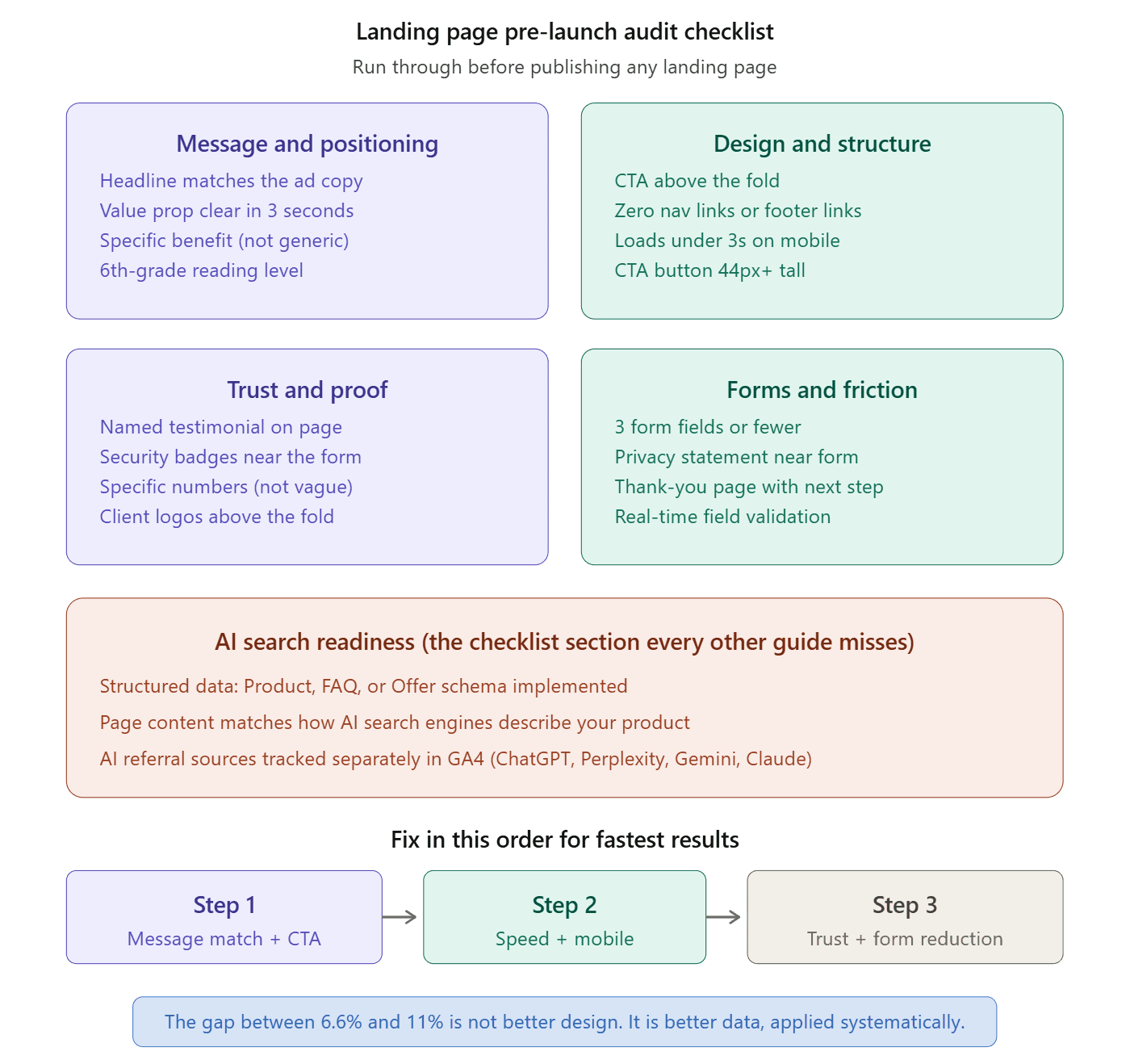
Landing Page Optimization Checklist (Pre-Launch Audit)
Run through this checklist before publishing any landing page:
Message and positioning:
Does the headline match the ad or link that drives traffic to this page?
Can a stranger read the headline and know exactly what you offer within 3 seconds?
Is the value proposition specific (not "We help businesses grow" but "We reduce your reporting time by 10 hours per week")?
Design and structure:
Is the CTA visible above the fold without scrolling?
Are there zero navigation links, footer links, or competing CTAs?
Does the page load in under 3 seconds on mobile?
Is the CTA button at least 44px tall on mobile?
Trust and proof:
Is there at least one specific, attributed testimonial on the page?
Are security badges or trust signals placed near the form?
Does the page include quantifiable proof (numbers, metrics, case study data)?
Forms and friction:
Does the form use 3 fields or fewer (unless the offer justifies more)?
Is there a clear privacy statement near the form?
Does the thank-you page confirm submission and provide next steps?
AI search readiness:
Does the page include structured data (Product, FAQ, or Offer schema)?
Does the page content match how AI search engines describe your product?
Are AI referral sources being tracked separately in GA4?
Frequently Asked Questions
What is a good landing page conversion rate in 2026?
The median across all industries is 6.6%. A "good" rate is 10%+. The top 10% of landing pages convert above 11%. But these numbers vary significantly by industry: events and entertainment average 12.3%, while SaaS averages 3.8%. Always benchmark against your specific industry and traffic source, not the global average.
How many landing pages should a company have?
Companies with 40+ landing pages generate 500% more conversions than those with fewer than 10. Each landing page enables a targeted value proposition for a specific audience, offer, or campaign. Create separate pages for each major ad group, audience segment, and offer type rather than sending all traffic to a single page.
What is the biggest conversion killer on landing pages?
Message mismatch between the ad and the landing page. When visitors click an ad promising one thing and land on a page delivering something different, bounce rates spike above 70%. The second biggest killer is page load speed: pages taking more than 5 seconds to load lose 3x more visitors than pages loading in 1 second.
How many form fields should a landing page have?
Three fields is the optimal starting point (name, email, and one qualifying question). Reducing from four to three fields can increase conversion rates by up to 50%. For higher-commitment offers (demos, consultations), use multi-step forms that break longer information requirements into 2-3 steps of 3-4 fields each.
Does video on landing pages increase conversions?
Yes, video can increase conversion rates by up to 86%, and users retain 95% of a video message vs. 10% from text. Keep videos under 90 seconds, never autoplay with sound, and place them near the top of the page without replacing the headline and CTA. Test video vs. no-video before investing in production.
How does AI search traffic behave on landing pages?
AI referral traffic arrives with higher context and pre-qualified intent because the AI has already filtered the user's needs through conversation. These visitors expect the page to match the specific recommendation the AI provided. Track AI referral traffic separately in GA4 and compare its conversion rate against other sources. Most brands find AI traffic converts at comparable or higher rates than organic search.
Should landing pages be optimized for SEO?
Landing pages designed for paid traffic should prioritize conversion over SEO. Landing pages receiving organic traffic need to balance both: target specific keywords in the title and meta description, but keep the page focused on a single conversion goal. For pages serving both paid and organic traffic, consider creating separate versions optimized for each channel.
Your Next Move
Open your highest-traffic landing page right now. Check three things: does the headline match the primary ad driving traffic to it? Does the page load in under 3 seconds on mobile? Is there one and only one CTA?
If any of those answers is "no," you have found your highest-impact optimization opportunity. Fix it before testing anything else.
Then set up the AI referral tracking in GA4 so you can see how the growing volume of AI search traffic behaves on your pages. This traffic source is invisible to most marketing teams, and the brands tracking it now are building a data advantage that compounds over time.
If you need expert help optimizing landing pages, conversion funnels, or AI search visibility, Passionfruit's team works with SaaS and ecommerce brands on exactly these challenges. See our case studies for measurable results.
The difference between 6.6% and 11% is not better design. It is better data, applied systematically, to every element that touches the visitor's decision.