The Data on YouTube and AI Search
A Quick Note on How to Read This Research
Two metrics show up throughout this report. They sound similar but measure very different things. Here's what each one means and why the difference matters.
Presence rate answers: "Did YouTube show up at all?"
If you ask Perplexity 100 questions and YouTube appears somewhere in 40 of those answers, the presence rate is 40%. It doesn't matter whether the answer included 1 YouTube link or 15. If at least one YouTube URL was in the response, it counts.
Think of it like shelf space. Presence rate tells you whether YouTube made it onto the shelf.
Citation share answers: In Answer Engine Optimization (AEO), citation share (often referred to as citation frequency or share of voice within AI answers) is a critical metric measuring how often your brand, domain, or content is cited as a source by AI-powered search engines such as ChatGPT, Perplexity, and Google AI Overviews across a specific set of relevant, targeted prompts.
It represents the percentage of AI-generated responses that reference your brand compared to your competitors, serving as a primary indicator of authority and visibility in the “zero-click” era.
Perplexity has a YouTube presence in 39.5% of its answers. ChatGPT cites it at 6.7%. Claude never cites it at all. Same queries, same month, completely different citation behavior.
Over the last seven months, we at Passionfruit tracked 21 million AI answers to understand how each engine treats YouTube as an evidence source. The gap between platforms is not marginal. There is a 40× difference between platforms that changes strategy depending on where your audience searches.
The question is no longer if YouTube matters in AI search. It is which platforms use it, which queries trigger it, and which industries benefit most.
Long-Form Videos Work and Shorts Are Excluded
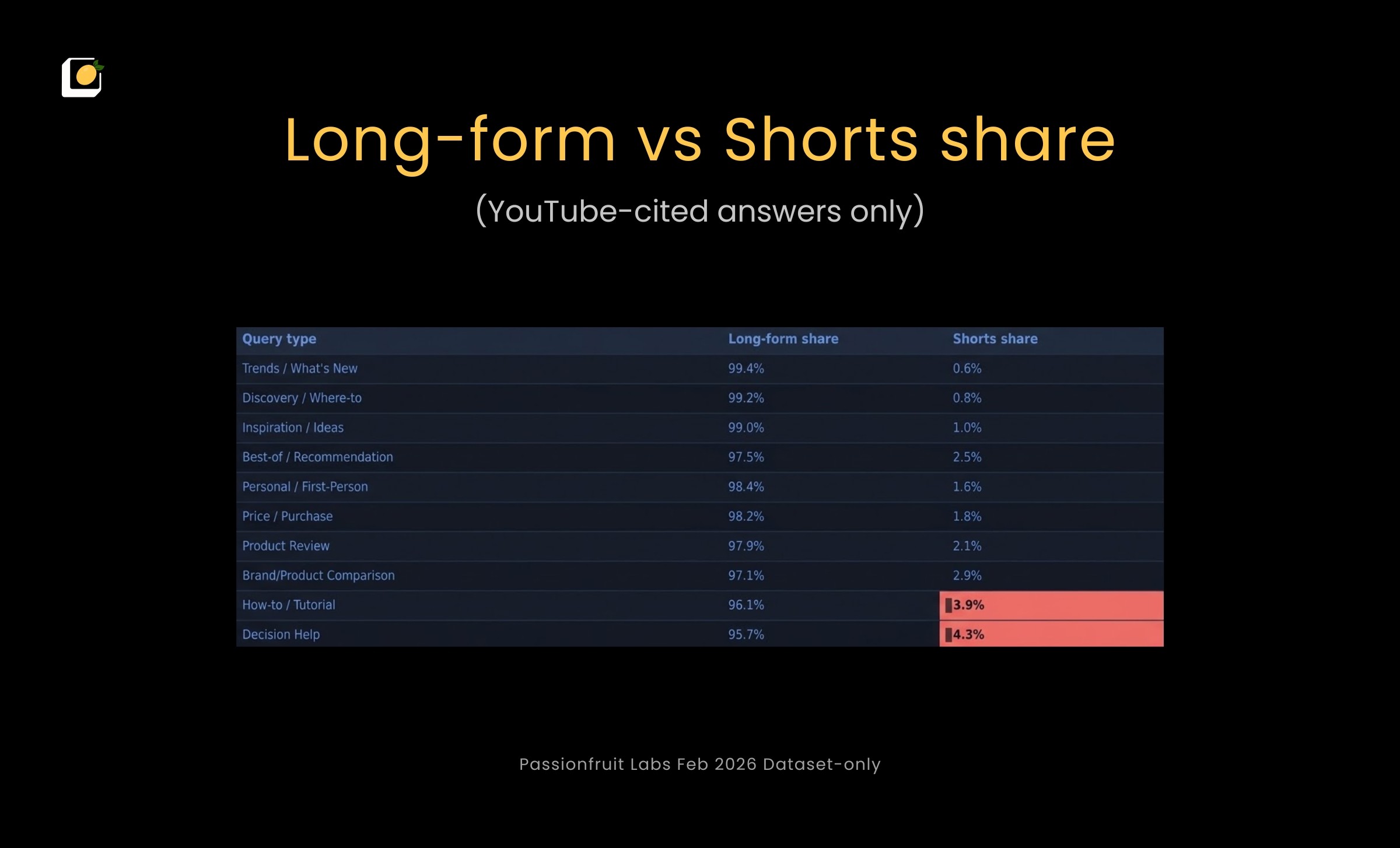
97.2% of all answers have long-form videos present in answers. Shorts capture 2.8% (average count across industries). This holds across every platform, every query type, and every industry in the dataset.
This is not a quality gap; it's architectural. AI retrieval systems need depth, structure, and extractable claims to build answers. Long-form videos provide these. Shorts cannot.
The highest Shorts penetration in any single query category is 4.3% (Decision Help). Across every category we analyzed, long-form video consistently outperforms Shorts for AI answers. Every dollar allocated to Shorts for AI search visibility performs better when redirected to long-form.
What Gets Cited: Profiling the YouTube Videos AI Actually Sources
We analysed every cited YouTube video with its metadata duration, view count, upload date, channel, and category, then measured which attributes predict whether AI cites a video once or returns to it across multiple queries.
View Count Is Not a Ranking Signal (Context is)
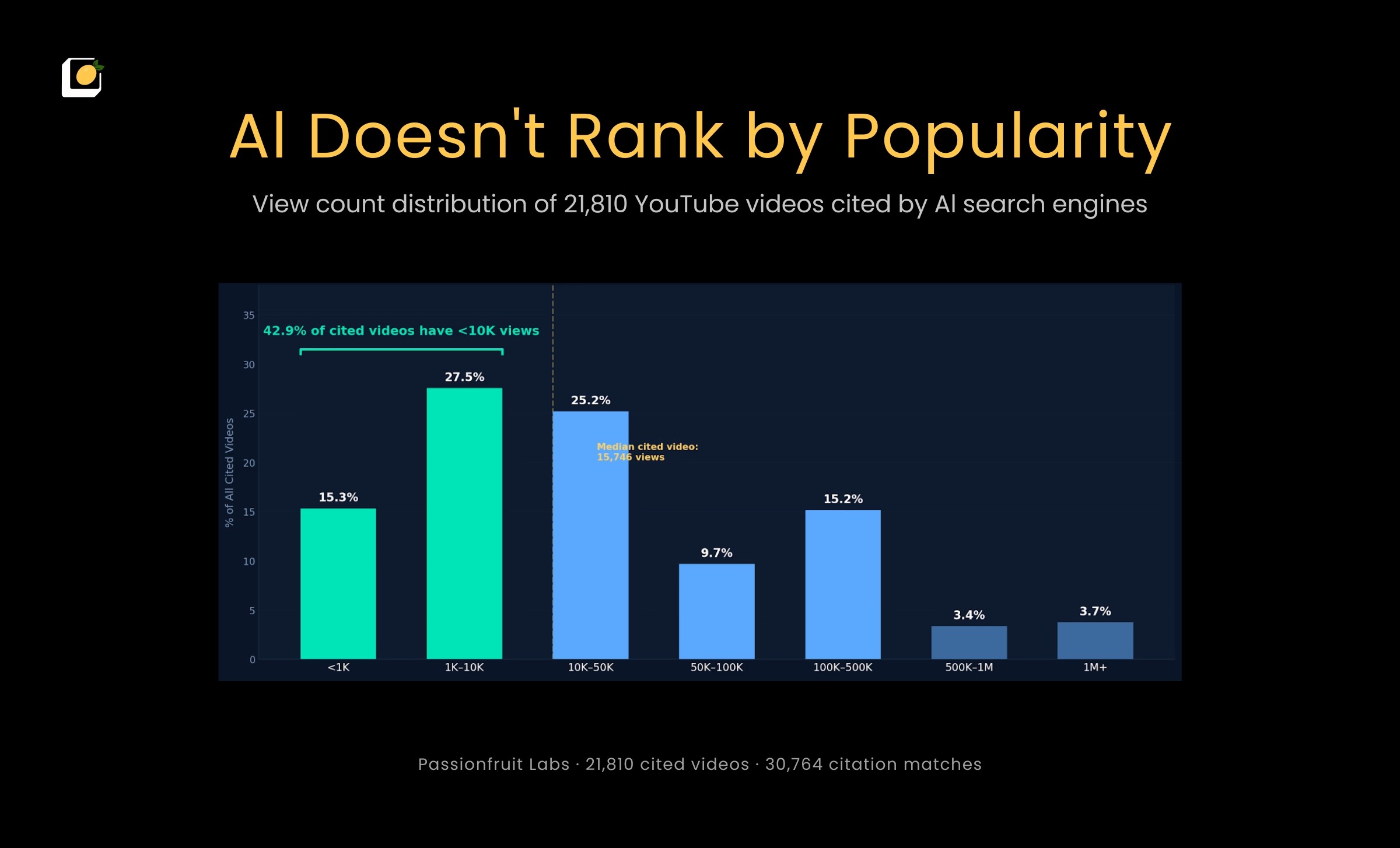
The median cited video has 15,746 views. The bottom quartile sits at 2,546.
42.9% of all videos AI cited had fewer than 10,000 views. Higher view counts do offer a slight edge, but videos above 100K appear across more query types (23.7% multi-prompt rate vs 13.7% for under 10K), and the gap is far smaller than any other distribution in digital marketing. A video with 8,000 views competes for the same answer slot as one with 500,000.
One channel, Savage Reviews, earned 170 citations from 6 videos averaging 3,055 views each. AI doesn't sort by popularity. It matches the content to the query.
10–20 Minutes Is the Citation Sweet Spot
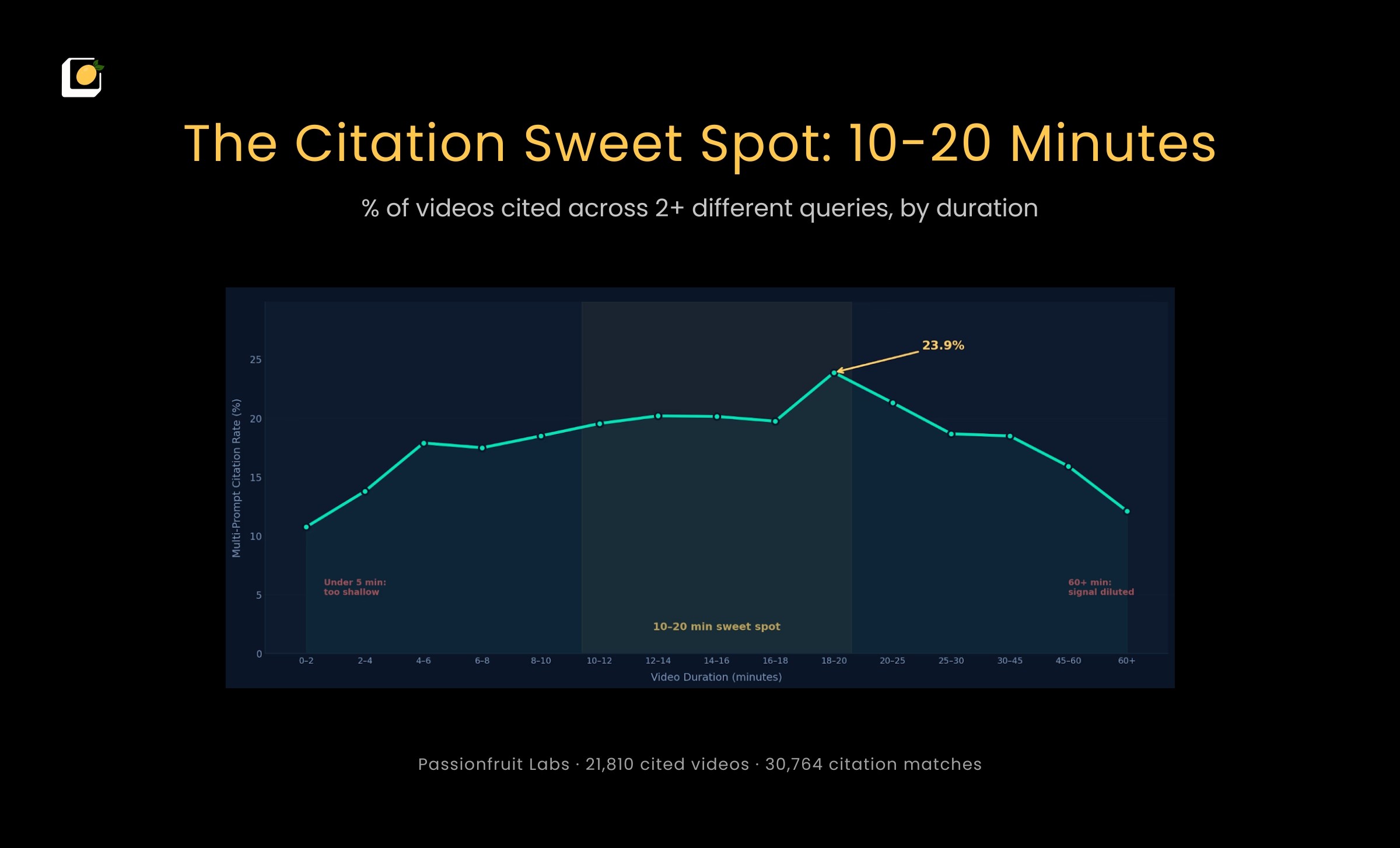
Under 5 minutes doesn't give AI enough to extract. Over 60 dilutes the signal with filler. Both ends perform at roughly the same low rate. The production target for your video to show up is 10–20 minutes. Long enough for depth, short enough that every minute carries information.
AI Has a Freshness Bias
If a video only shows up when someone asks "best kitchen chimney in India," that's a single-prompt citation. It answered one question.
If the same video shows up when someone asks "best kitchen chimney in India," and "faber vs elica chimney," and "how to clean kitchen chimney," that's a multi-prompt citation. AI keeps returning to it across different questions because it treats that video as a reliable source for the topic, not just one query.
So when the finding says:
2025+ videos: 21.8% multi-prompt rate → roughly 1 in 5 recent videos get cited across multiple different queries
Pre-2025 videos: 14.7% multi-prompt rate → roughly 1 in 7 older videos do
The gap means AI is more likely to treat a fresh video as a reusable source than an older one, even if the older video has more views and more time to accumulate authority. Recency makes a video stickier across the topic, not just within one answer.
Some Video Titles Get Cited Across More Queries Than Others
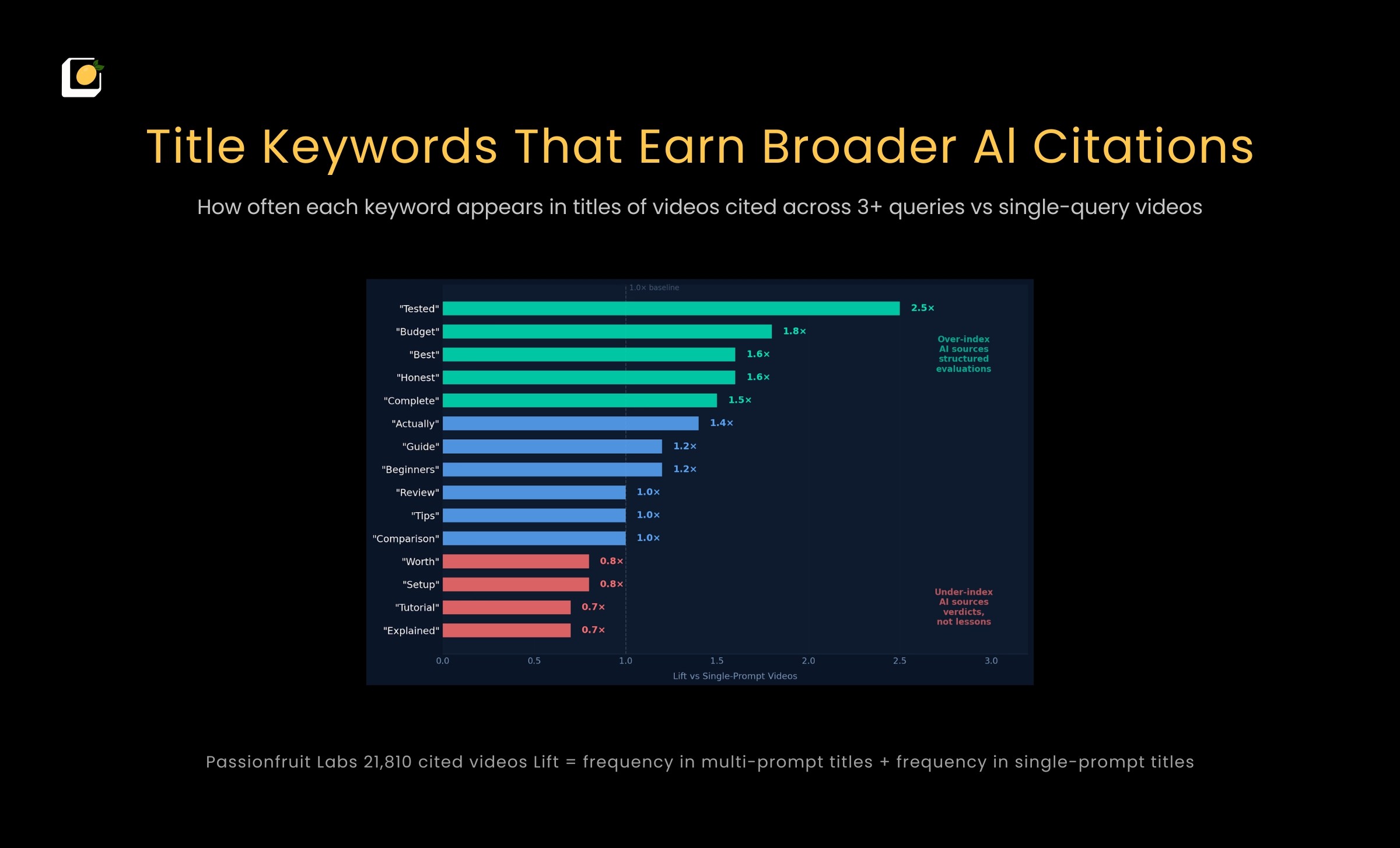
We compared the titles of videos AI cited across 3+ different queries against videos cited only once. Three keywords showed up significantly more often in the multi-query titles:
Videos titled "Tutorial" or "Explained" are actually less likely to get cited across multiple queries. Videos titled "Tested," "Budget," or "Best" are more likely. AI prefers content that evaluates and compares products over content that teaches how to use them.
Channel Authority Is Distributed
The top 10 most-cited YouTube channels account for just 4.2% of all AI citations in the dataset. The top 100 account for 15.6%. 73% of channels that received any citation at all were cited for only one video.
The channels that do earn repeated citations share one trait: niche depth within a single topic. The most-cited channel in the dataset, The Yoga Institute, had 91 of its videos cited across different AI queries, all covering the same subject. In AI search, topical depth beats channel size. A brand publishing 5 focused videos in its product category can match the citation footprint of a creator with 100× the subscribers.
YouTube's Role in AI Answers and What You're Actually Competing For
Across every platform, YouTube citation share is under 5% for any given response. It's one source sitting alongside dozens of articles, product pages, and documentation. A brand's video doesn't replace other content in an AI answer. It earns a slot alongside it.
What changes by platform is how crowded that slot or answer is.
On Gemini and ChatGPT, the YouTube citation slot is small. Two-thirds of the time, these platforms cite YouTube; they cite three or fewer videos. 37–40% of the time, they give exactly one YouTube video. If your video gets in, it faces minimal competition from other video sources in that answer.
On Perplexity, the dynamic is different. Only 23% of YouTube-containing answers feature a single video. 35% include eleven or more. Perplexity builds video evidence stacks, which means brands earning consistent visibility need multiple videos across related queries, not one hero video optimized for a single keyword.
This is the strategic split most teams miss. On Gemini, one well-structured long-form video can capture the video citation for an entire query category. On Perplexity, you need a content cluster of three to five videos covering different angles of the same topic to hold presence across the answers it builds.
How Often Each Platform Refers to YouTube
Each platform has a fundamentally different relationship with YouTube. We tracked how often each AI platform cited at least one YouTube video in its answer, monthly, from August 2025 to February 2026. The trajectories are not converging toward a single behavior; they reveal four distinct approaches to video as evidence.
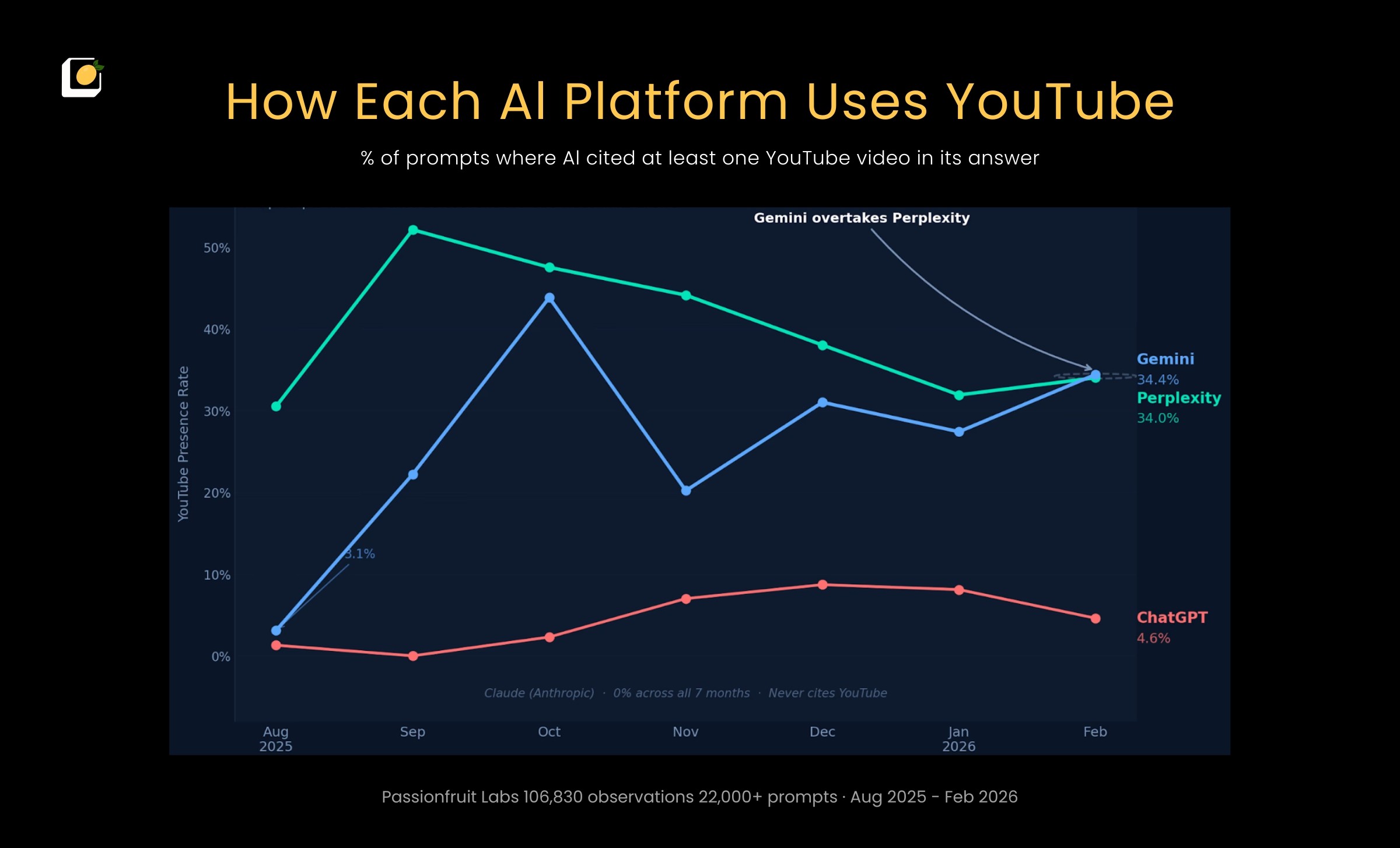
YouTube presence rate (% of answers with ≥1 YouTube video), monthly
The four platforms have fundamentally different relationships with YouTube:
The four platforms treat YouTube as fundamentally different types of evidence sources.
Platform | YT Presence Rate | YT Citation Share | Typical Depth |
Perplexity | 39.5% | 4.10% | 5 videos (median) |
Gemini | 29.9% | 2.40% | 2 videos (median) |
ChatGPT | 6.7% | 0.57% | 2 videos (median) |
Claude | 0.0% | 0.0% | — |
Perplexity uses YouTube the most. Nearly 4 in 10 answers include at least one YouTube video, and it typically pulls in multiple videos per answer, a median of 5, sometimes dozens. When someone asks about a specific brand, that presence jumps to 86.7%.
Gemini is catching up fast. Seven months ago, it rarely cited YouTube (3.1% of answers). By February 2026, it matched Perplexity at 34.4%. Gemini went from ignoring YouTube to treating it as a standard source in less than a year.
ChatGPT rarely uses YouTube, with a presence rate of just 6.7%. When it does, it's almost always for how-to or direct comparison queries. Unlike Perplexity and Gemini, mentioning a brand name in your query barely changes whether ChatGPT cites YouTube or not.
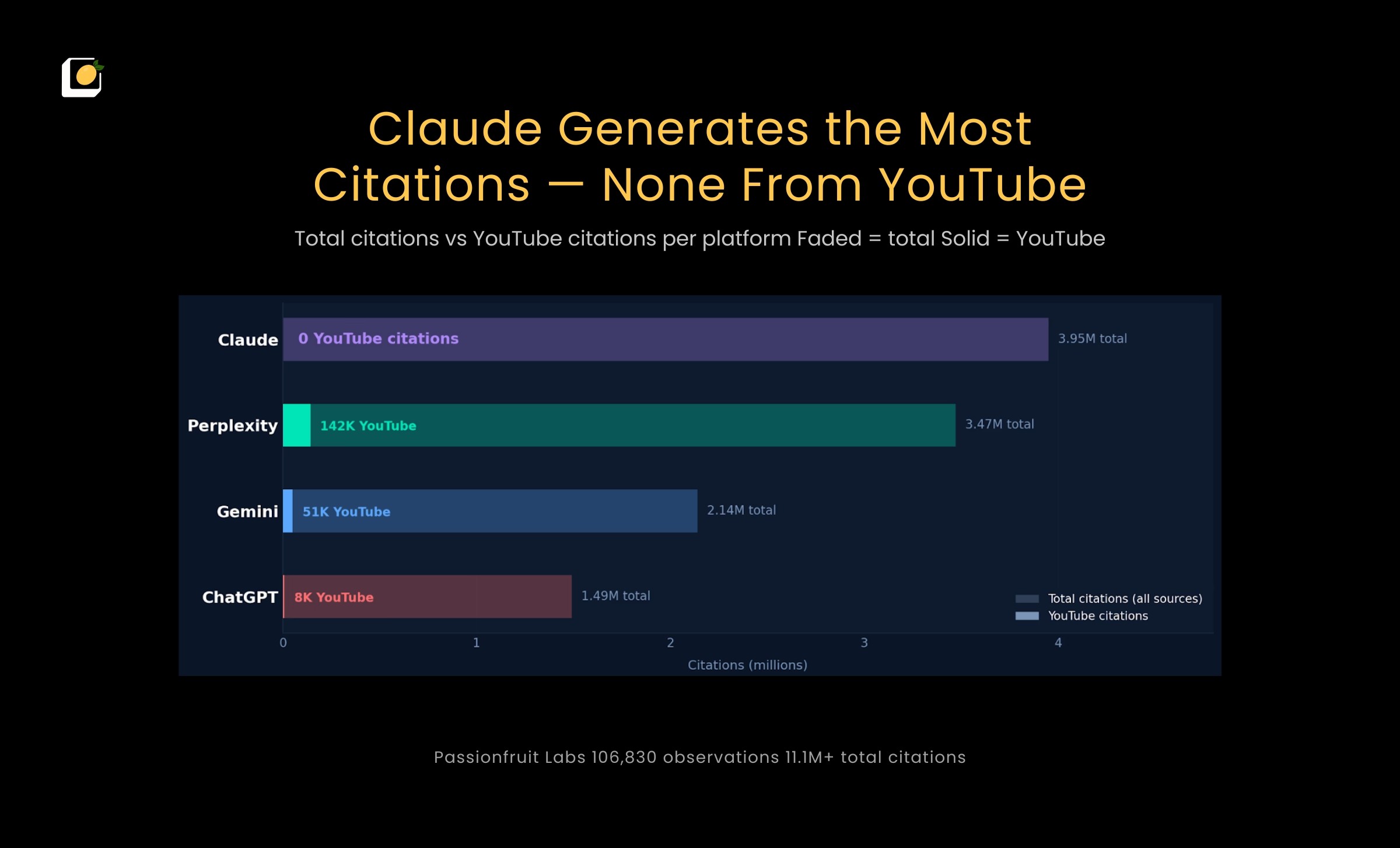
Claude never cites YouTube. Across all observations, it cited 3.95 million sources, none of which were YouTube. It generates the most citations of any platform in the dataset, all from non-video sources.
Query Patterns That Trigger YouTube
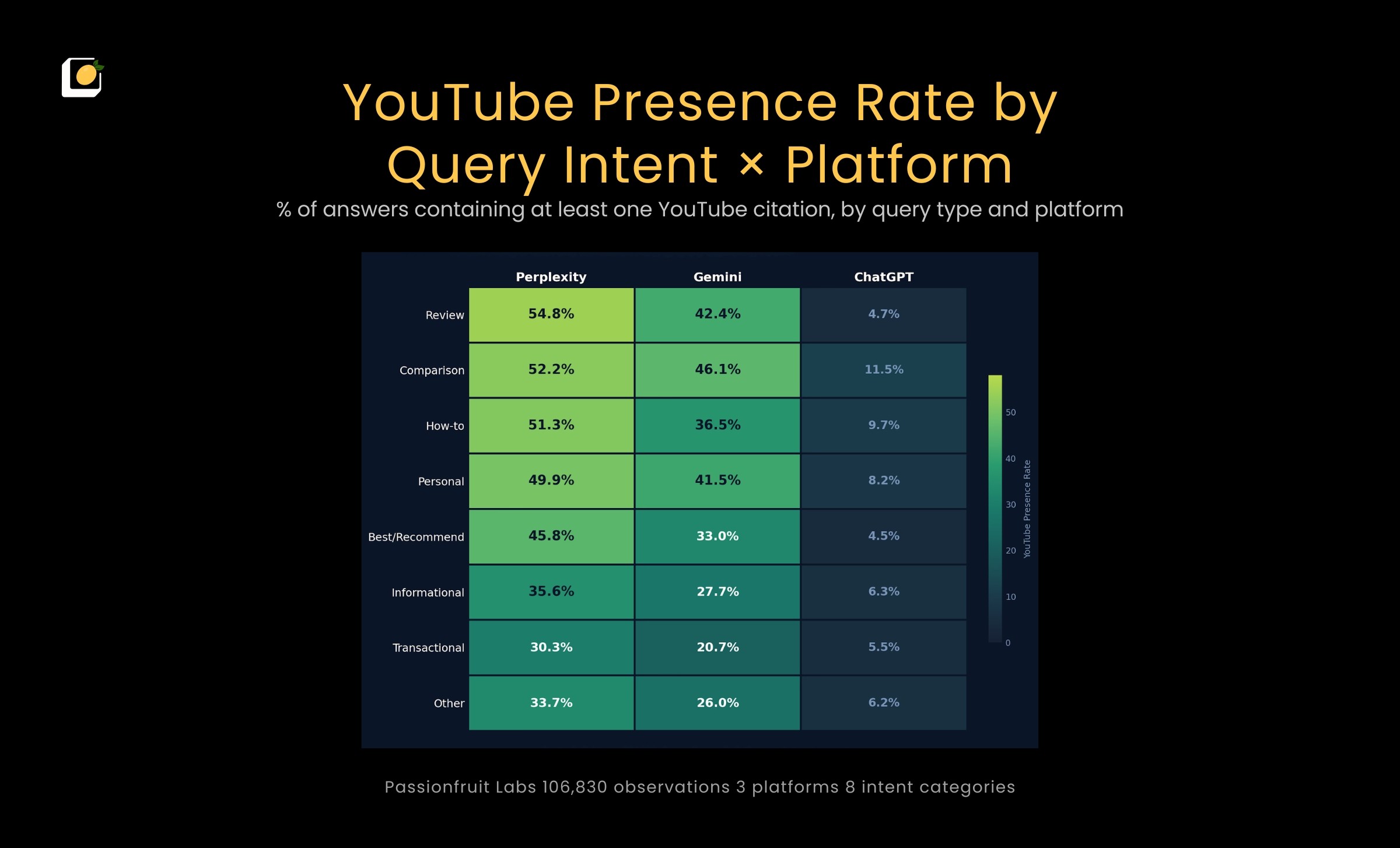
The same query types trigger YouTube across all platforms, but at dramatically different presence rates.
By intent (Presence rate)
Intent | Perplexity | Gemini | ChatGPT |
Review | 54.8% | 42.4% | 4.7% |
Comparison | 52.2% | 46.1% | 11.5% |
How-to | 51.3% | 36.5% | 9.7% |
Personal | 49.9% | 41.5% | 8.2% |
Best/Recommend | 45.8% | 33.0% | 4.5% |
Informational | 35.6% | 27.7% | 6.3% |
Transactional | 30.3% | 20.7% | 5.5% |
The rank order is nearly identical across all three platforms: Perplexity cites YouTube in over half of all review queries. ChatGPT cites it in under 5% of the same queries.
A brand optimizing video for review-intent queries will see returns on Perplexity immediately, but will need to target comparison-intent specifically to break through on ChatGPT, the only intent where ChatGPT crosses 10%.
By voice pattern
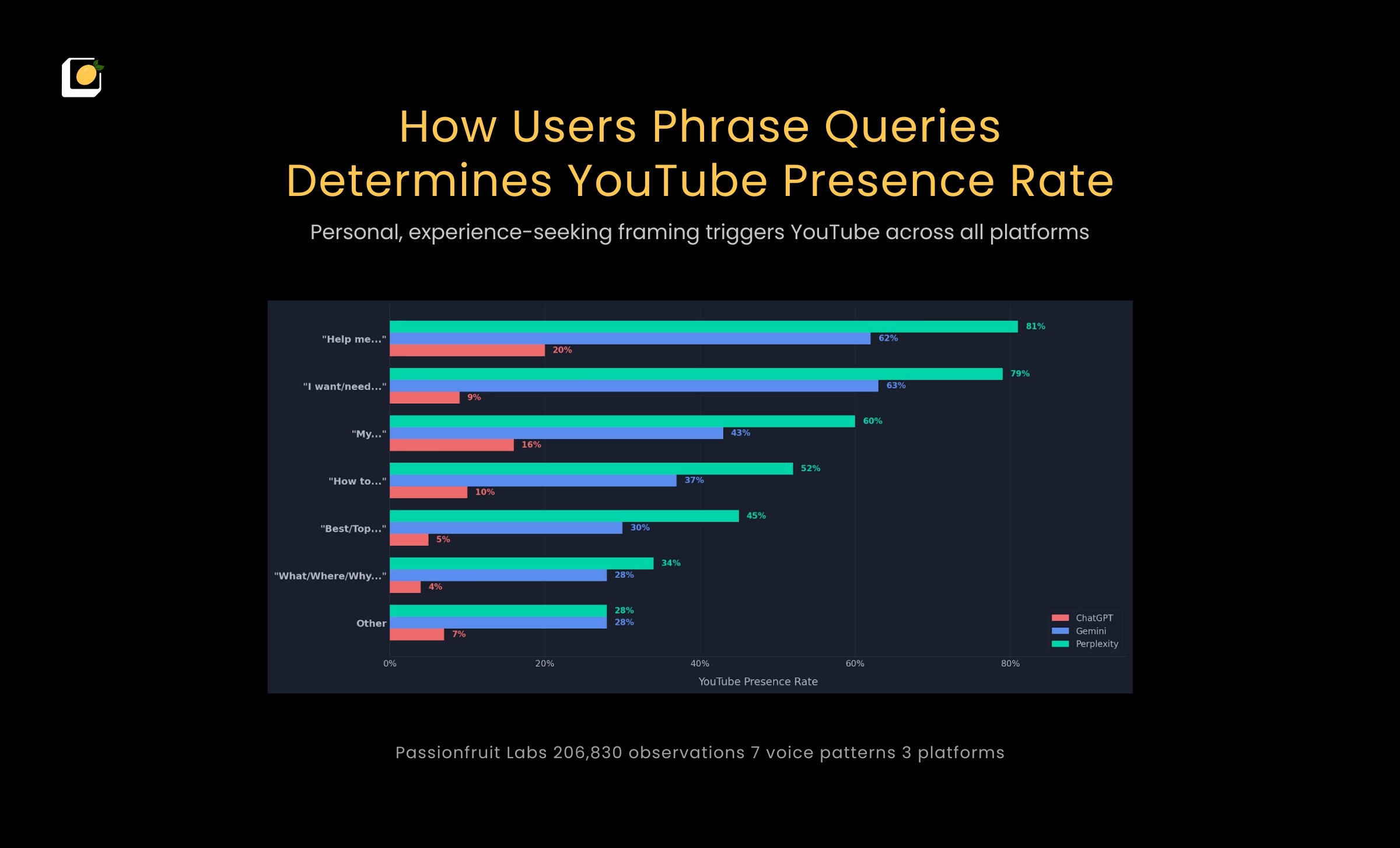
How users frame a question matters more than what they ask about. "Help me..." triggers a YouTube presence rate of 80.8% on Perplexity, 62.7% on Gemini, and 19.7% on ChatGPT. Even ChatGPT, which barely cites YouTube, triples its presence rate for "Help me" queries.
The pattern holds for "I want/need..." (79.9% / 65.5% / 8.7%) and "My..." (60.0% / 42.6% / 15.8%). Personal, experience-seeking framing is the universal YouTube trigger. "What/Where/Why..." queries get YouTube roughly half as often.
By prompt length
The 16-word (word count) threshold holds across all platforms. Under 16 words: Perplexity 39%, Gemini 32%, ChatGPT 8%. At 16+ words: Perplexity 70%, Gemini 65%, ChatGPT 13%. Longer, more detailed queries universally increase YouTube presence rates.
Branded queries
Segment | Perplexity | Gemini | ChatGPT |
Branded | 86.7% | 71.3% | 10.2% |
Non-branded | 39.2% | 29.5% | 6.6% |
Branded queries produce a significant presence rate lift on Perplexity and Gemini. When someone asks about a specific brand, Perplexity's YouTubepresence rate jumps from 39.2% to 86.7%, a 47.6 percentage point increase. Gemini jumps from 29.5% to 71.3%, a 41.8 percentage point increase. ChatGPT barely responds to this signal, moving from 6.6% to 10.2%.
On Perplexity, mentioning a brand name makes a YouTube mention near-certain. On Gemini, it makes YouTube the majority source, but not guaranteed. On ChatGPT, it makes almost no difference.
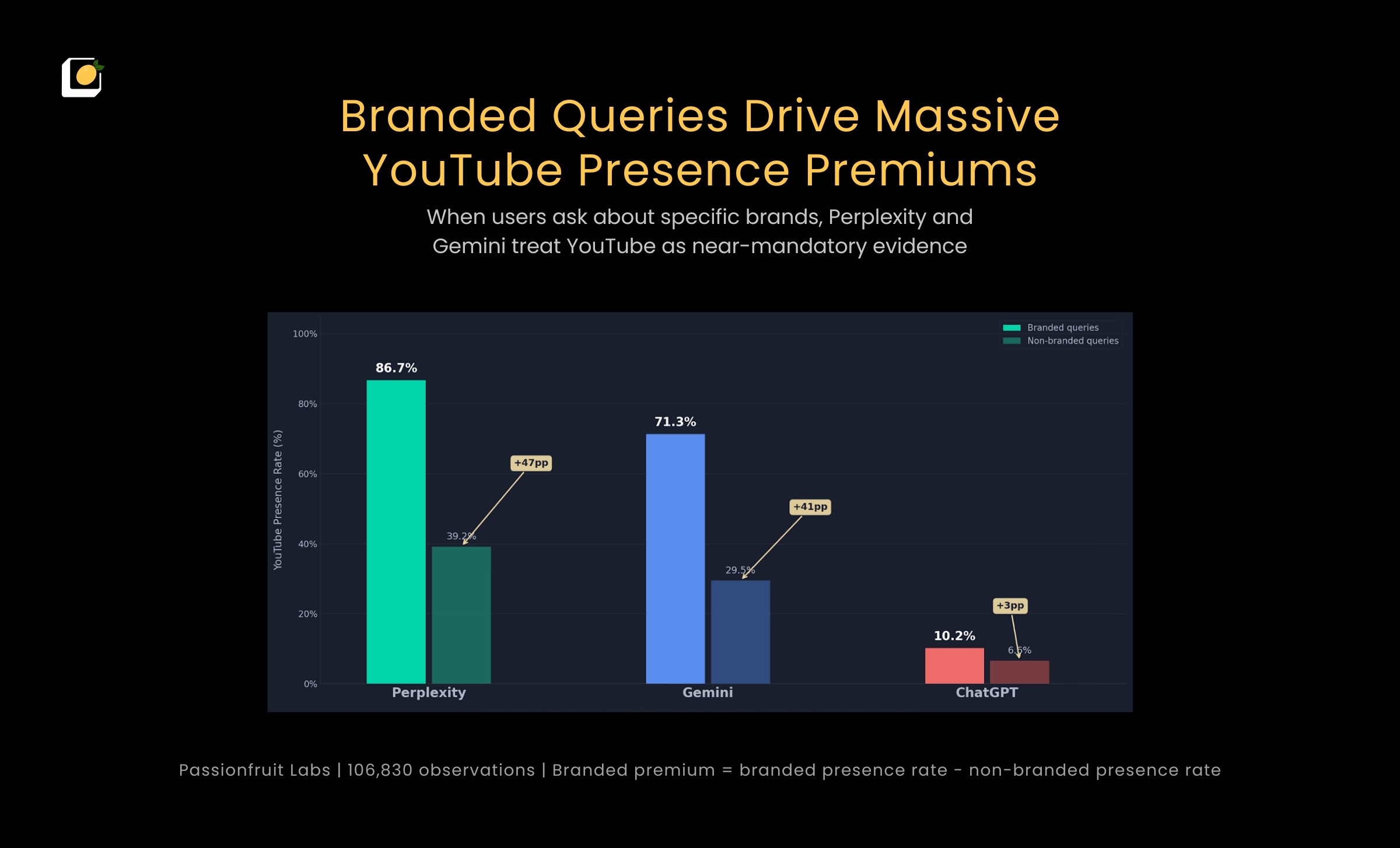
Branded comparison prompts hit 97.1%(across all prompts containing branded queries, M-o-M basis), YouTube presence rate... with 14.35 URLs per answer, 6× the non-branded rate. When AI evaluates brands, it builds its case almost entirely from video.
Industry Patterns and Trends
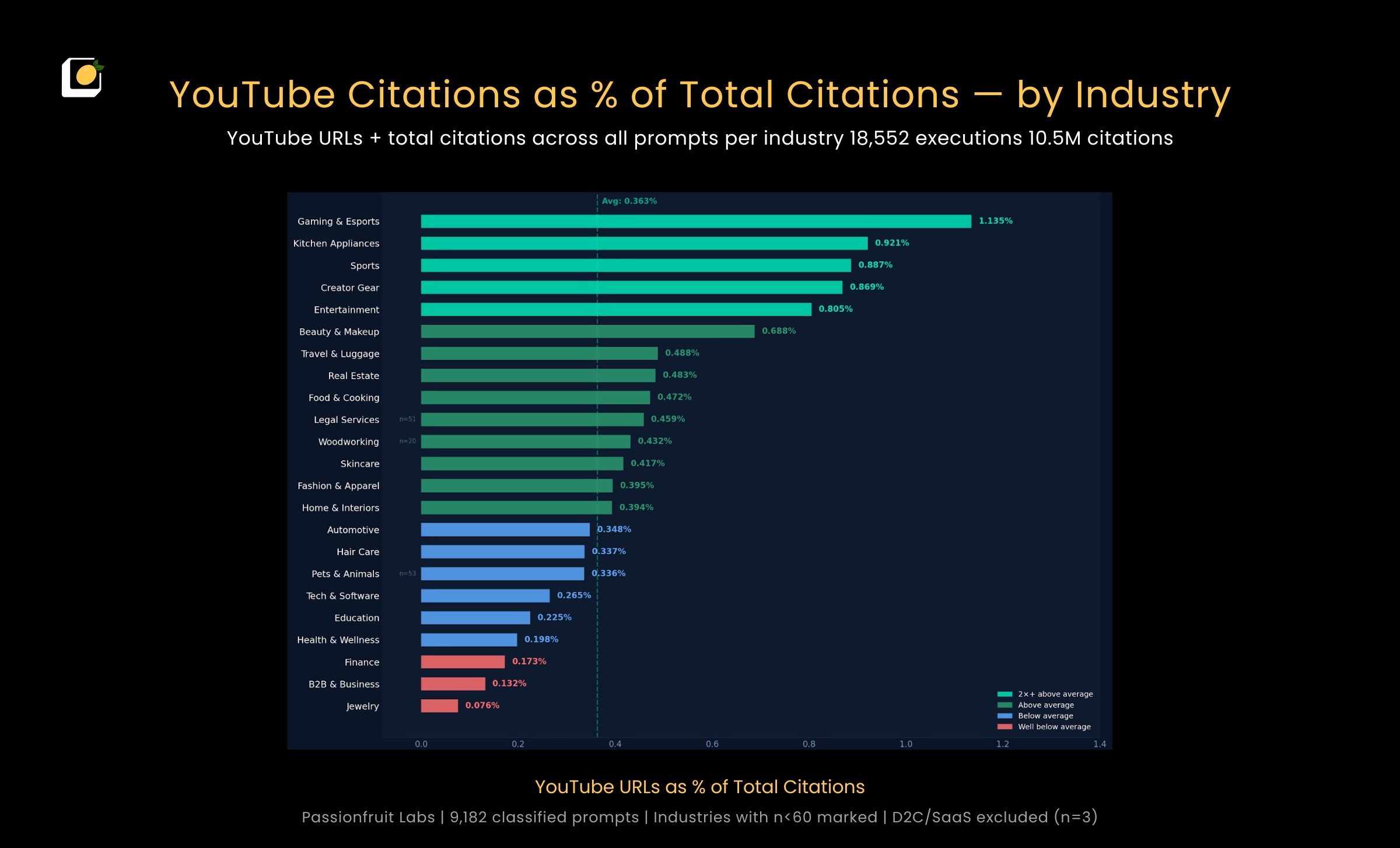
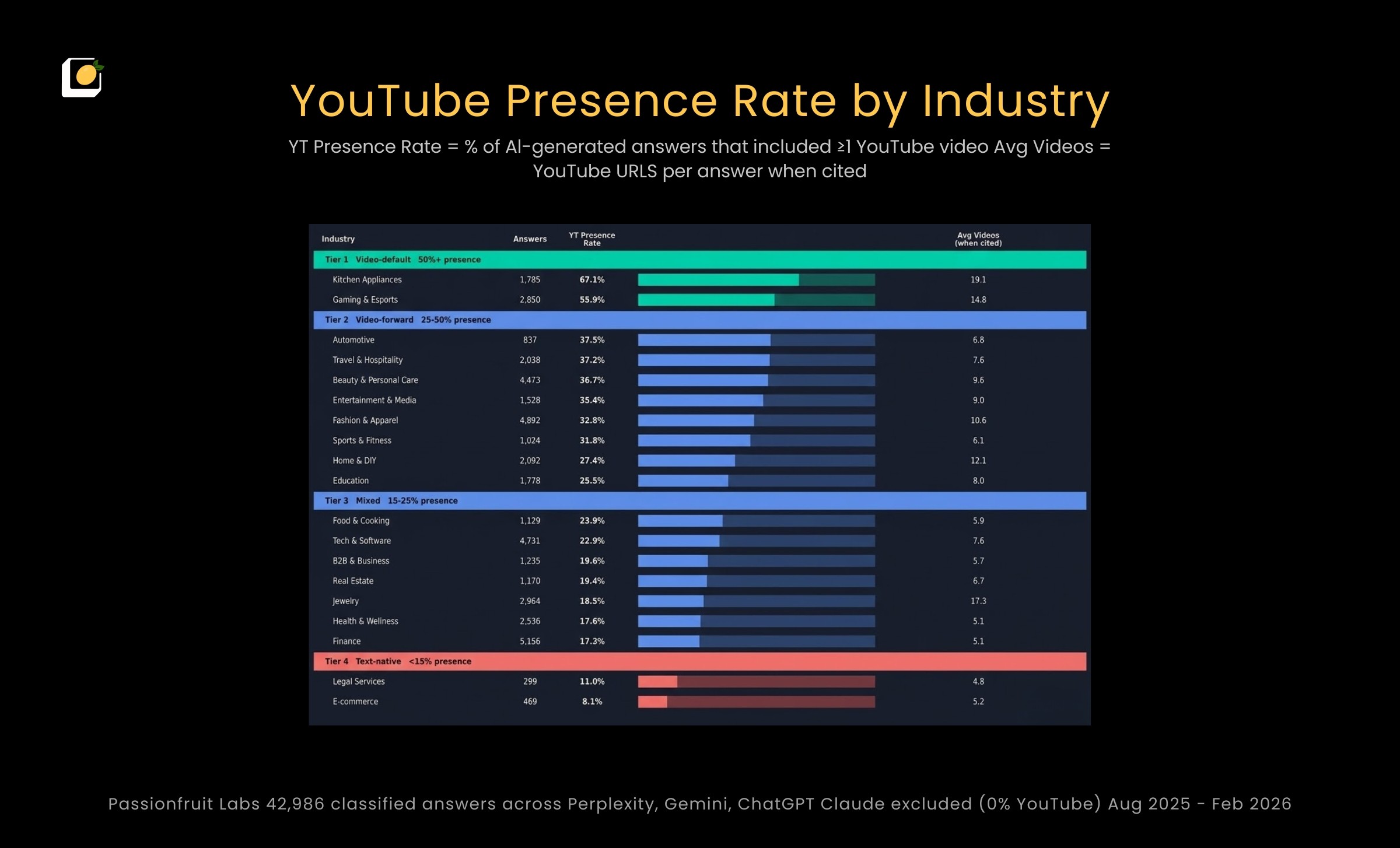
Industry-wise metric is a great predictor of YouTube presence rate. The gap from top to bottom is 65.6 percentage points.
Industry decides how much YouTube matters in your AI answers. The gap between the highest and lowest industries is 65.6 percentage points wider than any other variable in the dataset.
We measured the YouTube presence rate, the percentage of AI answers that included at least one YouTube mention per industry, aggregated across all platforms every month.
Tier 1: Video-default (85%+ presence rate). D2C Athleisure (95.7%), Woodworking (97.6%), Gaming & Esports (90.4%). In these industries, AI treats video as the expected evidence format. Nearly every answer includes YouTube.
Tier 2: Video-forward (55–85%). Fashion (59.1%). YouTube appears in more than half of the answers, but it isn't automatic. Worth investing in video for comparisons and reviews, while maintaining text content elsewhere.
Tier 3: Mixed (40–55%). Tech & Software (42.4%). AI defaults to documentation and articles for software queries. Video shows up selectively, mostly for hardware reviews and setup guides.
Tier 4: Text-native (under 40%). Finance (39.4%), B2B (33.0%), Legal (32.0%). These industries are won through written authority. Video is supplementary, not primary.
Your industry sets the ceiling. No amount of production quality pushes B2B to 90%. In Gaming, the floor is already 90%.
How industries trended over seven months
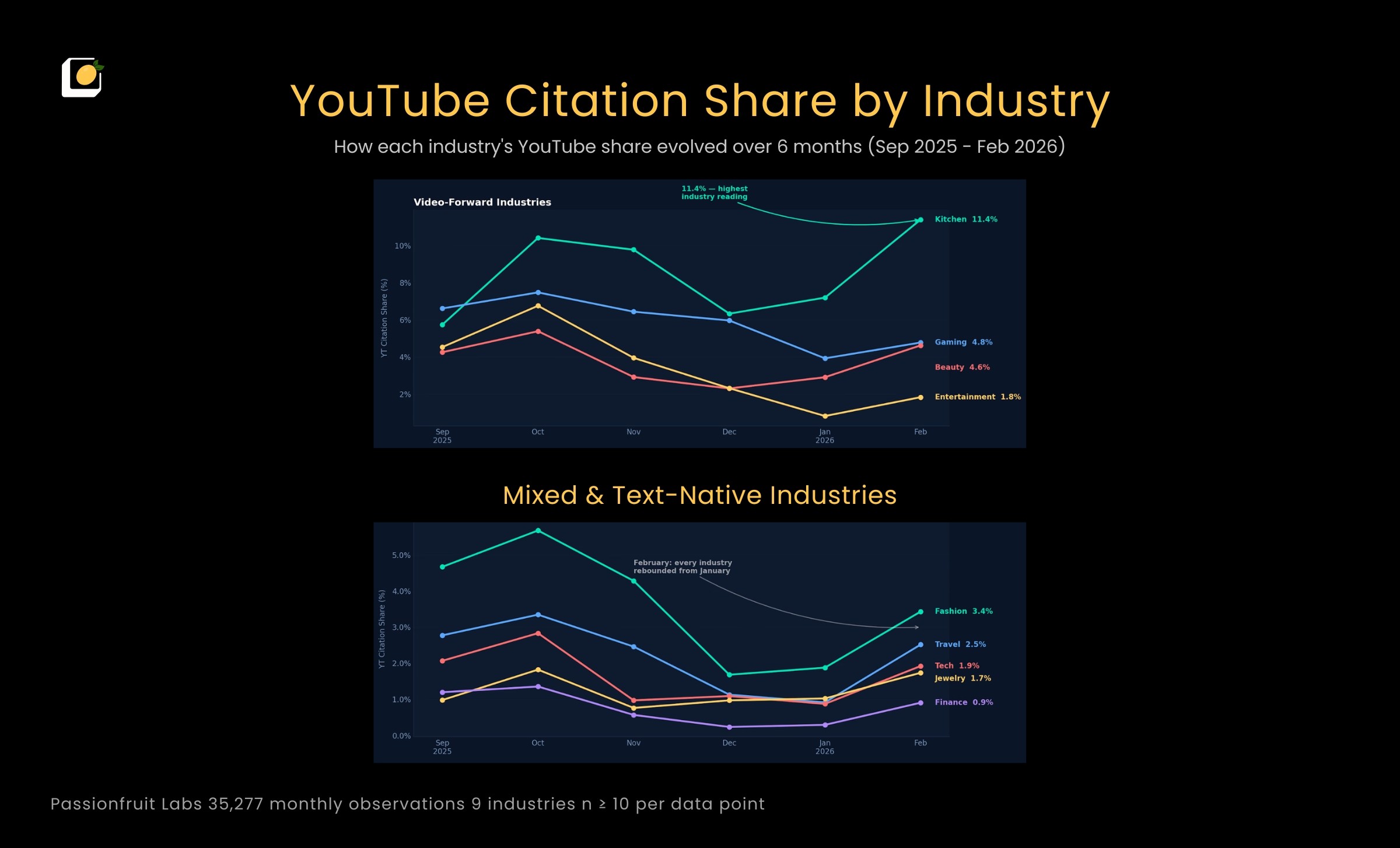
These tiers are not static. (Monthly trends below use YouTube presence share) Tracked month-over-month (August 2025 – February 2026):
Kitchen Appliances surged to 11.5% YouTube presence share in February, the highest single-industry reading in the dataset.
Beauty recovered from 2.2% to 4.8%.
Gaming & Esports never dropped below 3.9%, maintaining the highest sustained floor.
Entertainment is the only industry that declined continuously 5.6% to 1.5% with no recovery.
AI is shifting entertainment citations toward streaming platforms and review aggregators.
Every tracked industry showed a higher YouTube citation share in February than in January, the first time the entire dataset moved in one direction since the initial growth phase.
The overall trend follows three phases.
Experimentation (August–October 2025): YouTube presence rate climbed to a new level as AI tested it broadly.
Correction (November–January): A sharp pullback, with citation share dropping 53% in one month.
Stabilization (January–February): Presence rate flatlined at 40%, and citation share rebounded from 1.33% to 2.15%.
YouTube was not removed from the AI search. It was reserved for a narrower, higher-authority role, particularly branded comparisons, review queries, and industries where visual evidence is structural.
Conclusion
Perplexity cites the video by default. Gemini went from ignoring YouTube to matching Perplexity in seven months. ChatGPT barely uses it. Claude never does. A brand optimizing "for AI search" without knowing which platform its audience uses is optimizing for an average that describes none of them.
What holds everywhere: long-form wins at 97.2%. Shorts are not underperforming; they are structurally excluded. AI needs depth to build citations. Shorts cannot provide it.
The triggers are consistent across platforms: branded comparisons, honest reviews, and personal experience queries. The magnitudes differ by 40×.
Gemini's entire citation behavior changed in seven months. The platforms are still deciding how much to trust video. And the barrier to entry is lower than most brands assume 42.9% of cited videos have fewer than 10,000 views, and the top 100 channels hold just 15.6% of all citations. You don't need an existing audience. You need 10-20 minute structured reviews in your product category, published consistently, titled around what you tested and what you found.
The brands doing this now are not waiting for AI search to mature. They are training it on their content while the rules are still being written.
Get a Custom AI Search Visibility Audit
We'll analyze how your brand and competitors show up across Perplexity, Gemini, ChatGPT, and Google AI Overviews. You'll get a clear picture of where you're cited, where you're missing, and what to prioritize.
Book a free consultation.