SEO
Join 500+ brands growing with Passionfruit!
Google's latest research into training AI agents for deep research tasks reveals critical insights for content strategy. Understanding how AI agents navigate complex queries transforms how organizations approach content architecture and organic visibility.
Organizations investing in search visibility face a fundamental question as AI reshapes how users discover and consume information: how do AI agents actually find and synthesize answers from web content? Google's recently published SAGE research provides concrete answers that have significant implications for content strategy and SEO investment.
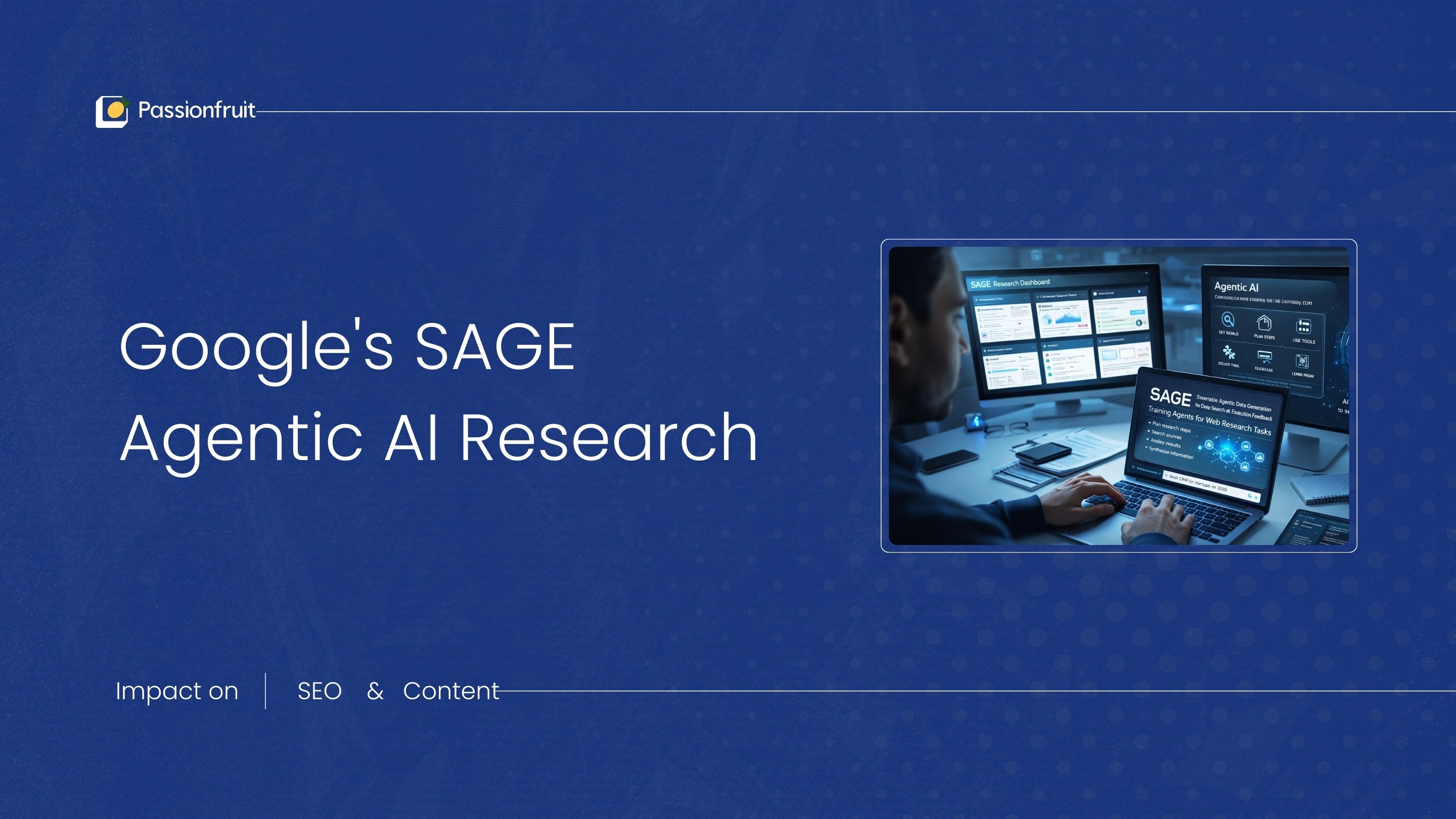
SAGE (Steerable Agentic Data Generation for Deep Search with Execution Feedback) represents Google's effort to create training data for AI agents capable of conducting genuine multi-step research. The research reveals how AI agents navigate complex queries and, crucially, what causes them to find complete answers on single pages rather than searching across multiple sources.
For organizations focused on organic visibility, these findings offer a strategic roadmap. Understanding what AI search is and how it's reshaping SEO becomes essential context for applying SAGE insights effectively. The research validates certain content strategies while challenging assumptions about how AI-driven discovery differs from traditional search.
What Is Google's SAGE Research and Why Should Content Strategists Care?
Google published the SAGE research paper to address a significant gap in how AI agents are trained for complex search tasks. Previous training datasets required minimal reasoning to answer questions. Datasets like Musique averaged only 2.7 searches per question, while Natural Questions required just 1.3 searches on average. This created a training gap where AI agents were not prepared for genuinely difficult research tasks requiring multiple sources and reasoning steps.
SAGE introduces a dual-agent system designed to generate truly challenging question-answer pairs. The first AI generates questions intended to require many reasoning steps and multiple searches. The second AI attempts to solve those questions while tracking exactly how it found answers. When the second agent solves questions too easily, that execution trace feeds back to improve question difficulty.
The strategic insight for content publishers emerges from understanding what makes questions "too easy" for AI agents to solve. The research identifies specific content characteristics that allow agents to find complete answers without extensive searching. These characteristics represent optimization opportunities for organizations seeking visibility in AI-driven search environments.
How Do AI Agents Approach Deep Research Tasks?
Understanding how AI agents conduct research illuminates why certain content structures outperform others. AI agents operating in deep research mode execute a series of searches, evaluate retrieved documents, extract relevant information, and synthesize findings into coherent answers.
The SAGE research reveals that agents typically pull from the top three ranked pages for each query they execute. This finding has profound implications: traditional search ranking remains foundational even for AI-driven discovery. Organizations that dismiss classic SEO fundamentals in favor of AI-specific optimization risk losing visibility in both channels.
AI agents approach complex queries by breaking them into sub-questions, searching for each component, and assembling findings. The research demonstrates that content architecture directly affects whether agents complete their research on your pages or navigate to competitors for missing information.
This behavior pattern explains why the four pillars of SEO remain relevant in AI search contexts. Technical excellence ensures your content is accessible to agents. Content quality determines whether agents find sufficient information. Authority signals influence ranking position, which determines whether agents encounter your content at all.
What Are the Four Shortcuts AI Agents Use to Avoid Multi-Step Reasoning?
The SAGE research identifies four specific scenarios where AI agents bypass complex multi-step reasoning. Understanding these shortcuts reveals what content characteristics satisfy agent requirements most efficiently.
Information Co-Location
The most common shortcut, accounting for 35% of cases where deep research proved unnecessary. Information co-location occurs when multiple pieces of information needed to answer a question exist within the same document. Instead of conducting separate searches for each component, the agent finds everything required in a single source.
For content strategists, this finding validates comprehensive content approaches. Pages that consolidate related information prevent agents from navigating to competitor sites for missing pieces. The strategic implication is clear: fragmented content across multiple thin pages creates opportunities for competitors to capture visibility that comprehensive pages would retain.
Multi-Query Collapse
This shortcut occurred in 21% of cases. Multi-query collapse happens when a single well-constructed search query retrieves sufficient information from different documents to solve multiple parts of a complex question simultaneously. The agent collapses what should be a multi-step process into a single retrieval.
Content structured to answer several related sub-questions enables this collapse to occur on your pages. Semantic headings that align with likely query variations, tables that consolidate comparative data, and clear answer structures all increase the probability that agents find comprehensive solutions in single retrievals.
Superficial Complexity
Accounting for 13% of cases, superficial complexity describes questions that appear complicated to humans but have direct answers accessible through straightforward search. The question's length or detail level creates an illusion of difficulty that search engines easily penetrate.
This finding reinforces that content optimized for clear, direct answers performs well even for seemingly complex queries. Agents do not require elaborate reasoning when content provides explicit answers to the underlying question regardless of how that question is phrased.
Overly Specific Questions
The second most common shortcut at 31% of cases. Questions containing extensive detail allow agents to find answers in initial searches without additional investigation. The specificity embedded in the question itself guides agents directly to relevant content.
For SEO strategy, this validates long-tail content approaches. Detailed, specific content that matches highly specific query patterns captures visibility for queries where less comprehensive competitors require additional searching to satisfy user needs.
How Does Information Co-Location Reshape Content Architecture Strategy?
Information co-location represents the most significant finding for content strategy. When your content consolidates the information agents need, you become the single source satisfying complex queries rather than one stop in a multi-site journey.
Traditional content strategies often fragment related information across multiple pages for keyword targeting or site architecture reasons. The SAGE research suggests this fragmentation creates competitive vulnerability. Agents seeking comprehensive answers may begin on your site but complete their research elsewhere if your content does not address related sub-questions.
Comprehensive content that addresses multiple facets of a topic allows agents to complete their research without additional searching. This does not require stuffing unrelated information into single pages. It requires thoughtful information architecture that anticipates what related questions users and agents might have and addresses them within logical content boundaries.
The practical application involves auditing existing content for completeness. Identify pages targeting complex topics and evaluate whether they address the sub-questions agents would likely generate when researching that topic. Where gaps exist, consolidation or expansion creates competitive advantage.
Understanding how to create SEO-friendly URL structures supports this strategy by ensuring consolidated content remains accessible and logically organized within your site architecture.
Why Does Classic SEO Remain Essential for Agentic AI Visibility?
The SAGE research confirms a finding that should temper enthusiasm for AI-specific optimization tactics: agents rely on traditional search results for content discovery. The research used Serper API to extract search results from Google, with agents pulling from top-ranked pages.
This means ranking well in traditional search remains foundational for AI visibility. Organizations cannot optimize specifically for AI agents while neglecting classic SEO fundamentals. The path to AI search visibility runs through traditional ranking success.
The research suggests agents typically pull from the top three ranked pages for each query. While live agentic AI systems may vary this approach, the implication is clear: ranking outside traditional top positions likely means exclusion from AI agent consideration entirely.
This finding validates continued investment in foundational SEO activities. Strong keyword optimization, authoritative backlinks, and structured content remain essential. Organizations questioning whether traditional SEO remains relevant in AI search environments have their answer: traditional ranking is the prerequisite for AI visibility, not a parallel concern.
Understanding what E-E-A-T means in SEO provides context for why authority signals matter doubly in agentic AI contexts. Agents rely on traditional ranking as a proxy for content quality, making the expertise, experience, authoritativeness, and trustworthiness signals that influence ranking also determinative of AI visibility.
How Should Organizations Structure Content for Agentic AI Discovery?
Applying SAGE insights requires systematic content architecture adjustments rather than tactical optimizations. The research points toward several structural principles that improve performance in agentic AI environments.
Consolidate Scattered Information
Audit your content ecosystem for topics where information fragments across multiple pages. Where logical consolidation is possible without compromising user experience, comprehensive pages outperform fragmented content in agentic AI contexts. This does not mean creating unfocused pages that address unrelated topics. It means ensuring pages addressing complex topics also address the related sub-questions agents will generate.
Structure for Sub-Question Discovery
Use semantic headings that reflect discrete sub-topics within your content. These headings should align with query variations agents might use when breaking complex questions into searchable components. Tables, structured lists, and clear answer formats help agents parse information efficiently.
Review generative engine optimization strategies for additional guidance on structuring content for AI consumption. The principles overlap significantly: clear structure, comprehensive coverage, and explicit answers support both generative AI citation and agentic AI discovery.
Interlink Strategically
Because agents may traverse multiple pages to construct deep answers, internal linking determines whether that traversal occurs within your content ecosystem or leads to competitors. Strategic interlinking helps agents discover related content on your site while distributing authority across your content cluster.
Internal links should connect logically related content in ways that support both user navigation and agent discovery. The goal is ensuring agents exploring a topic can find all relevant pieces of your content without returning to search results.
Prioritize Top-Three Ranking
Given that agents appear to pull from top-ranked results, ranking outside traditional top positions likely means exclusion from agent consideration. This makes competitive ranking more important, not less, in agentic AI contexts.
Focus optimization efforts on content with realistic paths to top-three positioning. For highly competitive topics, this may require content consolidation, authority building, or strategic repositioning to capture ranking opportunities.
What Are the Practical Implementation Steps?
Translating SAGE insights into actionable strategy requires systematic evaluation and adjustment across your content ecosystem.
Audit Content Completeness
Review high-value pages targeting complex topics. For each page, identify the sub-questions agents would likely generate when researching that topic. Evaluate whether your content addresses those sub-questions or requires agents to search elsewhere. Where gaps exist, expand content or consolidate related pages.
Evaluate Information Architecture
Assess whether your site structure fragments information that would serve users and agents better as consolidated content. Balance SEO considerations around keyword targeting with the competitive advantages of comprehensive coverage.
Strengthen Traditional SEO Fundamentals
Ensure foundational SEO elements support strong ranking performance. Keyword optimization, backlink development, technical SEO hygiene, and structured data implementation all influence the traditional ranking that determines AI agent discovery.
Implement Strategic Internal Linking
Review internal linking structures to ensure related content connects logically. Agents traversing your content ecosystem should encounter relevant related pages through natural linking rather than returning to search results.
Monitor Ranking Performance for Key Topics
Track ranking positions for content targeting topics where agentic AI visibility matters. Prioritize optimization efforts for content with realistic top-three ranking potential.
Connecting SAGE Insights to Business Outcomes
The SAGE research provides technical insights, but the strategic question remains: how do these findings connect to revenue and business outcomes?
Organizations investing in organic visibility seek measurable returns. Understanding how important SEO is for businesses in the current landscape contextualizes why SAGE insights matter beyond technical interest.
As AI agents increasingly mediate information discovery, content that satisfies agent requirements captures visibility that fragmented or incomplete content loses. This visibility translates to traffic, engagement, and ultimately revenue outcomes. Organizations that adapt content architecture to agentic AI requirements position themselves for sustained organic performance as search continues evolving.
The SAGE research does not suggest abandoning proven SEO fundamentals. It validates those fundamentals while illuminating how comprehensive, well-structured content creates competitive advantages in AI-mediated discovery. Organizations that invest in content architecture aligned with these principles build durable visibility assets that perform across both traditional and AI search channels.
Frequently Asked Questions
What is Google's SAGE research about?
SAGE (Steerable Agentic Data Generation for Deep Search with Execution Feedback) is Google's research into creating challenging training data for AI agents conducting multi-step research tasks. The research reveals how AI agents find and synthesize information from web content.
How does SAGE affect SEO strategy?
The research shows that comprehensive, well-structured content allowing AI agents to find complete answers without additional searching outperforms fragmented content. Traditional SEO fundamentals remain essential because agents rely on traditional ranking for content discovery.
What is information co-location in SEO?
Information co-location refers to having multiple related data points on the same page, which helps AI agents answer complex questions without navigating to additional sources. This was the most common reason agents avoided multi-step research in the SAGE study.
Should SEO focus shift entirely to AI optimization?
No. The SAGE research confirms that AI agents rely on traditional search ranking to discover content. Organizations should strengthen traditional SEO fundamentals while structuring content to satisfy agent requirements for comprehensive, well-organized information.
How do AI agents select which content to use?
According to the SAGE research, AI agents typically pull from top-ranked pages in traditional search results. Ranking in the top three positions appears particularly important for agent visibility, making traditional ranking a prerequisite for AI search performance.
What content structure works best for agentic AI?
Content that consolidates related information, uses semantic headings aligned with likely sub-queries, and provides clear direct answers performs well for agentic AI discovery. Comprehensive coverage of topics prevents agents from needing to search competitor sites for missing information.
Ready to align your content strategy with how AI agents actually discover and use information? Get started with a consultation to learn how revenue-focused SEO can build durable visibility across traditional and AI search channels.