SEO
Join 500+ brands growing with Passionfruit!
The decision framework for what to gate, what to leave open, and how to capture leads without sacrificing the organic traffic and AI citations that feed your funnel.
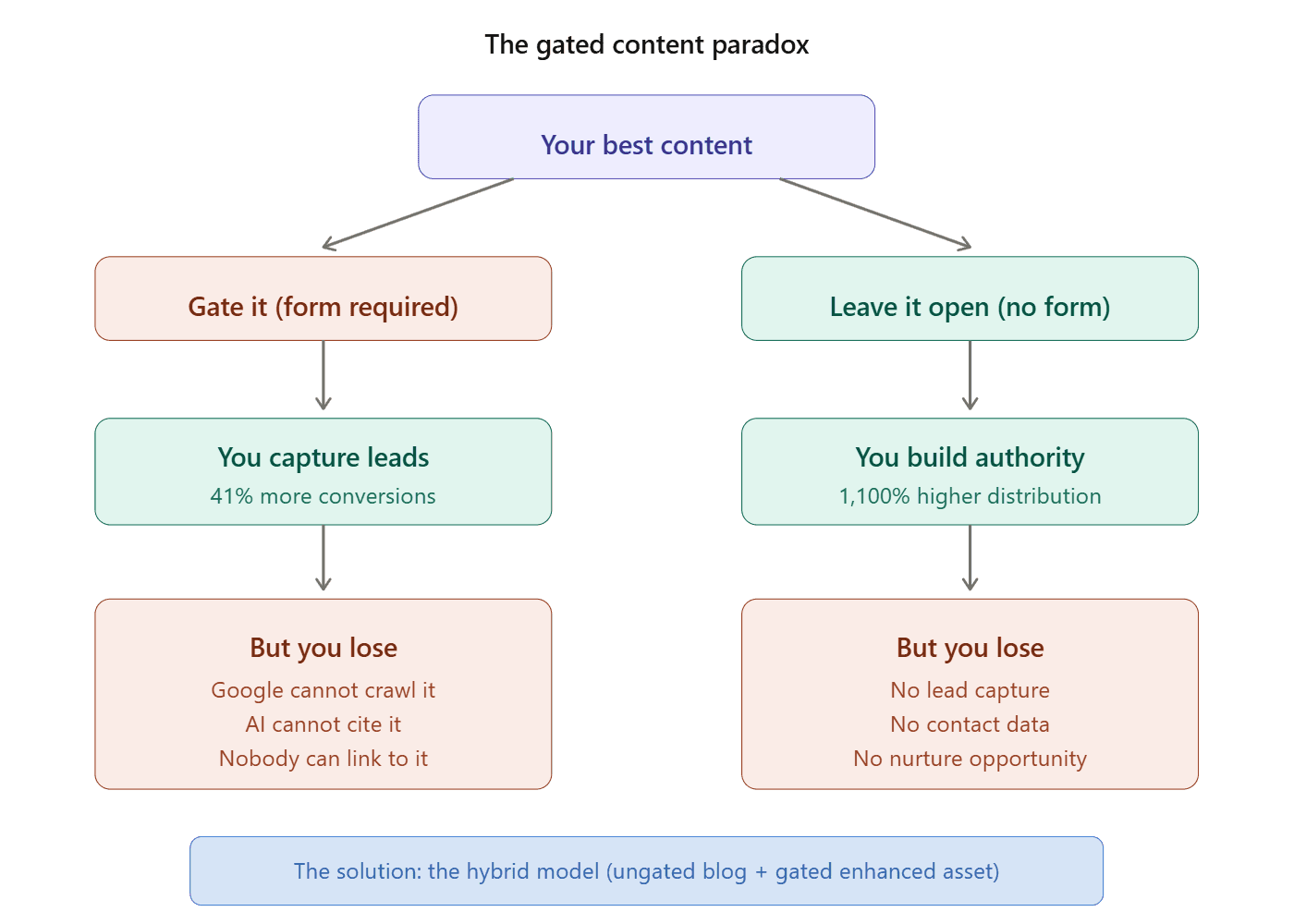
Gated content converts up to 41% more visitors into leads compared to similar ungated content. But here is the number nobody talks about: only 62% of people who fill out the form actually consume the content they downloaded.
That means 38% of your "leads" gave you a fake email or lost interest between the form and the PDF. And every page you gate becomes invisible to Google, AI search engines, and anyone who could have shared it, linked to it, or cited it.
This is the gated content paradox. Gating captures leads. But gating also shrinks your organic reach, blocks AI crawlers from citing your expertise, and fills your CRM with contacts who never read your content.
The solution is not "gate everything" or "ungate everything." It is a decision framework that tells you exactly which content to gate, which to leave open, and how to use a hybrid approach that captures leads without sacrificing the SEO and AI search visibility that feeds your funnel in the first place.
Our guide gives you that framework, with specific benchmarks, form optimization data, post-download nurture sequences, and the measurement system that connects gated content to revenue rather than just download counts.
What Gated Content Actually Is (And What It Is Not)
Gated content is any piece of content that requires a visitor to submit contact information through a form before they can access it. The exchange: they give you data (name, email, company, role), you give them something valuable (a guide, template, report, tool, webinar recording).
Common gated formats include ebooks and whitepapers, technical guides and buying guides, templates and checklists, webinar recordings and video tutorials, original research reports and industry benchmarks, interactive tools like calculators and configurators, and case studies with performance data.
What gated content is not: a sales pitch behind a form. If someone fills out your form and receives a thinly disguised product brochure, you have burned their trust and wasted a lead. The content behind the gate must deliver standalone value that the reader can use regardless of whether they ever buy from you.
The psychology works on two principles. The first is perceived value: users view gated resources as premium because the gate itself signals exclusivity. The second is reciprocity: when you offer something genuinely useful, people feel a natural willingness to share information in return.
For how gated content fits into your broader content architecture, see our guide on building topic clusters that rank and convert.
The Gate-or-Not Decision Framework
This is the section that separates strategic marketers from those who gate everything and wonder why their organic traffic stalls.
Gate this content (MOFU and BOFU assets)
Gate content that serves prospects in the middle and bottom of the funnel. These are people who already know your brand, understand their problem, and are evaluating solutions. Research shows 68% of prospects accept gates for high-quality, solution-oriented content, and decision-stage content sees 79% conversion rates when the business case is clear.
Gate these formats:
Original research with proprietary data
Detailed buying guides and comparison frameworks
Templates, calculators, and interactive tools
Webinar recordings and in-depth video tutorials
Case studies with specific performance metrics
Industry benchmark reports
Product demo access
Do NOT gate this content (TOFU assets)
Leave top-of-funnel content open. Blog posts, short explainers, infographics, basic how-to guides, and introductory videos should be freely accessible. Ungated TOFU content achieves up to 1,100% higher usage and distribution than gated equivalents.
Leave these formats open:
Blog posts and articles
Short videos and social clips
Infographics and visual explainers
Podcast episodes
Basic checklists and quick guides
FAQ pages and glossaries
Why this matters for SEO: Every piece of gated content is invisible to search engines. Google cannot crawl content behind a form. If you gate your best educational content, you lose the organic traffic, backlinks, and topical authority that feed your entire funnel. For understanding how organic visibility drives long-term growth, see our guide on SEO principles.
Why this matters for AI search: ChatGPT, Perplexity, Gemini, and Claude cannot access gated content. If your most authoritative, data-rich content sits behind a form, AI search engines cite your competitors instead. In 2026, where AI referral traffic is becoming a meaningful revenue channel, gating your best insights costs you citations, brand mentions, and the authority signals that AI systems use to evaluate your expertise.
The hybrid approach (best of both worlds)
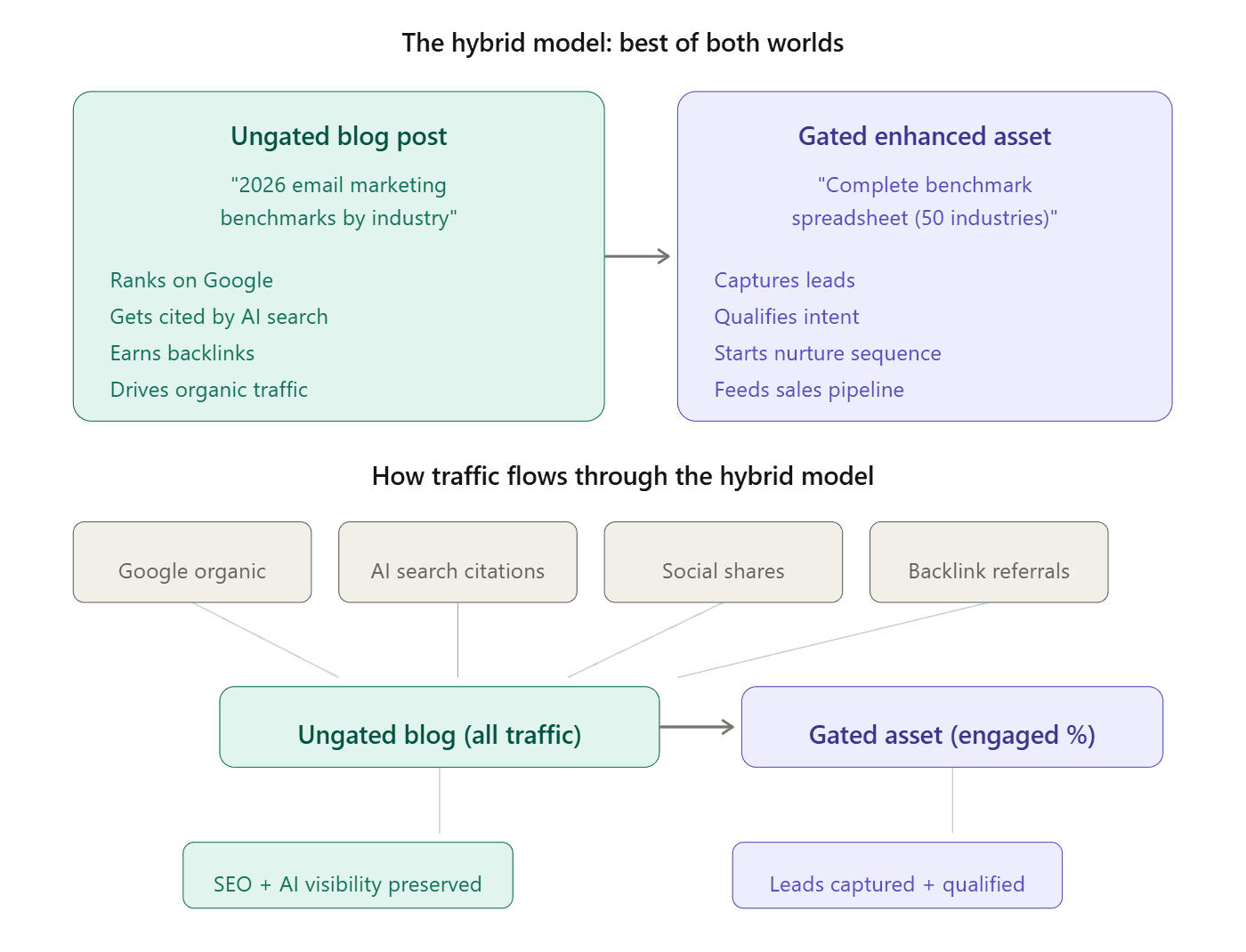
This is the model that high-performing teams use. You publish a comprehensive, ungated version of the content that ranks in Google and gets cited by AI search engines. Then you offer a gated "enhanced" version that adds extra value.
Example: Publish a detailed blog post on "2026 Email Marketing Benchmarks by Industry" (ungated, ranks for SEO, gets cited by AI). At the bottom and in a sidebar, offer a downloadable "Complete Email Marketing Benchmark Spreadsheet with 50 Industry Breakdowns" (gated). The blog post drives traffic. The downloadable asset captures leads. You get both.
Another example: Publish a comprehensive guide on keyword research (ungated). Offer a gated "Keyword Research Template and Prioritization Scorecard" that readers can download and use immediately. The guide builds authority. The template captures leads from people ready to take action.
This hybrid approach preserves your organic visibility, maintains your AI citation eligibility, and still captures leads from the subset of visitors who want the enhanced, actionable resource. For the full keyword research methodology, see our guide.
How to Build Gated Content That Converts at 5%+ (Not 2%)
The average landing page converts at 2.35%. The top 25% convert at 5.31%. The top 10% convert at 11.45%. Here is what separates each tier.
1. Match the gate to the intent stage
The biggest conversion killer is gating content that does not match where the visitor is in their buying journey. An engineer researching a problem for the first time does not want to fill out a form. A procurement manager comparing vendors for an active project does.
Map every gated asset to a specific funnel stage:
Awareness stage: Do not gate. Maximize reach.
Consideration stage: Gate strategically. Offer solution-oriented content (buying guides, comparison frameworks, benchmark reports).
Decision stage: Gate confidently. Offer high-value assets (ROI calculators, detailed case studies, product demos, custom assessments).
2. Optimize your form fields (every field costs you leads)
Reducing form fields from four to three boosts conversion rates by up to 50%. Every additional field you add creates friction that causes visitors to abandon the form.
The minimum viable form:
Name
Business email
Company name
That is three fields. It is enough to identify the lead, route them to the right sales rep, and begin qualification.
When to add more fields: Only when the additional data directly improves lead routing or qualification AND the content behind the gate is valuable enough to justify the friction. A detailed ROI calculator or a custom industry benchmark report can justify asking for job title, company size, and project timeline. A basic ebook cannot.
Progressive profiling: Instead of asking for everything upfront, collect additional information over time. First download: name, email, company. Second download: job title, company size. Third download: budget range, project timeline. Your marketing automation platform (HubSpot, Marketo, Pardot) handles this automatically by recognizing returning visitors and showing them new fields.
3. Build a landing page that earns the conversion
Each gated asset needs a dedicated landing page. That page must answer four questions in under 10 seconds:
What problem does this solve? Lead with the pain point, not the format. "Struggling to justify your marketing budget to the C-suite?" is better than "Download our whitepaper."
What specific value does the reader get? Be concrete. "Includes 50 industry benchmarks, 3 ROI calculation templates, and a board-ready presentation deck" tells the visitor exactly what they receive.
Who is this for? "Built for marketing directors and CMOs at B2B companies with $5M-50M revenue" qualifies the visitor before they fill out the form.
What do they need to do? One clear CTA. No competing navigation. No sidebar distractions. One path: fill out the form, get the content.
Proof elements that boost conversion: Add a preview (show the table of contents or a sample page), include a download count ("Downloaded 3,400+ times"), add a testimonial from someone who used the content, and show logos of companies whose employees have downloaded it.
For how this landing page fits into your broader conversion strategy, see our guide on organic traffic vs. organic conversions.
4. Deliver instant value (the 62% problem)
Only 62% of users who fill out a form actually consume the gated content. That means 38% of your leads never engage with what they downloaded. This is a massive waste.
How to fix it:
Deliver the content immediately on the thank-you page in addition to sending it via email. Do not make people wait for an email that might land in spam.
Make the content scannable. If your ebook is 40 pages, include an executive summary on page 1 that delivers the key insights in 2 minutes. Most people who do consume gated content do not read every page.
Send a "Did you get a chance to read it?" email 3 days later with the single most valuable insight from the content. This re-engages the 38% who downloaded but never opened it.
The Post-Download Nurture Sequence (Where Most Teams Fail)
Capturing the lead is step one. What happens next determines whether that lead becomes revenue or sits in your CRM indefinitely.
Here is the nurture sequence structure that converts gated content downloads into sales conversations.
Email 1: Immediate delivery (sent instantly)
Subject: Here is your [Asset Name] Content: Deliver the asset with a direct download link. Include one sentence highlighting the single most valuable insight inside. No sales pitch. No "book a demo" CTA. Just value delivery.
Email 2: Key insight + related content (sent 3 days later)
Subject: The one finding from [Asset Name] that surprised us Content: Pull out the most counterintuitive or actionable insight from the gated content. Expand on it briefly. Link to a related ungated blog post on your site that deepens the topic. This drives the lead back to your site and increases engagement.
Email 3: Case study or proof point (sent 7 days later)
Subject: How [Company Name] applied this and saw [specific result] Content: Share a relevant case study or customer success story that connects to the topic of the gated content. This moves the lead from "learning" to "believing." Include a soft CTA: "Want to see if this approach works for your situation? Reply to this email."
Email 4: Direct offer (sent 14 days later)
Subject: Quick question about [their company name] Content: Reference the specific content they downloaded. Ask one question related to their likely challenge. Offer a specific next step: a 15-minute call, a custom assessment, or a product demo. This is the first email with a direct sales CTA.
The timing principle: Wait until the lead has received value (emails 1-3) before asking for anything (email 4). Leads nurtured with relevant content produce a 20% increase in sales opportunities versus non-nurtured leads.
For building the email infrastructure that supports this nurture flow, see our guide on email marketing strategies that drive conversions.
How to Measure Gated Content ROI (Beyond Download Counts)
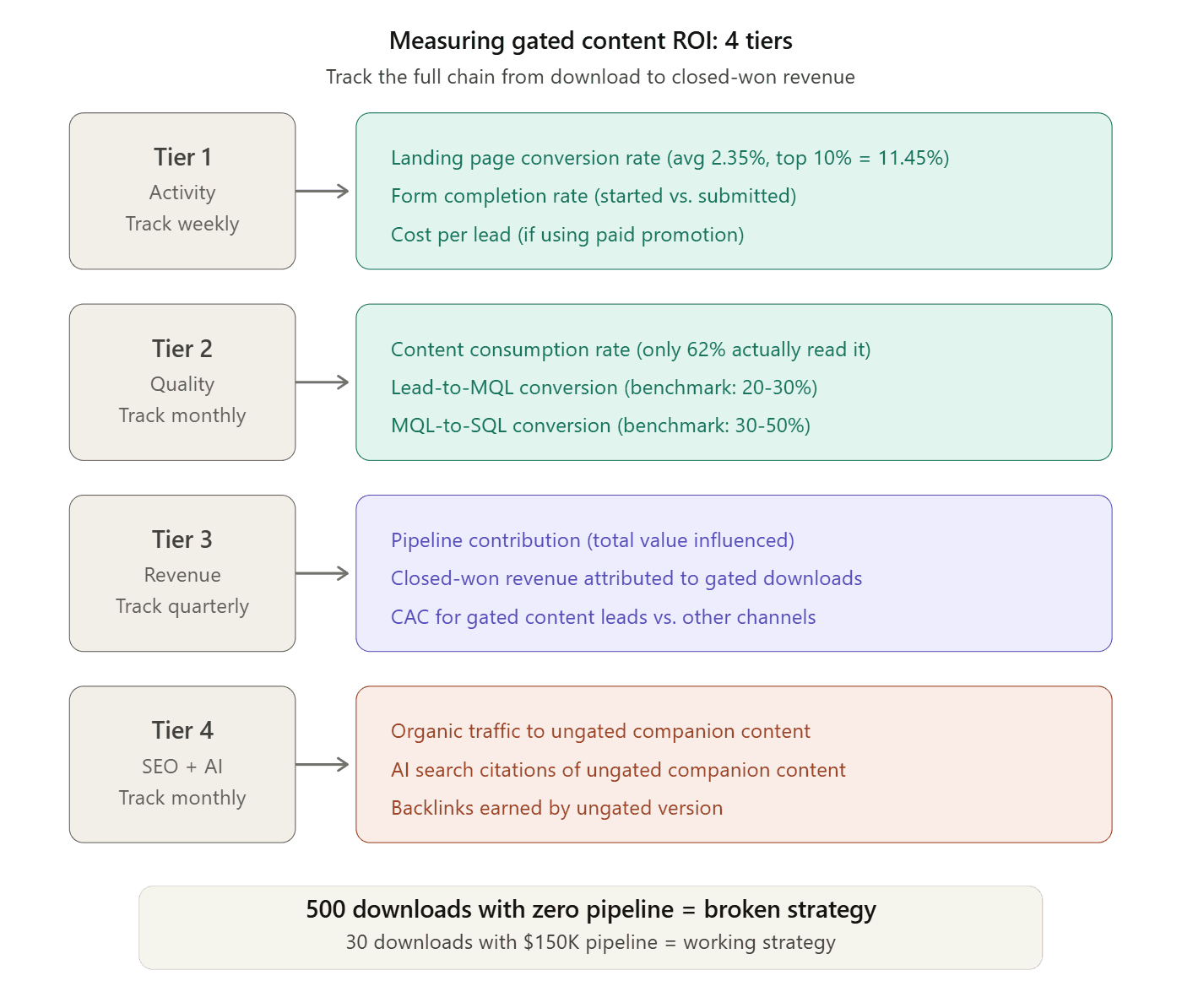
"We got 500 downloads" tells you nothing about revenue impact. Here is the measurement framework that connects gated content to business outcomes.
Tier 1: Activity metrics (track weekly)
Landing page conversion rate (benchmark: 2.35% average, 5.31% top quartile, 11.45% top decile)
Form completion rate (visitors who start the form vs. those who submit)
Cost per lead if using paid promotion
Tier 2: Quality metrics (track monthly)
Content consumption rate (what percentage of downloaders actually open/read the content)
Lead-to-MQL conversion rate (benchmark: 20-30% for well-qualified leads)
MQL-to-SQL conversion rate (benchmark: 30-50%)
Email nurture engagement (open rates, click rates on the post-download sequence)
Tier 3: Revenue metrics (track quarterly)
Pipeline contribution (total pipeline value influenced by the gated asset)
SQL-to-opportunity conversion rate (benchmark: 30-40%)
Closed-won revenue attributed to gated content downloads
Time from download to first sales conversation
Customer acquisition cost for gated content leads vs. other channels
Tier 4: SEO and AI impact metrics (track monthly)
Organic traffic to the ungated companion content (if using the hybrid model)
Keyword rankings for the ungated version
AI search citations of the ungated companion content
Backlinks earned by the ungated version (which benefit your entire domain authority)
The key insight: track the full chain from download to revenue, not just the download count. A gated asset that generates 100 downloads but zero pipeline is less valuable than one that generates 30 downloads and $150K in pipeline.
The Gated Content Formats That Convert Best (Ranked by Data)
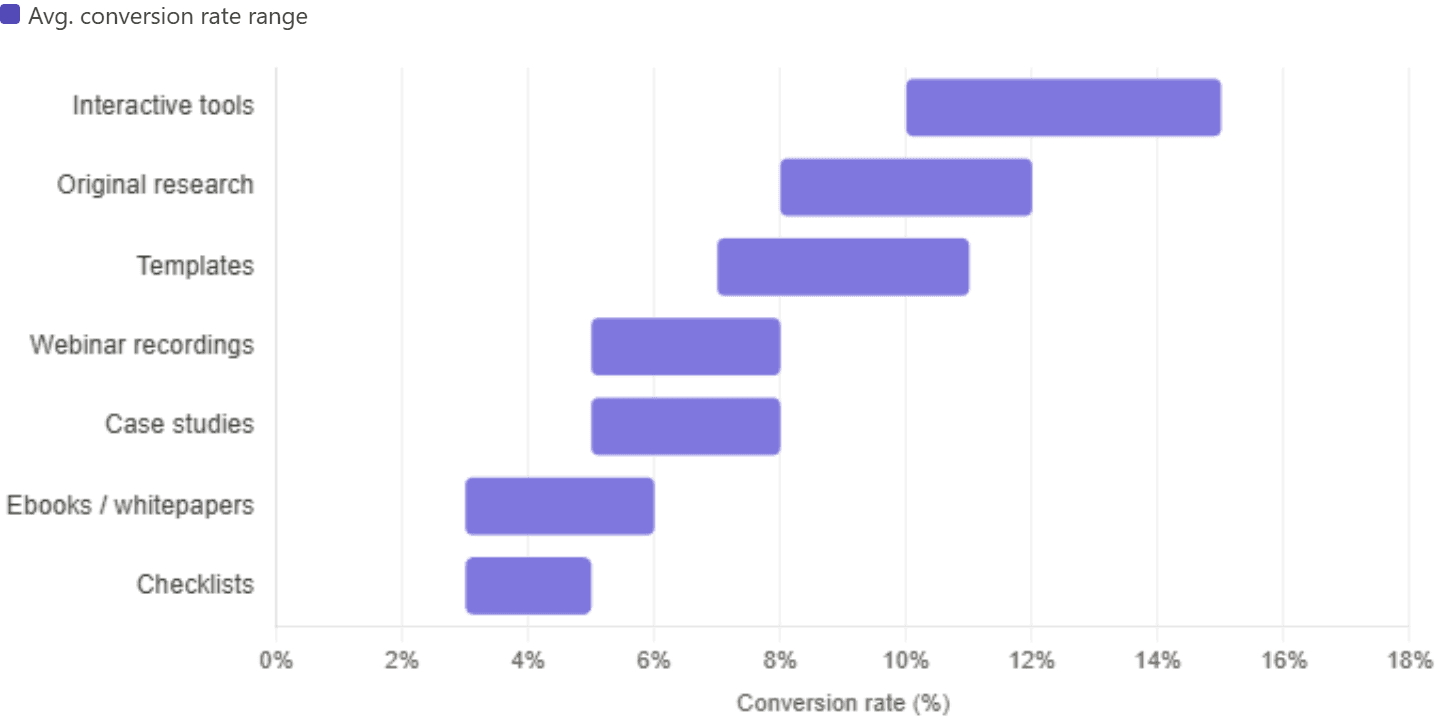
Not all gated formats perform equally. Here is how they rank based on conversion and lead quality data.
Format | Avg. Conversion Rate | Lead Quality | Best Funnel Stage | Best For |
|---|---|---|---|---|
Interactive tools (calculators, assessments) | 10-15% | Very high | MOFU/BOFU | SaaS, ecommerce, financial services |
Original research reports | 8-12% | High | MOFU | B2B, tech, consulting |
Templates and spreadsheets | 7-11% | Medium-high | MOFU | Marketing, operations, finance |
Webinar recordings | 5-8% | High | MOFU | B2B services, education, tech |
Detailed case studies | 5-8% | Very high | BOFU | All industries |
Ebooks and whitepapers | 3-6% | Medium | MOFU | B2B, professional services |
Checklists and quick guides | 3-5% | Medium-low | TOFU/MOFU | All industries |
Interactive tools consistently outperform static content because the user invests time in the experience before reaching the gate. By the time a calculator asks for an email to show the full results, the user has already demonstrated intent through their inputs. Interactive content drives roughly twice the conversion rate of static assets like PDFs.
7 Mistakes That Kill Gated Content Performance
1. Gating content that belongs in your blog
If the content answers a basic question that your prospects search for on Google, leave it ungated. Gating awareness-stage content "not only drastically reduces reach but also leads to unqualified leads who only want to access the content without genuine purchase interest." Save gates for content that goes deeper than what a blog post can cover.
2. Using the same form for every asset
A 15-page ebook does not justify the same form as a custom ROI calculator. Match form length to perceived value. Three fields for an ebook. Five to six fields for an interactive tool or assessment that delivers personalized results.
3. Ignoring the 62% who never consume the content
If most of your leads never read what they downloaded, your nurture sequence is emailing people who have no context for your follow-up messages. Deliver content on the thank-you page, send reminder emails, and pull key insights into your nurture sequence so leads absorb the value even if they never open the PDF.
4. Sending a sales pitch as email #1
The fastest way to lose a gated content lead is to send a "book a demo" email within hours of their download. They gave you their information for content, not a meeting. Deliver value first (emails 1-3), then make the ask (email 4) after you have earned the right.
5. Not connecting gated content to your SEO strategy
Every gated asset should have an ungated companion piece (blog post, article, or guide) that ranks in search, earns backlinks, and drives traffic to the gated landing page. Without this connection, your gated content relies entirely on paid promotion and email distribution. With it, organic traffic continuously feeds your lead capture.
6. Treating all leads the same regardless of what they downloaded
A lead who downloaded a "Beginner's Guide to Email Marketing" has different intent than one who downloaded a "CMO's Guide to Marketing Budget Justification." Segment your leads by the content they consumed and tailor follow-up accordingly. Your CRM and marketing automation platform make this straightforward.
7. Not measuring beyond downloads
Tracking downloads without tracking pipeline and revenue is like tracking website visits without tracking conversions. Use the four-tier measurement framework above to connect gated content to actual business outcomes.
Frequently Asked Questions
Should I gate content or leave it open for SEO?
Use the hybrid approach. Publish a comprehensive, ungated version that ranks in Google and gets cited by AI search engines. Offer a gated "enhanced" version (template, spreadsheet, full dataset) that adds extra actionable value. This preserves organic visibility while still capturing leads from engaged visitors.
How many form fields should I use?
Three fields (name, business email, company) is the optimal starting point. Reducing from four to three fields increases conversion by up to 50%. Add more fields only when the content value clearly justifies the friction, and use progressive profiling to gather additional data over subsequent interactions.
What conversion rate should I expect from gated content?
The average landing page converts at 2.35%. Top 25% performers hit 5.31%. Top 10% reach 11.45%. Interactive tools (calculators, assessments) consistently convert at 10-15%. High-value gated offers convert up to 11% of visitors, compared to just 2% for standard landing pages.
Does gated content hurt AI search visibility?
Yes. AI search engines cannot crawl content behind forms. If your most authoritative content is gated, AI platforms cite competitors with similar but freely accessible content instead. The hybrid approach (ungated blog + gated enhanced asset) solves this by keeping your best insights visible to AI crawlers while still capturing leads.
How do I know if my gated content is generating revenue, not just downloads?
Track the full chain: downloads, content consumption rate, lead-to-MQL conversion, MQL-to-SQL conversion, pipeline value influenced, and closed-won revenue. If your gated asset generates 500 downloads but zero pipeline contribution, the content or the follow-up sequence needs fixing.
What types of gated content work best for B2B?
Interactive tools (calculators, assessments, configurators) consistently produce the highest conversion rates and lead quality. Original research reports rank second because they contain proprietary data that cannot be found elsewhere. Templates and spreadsheets rank third because they offer immediate, practical value. Ebooks and whitepapers are effective but typically produce lower-intent leads than interactive formats.
How quickly should I follow up after someone downloads gated content?
Immediately. Deliver the content on the thank-you page and via email within seconds. Send a value-add email 3 days later highlighting the key insight. Send a case study at day 7. Make the first sales-oriented ask at day 14. The faster and more relevant your follow-up, the higher your conversion rate from lead to opportunity.
Your Next Move
Audit your existing gated content. For each asset, ask three questions: Is this content valuable enough to justify a gate? Does this asset have an ungated companion that ranks in search and gets cited by AI? Does the post-download nurture sequence deliver value before making a sales ask?
If the answer to any of those is "no," you have an optimization opportunity that directly impacts lead quality and pipeline.
Then identify your single highest-potential gated asset candidate: one piece of original research, one interactive tool, or one detailed buying guide that your audience cannot find anywhere else. Build it. Create the landing page. Set up the nurture sequence. Track it through to revenue.
If you need help building gated content strategies that integrate with your SEO and GEO efforts, Passionfruit's content team works with SaaS and ecommerce brands on exactly this challenge. See our case studies for measurable results.
The best gated content is not the content you hide. It is the content so valuable that people gladly exchange their information to get it.