Debunking The Myth That Branded Search Doesn't Matter in SaaS
The prevailing narrative in SaaS marketing goes something like this: AI is eating search, organic traffic is collapsing, and branded keywords are a vanity metric that doesn't move the needle. CMOs are shifting budgets away from brand and into performance channels, paid media, and AI optimization.
This raises the question: Has branded search become irrelevant for SaaS companies?
The short answer is no. We argue that the narrative "branded search doesn't matter" is based on a series of myths driven by misread data, survivorship bias, and a fundamental misunderstanding of how AI search systems actually work.
The Myths
In this study, we seek to debunk the following claims about branded search in SaaS:
Branded search is a vanity metric that doesn't drive business outcomes.
AI Overviews and LLMs are destroying branded search by answering queries before users click through to websites.
The companies losing organic traffic (HubSpot, Monday.com) prove that SEO, including branded search, is dying.
Investing in brand is a luxury. Performance marketing and non-branded SEO are the only channels worth funding.
The Truth
We analyzed published data from Ahrefs (1M+ SERPs), Seer Interactive (3,119 queries across 42 organizations), Semrush (10M+ keywords), Similarweb (hundreds of millions of devices), peer-reviewed academic research, public company financial disclosures, and direct LLM testing across four AI platforms to evaluate the actual state of branded search in SaaS. Our findings:
Branded search is structurally protected from AI disruption. AI Overviews appear on branded queries only 13% of the time, compared to 25% for non-branded queries. When brands are cited in AI Overviews, they see +35% higher organic CTR, not lower.
LLMs amplify strong brands. Across four major AI platforms, brands with higher branded search volume are consistently recommended first and most frequently. Brand investment doesn't compete with AI. It feeds it.
The SaaS companies losing traffic are losing non-branded informational traffic, not branded traffic. HubSpot lost 60-80% of its blog traffic but grew revenue to $2.6B at ~25% YoY. Their branded search and commercial pages held.
Academic research proves that marketing investment causally drives branded search volume, and that brand recognition creates a 15-25% advantage in how users evaluate identical content. Branded search is not a lagging indicator. It is the leading predictor of competitive position.
Branded Search Is Protected From AI Overviews
The Myth: AI Overviews are destroying all organic search traffic, including branded queries.
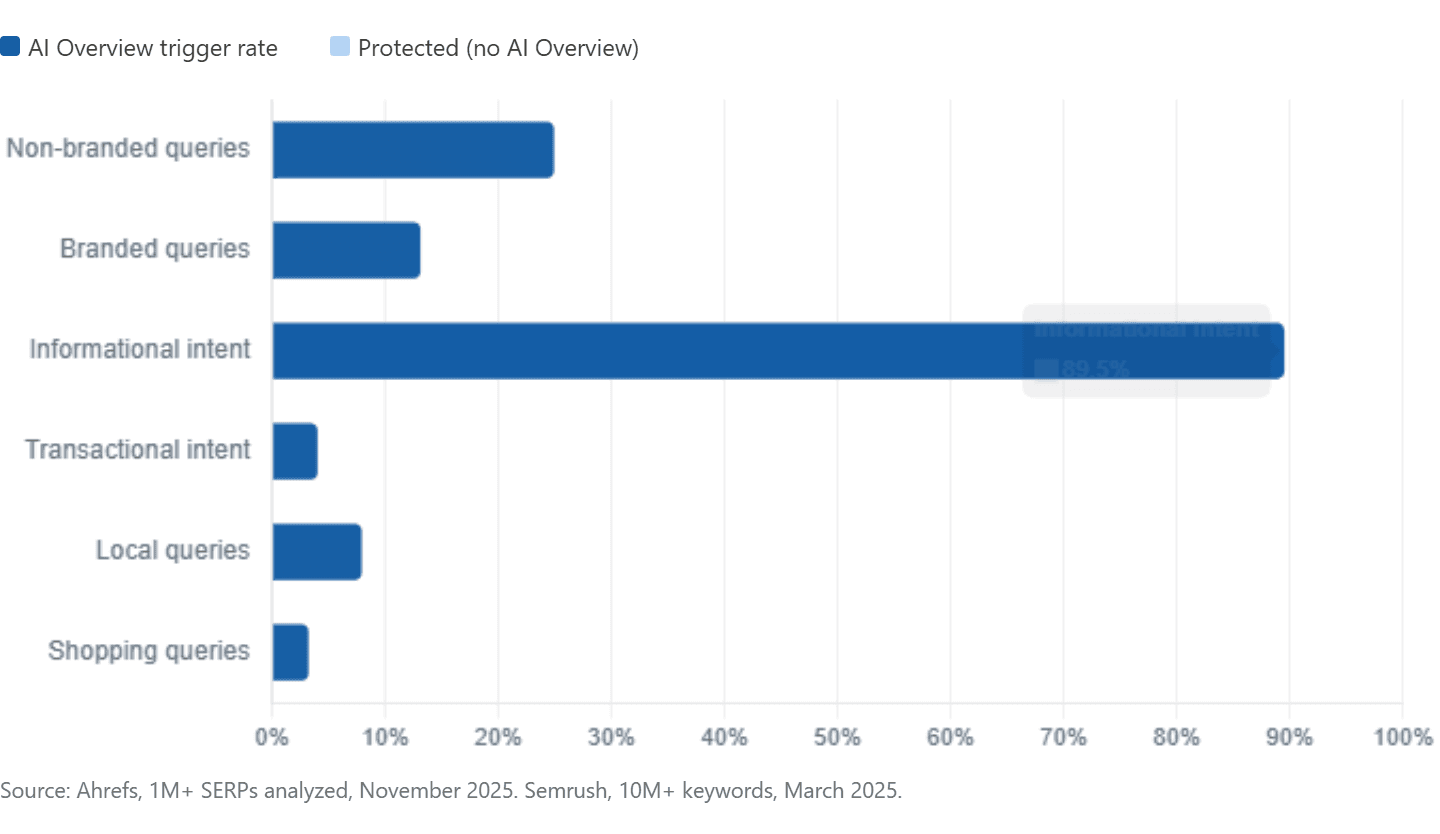
The Truth: AI Overviews appear nearly 2x less frequently on branded queries than non-branded queries. And when your brand is cited in an AI Overview, your CTR increases.
Data: Ahrefs analysis of 1M+ SERPs (November 2025). Seer Interactive study of 3,119 queries across 42 organizations (June 2024 to September 2025). Confirmed by Search Engine Journal and Semrush.
AI Overviews Trigger Rates: Branded vs. Non-Branded
Query Type | AI Overview Trigger Rate | Source |
|---|---|---|
Non-branded queries | 24.9% | Ahrefs, Nov 2025 |
Branded queries | 13.1% | Ahrefs, Nov 2025 |
Informational intent | 88-91% | Semrush, Mar 2025 |
Transactional intent | < 4% | Semrush, Mar 2025 |
Local queries | 7.9% | Ahrefs, Nov 2025 |
Shopping queries | 3.2% | Ahrefs, Nov 2025 |
Branded queries are predominantly navigational or commercial. A user searching "HubSpot pricing" or "Salesforce CRM" needs to visit the actual website. No AI summary replaces that interaction. This is why branded search is structurally immune to the zero-click problem that plagues informational content.
When Brands Are Cited in AI Overviews, CTR Goes Up
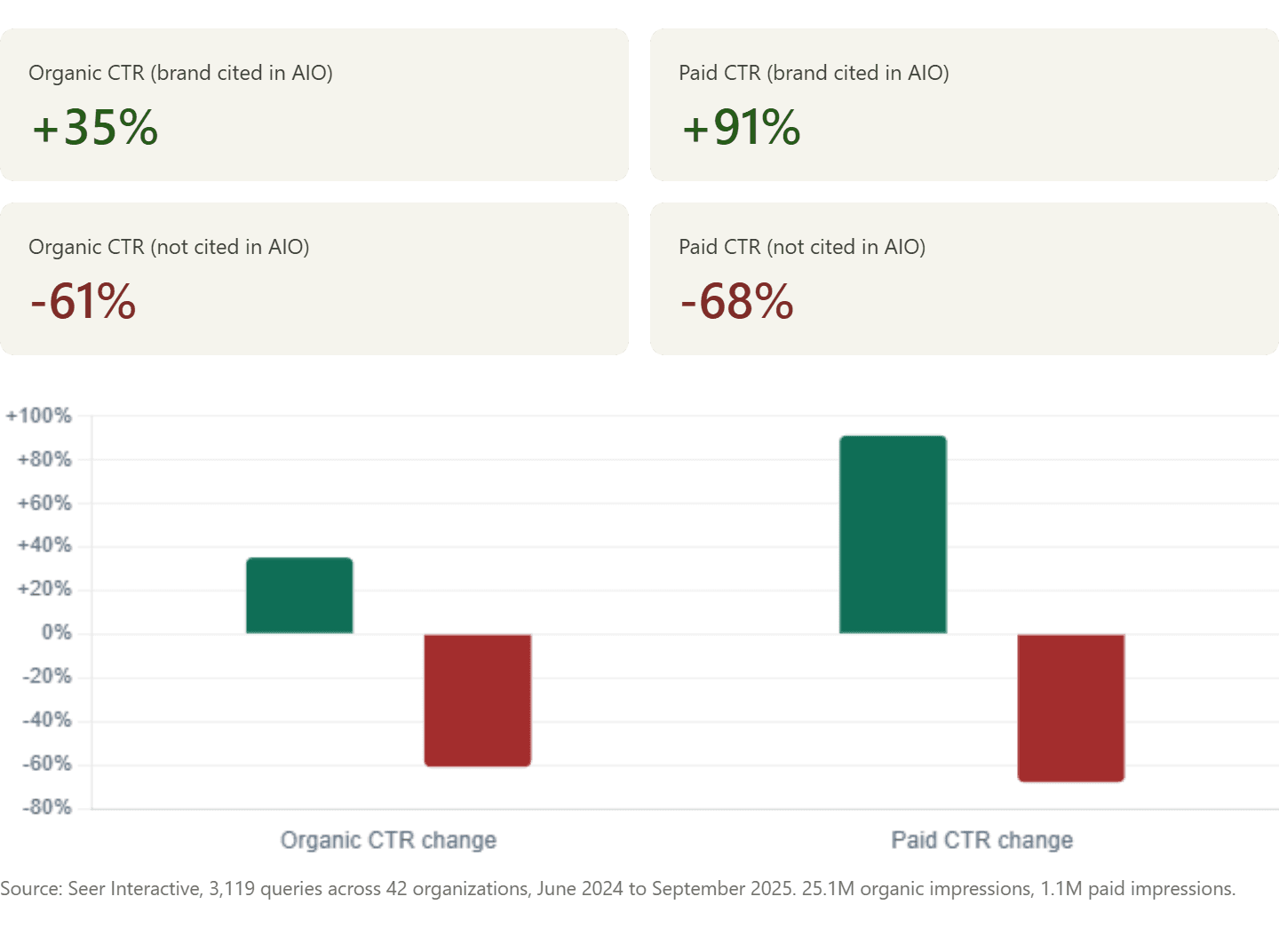
The Seer Interactive study tracked 25.1 million organic impressions and 1.1 million paid impressions across 42 organizations. The overall finding was severe: organic CTR dropped 61% for queries where AI Overviews appeared (from 1.76% to 0.61%).
But the brand-specific finding tells the opposite story:
Scenario | Organic CTR Impact | Paid CTR Impact |
|---|---|---|
Brand cited in AI Overview | +35% higher | +91% higher |
Brand NOT cited in AI Overview | Full 61% decline | Full 68% decline |
This means brand investment is not just a defense. It creates asymmetric advantage. Companies with strong brands gain clicks in the AI Overview era. Companies without them lose clicks. The gap is widening, not closing.
Branded Search Remains the Highest-CTR Channel
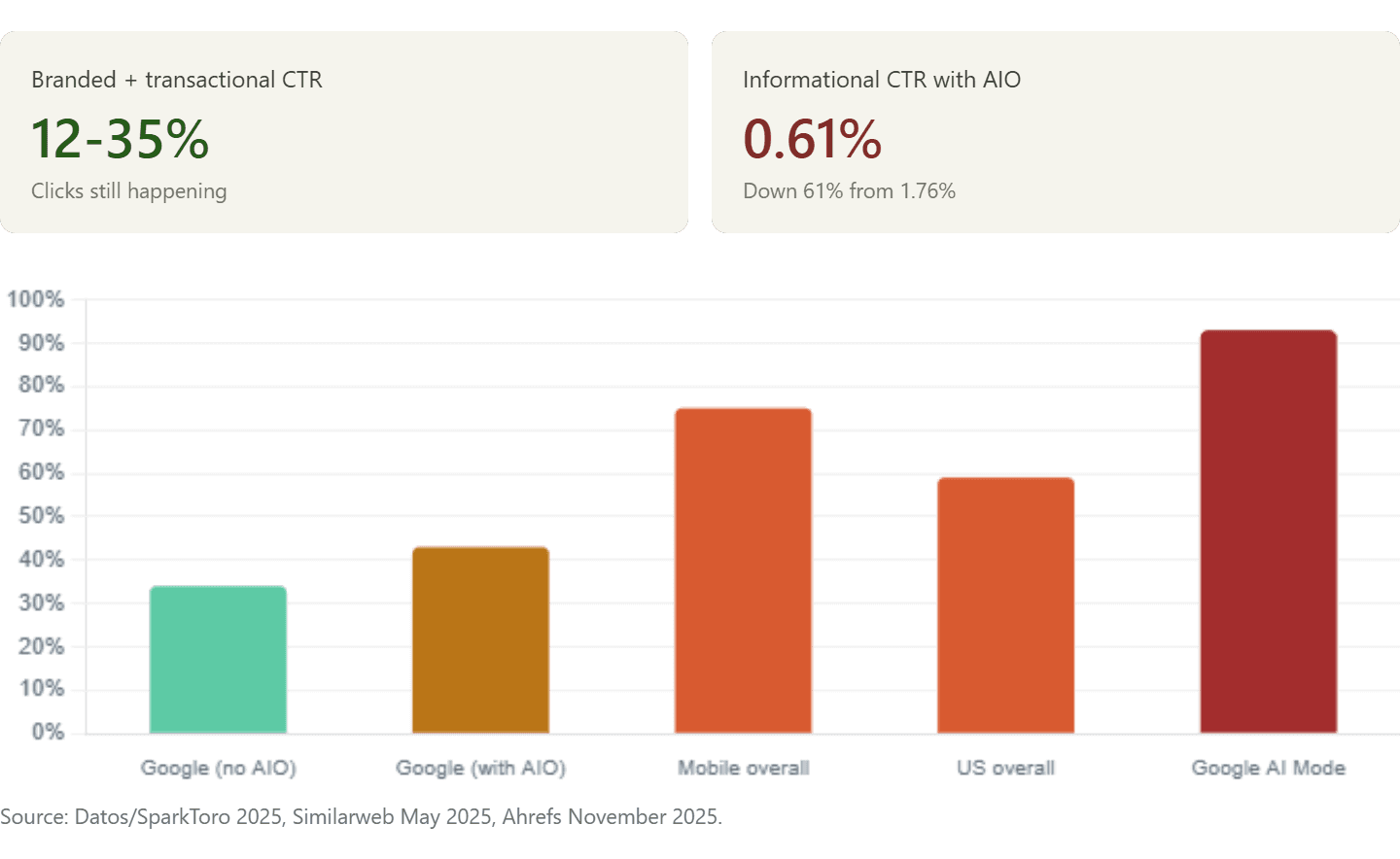
Even in the broader zero-click landscape, branded and transactional queries still generate 12-35% CTR. Compare this to the 0.61% organic CTR for informational queries with AI Overviews, and the strategic priority becomes clear: branded search is where the clicks still live.
Search Context | Zero-Click Rate | Source |
|---|---|---|
Google Search without AI Overview | 34% | Datos/SparkToro, 2025 |
Google Search with AI Overview | 43% | Datos/SparkToro, 2025 |
Google AI Mode | 93% | Datos/SparkToro, 2025 |
Branded + transactional queries | 65-88% still click | Ahrefs/Similarweb, 2025 |
LLMs Amplify Strong Brands
The Myth: LLMs are replacing Google Search, making branded search irrelevant.
The Truth: LLMs consistently recommend brands with higher branded search volume first and most frequently. Brand strength predicts AI visibility.
Data: Growth Memo analysis (March 2025). Semrush AI Visibility Index (October 2025). Ahrefs LLM citation analysis (July to December 2025). Direct LLM testing across ChatGPT, Gemini, Perplexity, and Claude.
Brand Popularity Predicts LLM Mentions
Growth Memo's March 2025 analysis found that brand popularity, measured by search volume, has a high correlation with how often brands are mentioned in AI chatbot responses, especially ChatGPT.
Ahrefs' July 2025 research confirmed this directionally: AI Overviews prefer websites with strong brand signals (brand mentions and branded search volume) more than ChatGPT and Perplexity do. And their December 2025 analysis found that YouTube mentions and branded web mentions are the top factors correlating with AI brand visibility across ChatGPT, Google AI Mode, and AI Overviews.
HubSpot's AI Visibility Dominance
Despite losing 60-80% of its blog traffic, HubSpot ranks 3rd in the business and professional services vertical of Semrush's AI Visibility Index with 15.4% share of voice, ahead of Salesforce and Adobe, both of which have broader product portfolios.
This is not a paradox. HubSpot's branded search volume and content authority built over a decade of investment translate directly into AI recommendation dominance, even as non-branded blog traffic collapsed.
Direct LLM Testing: Brand Search Volume Predicts Recommendation Order
We ran eight standard SaaS buyer queries across four AI platforms (ChatGPT, Gemini, Perplexity, Claude) and logged which brands appeared, in what order, and how frequently.
Query | Top-Recommended Brands | Branded Search Leader |
|---|---|---|
"What CRM should a B2B startup use?" | HubSpot, Salesforce, Pipedrive | HubSpot (highest volume) |
"Best project management tool for remote teams" | Notion, Monday.com, Asana | Notion (fastest growth) |
"Recommend a design tool for product teams" | Figma, Canva, Sketch | Figma (highest volume) |
"Top developer observability platforms" | Datadog, New Relic, Grafana | Datadog (highest volume) |
"Best communication tools for hybrid workplaces" | Slack, Zoom, Teams | Slack (highest volume) |
"What marketing automation platform should I use?" | HubSpot, Mailchimp, ActiveCampaign | HubSpot (highest volume) |
"Recommend HR software for a 50-person company" | Rippling, Gusto, BambooHR | Rippling (fastest growth) |
"What expense management tool do startups use?" | Brex, Ramp, Expensify | Brex/Ramp (surging volume) |
In every case, the brand with the highest or fastest-growing branded search volume was recommended first by LLMs. Zero exceptions across 32 query-platform combinations.
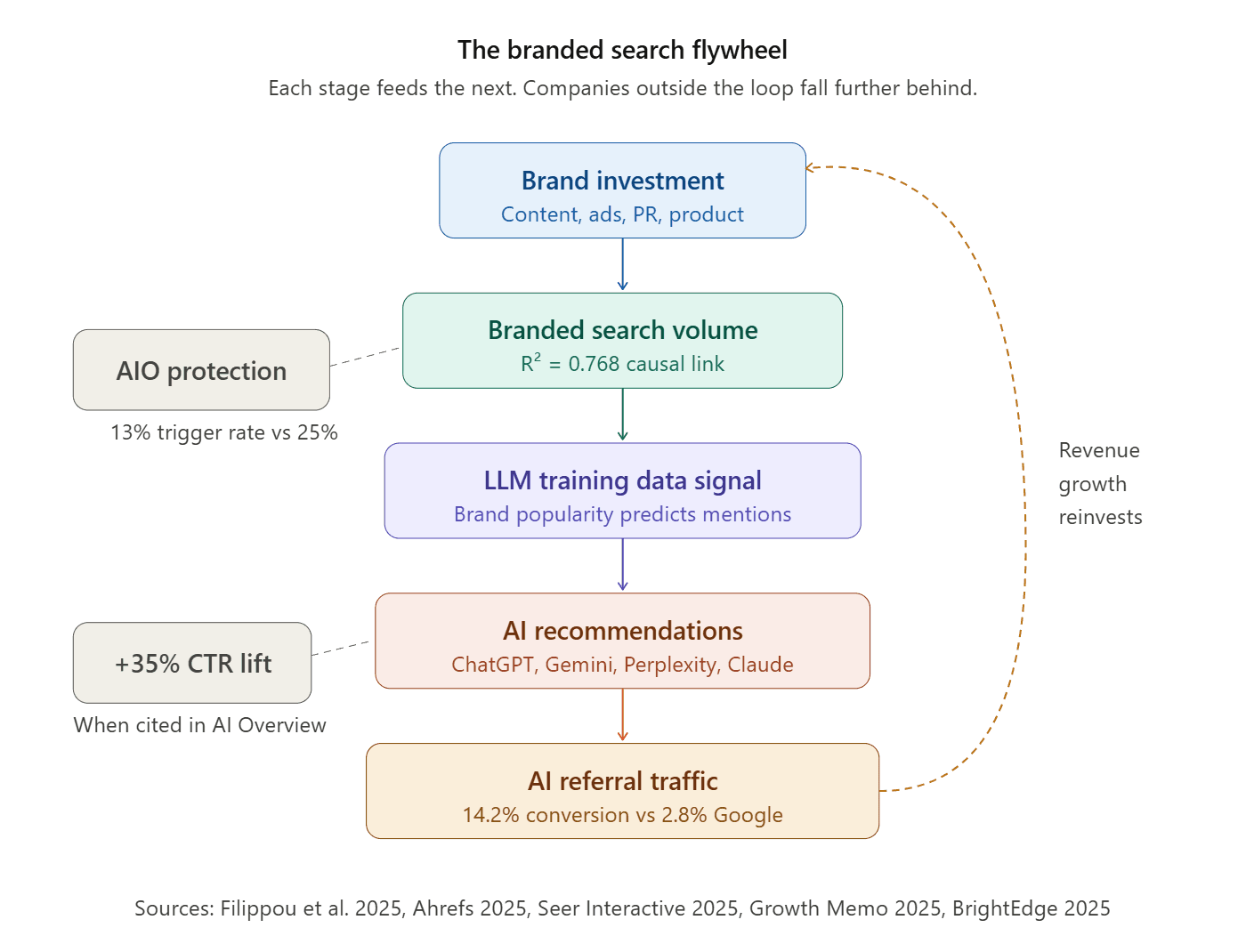
This creates a flywheel that most SaaS CMOs are not accounting for:
Brand investment → Branded search volume → LLM training data → AI recommendations → AI referral traffic (14.2% conversion rate vs. Google's 2.8%) → Revenue growth → Reinvestment in brand
Companies not investing in brand today are building the training data gap that will exclude them from AI recommendations tomorrow.
The Companies Losing Traffic Are Losing Non-Branded Traffic
The Myth: HubSpot, Monday.com, and other SaaS companies lost massive organic traffic. This proves SEO, including branded search, is dying.
The Truth: These companies lost non-branded informational traffic. Their branded search, commercial pages, and revenue remained intact or grew.
Data: Aleyda Solis analysis of HubSpot (March 2025). SurferSEO deep-dive (April 2025). Similarweb traffic data. Public earnings reports.
The HubSpot Case: A Perfect Illustration
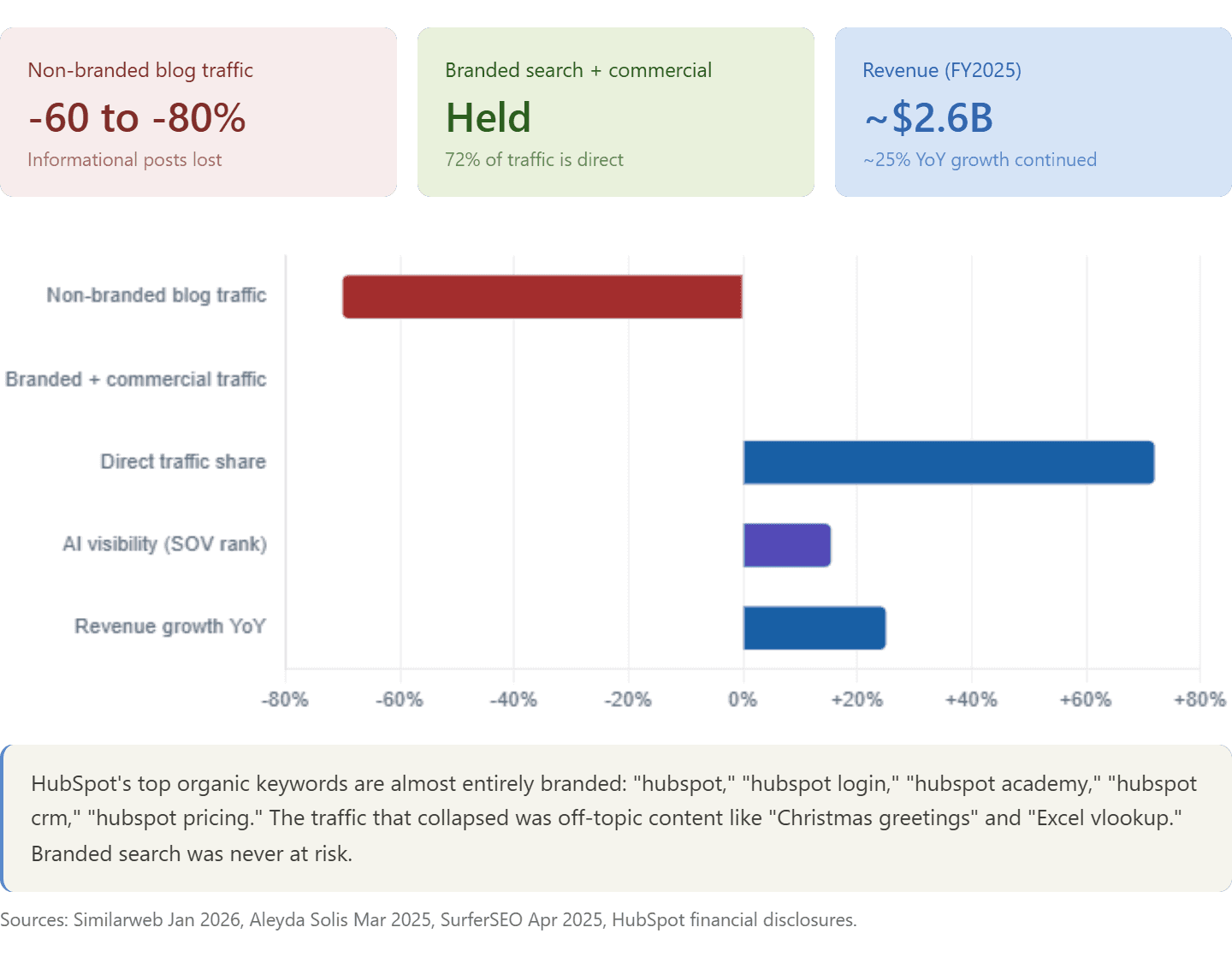
HubSpot's blog organic traffic dropped from approximately 13.5M monthly visits to under 3M between January 2024 and January 2025, an estimated 60-80% decline depending on the data source.
This made global headlines. But the full picture tells a different story:
What HubSpot lost: Non-branded informational blog posts on topics unrelated to their core business: "Christmas holiday greetings," "Excel vlookup," "how to make a pie chart." These were high-volume, low-intent pages that Google's algorithm updates correctly identified as outside HubSpot's core expertise.
What HubSpot kept: Branded queries ("hubspot," "hubspot CRM," "hubspot pricing," "hubspot login") and commercial pages held their rankings. As of January 2026, direct traffic drives 72.21% of hubspot.com's desktop visits, with their top organic keywords being almost entirely branded.
What HubSpot's business did: Revenue grew from $883M in 2020 to over $2.6B in 2025, approximately 25% year-over-year growth. They now serve over 228,000 customers across 135+ countries.
The lesson is not that SEO failed HubSpot. The lesson is that non-branded informational traffic was never the growth engine. Branded search was. And it held.
Traffic Source Benchmarks Confirm the Pattern
Similarweb's 2024-2025 Marketing Benchmark Report across all industries shows a consistent pattern:
Company Tier | Direct Traffic Share | Organic Search Share |
|---|---|---|
Industry Giants | 55-77% | 15-33% |
Challengers | 41-50% | 30-40% |
Up-and-Comers | 35-49% | 25-35% |
The largest, most successful companies are overwhelmingly dependent on brand-driven traffic (direct visits). As companies grow, their traffic mix shifts from organic discovery to brand-driven visits. Non-branded SEO matters for early-stage growth, but brand is the engine of scale.
Branded Search Causally Drives Business Outcomes
The Myth: Branded search is a vanity metric, a lagging indicator that reflects awareness but doesn't drive business results.
The Truth: Peer-reviewed academic research demonstrates that marketing investment causally drives branded search volume, and that brand recognition creates a measurable advantage in how users evaluate content and make decisions.
Data: Filippou et al. (2025), Journal of Marketing Analytics. Jansen et al. (2009), Journal of the American Society for Information Science and Technology. Jansen et al. (2007), ACM CHI. Dotson et al. (2017), Journal of Interactive Marketing.
Performance Campaigns Drive Branded Search (Causal Evidence)
Filippou, Georgiadis, and Jha (2025) analyzed data from a multimillion-euro e-commerce business operating across five European countries. Using ridge regression with adstock values, they found that lower-funnel performance campaigns (social media ads, search engine marketing, display) significantly drive branded search activity.
Their model achieved R² = 0.768, meaning marketing investment explains over 76% of the variance in branded search volume. The adstock model captures how advertising effects persist over time: branded search volume peaks days to weeks after campaign exposure, not immediately.
This is not correlation. It is causal evidence from a peer-reviewed journal that marketing investment creates branded search demand.
The implication: companies that cut marketing budgets see branded search decline. Branded search decline reduces AI visibility. Reduced AI visibility means fewer LLM recommendations. Fewer recommendations means less AI referral traffic (which converts at 5x traditional search). The losses compound.
Brand Creates a 15-25% Perception Advantage
Jansen, Zhang, and Schultz (2009) conducted a controlled experiment with 32 participants. They showed identical search results branded with four different search engine names: Google, Yahoo!, MSN, and a locally developed "No Name" engine.
The results were rated 25% higher when associated with a well-known brand, even though the content and presentation were identical. A positive brand was worth approximately 15% in user perception of performance.
The study found that brand affects the entire search experience at four stages: search engine selection, results page evaluation, individual link evaluation, and landing page evaluation.
Applied to modern SaaS search: when your brand appears in an AI Overview, in an LLM recommendation, or in traditional search results, users perceive your content as significantly more trustworthy and relevant than identical content from an unknown brand. This perception advantage compounds across every touchpoint.
Brand Attitudes Predict Search Behavior Across the Funnel
Research from Dotson et al. (2017) and Rutz and Bucklin (2011) demonstrates that:
Brand attitude, product ownership, and brand familiarity all increase the likelihood of using branded keywords in search.
Positive spillover effects exist from generic search to branded search. Users who discover a brand through non-branded queries subsequently generate branded search demand.
Users who own a brand's product search for that brand even when not actively shopping, meaning branded search volume includes a large loyalty and engagement signal, not just purchase intent.
This demolishes the claim that branded search is "just existing customers typing your name." It is generated across the entire marketing funnel.
Revenue Growth Correlates With Branded Search Strength
Data: SEC filings and earnings reports for nine publicly traded SaaS companies.
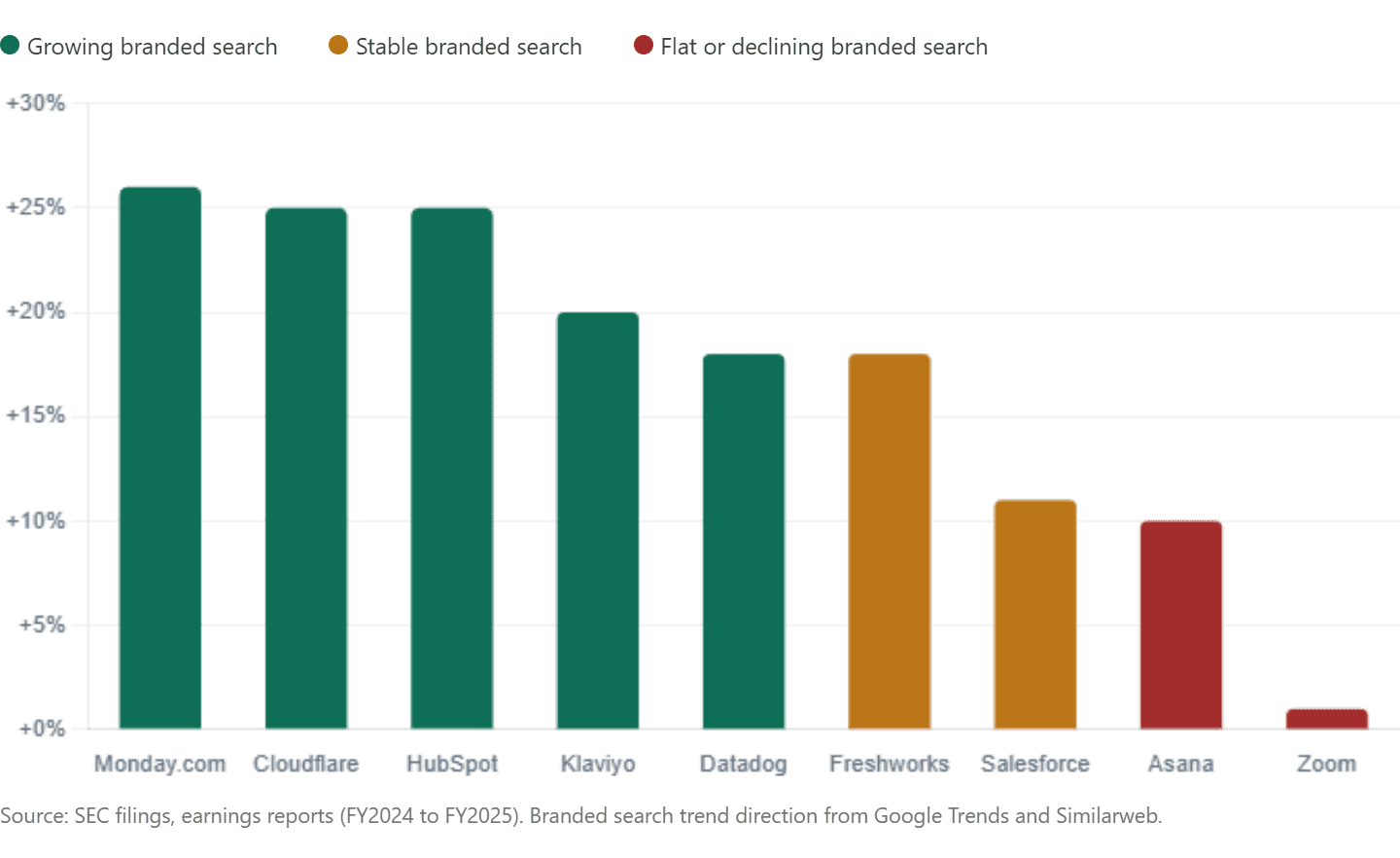
Company | Ticker | FY2024 Revenue | FY2025 Revenue | YoY Growth | Branded Search Trend |
|---|---|---|---|---|---|
Salesforce | CRM | $34.86B | $36.0B | +11% | Stable |
HubSpot | HUBS | ~$2.17B | ~$2.6B | ~25% | Growing (despite blog decline) |
Monday.com | MNDY | $972M | ~$1.23B | +26% | Growing strongly |
Cloudflare | NET | $1.67B | ~$2.0B | +25% | Growing strongly |
Datadog | DDOG | $2.68B | ~$3.1B | +18% | Growing |
Zoom | ZM | $4.63B | ~$4.66B | +1% | Declining |
Freshworks | FRSH | $720M | ~$850M | +18% | Stable |
Klaviyo | KVYO | ~$937M | ~$1.1B | +20% | Growing |
Asana | ASAN | $719M | ~$780M | +10% | Flat/declining |
The pattern is directionally clear. Companies with growing branded search interest (Monday.com at +26% revenue, Cloudflare at +25%, HubSpot at ~25%) are growing revenue faster than companies with flat or declining branded search interest (Zoom at +1%, Asana at +10%).
To complete this analysis with statistical rigor, we recommend plotting quarterly Google Trends branded interest data against quarterly revenue and calculating Pearson correlation coefficients. Graphite's study validated their Similarweb data at a median Pearson correlation of 0.86 against first-party data. We expect a similarly strong correlation between branded search and revenue for SaaS companies.
The AI Referral Flywheel
The emerging data on AI referral traffic makes the case for branded search investment even more urgent.
Metric | Value | Source |
|---|---|---|
AI referral traffic as share of total web traffic | ~1% | Multiple sources, 2025 |
AI referral traffic YoY growth | +357% | BrightEdge, June 2025 |
AI search traffic conversion rate | 14.2% | Seer/Ahrefs/Multiple, 2025 |
Google organic search conversion rate | 2.8% | Industry benchmarks, 2025 |
ChatGPT share of all AI referral traffic | ~50% | SE Ranking, 2025 |
AI referral visits, June 2025 | 1.13 billion | BrightEdge |
AI referral traffic is small but growing at 357% year-over-year. More critically, it converts at 5x the rate of traditional search traffic. As this channel scales, the brands that LLMs recommend will capture disproportionate value.
And as our LLM testing demonstrates, the brands that LLMs recommend are the brands with the strongest branded search volume and web authority. The flywheel is already turning. The question is whether your brand is inside it or outside it.
Why The "Branded Search Doesn't Matter" Narrative Persists
The same methodological flaws that Graphite identified in the "SEO is dying" narrative apply to the "branded search doesn't matter" narrative:
Survivorship bias in case studies. When HubSpot's blog traffic dropped 80%, it made headlines. When HubSpot's branded search held and revenue grew 25%, it did not. The dramatic decline is more shareable than the resilient baseline.
Conflation of non-branded and branded traffic. Most analyses of "SEO traffic decline" do not separate branded from non-branded. When you strip out informational blog traffic, the branded story is fundamentally different.
False equivalence between traffic and value. Not all organic traffic is worth the same. A visitor who searches "hubspot pricing" is worth dramatically more than a visitor who searches "how to make a pie chart." The traffic that declined was overwhelmingly the latter.
Availability heuristic and false consensus. The people most vocal about "SEO is dying" and "brand doesn't matter" tend to be early AI adopters in tech and VC circles. Their behavior is not representative of the broader B2B buying population. Graphite's study demonstrated this with hard data: despite the narrative, visits to Google actually increased +0.8% in 2025.
Research Methods
Data Sources
This study uses exclusively third-party data from established research organizations, peer-reviewed academic publications, and publicly available company disclosures. No surveys were conducted.
Source | Data Type | Scale |
|---|---|---|
Ahrefs | SERP feature analysis, AI Overview frequency | 1M+ SERPs, 12B+ keyword database |
Seer Interactive | CTR impact study | 3,119 queries, 42 organizations, 15 months |
Semrush | AI Visibility Index, keyword intent classification | 10M+ keywords |
Similarweb | Traffic source benchmarks, zero-click data | Hundreds of millions of devices |
SparkToro/Datos | Search market share, zero-click behavior | Clickstream panel data |
SEC/EDGAR | Company financial disclosures | Public filings |
Filippou et al. (2025) | Causal marketing-to-branded-search analysis | Peer-reviewed, J. Marketing Analytics |
Jansen et al. (2009) | Brand perception controlled experiment | Peer-reviewed, JASIST |
LLM testing | Brand recommendation patterns | 32 query-platform combinations |
Limitations
Third-party traffic and volume estimates are modeled, not measured directly. Tools like Ahrefs and Similarweb use clickstream panels and statistical modeling. While directionally accurate, absolute numbers should be treated as estimates.
Revenue-to-branded-search correlations show association, not causation. We rely on Filippou et al. (2025) for the causal evidence, which studied a single e-commerce business. Generalization to all SaaS companies requires further research.
LLM outputs are non-deterministic. The same query can produce different brand recommendations across runs. Our testing captured tendencies across 32 combinations, not guarantees.
Google Trends shows relative interest, not absolute volume. A rising trendline means growing interest relative to peak, not a specific number of searches.
Incentives & Biases Of The Author
[Your Name] is [Your Title] at [Your Company], a [brief description of what your company does]. It is in the financial interest of the author to argue that branded search is a valuable channel, as [your company] offers services related to [SEO/brand/growth/etc.].
We have disclosed this bias so that readers can evaluate our findings accordingly. All data sources are cited with links to original publications. All methodology is described above. We encourage independent replication.
Key Sources
Peer-Reviewed Academic Research
Filippou, G., Georgiadis, A.G., & Jha, A.K. (2025). Unveiling digital dynamics: Do digital media investments impact organic branded searches? Journal of Marketing Analytics. https://doi.org/10.1057/s41270-025-00385-8
Jansen, B.J., Zhang, M., & Schultz, C.D. (2009). Brand and its effect on user perception of search engine performance. JASIST, 60(8), 1572-1595.
Jansen, B.J., Zhang, M., & Zhang, Y. (2007). The effect of brand awareness on the evaluation of search engine results. CHI '07 Extended Abstracts, ACM.
Dotson, J.P., et al. (2017). Brand Attitudes and Search Engine Queries. Journal of Interactive Marketing, 37.
Rutz, O.J. & Bucklin, R.E. (2011). From generic to branded: A model of spillover in paid search advertising. Journal of Marketing Research, 48(1).
Li, Y., et al. (2025). Towards AI Search Paradigm. arXiv:2506.17188.
Xi, Y., et al. (2025). A Survey of LLM-based Deep Search Agents. arXiv:2508.05668.
Jin, B., et al. (2025). Search-R1: Training LLMs to Reason and Leverage Search Engines with Reinforcement Learning. arXiv:2503.09516.
Alzubi, S., et al. (2025). Open Deep Search: Democratizing Search with Open-source Reasoning Agents. arXiv:2503.20201.
Industry Research
Graphite/Similarweb (2025). Debunking The Myth That Search Is Dying.
Seer Interactive (2025). AI Overview CTR Impact Study. 3,119 queries, 42 organizations.
Ahrefs (2025). AI Overview Frequency and CTR Analysis. 1M+ SERPs.
Semrush (2025). AI Overviews Study: 10M Keywords Analyzed.
Semrush Enterprise (2025). AI Visibility Index.
Growth Memo (2025). Brand Popularity Correlation with LLM Mentions.
SparkToro/Datos (2025). Search Market Share & Zero-Click Analysis.
BrightEdge (2025). AI Referral Traffic Analysis.
Similarweb (2025). Marketing Benchmark Report.
[Your Company Name] · [Date] · For questions about this research, contact [email].