SEO
Join 500+ brands growing with Passionfruit!
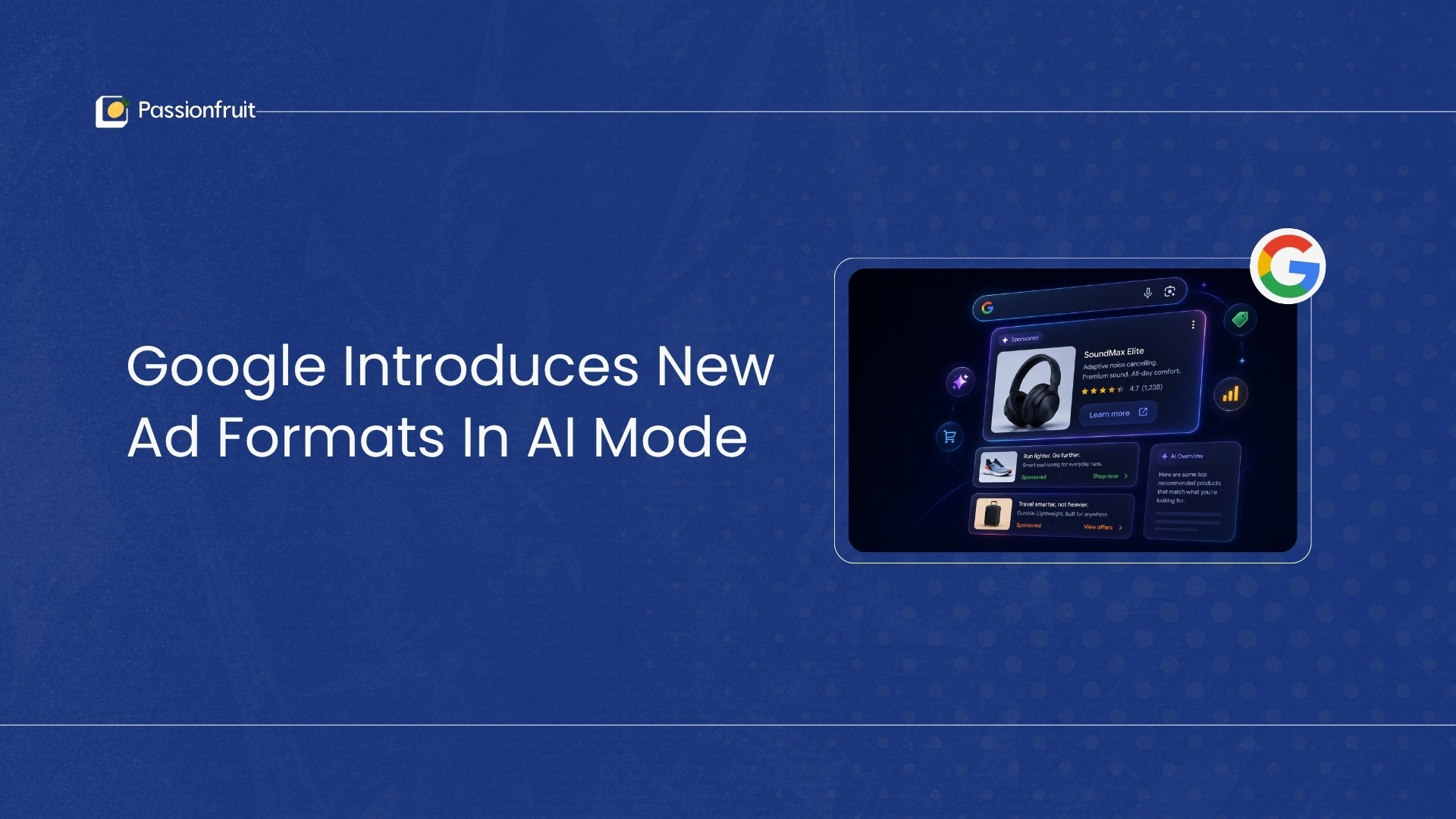
Google announced two new ad formats for AI Mode at Google Marketing Live 2026 on May 20: Conversational Discovery ads and Highlighted Answers.
Both are powered by Gemini. Both place ads directly inside AI-generated answers and recommendation lists. Both carry a "Sponsored" label and include an independent Gemini-written explainer alongside the ad creative.
For advertisers, the formats change what you optimize. Gemini now generates ad creative per query instead of serving a static asset, which makes structured product data, asset diversity, and landing page quality the levers that matter, not pre-built creative.
Our piece below explains both formats, how Google's approach differs from ChatGPT and Copilot ads, what the ad layer means for organic AI visibility, and how to prepare your campaigns now.
What Google announced at Marketing Live 2026
Google introduced four new Gemini-powered ad formats at Google Marketing Live 2026.
Two are in testing inside AI Mode:
Conversational Discovery ads
Highlighted Answers
Two are rolling out across Search in the coming months:
AI-powered Shopping ads (for high-consideration purchases like TVs and appliances)
Business Agent for Leads (open beta in the US for English-language accounts)
Google also expanded its Direct Offers pilot with AI-generated bundles, native checkout, and travel deals. Pilot brands include Chewy, Gap, and L'Oreal.
The announcement landed the same week Google confirmed at I/O that AI Mode passed 1 billion monthly users. Our Google I/O 2026 recap covers the full set of I/O announcements that set the stage for Marketing Live.
No public surfacing date has been confirmed for the two AI Mode formats. Both are in testing for now.
Conversational Discovery ads, explained
Conversational Discovery ads answer a user's specific question directly inside AI Mode, with creative that Gemini builds in real time for that query.
The shift is the creative generation. Instead of serving a static asset you built in advance, Gemini generates tailored creative and surfaces product features tied to the conversation. Google's example showed someone asking how to make their home smell like "fancy spas or a rainy forest" using low-maintenance solutions.
Each Conversational Discovery ad pairs with an independent AI explainer. The explainer is a Gemini-written context layer that synthesizes information about the product or service alongside the advertiser's creative.
Conversational Discovery ads target longer, exploratory prompts. Users refine what they want throughout the interaction rather than searching once with a single high-intent keyword.
The practical implication for advertisers:
Keyword targeting matters less. Conversation context matters more.
Static creative matters less. Structured product data and asset diversity matter more.
The ad you ship is not the ad the user sees. Gemini assembles it per query from your inputs.
Highlighted Answers, explained
Highlighted Answers place ads directly inside the recommendation lists that AI Mode generates.
When AI Mode returns a list of suggestions, a highly relevant ad can appear within that list as a Highlighted Answer. Google's example showed someone researching language learning apps before a trip, where a relevant app could appear inside the recommendation set.
The format moves the ad closer to the recommendation itself, rather than placing it alongside traditional search results.
For advertisers, that creates visibility earlier in the research process, before the user narrows to a final decision. Like Conversational Discovery ads, Highlighted Answers carry a "Sponsored" label and include a Gemini-written explainer.
How Google's AI Mode ads differ from ChatGPT and Copilot ads
Google is not alone in putting ads inside conversational AI answers. The difference is in the mechanics.
Microsoft has tested in-conversation ad formats inside Copilot since late 2025. OpenAI expanded ChatGPT shopping ads earlier in May 2026. Our explainer on what ChatGPT Ads are and how they work covers the OpenAI approach in detail.
Google's distinguishing pitch is the independent AI explainer. The Gemini-written context layer that sits alongside each ad is meant to make the reasoning visible to the user, which Google positions as a trust mechanism.
Here is how the three compare.
Feature | Google AI Mode ads | ChatGPT Ads | Microsoft Copilot ads |
|---|---|---|---|
Underlying model | Gemini | GPT and OpenAI models | OpenAI models via Bing |
Creative generation | Gemini builds creative per query | Advertiser provides creative | Advertiser provides creative |
Independent explainer | Yes, Gemini-written | No | No |
Placement | Inside AI answers and lists | Below the AI response | Inside Copilot answers |
Targeting basis | Conversation context | Conversation context | Conversation context |
Answer independence | Ad separate from organic answer | Ad separate from organic answer | Ad separate from organic answer |
The shared thread across all three: none of them let an advertiser pay to change the organic AI answer itself. The ad sits next to the answer, labeled, separate. That separation is the load-bearing principle for all conversational ad products in 2026.
What AI Mode ads mean for organic AI visibility
Here is the part most coverage skips. AI Mode ads are a paid layer that sits alongside the organic AI answer, not inside it.
The ad does not change which sources AI Mode cites in its organic response. Earned visibility through SEO, GEO, and AEO still determines whether your brand gets mentioned inside the answer itself.
Two implications follow.
First, organic and paid share the same foundation. The structured product data, clean feeds, entity-consistent content, and citation-worthy material that make a strong Conversational Discovery ad are the same signals that earn organic citation inside AI Mode. A brand investing in generative engine optimization already has most of what the paid layer needs.
Second, paid plus organic compounds. A brand cited organically inside the AI Mode answer AND running a Highlighted Answer in the recommendation list gets two placements in the same response. A brand running only the ad gets the sponsored slot while the organic answer recommends competitors.
The strategic takeaway: the ad layer rewards brands that already do the organic work. Paid is an accelerant on top of earned citation, not a substitute for it.
How to prepare for Google AI Mode ads
The formats are in testing, which means now is the preparation window. Six steps to be ready.
1. Audit your structured product data
Gemini builds Conversational Discovery and Shopping ad creative from your product data. Sparse or inconsistent feeds produce weak creative. Audit your Google Merchant Center feed for attribute completeness, accurate inventory, and descriptive product attributes.
2. Diversify your creative assets
Gemini assembles ads from the assets you provide. Give it range: multiple images, varied headlines, different value-proposition angles, and product feature descriptions written for conversational context rather than keyword density.
3. Strengthen landing page content
The ad sends traffic somewhere. Conversational searches arrive with specific, refined intent, so generic landing pages convert poorly. Match landing page content to the kind of exploratory, problem-solving queries these formats target.
4. Set up Performance Max and AI Max
Google's stated prep advice is to run campaigns through Performance Max and AI Max tools, which is how the new formats will surface when they roll out. Get these campaign types configured before the formats go live.
5. Tighten first-party conversion signals
Conversational searches are harder to attribute than keyword searches. First-party conversion data (pixels, conversions API, clean event tracking) becomes the reliable measurement layer when keyword-level attribution gets murky.
6. Audit your organic AI Mode presence in parallel
The paid layer works hardest when the brand already earns organic citation. Run a baseline audit of how your brand appears across AI Mode, ChatGPT, Perplexity, Gemini, and Claude before the ad formats launch, so paid amplifies a strength rather than papering over a citation gap.
Get ready before the formats go live
AI Mode passed 1 billion monthly users this month, and Google is now building the commercial layer on top of that scale.
The advertisers who win the first 12 months of AI Mode ads will be the ones whose product data, creative assets, and organic citation foundation are already in place when the formats roll out. Preparation now is cheaper than catching up later.
The cleanest first step is a baseline audit that maps how your brand currently shows up across AI Mode and the other major AI surfaces. Look at how Passionfruit's GEO service builds the citation strategy on top of a solid SEO foundation, see the cross-platform citation tracking inside Passionfruit Labs, and talk to the team before the next budget cycle.
FAQs
What are the new Google AI Mode ad formats?
Google announced two AI Mode ad formats at Google Marketing Live 2026: Conversational Discovery ads and Highlighted Answers. Conversational Discovery ads answer a user's specific question with creative that Gemini builds per query. Highlighted Answers place relevant ads inside AI Mode recommendation lists. Both are Gemini-powered, carry a "Sponsored" label, and include an independent Gemini-written explainer. Two more formats, AI-powered Shopping ads and Business Agent for Leads, are rolling out across Search separately.
When will Google AI Mode ads launch?
The two AI Mode formats, Conversational Discovery ads and Highlighted Answers, are in testing as of May 2026, with no confirmed public surfacing date. AI-powered Shopping ads and Business Agent for Leads are rolling out across Search in the coming months. Business Agent for Leads is already in open beta in the US for English-language accounts.
How are Conversational Discovery ads different from regular Search ads?
Regular Search ads serve static creative the advertiser built in advance, matched to keyword targeting. Conversational Discovery ads use Gemini to generate creative tailored to a specific conversational query in real time, matched to the context of the conversation rather than keywords. Each ad also pairs with an independent Gemini-written explainer that synthesizes context about the product or service.
Do Google AI Mode ads change the organic AI answer?
No. AI Mode ads sit alongside the organic AI-generated answer as clearly labeled sponsored placements. The ads do not change which sources AI Mode cites in its organic response. Earned visibility through SEO, GEO, and AEO still determines whether your brand is mentioned inside the answer itself, which is why organic citation work remains the foundation underneath any paid AI Mode strategy.
How do I prepare my campaigns for Google AI Mode ads?
Six steps. Audit your structured product data in Google Merchant Center for completeness and accuracy. Diversify your creative assets so Gemini has range to work with. Strengthen landing page content for conversational, exploratory intent. Set up Performance Max and AI Max campaigns. Tighten first-party conversion signals for measurement. Audit your organic AI Mode citation presence in parallel, so paid amplifies an existing strength.
How do Google AI Mode ads compare to ChatGPT Ads?
Both place ads inside conversational AI experiences using conversation context rather than keywords, and both keep ads separate from the organic answer. The main difference is creative generation and the explainer. Google's Gemini builds Conversational Discovery ad creative per query and pairs each ad with an independent Gemini-written explainer. ChatGPT Ads use advertiser-provided creative placed below the AI response. Microsoft Copilot ads, also OpenAI-model-based, have been in testing since late 2025.