SEO
Join 500+ brands growing with Passionfruit!
Google I/O 2026 happened on May 19 and 20 at the Shoreline Amphitheatre, and the conference covered four major threads that every SEO and GEO operator should understand by next planning cycle: a redesigned and significantly expanded AI Mode in Search, the launch of Universal Cart as a consumer-facing agentic shopping layer on top of Universal Commerce Protocol, an expansion of SynthID and C2PA content verification across Search and Chrome, and a broad rollout of agentic capabilities across Gemini, the Workspace apps, YouTube, and developer tools. Liz Reid, VP and Head of Search, confirmed AI Mode has passed 1 billion monthly users and that queries have more than doubled every quarter since launch.
The recap below groups every I/O 2026 announcement by the operator function it affects, rather than by the order Google announced them. Read straight through for the full picture, or jump to the section that matters most for your team. Each section ends with concrete actions to take in the next 30, 60, and 90 days.
What changed in Search itself
The most consequential announcements for SEO operators landed in the Search section of the keynote. Five changes are now live or rolling out across the rest of 2026.
Gemini 3.5 Flash is now the default model in AI Mode
Google made Gemini 3.5 Flash the new default model in AI Mode globally, starting today. The model rolled out across the Gemini app, Search, Antigravity 2.0, and the Gemini API. Per the 9to5Google recap, Gemini 3.5 Flash surpasses Gemini 3.1 Pro on coding, agentic, and multimodal benchmarks while running 4x faster than other frontier models on output tokens per second. Gemini 3.5 Pro is in testing and ships next month.
For operators, the model change reinforces an existing pattern: AI Mode answers are now generated by a model that ranks higher than the previous Pro tier on agentic and multimodal reasoning. Content structured for direct-answer extraction, entity consistency, and clear comparative claims is more likely to be surfaced and synthesized accurately than content that depends on dense prose or implicit relationships.
The Search box was redesigned for the first time in 25 years
Liz Reid called the redesigned Search box the biggest upgrade in over 25 years. The new box expands dynamically to accommodate longer queries, offers AI-powered suggestions beyond traditional autocomplete, and accepts multimodal inputs including images, files, videos, and Chrome tabs directly. Classic search results still appear alongside AI features. The redesigned box is rolling out today in all countries and languages where AI Mode is available.
Separately, users can now ask follow-up questions directly from an AI Overview, which flows into a conversational AI Mode session with context carrying over. Live today on desktop and mobile worldwide.
The operator implication: queries are getting longer, more conversational, and more multimodal. SEO content optimized for short keyword queries is increasingly out of alignment with how users actually search. Content built around question-and-answer structures, comparative claims, and entity-rich passages will absorb more of the new query volume than thin keyword-targeted pages.
Search agents are coming this summer
Google announced background-running Search agents for AI Pro and Ultra subscribers, launching this summer. The first type, information agents, monitor the web (blogs, news sites, social posts) plus Google's real-time data on finance and shopping, then deliver updates on the user's specific questions of interest. A separate agentic booking layer is expanding to local services, with categories like home repair and pet care including agent-initiated phone calls to businesses on the user's behalf. Booking features will roll out to everyone in the U.S. this summer.
The shift this signals is bigger than the feature itself. Search is being repositioned from an in-the-moment query tool into a persistent monitoring layer that operates on the user's behalf between active sessions. The pattern follows what Sundar Pichai outlined in April when he called search an "agent manager."
For operators, the implications cut both ways. Brands cited inside AI Mode and AI Overviews will accumulate more recurring impressions because agents will resurface them in background monitoring loops. Brands not cited inside AI Mode will lose more share than they have already, because the missed visibility compounds across more user sessions.
Generative UI and Antigravity mini apps are coming to Search
Search will soon generate custom visual tools, simulations, and interactive dashboards in response to user queries. The capability runs on Gemini 3.5 Flash and the Antigravity platform, and Reid compared the outputs to "mini apps for specific tasks" like tracking a health routine or managing a move. Free generative UI capabilities ship to everyone this summer. Custom Antigravity mini apps roll out in the coming months for AI Pro and Ultra subscribers in the U.S.
Operator translation: a meaningful slice of queries that previously resulted in clicks to comparison sites, calculator tools, and template downloads will now be answered natively inside Search with a generated artifact. The classic SEO play of building utility tools as content (calculators, generators, comparators) loses ground to whatever Search itself can synthesize on demand.
Personal Intelligence expanded internationally, no subscription required
Personal Intelligence in AI Mode is expanding to nearly 200 countries and territories across 98 languages, and the feature no longer requires a subscription. Users can connect Gmail and Google Photos to AI Mode, with Calendar support coming next. The feature originally launched for AI Pro and Ultra subscribers in January and expanded to free U.S. users in March.
The personalization layer means a given user's AI Mode result is increasingly shaped by their own Gmail history, photo library, and (soon) calendar context. Two users querying the same product category will see different cited sources depending on which brands have appeared in their personal Google data already. The implication is that earned brand presence inside a user's existing Google footprint (newsletter subscriptions, prior receipts, calendar invites, customer support emails) becomes a direct ranking signal for that user.
What to do in the next 30 to 90 days
In 30 days: audit your content for direct-answer paragraph structure and entity-consistent naming, with priority on the top 20 highest-value query targets. Verify how your brand appears in AI Mode against ChatGPT, Perplexity, Gemini, and Claude using a citation tracking platform. Read our comparison of AEO and GEO tracking tools for B2B SaaS or the ecommerce equivalent for the right tooling stack.
In 60 days: identify the top 10 utility-tool URLs on your site (calculators, generators, comparators) and decide which ones to harden with proprietary data, gated experiences, or community features that generative UI cannot replicate easily.
In 90 days: audit how your brand currently shows up inside AI Mode personalized results by testing logged-in queries from accounts that have meaningful Gmail and Photos history in your category. Personal Intelligence makes earned email presence (newsletters, receipts, support correspondence) a direct visibility lever that should be tracked alongside owned-content visibility.
What changed in commerce
The commerce announcements were the second-biggest thread of I/O 2026. Universal Cart launched as the consumer-facing layer of the broader Universal Commerce Protocol initiative, and UCP itself expanded geographically and into new categories.
Universal Cart launched as the agentic shopping hub
Universal Cart is a Gemini-powered intelligent shopping cart that follows users across Google properties (Search, Gemini, YouTube, Gmail) and participating merchants. Once a user adds a product, the cart works in the background to monitor deals, price drops, inventory availability, and purchase opportunities. The cart can identify product incompatibilities, suggest alternatives, surface loyalty perks, and recommend savings opportunities automatically, and it integrates with Google Wallet for payment methods, loyalty programs, and merchant offers.
Launch merchants for this summer include Nike, Sephora, Target, Ulta Beauty, Walmart, Wayfair, and other Shopify merchants. For multi-retailer purchases like custom PC builds, the cart can validate compatibility across components before checkout.
For brands, the announcement reinforces a pattern Google has been building since the NRF launch of the underlying protocol in January: Google wants more of the purchase journey happening inside Google-owned experiences rather than on retailer sites. Brands with strong product feeds, accurate inventory data, loyalty integrations, and competitive pricing gain stronger visibility inside Universal Cart. Brands without those foundations effectively disappear from the surface entirely.
UCP expanded geographically and into new verticals
The Universal Commerce Protocol itself expanded with several updates: UCP-powered checkout is rolling out into Canada and Australia, with the U.K. planned later. UCP is coming to YouTube in the U.S. Google announced expansion into hotel bookings and local food delivery. The protocol now has broader retailer and technology partner adoption beyond the original NRF launch group.
The geographic and vertical rollout is the expansion thread of the UCP story that started at NRF in January and got its first major update in March. Our explainer on what UCP means for SEO strategy and our breakdown of the March 2026 UCP update covering Cart, Catalog, and Identity Linking cover the foundational mechanics that I/O builds on.
What to do in the next 30 to 90 days
In 30 days: audit your Google Merchant Center feed for attribute completeness and accuracy. Sparse or inconsistent feeds get filtered out of Universal Cart's matching layer.
In 60 days: if you are a Shopify-native brand or a launch-partner retailer (Nike, Sephora, Target, Ulta, Walmart, Wayfair), start a UCP integration scope. The competitive cost of not being on this surface goes up every quarter through 2026.
In 90 days: review loyalty program and Wallet integrations. Universal Cart explicitly references both as ranking signals for which offers it surfaces.
What changed in trust and content provenance
The provenance announcements affect a different operator function: anyone responsible for brand protection, content compliance, or AI-content disclosure policy.
SynthID verification expanded to Search and Chrome
Google is expanding SynthID verification to Search starting today, with Chrome support planned for the coming weeks. Users can check whether an image was made with AI through features like Lens, AI Mode, and Circle to Search. The verification works on imperceptible digital watermarks embedded at the point of creation, which means the watermark survives stripped metadata and most editing tools.
Industry adoption of SynthID is expanding. OpenAI, Kakao, and ElevenLabs are bringing SynthID watermarking to their AI-generated content. Google has open-sourced its SynthID text watermarking technology and partnered with NVIDIA to watermark AI-generated video from NVIDIA's Cosmos models.
C2PA Content Credentials verification is rolling out
Google added verification for C2PA Content Credentials, an industry standard for recording how media was created and modified. C2PA verification is rolling out in the Gemini app today and will roll out to Search and Chrome in the coming months. Meta, as a fellow C2PA Steering Committee member, will start labeling camera-captured media with Content Credentials on Instagram, which means photos and videos shot on Pixel phones will be recognized and labeled on Instagram as camera-captured.
AI Content Detection API launched on Google Cloud
Google launched an AI Content Detection API on Google Cloud's Gemini Enterprise Agent Platform, available to select partners. Initial partners include Shutterstock, Snap, Avid, Fox Sports, and Canva. Use cases include sorting feeds, preventing insurance fraud, fact-checking, and labeling synthetic media.
For operator translation: any content workflow that relies on AI-generated images, video, or audio is moving toward a public, queryable verification layer. Brands publishing AI-generated visual content without watermarking or content credentials will be increasingly visible as AI-content publishers when Search and Chrome users query provenance. The competitive implication is uneven by category, but content-heavy industries (publishing, ecommerce product imagery, stock content, advertising creative) should expect provenance disclosure to become a default user expectation by the end of 2026.
What to do in the next 30 to 90 days
In 30 days: audit your owned image, video, and audio content for AI-generated assets, and decide your disclosure policy for each category.
In 60 days: if you produce AI-generated content at scale, evaluate adopting SynthID or C2PA Content Credentials on outputs, both for compliance and because labeled content will be more trusted by users in the new verification layer.
In 90 days: align legal, brand, and content teams on a public-facing AI-content disclosure standard that will hold up when users query provenance from Lens or Circle to Search.
What changed in the broader Gemini and agentic ecosystem
A third bucket of announcements affects how operators think about AI tools that sit outside Search itself but increasingly influence what gets cited inside it.
Gemini Omni is the new multimodal model family
Gemini Omni is a new series of models that combines Gemini's reasoning capabilities with creation. Gemini Omni Flash accepts image, audio, video, and text input and outputs video grounded in real-world knowledge that can be easily edited. Rolling out to AI Plus, Pro, and Ultra in the Gemini app, Google Flow, and YouTube Shorts.
For SEO and GEO operators, the model's significance is that Google's own creative tools are getting materially better, which compresses the gap between what brand teams produce manually and what users can generate ad hoc inside Google products. Original creative becomes a differentiator only where the editorial bar is high.
Gemini Spark is the cloud-native personal agent
Gemini Spark is a personal agent that takes actions on the user's behalf across their digital life. The agent integrates with Gmail, Docs, and other Google Workspace apps and will expand to third-party tools via MCP over the summer. Spark is cloud-based, which means it continues working in the background even when the user closes their laptop or locks their phone. Available next week to AI Ultra subscribers in the U.S.
Daily Brief synthesizes a personal digest from Workspace data
Daily Brief is a personalized digest that sifts through the user's Gmail, Calendar, and Tasks to prioritize and organize what they need to do, with suggested next steps. Rolling out to AI Plus, Pro, and Ultra in the U.S. today.
Both Spark and Daily Brief signal that Google's primary AI surface is increasingly the user's personal Workspace environment, not the public web. Brands that earn presence inside user Workspace data (newsletters that get opened, calendar invites that get accepted, tasks that get linked to brand pages) gain visibility inside these new agentic surfaces. Brands without that presence become invisible to the user's daily synthesized brief.
Ask YouTube, Google Pics, and Pomelli launched as consumer creation tools
Ask YouTube handles complex search queries and follow-ups across the YouTube catalogue with interactive structured responses. Google Pics is an AI image generation and design app for end users. Pomelli adds AI agents that design brand books and launch websites for small businesses.
For operators, the most significant of these is Pomelli. AI agents that produce brand books and websites at the entry-level competitive layer reduce the differentiation of low-end agency offerings. Mid-market and above continues to require human strategic input.
The Gemini app moved to a compute-used pricing model
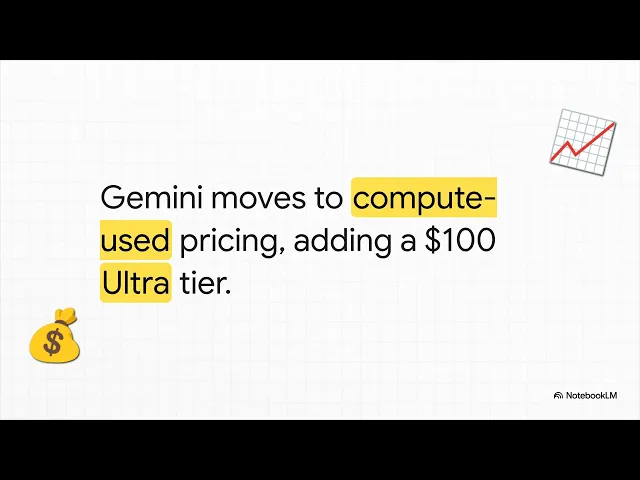
Google quietly shifted the Gemini app from daily prompt limits to a "compute-used" model that factors in the complexity of each prompt, the features used, and chat length. A new $100 AI Ultra plan tier was added to the existing $200 tier, and Google AI Plus and Pro tiers were also updated.
The pricing change matters for any operator using Gemini at scale for content workflows. Long, complex chats that previously fit within a daily limit now consume more compute and may push users into higher tiers faster.
The single biggest takeaway for operators
If only one number from I/O 2026 lands in a board deck this quarter, it should be Liz Reid's confirmation that AI Mode passed 1 billion monthly users and that queries have more than doubled every quarter since launch. AI search has moved out of early-adopter territory and into mass-market behavior, faster than nearly any digital platform shift in the past decade.
For SEO operators, the implication is that organic visibility now depends on AI surface citation as much as on classic ranking. For GEO operators, the implication is that the surface area being optimized has expanded materially in 18 months. For founders and CMOs running marketing programs without an AI search layer, the implication is that the cost of catching up is going up every quarter the gap stays open.
Show up where the next billion queries happen
I/O 2026 is the moment AI search stopped being a future-tense investment. Universal Cart pulls commerce inside Google. AI Mode pulls discovery inside Google. Personal Intelligence pulls personalization inside Google. Search agents pull continuous monitoring inside Google. The brands that will compound visibility through the rest of 2026 are the ones already structuring their content, product data, and third-party presence to be cited across these surfaces.
The cleanest first step is a baseline audit that maps where your brand currently shows up across Google AI Mode, ChatGPT, Perplexity, Gemini, AI Overviews, and Claude. Look at how Passionfruit's GEO service builds the citation strategy on top of a solid SEO foundation, see the cross-platform citation tracking inside Passionfruit Labs, and talk to the team before the next budget conversation. If you are still working through the broader framing on whether GEO is its own discipline, our explainer on whether GEO is still SEO covers it.
Frequently Asked Questions
What were the biggest Google I/O 2026 announcements for SEO?
The biggest SEO-related announcements at Google I/O 2026 include the expanded AI Mode in Google Search, Gemini 3.5 Flash becoming the default AI Mode model, Search agents, generative UI in Search, Universal Cart for agentic shopping, and expanded SynthID and C2PA content verification. These changes increase the importance of optimizing for AI-generated answers and other Google AI surfaces.
How will Google AI Mode affect SEO in 2026?
Google AI Mode is making search more conversational, multimodal, and task-oriented. Users can ask longer questions, upload images and files, and continue conversations from AI Overviews into AI Mode. For SEO, this increases the importance of clear answers, structured content, consistent entities, and content that can be accurately extracted and cited by AI systems.
What are Google Search agents and how will they affect SEO?
Google Search agents are background-running AI agents designed to monitor information across the web and provide users with updates on specific topics. As these agents repeatedly retrieve information, brands that are cited in AI Mode and other Google AI surfaces may gain additional visibility, while brands that are consistently absent from those sources may miss opportunities to appear in ongoing user research.
What is Universal Cart and what does it mean for ecommerce SEO?
Universal Cart is Google's Gemini-powered shopping experience that follows users across Search, Gemini, YouTube, and Gmail. It can monitor product prices, inventory, deals, and purchase opportunities. For ecommerce brands, accurate product feeds, inventory information, pricing, loyalty data, and integration with Google's commerce ecosystem become increasingly important for visibility in agentic shopping experiences.
How does Google I/O 2026 change GEO and AI search optimization?
Google I/O 2026 expands the number of AI surfaces that brands need to consider, including AI Mode, AI Overviews, Search agents, generative UI, and agentic commerce. GEO therefore increasingly involves making information easy for AI systems to understand, retrieve, verify, and cite—not simply optimizing pages for traditional keyword rankings.
What should SEO teams do after Google I/O 2026?
SEO teams should audit important content for direct-answer structures, consistent entity information, and clear comparative claims; monitor brand citations across AI search platforms; improve Google Merchant Center product data for ecommerce; and review AI-generated content for provenance and disclosure requirements. These steps help prepare websites for the growing role of AI-powered search and agentic discovery.