AI
Join 500+ brands growing with Passionfruit!
From the moment a user types a prompt in ChatGPT to the moment they buy from your store. The complete framework for understanding, optimizing, and measuring the AI search funnel.
When someone searches Google, you can see the keyword they typed, the page they landed on, and whether they converted. The path is linear. The tracking is mature. You have had 20 years to build systems around it.
When someone asks ChatGPT "What is the best organic skincare brand for sensitive skin?", something completely different happens. The AI does not paste that full question into a search engine. It breaks it into smaller sub-queries, retrieves passages from multiple sources, synthesizes a single answer, and may or may not cite your brand. The user might click through to your site, or they might get their answer entirely within the AI interface and never visit your website at all.
This is the GEO funnel. It works differently from the SEO funnel at every stage. And most brands have zero visibility into it because they are still trying to measure AI search with tools built for Google.
Our guide breaks down exactly how the GEO funnel works, how to optimize for each stage, how to track your visibility with Passionfruit Labs, and how to connect the dots to revenue in GA4. No speculation. No theory. Just the mechanics that determine whether AI search engines recommend your brand or your competitor's.
For the broader context of how GEO, AEO, and SEO relate to each other, see our complete SEO vs. GEO vs. AEO guide.
How the GEO Funnel Actually Works (Query to Answer to Revenue)
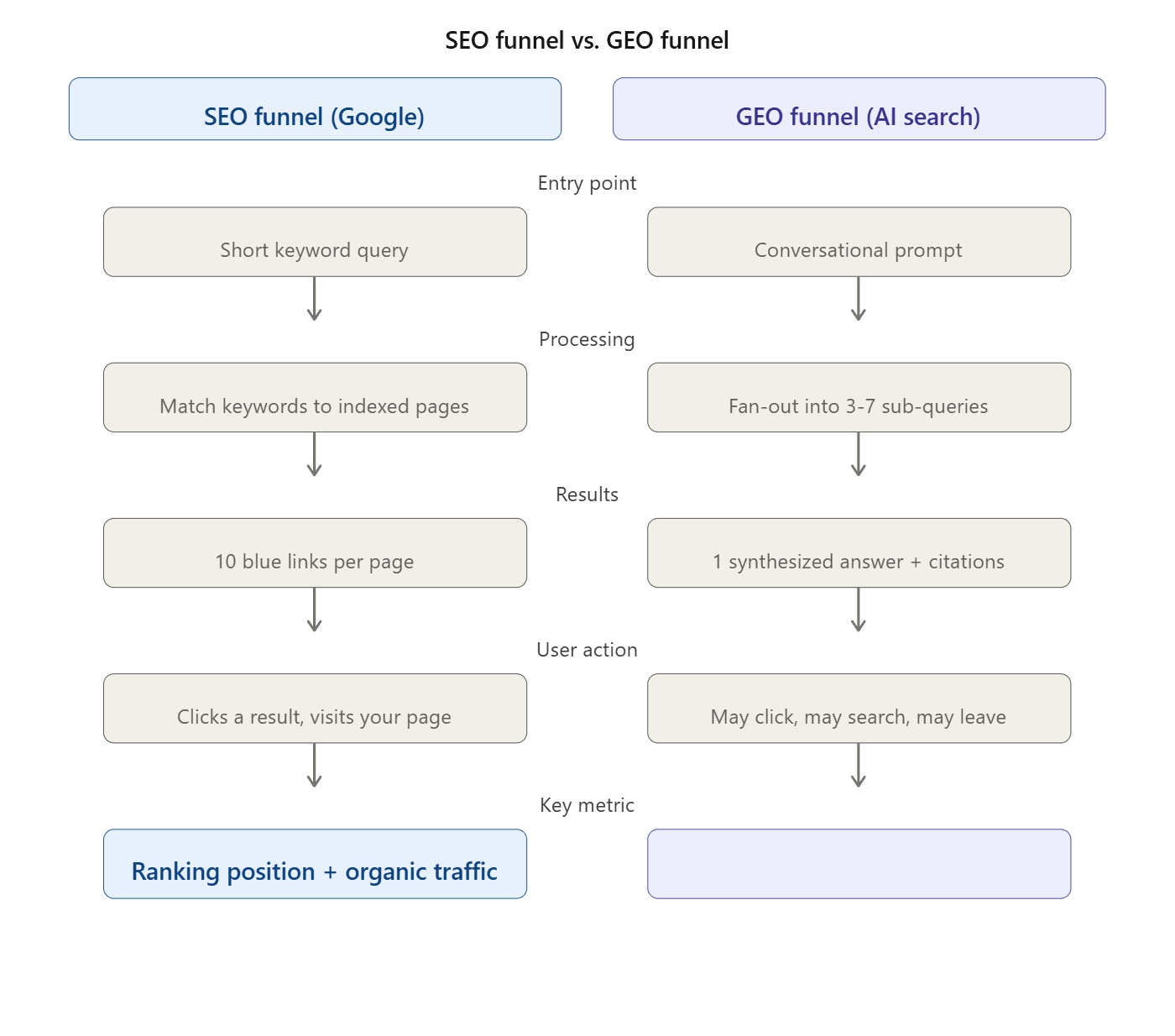
The traditional SEO funnel is simple: user types keyword, Google returns ranked results, user clicks a result, user lands on your page, user converts or leaves. You optimize the page, build backlinks, and track everything in Google Analytics.
The GEO funnel has five stages, and three of them are invisible to your current analytics.
Stage 1: The User Prompt
A user types a natural language question into ChatGPT, Perplexity, Gemini, Claude, or Google AI Mode. Unlike Google search queries (short, keyword-focused), AI prompts are conversational, specific, and often multi-layered.
Examples of how the same buying intent looks different:
Google search: "best organic face serum"
AI prompt: "What is the best organic face serum for someone with sensitive skin who wants anti-aging benefits under $50?"
The AI prompt contains far more intent signals: product category, skin type, benefit, and price range. This specificity changes everything about how the AI retrieves information.
Stage 2: Query Fan-Out (The Invisible Expansion)
This is the stage most marketers do not know exists, and it is the most important one to understand.
When the AI receives that prompt, it does not search for the full sentence. It decomposes it into multiple sub-queries and searches for each one separately. This process is called "query fan-out."
For the prompt "What is the best organic face serum for someone with sensitive skin who wants anti-aging benefits under $50?", the AI might generate these sub-queries:
"best organic face serum 2026"
"organic serum sensitive skin"
"anti-aging face serum ingredients"
"face serum under $50 reviews"
"organic skincare brands for sensitive skin"
Each sub-query hits different web pages. The AI retrieves relevant passages from each result, then synthesizes them into a single answer.
Why this matters for your strategy: You do not need to rank for the exact long-tail prompt the user types. You need to rank for the shorter sub-queries the AI generates from that prompt. If your content ranks for "best organic face serum 2026" and "organic skincare brands for sensitive skin," the AI retrieves your content during fan-out and you have a strong chance of being cited in the final answer.
This is fundamentally different from SEO, where you optimize one page for one primary keyword. In GEO, one user prompt creates 3 to 7 sub-queries, and you need content that ranks for several of them to maximize your citation probability.
For understanding how to identify and target these sub-queries, see our keyword research guide for AI and SEO.
Stage 3: Retrieval and Evaluation (RAG)
The AI uses Retrieval-Augmented Generation (RAG) to pull specific passages from the web pages it found during fan-out. It does not read your entire page. It extracts the passages most relevant to each sub-query.
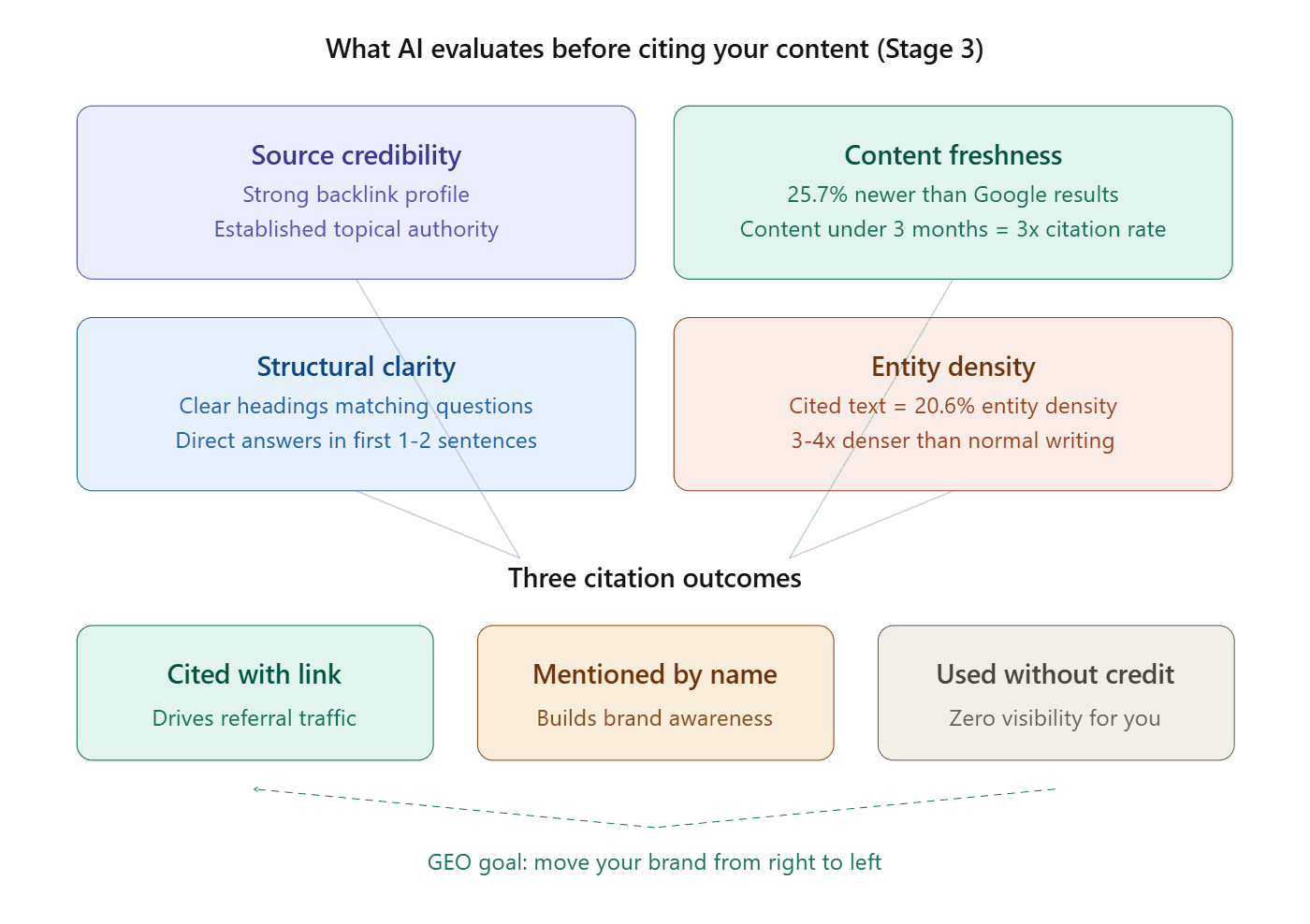
During this stage, the AI evaluates:
Source credibility. Does the page come from a site with established authority? Sites with strong backlink profiles and topical authority score higher.
Content freshness. ChatGPT shows a preference for content that is 25.7% fresher than what appears in organic Google results. Content under 3 months old is 3x more likely to be cited.
Structural clarity. Can the AI easily extract a clear, direct answer from the passage? Pages with well-structured headings, concise paragraphs, and direct answers to specific questions perform better.
Entity density. Research from Princeton and Georgia Tech found that heavily cited text has an "entity density" of 20.6%, roughly 3 to 4x higher than normal English writing. This means the passages AI systems prefer are information-dense, fact-rich, and specific.
Your content does not need to be the #1 result on Google to be cited by AI. But it does need to be in the top 10 organic results. Research shows that AI citations lean heavily on the top 10 organic results. Strong SEO remains the foundation of GEO visibility.
Stage 4: Synthesis and Citation
The AI combines passages from multiple sources into a single, coherent answer. It attributes some sources with citations (linked or named), mentions others without links, and uses information from yet other sources without any attribution.
Your brand can appear in three ways:
Cited with a link. The best outcome. The user sees your brand name and can click through to your site. This drives measurable referral traffic.
Mentioned by name without a link. Good for brand awareness. The user learns about your brand and may search for you separately on Google, creating a branded search that your analytics can capture.
Used as a source without attribution. The AI uses information from your page but does not name you. You get no visibility. This happens most often with generic, unbranded content.
The goal of GEO optimization is to move your brand from "used without attribution" to "cited with a link" for the prompts that matter most to your business.
For strategies on increasing your citation rate, see our guide on how to 10x your brand mentions in AI search results.
Stage 5: User Action (Click, Search, or Closed-Loop)
After receiving the AI's answer, the user does one of three things:
Clicks a citation link and visits your site. This is trackable as AI referral traffic in GA4.
Searches your brand name on Google after seeing it mentioned. This shows up as branded organic search traffic, but you cannot attribute it to the AI touchpoint without additional tracking.
Gets their answer and leaves. No click, no search, no visit. The AI answered their question using your content, but you received no traffic. Your brand was still endorsed in the answer, which builds awareness for future interactions.
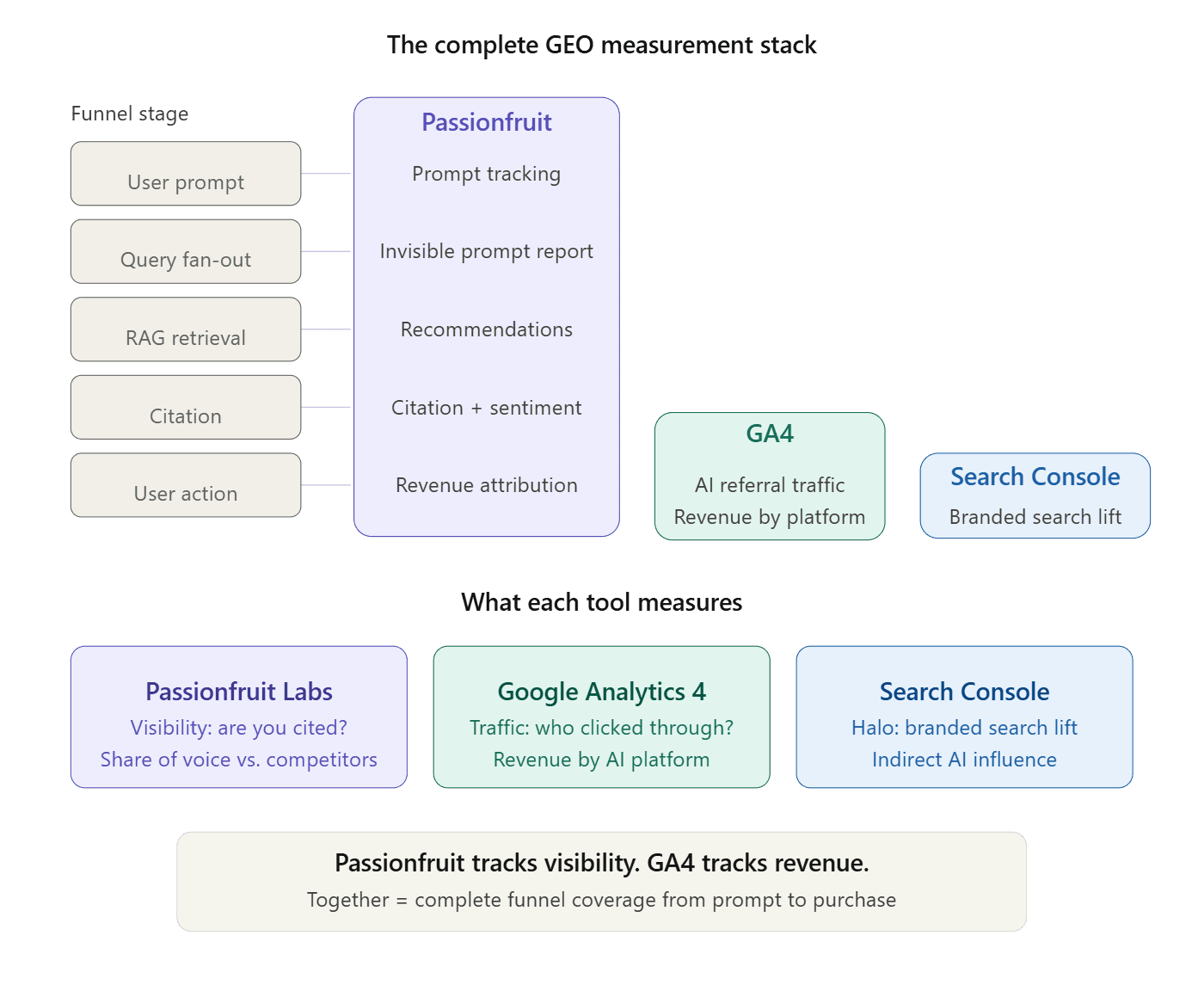
This is why GEO measurement requires two separate systems: a visibility tracking tool that monitors whether you are being cited (regardless of clicks), and an analytics tool that tracks the traffic and revenue that AI citations generate.
How to Optimize for Each Stage of the GEO Funnel
Understanding the funnel is step one. Optimizing for it is step two. Here is what to do at each stage.
Optimize for Stage 2: Win the Sub-Queries
Since AI breaks prompts into sub-queries during fan-out, your content needs to rank for the fragments, not just the full question.
Action steps:
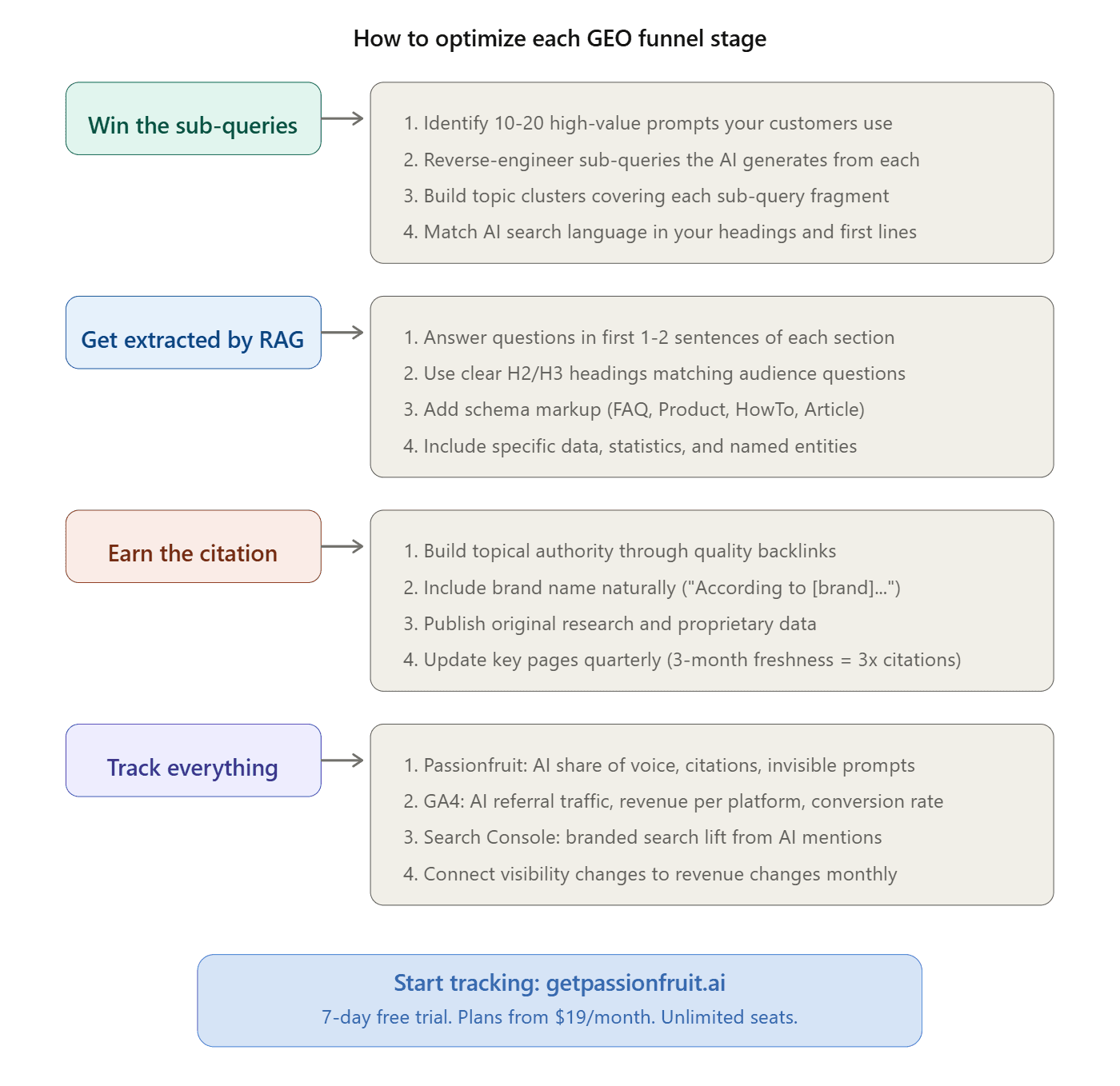
Identify 10 to 20 high-value prompts in your space. Ask ChatGPT, Perplexity, and Gemini questions your customers ask. Document the exact prompts.
Reverse-engineer the sub-queries. For each prompt, think about what shorter queries the AI would generate. "What is the best email marketing platform for a small ecommerce business?" breaks into "best email marketing platforms 2026," "email marketing ecommerce features," and "email marketing pricing small business."
Ensure you have content ranking for each sub-query. This is where topic clusters become critical. A single pillar page cannot cover all the sub-queries. You need cluster pages targeting each fragment.
Use the same terminology the AI searches for. AI sub-queries use simple, direct phrasing. Match that language in your headings and opening paragraphs.
Optimize for Stage 3: Make Your Content Easy to Extract
AI systems prefer content they can easily parse into clean, citable passages.
Action steps:
Answer questions directly in the first 1 to 2 sentences of each section. Do not bury the answer after three paragraphs of context. Lead with the answer, then provide supporting detail.
Use clear H2 and H3 headings that match the questions your audience asks. "How much does organic skincare cost?" as an H2 is more extractable than "Pricing Considerations."
Add structured data and schema markup. FAQ schema, Product schema, HowTo schema, and Article schema all help AI crawlers understand your content's structure.
Include specific data points, statistics, and named entities. Research shows that content with higher entity density gets cited more frequently. Replace "many customers prefer organic products" with "73% of skincare buyers actively seek organic ingredients, according to [source]."
Keep content fresh. Update key pages quarterly. Content under 3 months old is 3x more likely to be cited by AI systems.
Optimize for Stage 4: Earn Citations, Not Just Mentions
The difference between being cited with a link and being used without attribution comes down to brand authority and content specificity.
Action steps:
Build topical authority through backlinks. Sites with strong backlink profiles are cited more frequently. See our guide on how to earn high-quality backlinks.
Include your brand name naturally in content. AI systems are more likely to attribute information to a named source than to generic content. "According to Passionfruit's research..." is more citable than presenting the same data without attribution.
Publish original research and proprietary data. AI systems cite primary sources over secondary ones. If you are the origin of a data point, you get the citation.
Implement FAQ schema on key pages. This structures your answers in a format that AI systems can extract cleanly.
How to Track AI Search Visibility With Passionfruit Labs
Traditional analytics tools (Google Analytics, Search Console) cannot tell you whether your brand is being mentioned in AI-generated answers. They only see traffic after a user clicks through to your site. They are blind to Stage 1 through Stage 4 of the GEO funnel.
Passionfruit Labs closes this gap. It is a purpose-built AI search optimization platform that tracks your brand's visibility across ChatGPT, Perplexity, Gemini, and Claude, then connects that visibility to actionable recommendations and revenue data.
Here is exactly what Passionfruit tracks and how to use each feature.
Brand Mentions and Citation Tracking
Passionfruit runs your target prompts across AI platforms daily and monitors whether your brand is mentioned, cited with a link, or absent from the response. This gives you a real-time view of your AI search visibility that no other analytics tool provides.
How to use it:
Add your brand and up to unlimited competitors.
Define 20 to 150 prompts (depending on your plan) that your customers use when asking AI about your product category.
Passionfruit runs these prompts daily across ChatGPT, Perplexity, Gemini, and Claude.
Review the results: which prompts mention your brand? Which cite a competitor? Which mention no one in your category?
The "Prompts We Are Invisible On" report is the highest-value feature for optimization. It shows you the exact queries where your competitors are being recommended and you are not. Each invisible prompt is an optimization opportunity.
AI Share of Voice
Passionfruit calculates your "AI Share of Voice," the percentage of relevant AI-generated answers that mention or cite your brand versus competitors. This is the GEO equivalent of keyword ranking position in traditional SEO.
How to use it:
Track your AI Share of Voice over time to measure whether your GEO efforts are increasing visibility.
Benchmark against competitors to understand your relative position.
Identify which competitors dominate which prompt categories, then prioritize content creation for the gaps.
Sentiment Analysis
Not all mentions are positive. Passionfruit analyzes the sentiment of how AI platforms describe your brand: positive, neutral, or negative. If ChatGPT is recommending your product but noting concerns about pricing or quality, you need to know.
How to use it:
Monitor sentiment shifts monthly.
If negative sentiment appears, trace it to the source content that the AI is drawing from. Often, a single negative review article or forum thread is influencing the AI's portrayal.
Create or update content that addresses the concern directly, so the AI has better source material.
Actionable Content Recommendations
This is what separates Passionfruit from dashboards that show data but do not tell you what to do. Passionfruit generates specific, prioritized action plans:
"Create a collection page for vacation wear" (because AI users are searching for it and you have no relevant page)
"Write a blog on 'Comprehensive guide for summer essentials'" (because competitor X is being cited for this and you are not)
"Get a linen pants focused backlink from Vogue" (because the AI is sourcing from high-authority fashion publications you are not linked from)
These are not generic suggestions. They are derived from the actual prompts where you are invisible and the actual sources that competitors are being cited from.
Revenue Attribution from AI Search
Passionfruit connects to your Google Analytics to show sessions, active users, and revenue generated from each AI platform separately. You can see exactly how much revenue ChatGPT referral traffic generates versus Perplexity versus Gemini.
This is the metric that turns GEO from a brand awareness exercise into a revenue channel you can optimize and scale.
Plans start at $19/month for solopreneurs tracking ChatGPT visibility, scaling to $49/month for multi-platform tracking (ChatGPT, Gemini, Perplexity), and $99/month for full coverage including Claude. Enterprise and agency plans offer unlimited prompts, custom frequency, and coverage across every AI platform including Google AI Overviews, Grok, Meta AI, Copilot, and DeepSeek. All plans include unlimited seats with no per-user cost.
Start a 7-day free trial of Passionfruit Labs
How to Track AI Search Traffic and Revenue in GA4
Passionfruit tracks your visibility (whether you appear in AI answers). GA4 tracks your traffic and revenue (what happens after someone clicks through from an AI answer). You need both.
Here is the step-by-step GA4 setup for tracking AI search as a distinct channel.
Step 1: Identify AI Referral Sources
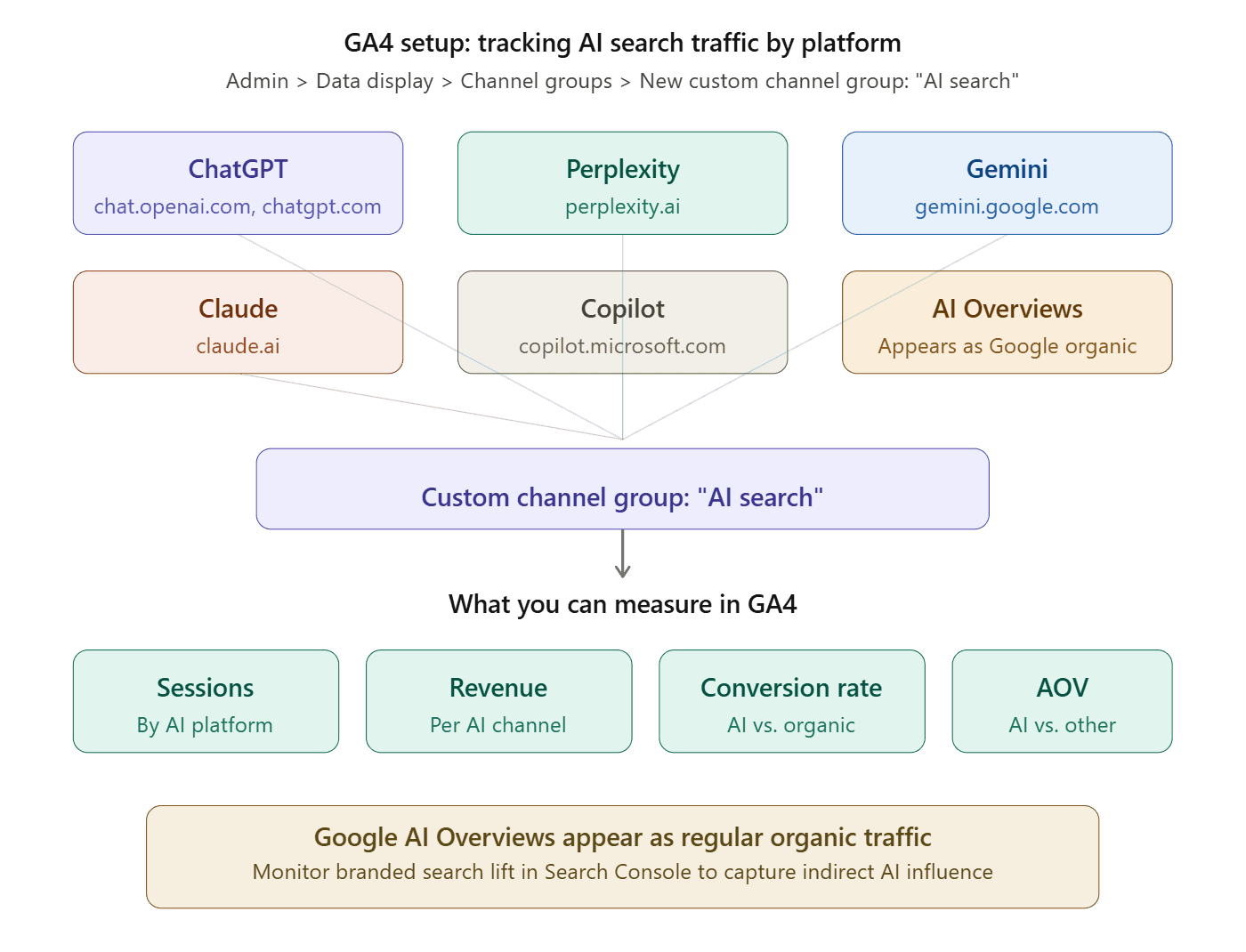
AI platforms send traffic with specific referral strings. The most common ones:
ChatGPT: chat.openai.com, chatgpt.com
Perplexity: perplexity.ai
Gemini: gemini.google.com
Claude: claude.ai
Google AI Overviews: These appear as regular Google organic traffic, making them harder to separate (more on this below)
Microsoft Copilot: copilot.microsoft.com
Step 2: Create a Custom Channel Group in GA4
Go to Admin, then Data Display, then Channel Groups. Create a new custom channel group called "AI Search" with rules that match the referral sources above.
For each AI platform, add a rule:
Source matches "chat.openai.com" OR "chatgpt.com" = "ChatGPT"
Source matches "perplexity.ai" = "Perplexity"
Source matches "gemini.google.com" = "Gemini"
Source matches "claude.ai" = "Claude"
This separates AI referral traffic from your regular organic and referral channels so you can analyze it independently.
For the full technical walkthrough, see our step-by-step guide on tracking AI/LLM chatbot traffic separately in GA4.
Step 3: Set Up UTM Parameters for AI-Specific Campaigns
If you are running content specifically optimized for AI search visibility, tag those landing pages with UTM parameters so you can track performance:
?utm_source=geo&utm_medium=ai-search&utm_campaign=[campaign-name]
This lets you measure whether pages you optimized for GEO are receiving more AI referral traffic after optimization.
Step 4: Track Revenue by AI Platform
In GA4, go to Monetization, then Ecommerce Purchases. Apply your custom "AI Search" channel group as a filter. You can now see:
Total revenue from AI search referrals
Revenue broken down by platform (ChatGPT vs. Perplexity vs. Gemini vs. Claude)
Average order value from AI search visitors versus other channels
Conversion rate of AI search traffic versus organic Google traffic
This is the data that proves whether GEO is worth your investment. Most brands that track this properly find that AI referral traffic converts at comparable or higher rates than organic search traffic, because the AI has already pre-qualified the visitor's intent.
For a deeper dive into comparing AI traffic to organic, see our guide on how to track and tag AI referral traffic in GA4.
Step 5: Monitor Branded Search Lifts
Not all AI-influenced traffic arrives through direct referral links. Many users see your brand mentioned in an AI answer and then search for you on Google separately. This shows up as branded organic search, not AI referral traffic.
Track your branded search volume in Google Search Console. If you see branded impressions and clicks increasing in correlation with improved AI visibility (as tracked in Passionfruit), the AI mentions are driving that lift even though GA4 cannot directly attribute it.
The Complete GEO Measurement Stack
Here is how all the pieces fit together:
What You Track | Where You Track It | Why It Matters |
Which prompts mention your brand | Shows your AI visibility independent of clicks | |
Which prompts you are invisible on | Identifies optimization opportunities | |
AI Share of Voice vs. competitors | Benchmarks your position in the AI search landscape | |
Sentiment of AI mentions | Catches negative positioning before it compounds | |
AI referral traffic by platform | GA4 (custom channel group) | Measures clicks from AI citations |
Revenue from AI search visitors | GA4 (ecommerce reports) | Connects AI visibility to business outcomes |
Branded search lift from AI mentions | Google Search Console | Captures indirect AI influence on Google search |
Content actions to improve visibility | Turns data into prioritized next steps |
Passionfruit tracks visibility. GA4 tracks traffic and revenue. Search Console tracks the branded search halo. Together, they give you complete funnel coverage from AI prompt to purchase.
The GEO Funnel vs. The SEO Funnel: A Side-by-Side Comparison
Dimension | SEO Funnel | GEO Funnel |
Entry point | Keyword typed into Google | Conversational prompt in AI platform |
Query processing | Google matches keywords to indexed pages | AI breaks prompt into sub-queries (fan-out), retrieves passages via RAG |
Ranking mechanism | PageRank, backlinks, on-page signals | Source credibility, content freshness, entity density, structural clarity |
Result format | List of 10 blue links per page | Single synthesized answer with optional citations |
User action | Clicks a result, visits your page | May click citation, may search your brand, or may get answer without clicking |
Traffic tracking | Google Analytics, Search Console | GA4 (for clicks), Passionfruit Labs (for visibility) |
Optimization focus | One page per keyword | Content covering multiple sub-queries per prompt |
Content format | Long-form, keyword-optimized pages | Information-dense, directly answerable, entity-rich passages |
Key metric | Ranking position, organic traffic | AI Share of Voice, citation rate, AI referral revenue |
The SEO funnel and GEO funnel are not competitors. They are complementary. Strong SEO performance (high rankings, quality backlinks, topical authority) is what gets your content into the pool of sources that AI systems draw from during fan-out and retrieval. GEO optimization ensures your content is structured, fresh, and authoritative enough to be selected and cited from that pool.
For the full framework on optimizing for both simultaneously, see our complete generative engine optimization guide.
Your Next Move
Pick 10 prompts your customers use when asking AI about your product category. Type them into ChatGPT and Perplexity right now. Document whether your brand appears, which competitors are cited, and where you are completely invisible.
Those "invisible" prompts are your highest-value optimization targets. Each one represents a customer asking for a recommendation in your category and being sent to a competitor.
Then start a free 7-day trial of Passionfruit Labs to track those prompts automatically, daily, across every major AI platform. Connect your GA4 to measure the revenue those citations generate. You now have complete funnel coverage from AI prompt to purchase.
The brands winning in AI search in 2026 are not the ones with the most content. They are the ones who understand how the GEO funnel works and track every stage of it.
You cannot optimize what you cannot see. Passionfruit makes the invisible funnel visible.
FAQs
What is a GEO funnel?
A GEO funnel is the path a user takes from typing a prompt in an AI search engine to taking action on your brand. It has five stages: user prompt, query fan-out (where the AI breaks the prompt into sub-queries), retrieval and evaluation (where the AI pulls passages from web sources), synthesis and citation (where the AI generates an answer and attributes sources), and user action (click, branded search, or closed-loop). Unlike the SEO funnel, most stages happen inside the AI system and are invisible to traditional analytics.
What is query fan-out in AI search?
Query fan-out is the process where an AI search engine decomposes a user's conversational prompt into multiple shorter sub-queries and searches for each one separately. For example, "What is the best VPN for streaming Netflix in Europe?" becomes separate searches for "best VPN 2026," "VPN Netflix streaming," and "VPN Europe servers." This means your content needs to rank for the fragments of a prompt, not just the full question. Topic clusters that cover multiple angles of a subject perform best during fan-out.
How do I track whether my brand appears in AI search answers?
You need a dedicated GEO tracking tool. Passionfruit Labs runs your target prompts across ChatGPT, Perplexity, Gemini, and Claude daily and reports whether your brand is mentioned, cited with a link, or absent. It also tracks AI Share of Voice versus competitors, sentiment analysis, and provides actionable content recommendations. Plans start at $19/month. Traditional analytics tools like GA4 only track traffic after a click, so they cannot tell you whether you are being mentioned without a link.
How do I track AI search traffic in Google Analytics?
Create a custom channel group in GA4 that matches AI referral sources (chat.openai.com, chatgpt.com, perplexity.ai, gemini.google.com, claude.ai, copilot.microsoft.com). This separates AI referral traffic from other channels. Then use GA4's ecommerce reports to measure revenue from AI search visitors specifically. For the full setup, see our step-by-step GA4 guide for AI traffic.
How is GEO different from SEO?
SEO optimizes pages to rank in traditional search engine results. GEO optimizes content to be cited in AI-generated answers. SEO targets keywords. GEO targets prompts and sub-queries. SEO measures ranking position and organic traffic. GEO measures AI Share of Voice, citation rate, and AI referral revenue. The two are complementary: strong SEO puts your content in the pool of sources AI systems draw from, and GEO optimization ensures your content gets selected and cited from that pool.
What content format works best for AI search citations?
Content that is information-dense, directly answerable, well-structured with clear headings, and rich in named entities and specific data points. Research shows that cited passages have entity density of 20.6%, roughly 3 to 4x higher than normal writing. Lead each section with a direct answer to the question your heading poses, then provide supporting context. Implement FAQ schema, Product schema, and Article schema to help AI crawlers parse your content. Content under 3 months old is 3x more likely to be cited, so update key pages quarterly.
How quickly can I see results from GEO optimization?
Some organizations report measurable improvements in AI citations within 10 days of implementing targeted optimizations. However, sustainable visibility improvements typically take 4 to 8 weeks. The variables are your existing domain authority (higher authority sites see faster results), the competitiveness of your prompt space, and whether your content ranks in Google's top 10 for the relevant sub-queries. Track progress in Passionfruit Labs weekly to see citation rate changes and in GA4 monthly to see traffic and revenue impact.