SEO
Join 500+ brands growing with Passionfruit!
For Google's own AI features, yes. Generative engine optimization (GEO) and answer engine optimization (AEO) are, in Google's words, still SEO. For ChatGPT, Perplexity, Claude, and the rest of the AI search ecosystem, the picture is more complicated, because those surfaces run on different retrieval rules and weight signals Google's index doesn't fully capture. The honest answer to "is GEO still SEO?" depends on which surface you're optimizing for, and the new Google documentation makes that distinction crisper than it has ever been.
On May 15, 2026, Google published "Optimizing your website for generative AI features on Google Search," its first official guide to AI Overviews and AI Mode. The document is short, plainspoken, and pointed. The page names tactics site owners can ignore, identifies what actually drives visibility inside Google's AI surfaces, and reframes the GEO/AEO conversation as a subset of SEO rather than a parallel discipline. The piece below covers what Google said, where the framing is accurate, where it stops short, and what marketers should change as a result.
What Google's new documentation actually says
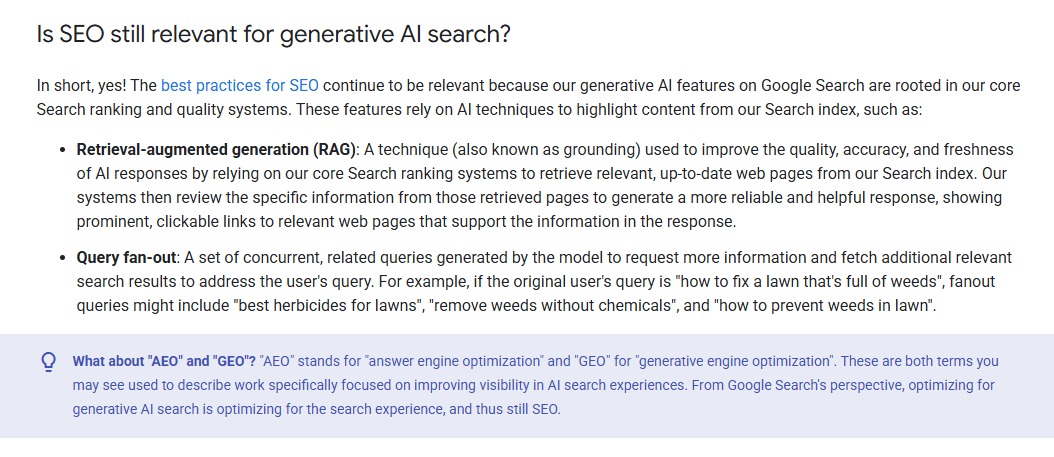
Google's documentation states directly that "optimizing for generative AI search is optimizing for the search experience, and thus still SEO." The page acknowledges the terms AEO and GEO, defines them, and folds the work into standard SEO for the purposes of Google Search. The reasoning rests on architecture: AI Overviews and AI Mode are powered by retrieval-augmented generation (RAG) and query fan-out, both of which pull from Google's regular Search index using the same core ranking systems.
There is no separate AI ranking layer underneath Google's AI features. Content that ranks well in classic Search is the same content eligible for AI Overview citations, and the signals that earn one earn the other. The guide also names a list of tactics it considers unnecessary for Google's AI features, and a shorter list of fundamentals it considers load-bearing.
We covered the broader budget allocation question in our breakdown of how to fund SEO, GEO, and AEO across a single quarter, and our SEO vs GEO vs AEO comparison maps which work feeds which surface. Both predate Google's May 15 documentation, and both still hold up because the underlying logic is the same: clean SEO infrastructure is the floor for visibility across Google and AI surfaces alike.
What Google says you can stop doing
The mythbusting section is the most discussed part of the documentation, because it pushes back on tactics a meaningful share of the GEO industry has been selling. Five practices land in the "not necessary" bucket for Google Search specifically.
llms.txt files
Google says you do not need to create llms.txt files or any "special" machine-readable markup to appear in its generative AI features. The crawler may discover the file like any other text file, but it gets no special treatment in ranking or AI inclusion. For Google AI Overviews, llms.txt is not a lever.
The nuance worth keeping: llms.txt may still be read by some non-Google AI surfaces, particularly Anthropic's Claude and smaller open-source LLM projects. Keep the file if you already have one. Stop paying for tools that pitch llms.txt as a Google AI strategy.
Content chunking for AI
Google says there is no requirement to break content into small pieces for AI systems. Its systems can understand multiple topics on a longer page and surface the relevant section per query. Danny Sullivan made the same point in January 2026, citing internal Google engineering conversations that recommend against chunking.
Short paragraphs and clear sub-headings still work because they help human readers. Cutting articles into 50-word answer blocks to please an AI parser is a tactic Google now explicitly says is not needed.
AI-specific content rewriting
Google says AI systems can understand synonyms and general meanings. Site owners do not need to capture every long-tail keyword variation or write in a special "AI-friendly" format. Writing naturally for human readers is the stronger signal for both humans and machines.
Inauthentic mention-building
Buying brand mentions across blogs, forums, and videos to influence AI citation is listed as ineffective. Google's core ranking systems focus on quality, and its spam systems already block the patterns inauthentic mention campaigns produce.
The narrower legitimate version of this work, earning genuine third-party mentions through editorial coverage, expert citations, and community participation, still matters. The line is between earned and manufactured.
Special schema for AI
Google says structured data is not required for generative AI search and there is no special schema.org markup designed for AI features. The documentation explicitly recommends continuing to use structured data as part of overall SEO strategy for rich result eligibility, which has indirect benefits for AI visibility, but stops short of calling schema a direct AI citation lever.
Our FAQ schema guide for AI answers covers the rich-result side of that work, which remains worthwhile even under Google's narrower framing.
What Google says actually works
The "what to focus on" list is shorter than the mythbusting list, and that is the more useful content for marketers. Three categories carry most of the weight inside Google's documentation.
Non-commodity content with a real point of view
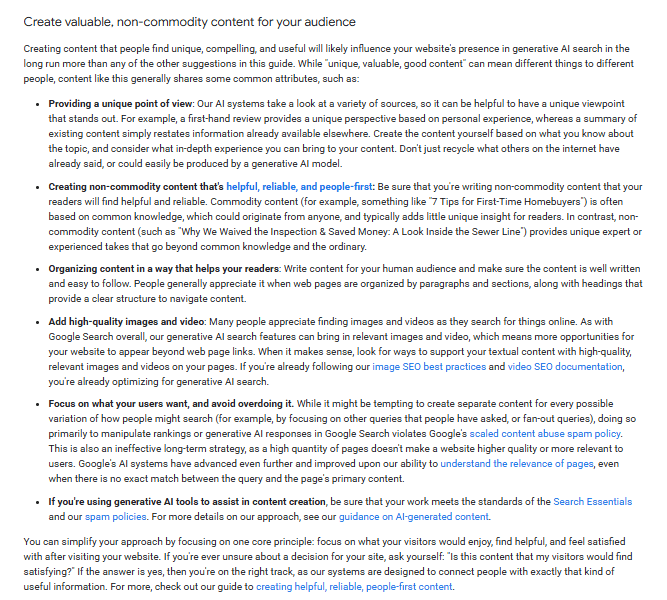
The guide draws a sharp contrast between commodity content ("7 Tips for First-Time Homebuyers") and non-commodity content ("Why We Waived the Inspection & Saved Money: A Look Inside the Sewer Line"). The distinction is whether the piece adds unique insight, first-hand experience, original data, or a perspective the model cannot synthesize from elsewhere. Commodity content is increasingly replaceable. Non-commodity content earns citation.
Technical hygiene
Pages must be indexed and eligible for snippets to appear in AI features. The recommendations are standard SEO discipline: follow crawling best practices, use semantic HTML, follow JavaScript SEO basics, deliver good page experience, reduce duplicate content.
Multimedia and entity signals
The documentation calls out images and video as content types that get surfaced in AI responses. The same page also recommends Merchant Center feeds and Google Business Profiles for product and local visibility, which is consistent with how Google's AI features pull commercial and local data into answers.
Where Google's framing stops short
Google's documentation is accurate, but it covers Google's AI features. The guide says so explicitly. AI Overviews and AI Mode are powered by Google's index, and the optimization work for those surfaces is, mechanically, SEO. The same is not automatically true for ChatGPT, Perplexity, Gemini, or Claude, which build their answers on different retrieval pipelines and weight different sources.
A few specific differences worth holding in mind.
ChatGPT pulls heavily from Bing search results and from publicly indexed sources, with documented citation skews toward Wikipedia, Reddit, and high-authority editorial domains. Perplexity is real-time, citation-first, and Reddit-heavy. Claude works through user-uploaded knowledge and connected services for some experiences, and through web search for others. Gemini is closest to Google's stack and benefits most directly from strong Google Search performance, which is consistent with Google's own framing.
Cross-platform citation tracking, which is the work GEO services actually do, remains operationally distinct from classic SEO because the surfaces are distinct. Strong organic SEO is a prerequisite for being eligible for citation across all of them, but it is not sufficient by itself for ChatGPT or Perplexity, where signals like community presence, third-party mentions, and entity consistency across the open web carry more weight than they do on Google.
Our comparison of AEO and GEO tracking tools for B2B SaaS and our equivalent breakdown for ecommerce cover the measurement work that exposes these differences in practice. The brands seeing 5x variance in citation share between ChatGPT and Google AI Overviews are not running two different ranking systems, they are running one content strategy against two retrieval architectures that read it differently.
What to actually do about it
Translating the documentation into practical changes is straightforward. The work splits into three buckets.
Keep doing: classic SEO discipline that earns ranking in Google Search. Technical health, crawlability, semantic HTML, fast page experience, indexable content, internal linking that maps topical authority. Non-commodity content built on original insight, first-hand experience, and clear entity signals. Multimedia where it adds genuine value. Structured data where it earns rich results, treated as an SEO play rather than an AI-specific lever.
Stop doing: paying for llms.txt generation as a Google AI lever, chunking content into 50-word answer blocks to please AI parsers, rewriting copy in special "AI-friendly" formats, buying inauthentic mention placements, and treating schema as a direct AI citation mechanism.
Start doing: cross-platform citation tracking that surfaces how your brand appears in ChatGPT, Perplexity, Gemini, AI Overviews, and Claude, rather than treating "AI visibility" as a single metric. Third-party presence work on the platforms AI surfaces actually cite (Reddit, YouTube, Wikipedia, editorial coverage). Entity consistency audits that make sure your brand name, product names, and category descriptions read the same across the open web. The work pays off across both Google AI features and the surfaces Google's documentation does not cover.
Cited brands inside Google AI Overviews earn approximately 120% more organic clicks per impression than uncited brands on the same queries, per Seer Interactive's March 2026 update. That citation premium, more than any individual tactic, is the operational case for treating AI visibility as a real investment area rather than a side project, regardless of which acronym the work runs under.
The shift is here. Be part of the answer.
Google's documentation does not end the conversation about AI search visibility. The page tightens it. For Google's own AI features, the work is SEO, and the brands already winning Google Search are best positioned to keep winning as AI Overviews and AI Mode expand. For the rest of the AI search ecosystem, the work goes further, because the surfaces that ChatGPT, Perplexity, and Claude read are broader than Google's index.
If your team has been waiting for the framing to settle before investing, enough has settled to act on. Start with a current-state audit that maps how your brand currently shows up across Google, AI Overviews, ChatGPT, Perplexity, Gemini, and Claude. Look at how Passionfruit's GEO service builds the citation strategy on top of a strong SEO foundation, see the cross-platform tracking inside Passionfruit Labs, and talk to the team before the next budget cycle locks in.
Frequently asked questions
Did Google say GEO is dead?
No. Google said that, from its perspective, optimizing for its own generative AI features is still SEO. The position applies to Google AI Overviews and AI Mode specifically. The documentation does not say GEO as a broader discipline (covering ChatGPT, Perplexity, Claude, Gemini, and other AI surfaces) is unnecessary or ineffective. Google's framing reclassifies the work for Google's surfaces. Cross-platform citation work remains its own operational discipline.
Should I delete my llms.txt file?
No need. Google says llms.txt does not help with its AI features, but the file is not harmful and may still be read by some non-Google AI surfaces. Anthropic's Claude and smaller open-source projects have shown willingness to use llms.txt-style manifests. Keep it if you have one. Stop paying tools that position llms.txt generation as a Google AI lever, since for Google specifically it does nothing.
Should I stop adding schema markup to my pages?
No. Google's documentation says schema is not required for generative AI search and there is no special AI schema. The same documentation recommends continuing to use structured data for rich result eligibility, which improves how your pages appear in classic Search and indirectly supports AI Overview citation. Schema remains an SEO play with proven benefits. The shift is in framing, not in the work itself.
Do AI Overviews still matter if Google says optimization is just SEO?
Yes, more than ever. AI Overviews appear on approximately 48% of tracked Google queries as of February 2026, per BrightEdge, up from 31% a year earlier. Healthcare queries trigger AI Overviews 88% of the time, B2B Technology 82%. Cited brands earn meaningfully more clicks per impression than uncited brands. The fact that the optimization work is "still SEO" makes the citation upside more accessible, not less significant.
How does GEO work differently for ChatGPT and Perplexity than for Google?
ChatGPT pulls from Bing search results and skews citation toward Wikipedia, Reddit, and editorial domains. Perplexity is real-time, citation-first, and Reddit-heavy. Both weight third-party mentions, community presence, and entity consistency more heavily than Google's AI features do. Strong Google SEO is a floor for visibility on those surfaces, not a ceiling. Cross-platform citation tracking and presence on the platforms AI tools actually read are what move the needle beyond Google's own index.
What should I tell my agency or in-house team to change?
Three concrete shifts. Stop paying for llms.txt generation, AI-specific content chunking, and inauthentic mention campaigns as Google AI strategies. Keep investing in technical SEO, non-commodity content, semantic HTML, and structured data for rich results. Add cross-platform citation tracking that shows your brand's visibility inside ChatGPT, Perplexity, Gemini, AI Overviews, and Claude as distinct metrics. The work that earns citation across all of them shares a foundation, but the measurement and the third-party presence work cannot be collapsed into a single dashboard.