AI
Join 500+ brands growing with Passionfruit!
It's 9:47 AM on a Tuesday. Your Slack channel explodes with alerts. Organic traffic dropped 43% overnight. Your Head of Growth is asking questions you can't answer yet. Your CEO wants a status update in 30 minutes.
This isn't hypothetical. It's happening right now to growth teams across every industry as Google rolls out AI Overviews, launches core updates, and fundamentally reshapes how search results appear. According to research from BrightEdge, zero-click searches now account for over 57% of all Google queries, meaning more than half of your potential traffic never makes it past the AI-generated answer.
The teams that survive these incidents aren't lucky. They're prepared. They have runbooks, clear ownership, and systematic processes that turn chaos into coordinated response. Passionfruit provides the unified monitoring and incident response framework that enterprise growth teams rely on to detect visibility drops within hours, diagnose root causes across both traditional search and AI platforms, and recover revenue faster than teams using fragmented tools.
Our playbook gives you exactly that: a step-by-step framework to diagnose, respond, and recover when your organic visibility takes a hit.
Understanding Google Search Traffic After ChatGPT: The Paradigm Shift
The launch of ChatGPT in November 2022 fundamentally altered how users discover information online. Within two months, ChatGPT reached 100 million users, becoming the fastest-growing consumer application in history. Google responded with Gemini (formerly Bard) and AI Overviews integrated directly into search results. By early 2024, AI-powered search platforms were handling over 2 billion queries monthly.
For growth teams, this shift created a critical problem: you could maintain or even improve your traditional Google rankings while simultaneously losing massive visibility because users were getting answers from AI systems instead of clicking through to websites. This explains why so many companies report that their Google organic traffic dropped 20-40% even without ranking penalties or technical issues.
The data tells a stark story. Websites that appeared in position 1-3 for commercial queries historically captured 50-60% of click-through traffic. Post-ChatGPT, those same positions might generate only 30-35% CTR because Google's AI Overview answered the query directly, or users switched to asking ChatGPT instead of searching Google at all.
This isn't a temporary disruption. It's a permanent expansion of the search landscape where visibility now requires optimization across multiple platforms simultaneously, not just Google rankings.
Why Traditional SEO Incident Response Fails When Google Traffic Drops
Traditional SEO incident response was built for a different search landscape. You'd check Google Search Console, analyze ranking drops, review backlinks, and run technical audits. That approach worked when search was predictable.
Now you're competing on four fronts simultaneously: Google's traditional organic results, Google's AI Overviews, standalone AI platforms like ChatGPT and Perplexity, and vertical search engines specific to your industry.
A traffic drop might mean:
Your content lost rankings in traditional search
Your brand lost citation visibility in AI responses
Competitors captured your share of voice across AI platforms
Technical issues blocked AI crawlers from accessing your content
Sentiment shifts damaged how AI systems describe your brand
Without systematic visibility into all these channels, you're responding to symptoms without diagnosing the disease. That's why modern incident response requires a unified GEO monitoring framework that tracks performance across every search surface where your buyers discover solutions. Passionfruit was built specifically for this challenge: tracking your brand's visibility, citation frequency, sentiment, and competitive positioning across Google's traditional results, AI Overviews, ChatGPT, Perplexity, and Claude, all while connecting visibility metrics directly to revenue impact rather than vanity traffic numbers.
The Five-Stage GEO Incident Response Framework
Effective incident response follows a clear sequence: Detect, Diagnose, Triage, Remediate, Monitor. Each stage requires specific tools, clear ownership, and measurable outcomes tied to business impact, not vanity metrics.
Stage 1: Detection and Alert Configuration
Speed matters in incident response. The difference between catching a 10% visibility d
rop versus a 40% drop often comes down to having the right alerts configured. Most teams rely solely on Google Analytics or Search Console, which means they're already days behind when they notice the problem.
Modern detection requires continuous monitoring across multiple dimensions:
Set up automated alerts for:
Organic traffic drops exceeding 15% week-over-week
Ranking position changes for revenue-driving keywords
Share of voice decreases across AI platforms (Google, Perplexity, ChatGPT, Claude)
Citation frequency drops for your brand mentions
Sentiment score changes in AI-generated responses
Technical crawl errors or accessibility issues
Your monitoring dashboard should track these metrics in real time, not once a week. When traffic drops 30%, you need to know within hours, not when you open your Monday morning report.
The most sophisticated teams use GEO monitoring platforms that aggregate data across all search surfaces. These systems track which prompts and queries trigger AI responses that mention your brand, measure your position in those responses, and alert you the moment visibility drops below threshold. Passionfruit's monitoring platform provides exactly this unified visibility, tracking your brand's performance across Google AI Overviews, ChatGPT, Perplexity, and Claude while tying every metric to revenue impact rather than vanity traffic numbers.
Stage 2: Rapid Diagnosis Through Content Gap Analysis
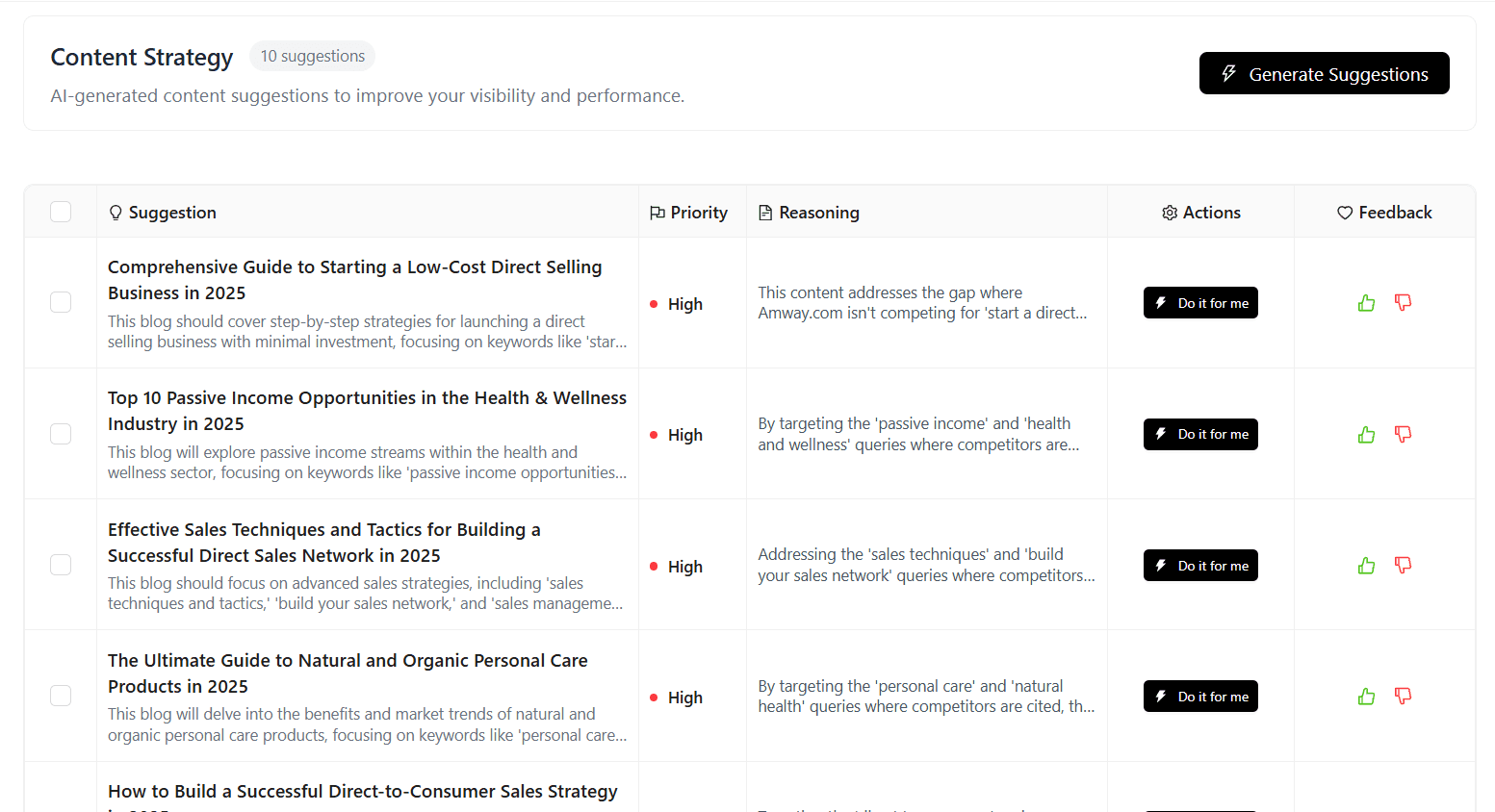
Once you've detected an incident, you need to diagnose the root cause fast. This means moving beyond surface-level metrics to understand exactly where you lost ground and why.
Content Gap Analysis reveals opportunities where competitors are gaining visibility while your content isn't appearing at all. The analysis answers critical questions:
Which search intents are now being served by AI-generated answers instead of your content?
What topics are competitors covering that you're not?
Where have your content priorities created blind spots in coverage?
Advanced GEO platforms use AI to generate content suggestions based on real-time gap analysis. These tools scan thousands of queries across multiple platforms, identify where your competitors appear in AI responses while your brand doesn't, and prioritize opportunities by commercial value. Passionfruit's content strategy module automatically generates prioritized content briefs based on actual citation gaps, complete with reasoning for why each opportunity matters and which competitors are winning the visibility you're missing.
For example, if your competitors are being cited in AI responses for "best enterprise CRM for scaling startups" and your brand never appears, that's a high-priority gap. The platform automatically generates a content brief explaining why the gap exists, what search intent you need to satisfy, and which competitor content is winning the citations.
Key diagnostic questions to answer:
Which specific queries or prompts triggered the traffic drop?
Did you lose traditional organic rankings, AI citation visibility, or both?
Are competitors gaining share of voice while you're declining?
Did a recent algorithm update or AI platform change correlate with the drop?
Are technical issues preventing proper content crawling or indexing?
This diagnostic phase should take 2-4 hours maximum. You're not solving the problem yet. You're building a clear picture of what broke so you can triage effectively.
Diagnosing Google Search Traffic Drop Patterns: Core Updates vs. AI Disruption
Not all Google traffic drops have the same root cause, and misdiagnosing the problem leads to wasted effort on the wrong solutions. Understanding the specific pattern of your traffic decline determines your entire recovery strategy.
Core Algorithm Update Drops When Google rolls out a core update (typically 3-4 times per year), traffic changes usually affect entire sections of your site or specific content types. You'll see:
Broad ranking declines across multiple keywords simultaneously
Impact correlating directly with the update rollout dates
Similar patterns affecting competitors in your niche
Changes in how Google evaluates E-E-A-T signals for your content
AI Overview Displacement This is the most common cause of Google organic traffic dropped scenarios in 2024-2025. Your rankings might stay identical, but CTR collapses because Google's AI Overview answers the query directly. Indicators include:
Rankings stable but traffic down 30-50%
Informational and how-to content hit hardest
Featured snippet losses correlating with AI Overview launches
Queries where AI provides "sufficient" answers without requiring clicks
Gemini Integration Impact Google's integration of Gemini into search creates a distinct drop pattern. Gemini drops typically affect:
Complex research queries where AI synthesis adds value
Comparison and evaluation searches
Technical troubleshooting and problem-solving queries
Educational and explanatory content
When diagnosing your Google search traffic drop, segment your analysis by query intent type (informational, navigational, commercial, transactional) and content category. This reveals whether you're experiencing algorithm penalties, AI displacement, or competitive losses requiring different response strategies.
Stage 3: Prompt Monitoring and Visibility Tracking
Understanding where your brand appears in AI-generated responses requires systematic prompt monitoring. This goes far beyond traditional keyword tracking because AI platforms respond to natural language queries, not just keyword strings.
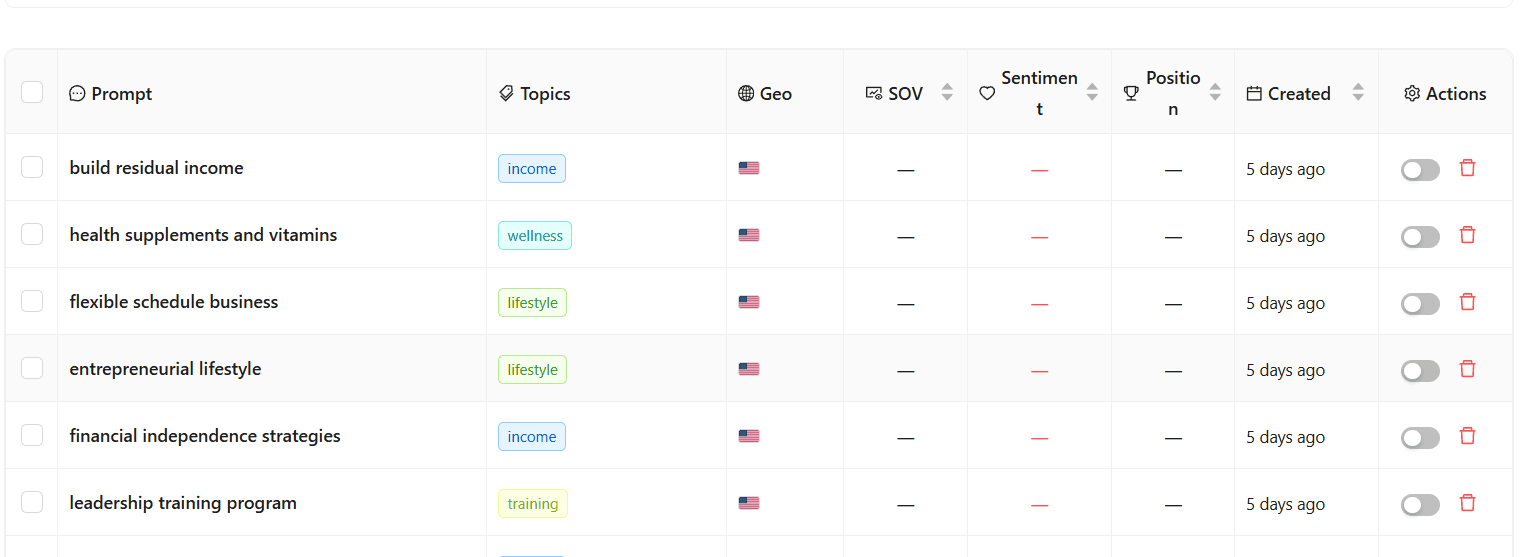
Prompt monitoring tracks:
Specific questions and conversational queries that should trigger mentions of your brand
Which AI platforms (Google, Perplexity, ChatGPT, Claude) include your content in responses
Your position within AI-generated answers (first mention, third mention, not mentioned)
Share of voice compared to competitors for critical topics
Geographic variations in AI response visibility
For instance, you might monitor prompts like "build residual income," "health supplements and vitamins," or "flexible schedule business." These represent actual user intent, not just keywords. Passionfruit's prompt monitoring system tracks whether AI platforms cite your content, where you rank in those citations, and how sentiment shifts over time, all while connecting visibility changes directly to pipeline impact and revenue metrics.
The goal isn't to track every possible query. It's to focus on the 70-100 high-value prompts that drive the majority of your qualified traffic and conversions. These are queries where appearing in AI responses directly correlates with pipeline growth and revenue.
Most teams discover they're invisible across 60-70% of commercially valuable prompts, even when they rank well in traditional search. This gap represents massive lost opportunity because AI-powered search is growing faster than traditional search ever did.
Stage 4: Citation Analysis and Competitive Intelligence
Once you understand your visibility gaps, you need to know why competitors are winning citations while you're not. This requires deep citation analysis across domains, pages, and content types.
Citation analysis reveals:
Which domains AI platforms cite most frequently for your target topics
Specific pages that consistently appear in AI-generated responses
Average ranking position for cited content (first citation, third citation, etc.)
Citation frequency percentages by domain and by specific URL
Content characteristics that correlate with higher citation rates
For example, when analyzing the prompt "continuous learning opportunities," you might discover that positivity.org earns citations in 17.5% of responses with an average rank of 4.1, while educate-me.co captures 7.5% of citations at position 4.0. These metrics tell you exactly which competitors to study and what content performance looks like for winners.
The most valuable insight from citation analysis is understanding what makes content citation-worthy. Common patterns include:
Authoritative, data-backed content from recognized experts
Structured information that AI can easily parse and extract
Content that directly answers specific questions without fluff
Pages with strong E-E-A-T signals (Experience, Expertise, Authoritativeness, Trust)
Fresh, regularly updated content rather than stale archives
Citation analysis also identifies which of your existing pages are already earning some visibility. These represent quick wins where optimization could dramatically improve citation rates and traffic recovery.
The Google Search Drop After ChatGPT: Competitive Reallocation Dynamics
The massive Google search drop after ChatGPT launched didn't impact all websites equally. While aggregate search volume declined across Google, the remaining traffic reallocated dramatically based on how well content performed in AI-mediated discovery.
Winners in this reallocation shared specific characteristics:
Content designed to earn citations from AI systems, not just rank in traditional search
Strong brand authority that AI platforms recognize and trust
Structured, parseable information architecture
Regular content updates demonstrating freshness and accuracy
Multi-platform visibility strategy rather than Google-only optimization
Losers typically exhibited:
Over-optimization for traditional ranking factors that AI systems ignore
Thin content designed to capture long-tail keywords through volume
Outdated information that AI platforms flagged as potentially unreliable
Single-platform dependency leaving them vulnerable to any Google change
No visibility strategy for ChatGPT, Perplexity, Claude, or other AI platforms
The competitive advantage now goes to brands that can maintain visibility across the entire search ecosystem: Google's traditional results, Google's AI Overviews, ChatGPT, Perplexity, Claude, and vertical search platforms specific to their industry.
This isn't about abandoning SEO fundamentals. It's about expanding your definition of "search" to include every platform where your buyers discover solutions. The teams experiencing the least impact from Google search drops after ChatGPT are those who built visibility diversification into their strategy before the crisis hit.
Stage 5: Platform Distribution Insights
Not all AI platforms weight content the same way. Google's AI Overviews prioritize different signals than ChatGPT, which differs from Perplexity's citation logic. Understanding your performance across platforms helps you prioritize optimization efforts.
Platform distribution tracking measures:
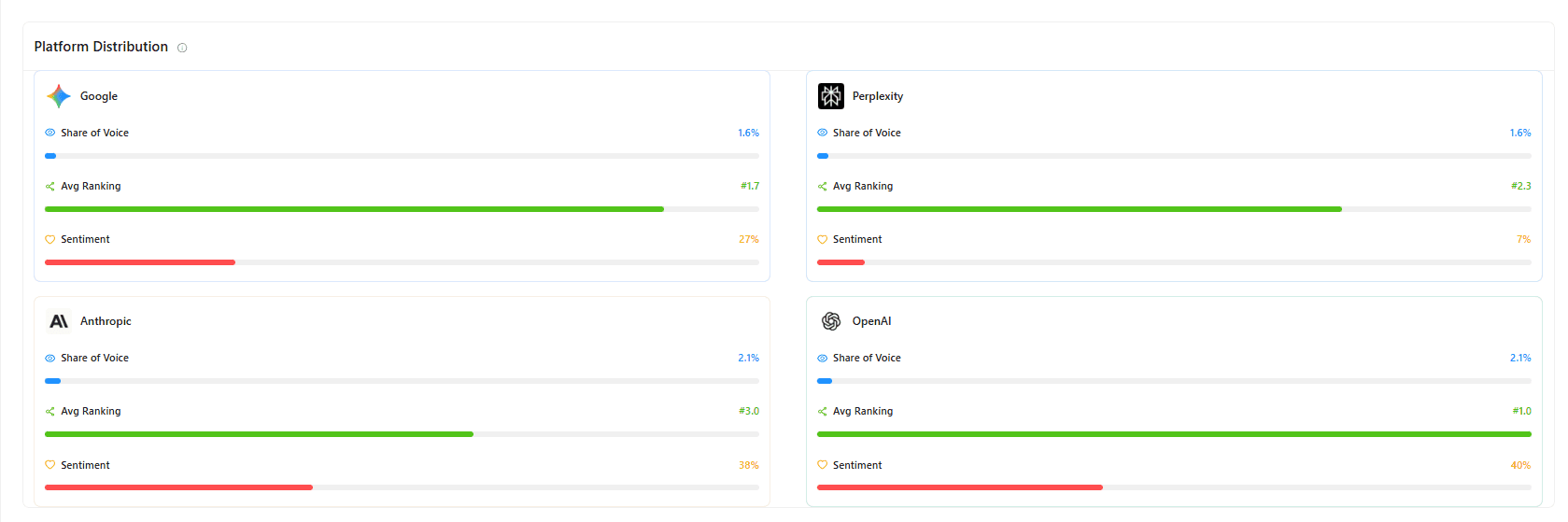
Share of voice percentage on each major AI platform
Average ranking position when you do appear
Sentiment analysis (positive, neutral, negative) for brand mentions
Platform-specific citation patterns and content preferences
For instance, your brand might have 1.6% share of voice on Google with an average ranking of 1.7 and 27% positive sentiment, while on OpenAI you have 2.1% share of voice, ranking 1.0, with 42% positive sentiment. These differences tell you where to focus optimization efforts and which platforms represent the biggest opportunities.
Platform distribution insights also reveal technical gaps. If you appear frequently on Perplexity but never on ChatGPT, that might indicate crawl accessibility issues specific to OpenAI's bot or content formatting that one platform handles better than others.
The goal is to build a balanced distribution strategy rather than putting all your optimization effort into a single platform. Just as you wouldn't optimize only for Google and ignore Bing entirely, you can't afford to ignore ChatGPT, Perplexity, or Claude when they collectively represent 30-40% of search-driven discovery. Passionfruit provides unified visibility across all four major AI search platforms in a single dashboard, eliminating the need to juggle multiple tools or manually compile data from disparate sources.
Sentiment Analysis and Context Monitoring: The Hidden Dimension
Here's what most teams miss completely: it's not enough to track whether you're cited. You need to understand the context and sentiment of those citations because negative visibility is often worse than no visibility at all.
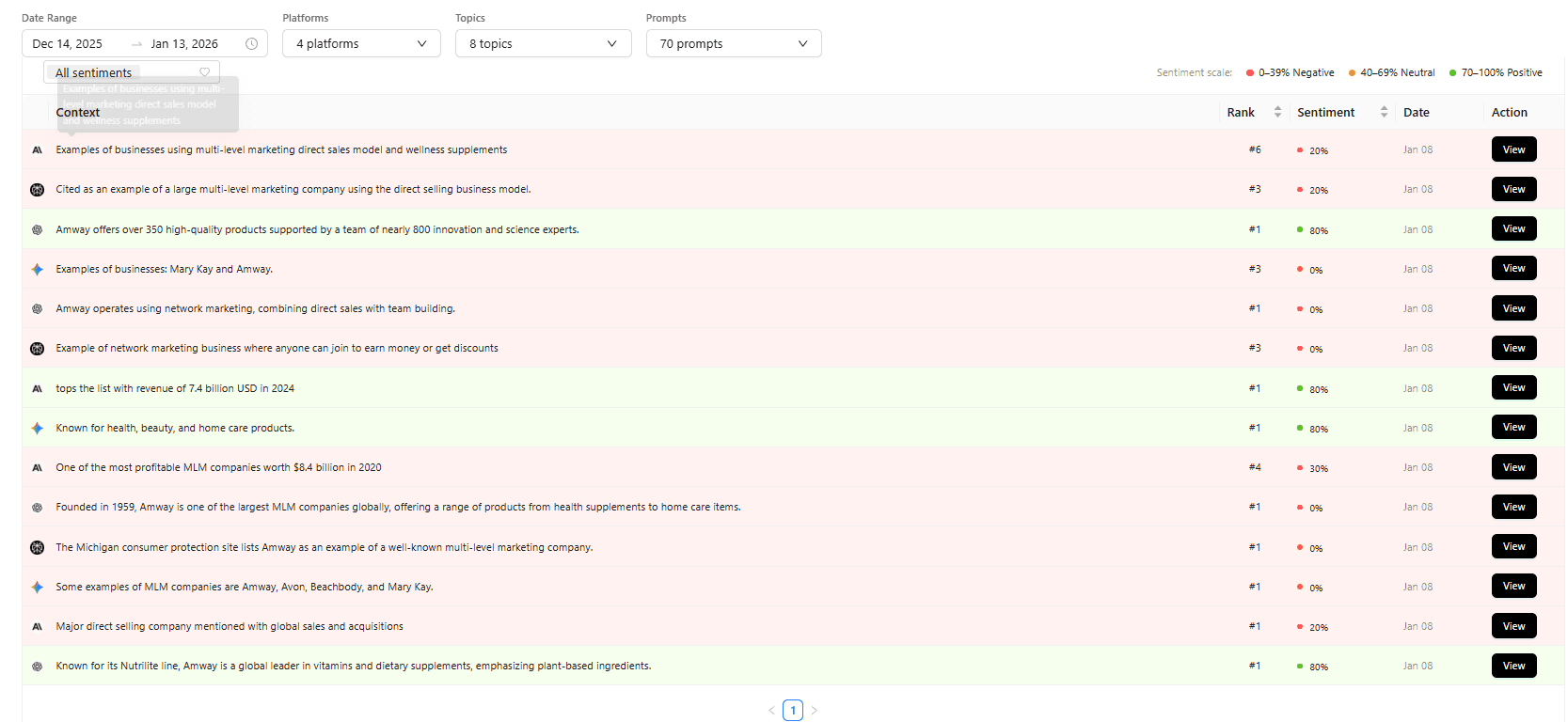
Context monitoring reveals:
The exact language AI platforms use when mentioning your brand
Whether mentions occur in positive, negative, or neutral contexts
Specific claims or associations AI systems make about your company
How positioning and messaging varies across different query types
Reputation risks from outdated or inaccurate information in AI training data
For example, AI might cite your brand as "an example of outdated network marketing models" in responses about modern direct sales businesses. That citation technically increases your visibility metrics but damages your brand and drives away qualified prospects.
Sentiment tracking assigns scores to each mention, typically on a scale where 0-39% indicates negative sentiment, 40-69% neutral, and 70-100% positive. By monitoring sentiment alongside visibility, you can quickly identify reputation issues that require immediate response. Passionfruit's sentiment monitoring automatically flags negative context patterns and alerts your team when brand mentions shift from positive to neutral or negative, giving you early warning of reputation issues before they impact revenue.
The most sophisticated incident response includes regular sentiment audits where you:
Review the top 50-100 contexts where your brand appears in AI responses
Flag negative or misleading characterizations for content response
Identify positive mention patterns to amplify in your content strategy
Track sentiment changes over time to measure brand health in AI systems
One enterprise SaaS company discovered that while their share of voice was growing, 68% of their mentions occurred in negative contexts related to a product issue from three years ago. Without sentiment monitoring, they would have celebrated increased visibility while their brand reputation deteriorated across AI platforms.
Building Your Incident Response Runbook
Theory doesn't help when traffic tanks at 9:47 AM. You need a documented runbook that anyone on your team can execute without guessing or improvising.
Your runbook should include:
Detection Protocol (0-2 hours)
Automated alert triggers and notification channels
Dashboard URLs and login credentials for all monitoring tools
Initial data collection checklist (traffic, rankings, citations, technical status)
Stakeholder notification templates for different severity levels
Diagnostic Checklist (2-4 hours)
Step-by-step investigation sequence to identify root cause
Decision tree for categorizing incident type (ranking drop, citation loss, technical issue, etc.)
Tools and queries to run for each incident category
Documentation template for findings and initial hypothesis
Triage Matrix (4-6 hours)
Severity classification criteria based on traffic impact and revenue risk
Resource allocation framework by severity level
Timeline expectations for different incident types
Escalation paths and executive communication protocols
Remediation Playbooks (6 hours - 2 weeks)
Content optimization procedures for citation improvement
Technical SEO fixes for crawl and indexing issues
Link building and authority signals for ranking recovery
Platform-specific optimization for AI visibility gaps
Monitoring and Reporting (Ongoing)
Daily check-in cadence during active incidents
Weekly status update templates for stakeholders
Success metrics and recovery milestones
Post-mortem documentation requirements
The runbook should live in your team wiki or knowledge base where everyone can access it. Review and update it quarterly as the search landscape evolves.
When Google Drops Hit: Severity Classification and Response Timelines
Not all traffic incidents require the same urgency or resource allocation. Understanding the severity and velocity of Google drops helps you respond proportionally without overreacting to normal fluctuations or underreacting to existential threats.
Severity Level 1: Drop Google Gravity Events (Critical) These are catastrophic visibility losses requiring immediate all-hands response:
Traffic decline exceeds 40% within 7 days
Revenue-critical keywords drop from page 1 to page 3+ simultaneously
Multiple competitors surge while your visibility collapses across the board
Clear correlation with major algorithm updates or manual actions
Response timeline: Incident declared within 2 hours, executive briefing within 4 hours, full response team mobilized within 24 hours. These events threaten quarterly revenue targets and require CEO visibility.
Severity Level 2: Significant Google Drops (High Priority) Material impact requiring coordinated response but not emergency mobilization:
Traffic decline between 20-40% over 14 days
Key commercial keywords losing positions but maintaining page 1 presence
AI Overview displacement affecting high-value content
Isolated to specific content categories or topic clusters
Response timeline: Investigation begins within 24 hours, diagnosis completed within 48 hours, remediation plan drafted within 72 hours.
Severity Level 3: Moderate Traffic Fluctuations (Monitor) Observable changes requiring investigation but not immediate action:
Traffic variance between 10-20% over 30 days
Seasonal patterns or normal algorithmic flux
Minor ranking position shifts without significant traffic impact
Isolated page-level issues affecting non-critical content
Response timeline: Weekly monitoring, analysis during regular performance reviews, optimization scheduled in normal sprint cycles.
Understanding where your incident falls on this spectrum prevents resource waste on minor fluctuations while ensuring you mobilize appropriately when Google drops genuinely threaten business outcomes.
Operational Edge: Turning Reactive Response into Proactive Resilience
The best incident response is the one you never need. Once you've resolved the immediate crisis, the goal is to build systems that prevent future incidents or detect them so early they never become crises.
Proactive resilience strategies include:
Continuous Content Monitoring Don't wait for traffic to drop before checking your visibility. Daily automated scans across AI platforms should be part of your normal operations, not emergency protocol. Passionfruit runs continuous monitoring across all major search surfaces, detecting visibility changes within hours rather than days or weeks, so you can respond to issues before they become full-blown crises.
Diversified Traffic Sources Over-dependence on any single channel creates massive vulnerability. Balance your organic visibility across traditional search, AI platforms, and other discovery channels.
Citation-Worthy Content Library Build a repository of authoritative, frequently-updated content specifically designed to earn AI citations. These assets become your foundation during incidents.
Alert Workflow Integration Connect your monitoring alerts directly to your project management system so incident response begins automatically when thresholds trigger.
Executive Dashboard Alignment Tie visibility metrics directly to business KPIs so leadership understands the revenue impact of search performance, not just traffic numbers.
The teams that excel at incident response treat it as operational discipline, not ad hoc emergency management. They have documented processes, clear ownership, regular training, and post-mortem reviews after every incident to continuously improve their response capability.
Measuring What Matters: KPIs for Incident Response
Vanity metrics won't help you justify incident response investment to executives. You need to connect visibility changes directly to business outcomes.
Critical KPIs to track:
Revenue impact from affected keywords and queries
Conversion rate changes correlated with visibility drops
Customer acquisition cost increases due to lost organic traffic
Share of voice compared to competitors across all platforms
Time-to-recovery for different incident types
Cost of incident response (team hours, tools, external support)
For example, instead of reporting "we lost 30% of organic traffic," report "we lost $47K in monthly revenue from qualified leads across 12 high-intent keywords, increasing our CAC by 28%." That frames the incident in language executives understand and makes the case for proactive monitoring investment. Passionfruit's revenue-first approach automatically maps visibility changes to pipeline impact and revenue attribution, giving you executive-ready reporting without manual calculation or spreadsheet gymnastics.
The goal isn't perfect prevention. It's reducing frequency, minimizing impact, and accelerating recovery when incidents occur.
Next Steps: Implement Your Playbook Today
You don't need to build everything at once. Start with the highest-leverage components and iterate from there.
Week 1: Set up detection Configure automated alerts for your top 20 revenue-driving keywords and queries. Use Google Search Console, Google Analytics, and a GEO monitoring platform to track traditional and AI search visibility. Passionfruit provides pre-built alert workflows that connect directly to your Slack or email, eliminating the manual configuration that takes most teams weeks to set up properly.
Week 2: Document your runbook Create the basic incident response template with clear roles, responsibilities, and escalation paths. Test it with a tabletop exercise simulating a traffic drop.
Week 3: Implement prompt monitoring Identify the 50 most valuable queries where your ideal customers discover solutions. Track your visibility across Google, Perplexity, ChatGPT, and Claude for these prompts.
Week 4: Build citation analysis Audit where competitors appear in AI responses for your target topics. Document what makes their content citation-worthy and identify quick wins for your own optimization.
The teams winning in this new search landscape aren't the ones with the biggest content budgets or the most sophisticated technical stacks. They're the teams with systematic visibility into performance, clear playbooks for response, and the operational discipline to execute consistently.
Want to see how your brand performs across AI search platforms right now? Explore Passionfruit's GEO monitoring platform and get visibility into the citation gaps, sentiment issues, and competitive threats that traditional SEO tools can't detect.
Traffic will drop again. Algorithm updates will disrupt rankings. AI platforms will shift their citation logic. The question isn't whether you'll face another incident. It's whether you'll be ready when it happens.
Frequently Asked Questions
How long does it typically take to recover from a major traffic drop caused by an algorithm update?
Recovery timelines vary significantly based on the root cause and the quality of your response. For technical issues like crawl blocks or indexing problems, you can see recovery within 2-3 weeks once fixes are deployed. For content quality issues or citation visibility gaps, meaningful recovery typically takes 6-12 weeks as you rebuild authority and AI systems recrawl and re-evaluate your content. The key is starting your response within the first 48 hours when incidents occur.
What's the difference between traditional SEO incident response and GEO incident response?
Traditional SEO incident response focuses primarily on ranking drops in Google's organic results, technical crawl issues, and backlink problems. GEO incident response adds an entire layer of complexity by tracking visibility across multiple AI platforms (Google AI Overviews, ChatGPT, Perplexity, Claude), measuring citation frequency and positioning, monitoring sentiment in AI-generated responses, and optimizing for how generative models extract and present information. You need both approaches working together.
Should we prioritize traditional organic rankings or AI citation visibility during an incident?
This depends entirely on where your qualified traffic originates. For most B2B and enterprise companies, traditional organic rankings still drive 60-70% of search traffic, so those should be your first priority during incidents. However, AI-powered search is growing 3x faster than traditional search according to recent Gartner research, so you cannot ignore citation visibility. The most effective approach is parallel workstreams addressing both simultaneously rather than choosing one over the other.
How do we measure the ROI of investing in GEO monitoring and incident response?
Calculate the revenue value of your organic traffic by segment (branded, non-branded, commercial intent, informational), then multiply your average monthly revenue by the percentage drop during past incidents. That's your risk exposure. Compare that to the cost of monitoring tools, documented playbooks, and team training. Most mid-market and enterprise companies discover their risk exposure is 50-100x higher than the cost of proper incident response systems, making the ROI calculation straightforward.
What tools do we need to build an effective incident response system?
At minimum, you need Google Search Console and Google Analytics for traditional SEO monitoring. For comprehensive GEO coverage, you'll want a specialized platform that tracks visibility across multiple AI search engines, monitors citation frequency and sentiment, and provides automated alerts. Passionfruit combines traditional SEO monitoring with GEO visibility tracking in a single platform, eliminating the need to stitch together data from multiple tools. Additional complementary tools that strengthen your response capability include technical SEO crawlers like Screaming Frog, rank tracking software, and project management systems to coordinate response activities across your team.
How often should we update our incident response runbook?
Review and update your runbook quarterly at minimum. The search landscape is evolving rapidly with new AI platforms launching, existing platforms changing their algorithms, and Google continuing to roll out updates to Search Generative Experience. After every major incident, conduct a post-mortem and update the runbook based on lessons learned. The most resilient teams treat their runbook as a living document that improves continuously rather than a static reference created once and forgotten.