SEO
Join 500+ brands growing with Passionfruit!
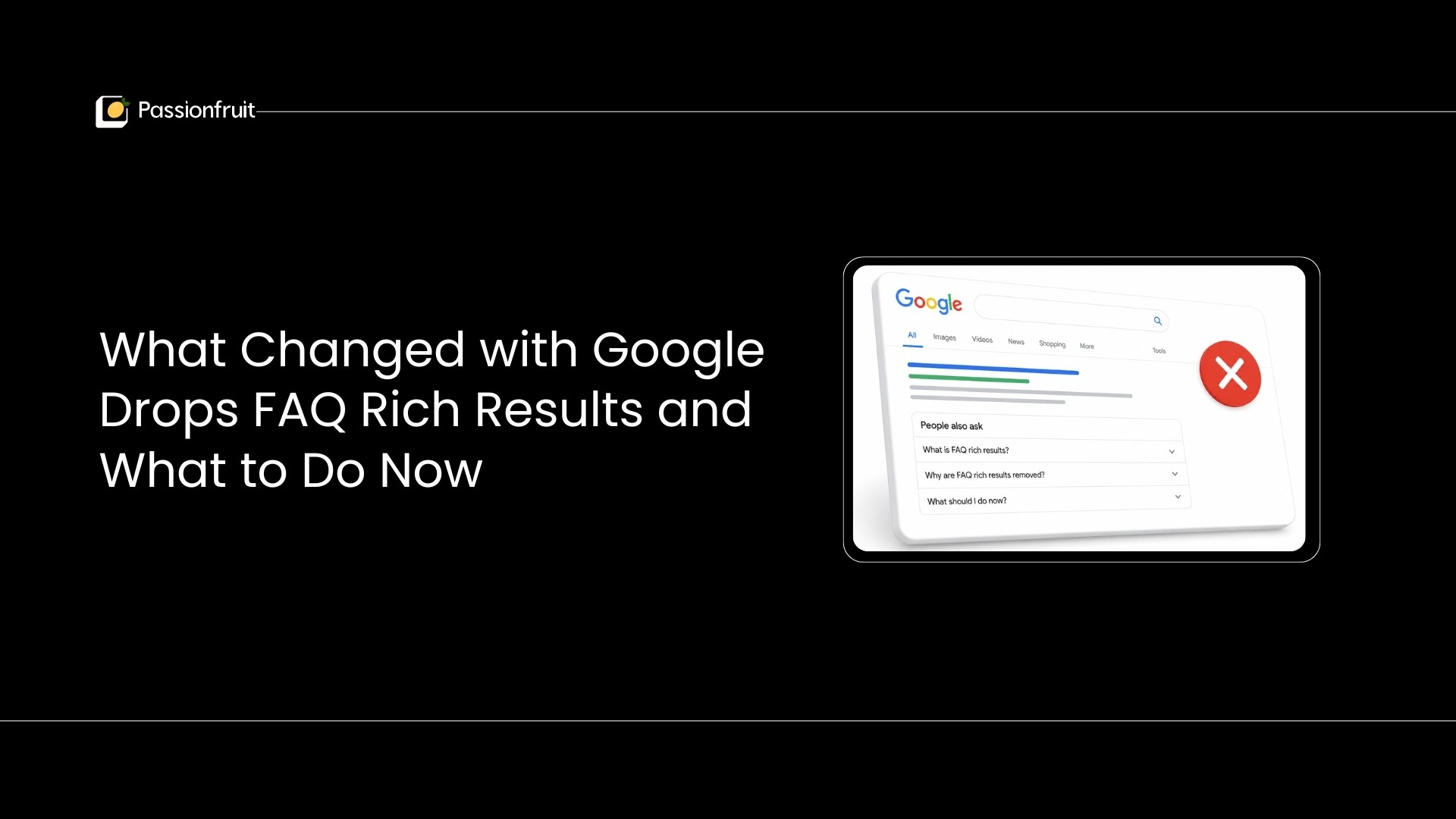
Google deprecated FAQ rich results on May 7, 2026, ending a feature that for years let publishers expand their SERP listings with question-and-answer dropdowns. The rich results disappeared from Google Search. The reporting and testing tools follow in stages: Search Console reporting and Rich Results Test support end in June 2026, and Search Console API support ends in August 2026.
The change has produced two overcorrected reactions in the SEO industry, "schema is dead" and "FAQ schema matters more than ever for AI search," neither of which is fully accurate. The truth is more practical, and the action items are smaller than most takes suggest.
What Google changed about FAQ rich results
Google added a deprecation notice at the top of its FAQ structured data developer documentation on May 7, 2026. FAQ rich results no longer appear in Google Search results. FAQPage as a Schema.org type is still valid, and the markup can stay on your pages without causing problems. Google's own documentation confirms unused structured data does not affect Search.
The deprecation runs across three timelines:
May 7, 2026. FAQ rich results stopped appearing in Google Search.
June 2026. The FAQ search appearance filter, the FAQ rich result report in Search Console, and Rich Results Test support are removed.
August 2026. The FAQ rich result data in the Search Console API is removed.
Teams running automated dashboards or BigQuery exports against the Search Console API need to update those calls before the August deadline, or risk silent NULL returns in downstream reporting.
What still works
FAQPage structured data remains a valid Schema.org type. The markup continues to be crawlable by Bingbot, PerplexityBot, and the various retrieval-augmented generation crawlers indexing the open web. Google has stated unused structured data does not cause problems for Search, and the documentation update on May 7 specifically notes the markup can be left in place.
For practical purposes, FAQ schema is no longer a SERP appearance lever. Whether it remains a useful signal for AI retrieval is a separate question, and one worth treating carefully.
Why Google deprecated FAQ rich results
Google did not publish a separate blog post explaining the deprecation, and the documentation note offers no reasoning. The pattern in Google's own behavior over the past three years tells the story on its own.
In August 2023, Google restricted FAQ rich results to "well-known, authoritative government and health websites" only. Most sites lost eligibility at that point, with a few specific verticals retained. The May 2026 deprecation finishes that withdrawal for the verticals that had remained eligible.
The May 2026 announcement is consistent with how Google has handled other structured data types. HowTo rich results were fully deprecated on desktop in September 2023. In June 2025, Google retired seven additional structured data types (Book Actions, Course Info, Claim Review, Estimated Salary, Learning Video, Special Announcement, and Vehicle Listing) on the same reasoning, that the analysis showed the features were not widely used and no longer added significant user value.
The underlying pattern: when a rich result feature gets aggressively scaled by SEO tooling and stops faithfully describing the page, Google narrows eligibility to a vertical and then removes the feature entirely. The markup specification stays. The visible SERP enhancement does not.
Should you remove FAQ schema from your site?
The short answer is no, not unless your FAQ implementation is genuinely abandoned or describes content the page no longer contains. Google has stated unused structured data does not cause problems. Other crawlers still parse it. The cost of leaving valid markup in place is essentially zero.
When to keep FAQPage markup
Keep your FAQ schema if all of the following hold: the questions and answers reflect content that actually appears on the page, the schema validates without errors, and the FAQ section serves real users. Help centres, regulator FAQ pages, support pages, and product FAQs all fall into this category. The schema describes what the page contains, and continues to function as machine-readable structured content for non-Google retrieval systems.
When to remove or simplify
Remove FAQ schema in two specific cases:
The markup describes questions or answers that no longer appear on the page (mismatched schema is a maintainability liability and can flag as a quality signal).
The FAQ section was added solely to trigger the rich result, has weak content, and would not be missed if both the schema and the section were cut.
In the second case, removing the section itself is the bigger improvement, not removing the markup alone. The page reads cleaner, the topic stays focused, and the structured data layer matches reality. Our breakdown of FAQ schema for AI answers covers the formats and quality patterns that distinguish FAQ content worth keeping from FAQ content built only to game the SERP.
Does FAQ schema still help AI search?
Here is where the debate gets contested, and the honest answer requires separating two layers that often get conflated. The stakes are real: Pew Research Center found that 58% of users encountered an AI summary in at least one Google search during March 2025, and clicked traditional links roughly half as often when an AI summary appeared. If FAQ schema does meaningfully influence AI extraction, that is where the impact would show up.
The first layer is the visible Q&A content on the page. Pages that organize information as a clear question followed by a direct, concise answer are easier for LLMs to extract during retrieval. The question framing, the standalone answer block, and the consistent format together help the model locate a citable fragment without ambiguity. The visible content earns the citation.
The second layer is the JSON-LD schema markup itself. The evidence here is mixed. Microsoft's Fabrice Canel confirmed in March 2025 that schema markup helps Microsoft's LLMs understand content for Copilot. A separate December 2024 study from Search/Atlas found no correlation between schema markup coverage and citation rates across AI platforms. OpenAI, Anthropic, and Perplexity have not published guidance on how their retrieval systems treat JSON-LD specifically.
The defensible position: FAQ schema is cheap insurance with unclear upside for AI citation, while visible Q&A formatting on the page does the load-bearing work. For brands building AI search visibility across SEO, GEO, and AEO surfaces, the answer is to prioritize the content layer first, then keep the schema layer as a low-effort addition where the markup accurately describes the page. Building the dependable foundation behind both layers is what most search engine optimization services and generative engine optimization services actually do, even when the conversation gets framed around markup.
What to do this week
The action items are smaller than the coverage suggests. Four steps cover most teams.
Export your historical FAQ rich result data from Search Console before June 2026, so the baseline is preserved for any future before-and-after CTR analysis.
Audit existing FAQ implementations. Confirm the schema matches the visible content on the page. Remove orphaned markup or weak FAQ sections that exist only to gain SERP pixels.
Update QA processes that used the Rich Results Test as a "will this trigger the FAQ dropdown" check. Replace with general structured-data validation focused on schema accuracy.
Adjust API and BigQuery pipelines pulling FAQ rich result data before August 2026, to avoid silent failures and stale dashboards.
The work here is largely a hygiene exercise, not a strategic pivot. The visible-content discipline that drives AI citation, the same discipline that should govern your broader budget split across SEO, GEO, and AEO, does not change because Google retired a rich result feature.
Make your content the answer, not the enhancement
The SERP enhancement era ends quietly this year. The brands that win AI search visibility are the ones treating their pages as machine-readable, citation-ready content built around real questions and real answers, not the ones layering schema markup over thin pages and hoping rich results carry the click.
If your team is still treating FAQ schema as a visibility hack rather than as part of a deeper citation strategy, the gap will widen with every AI Overview and every ChatGPT-cited answer that someone else's content earns. The fastest way to close it is a baseline audit of what AI surfaces currently say about your brand, then a focused plan that fixes what is breaking first. Look at how Passionfruit's GEO services approach the audit, see the citation tracking inside Passionfruit Labs, and talk to the team when you are ready to move.
Frequently asked questions
When did Google deprecate FAQ rich results?
Google deprecated FAQ rich results on May 7, 2026. Search Console reporting and Rich Results Test support are scheduled for removal in June 2026, and Search Console API support is scheduled for removal in August 2026.
Is FAQPage schema dead?
No. FAQPage is still a valid Schema.org type. Google deprecated the rich result feature, not the markup itself. FAQ schema can remain on pages without causing problems and may continue to be parsed by other crawlers and retrieval systems, including those used by AI search engines.
Should I remove FAQ schema from my pages?
Generally no. Keep FAQ schema when the markup accurately describes visible questions and answers on the page. Remove it only if the schema references content that no longer exists, or if the FAQ section itself was thin and was added solely for the SERP enhancement.
Does FAQ schema help AI search citations?
The evidence is mixed. Microsoft has confirmed schema markup helps its LLMs understand content for Copilot. A separate December 2024 study from Search/Atlas found no correlation between schema markup coverage and citation rates across AI platforms. Visible Q&A formatting on the page does more measurable work than the JSON-LD layer alone.
Will my Google rankings drop after the deprecation?
Google has stated rankings are not affected by the deprecation. The change is a search-appearance change, not an algorithmic one. Sites that previously benefited from larger FAQ dropdowns may see CTR shifts on those pages, but ranking positions are not adjusted as a result of the deprecation.
What schema types still produce rich results in Google Search?
Product, Review and AggregateRating, Article, Recipe, Video, Organization, LocalBusiness, and BreadcrumbList are among the schema types that continue to produce rich results. Google's structured data documentation lists the currently supported features, and the supported set has narrowed across 2023, 2025, and 2026 as Google retired underused or abused types.