SEO
Join 500+ brands growing with Passionfruit!
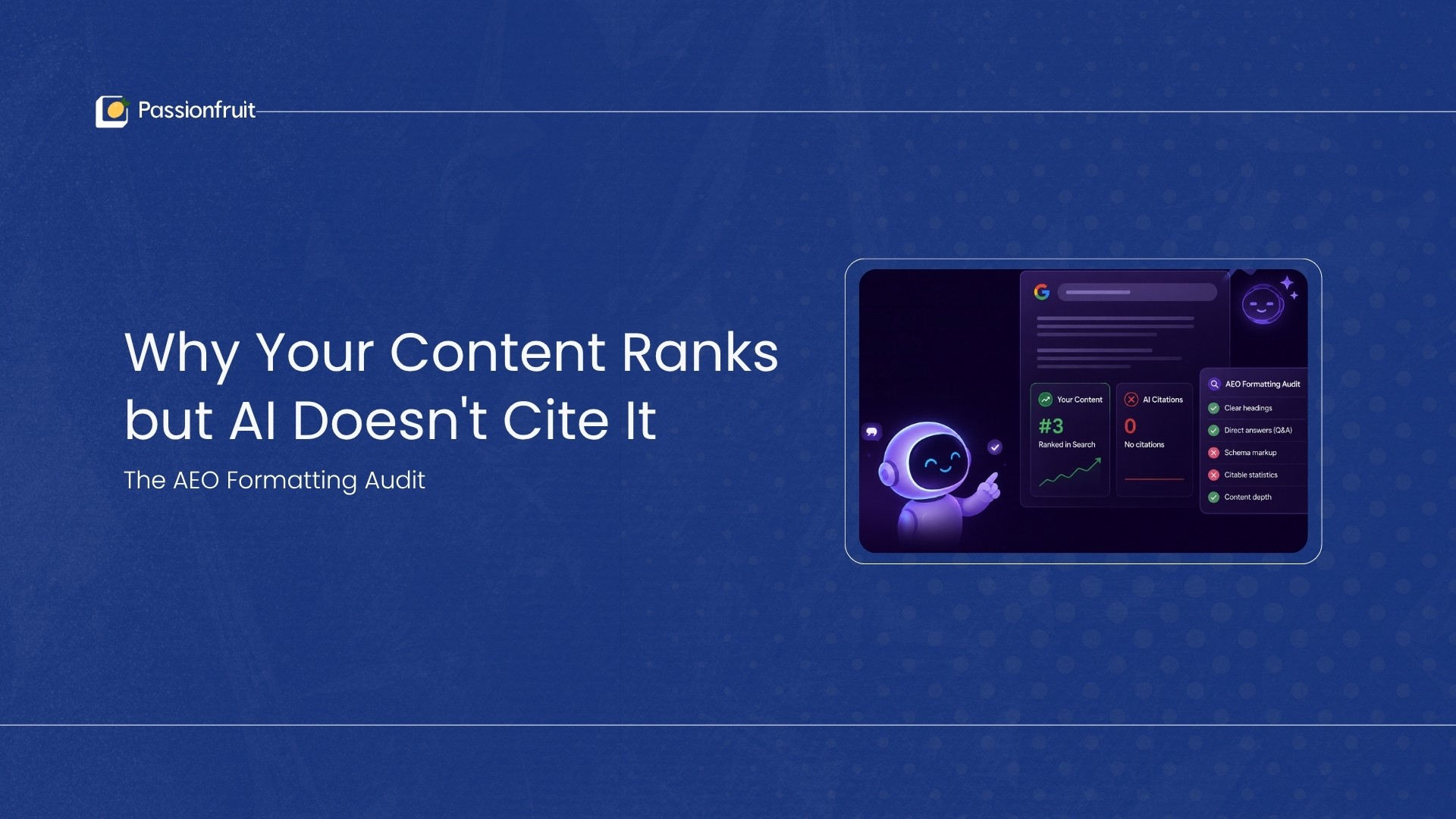
Across the structural studies published on AI citation in 2025 and 2026, one pattern repeats: the pages AI engines cite share a small set of formatting features, and the pages they skip share a small set of formatting failures.
The Princeton and Georgia Tech GEO study found that structuring content for extraction lifted AI visibility by up to 40%.
A page can rank on the first page of Google and still earn zero AI citations. The cause is usually structural, not topical, and the data points to which structures matter.
The piece below lays out what the citation data shows, the methodology to audit your own pages against it, the honest limits of what that data can prove, and the fixes ranked by the size of their likely impact.
What the data says, and what it doesn't
Before the tactics, a note on what these numbers can and cannot tell you. The causation point is the part most AEO advice skips.
The structural studies are correlational. The AirOps finding that 68.7% of cited pages use logical heading hierarchy does not prove that fixing your heading hierarchy causes citations. The clean hierarchies may simply come from publishers who also do many other things well, with the underlying authority driving both the structure and the citation.
Seer Interactive's study lead Tracy McDonald raised the same caution about their AI Overview CTR data: citation and performance correlate, but correlation is not proof that one causes the other. Brands with stronger authority may simply be more likely to be both well-structured and well-cited.
So treat the structural data as directional, not deterministic. Clean structure is associated with citation strongly enough to act on, but not strongly enough to guarantee that formatting alone will get you cited. The honest framing matters, because teams that expect a formatting fix to deterministically produce citations will misread their own results.
With that caveat set, the data is still actionable. Here is why.
Why ranked pages get skipped: the retrieval mechanism
AI engines do not read pages the way people do. The engines retrieve and extract passages.
When a user asks an AI engine a question, the engine breaks the query into sub-queries, searches an index, pulls back passages, and synthesizes an answer from the chunks it can cleanly extract and attribute. The unit of citation is the passage, not the page.
That single fact explains the ranking-without-citation gap. Google ranks whole pages. AI engines cite individual passages. A page can rank well overall while each passage on it is too buried, too long, or too vaguely labeled for an engine to lift out and trust.
The structural data fits this mechanism. Single-H1 anchoring (87% of cited pages) and logical hierarchy (68.7%) both help an engine map where one idea ends and the next begins. List formatting plus schema (2.8x citation rate) gives the engine discrete, bounded units to extract. The features that correlate with citation are the features that make passage-level extraction easier.
The five formatting signals, ranked by likely impact
Five structural problems account for most citation failures. The data does not give a clean impact percentage for each, so the ranking below reflects which signals most directly govern passage extraction, ordered from highest likely impact to lowest. Treat the order as a hypothesis to test on your own pages, not a proven hierarchy.
Signal 1: Buried answers (highest likely impact)
AI engines weight the opening of a passage most heavily as the answer to the section's implied question. Content that opens with background before delivering the answer reads, to the engine, as if the section never answered the question.
The detection test: read only the first two sentences under each heading. If those sentences do not contain the core answer, an engine will not find it either.
Why this ranks first: it directly controls whether the answer is extractable at all. Every other signal is secondary if the answer itself is buried.
Signal 2: Vague headings
Headings should read as standalone questions or clear topic labels. Abstract headings like "Key Considerations" give an engine no signal about what the section answers.
The detection test: export every heading and read them in isolation with no body text. Each should communicate what its section covers. A heading you cannot interpret alone gives an engine nothing to match a query against.
Why this ranks second: headings are how engines map query intent to passages. Clean hierarchy correlated with citation in 68.7% of cited pages, which makes heading quality the second-most-direct lever after answer placement.
Signal 3: Missing question-and-answer pairs
Engines preferentially cite content where a question appears in a heading and the answer appears in the one or two sentences directly below.
The detection test: compare your headings against the questions buyers actually ask AI about your topic. Where headings do not frame those questions, you have a citation gap.
Why this ranks third: it expands the surface area of extractable answers, but only once Signals 1 and 2 are handled.
Signal 4: Wall-of-text sections
Sections that run long without subheadings, lists, or breaks force an engine to guess where one point ends and the next begins, which lowers extraction confidence.
The detection test: flag any section between headings that runs long without an internal break. Long sections usually contain several points that should be split into discrete, citable segments.
Why this ranks fourth: list and chunk formatting correlated with a 2.8x citation rate, so the effect is real, but it amplifies extraction rather than enabling it.
Signal 5: Schema, handled honestly (lowest standalone impact)
Most AEO guides rank schema near the top. The data and Google's own guidance suggest it belongs lower as a standalone lever.
Google's May 2026 AI optimization documentation states that structured data is not required for its generative AI features and that there is no special schema for AI search. At the same time, schema appears on cited pages at high rates, and schema combined with list formatting correlated with the 2.8x citation lift.
The honest reading: schema is not a standalone citation switch, but it correlates with the same clean structure that earns citations, and it still earns rich results in classic search. Treat it as structural hygiene. One rule holds regardless: incorrect schema is worse than none, because mismatched types and empty fields actively confuse extraction. Our guide to FAQ schema for AI answers covers where it genuinely helps.
The audit methodology
Here is the methodology to test your own pages against the structural data. The method is built to be repeatable, so you can re-run it and track the trend rather than reacting to a single snapshot.
Inputs
Page inventory: your top 50 to 100 pages by organic traffic, from Google Search Console
Citation data: which of those pages currently earn AI citations, from a citation tracking platform like Passionfruit Labs
The five-signal diagnostic above
Step 1: Build the inventory
Pull your top 50 to 100 pages by organic traffic. If you have fewer than 50, start with what you have. Even the top 10 surface patterns that repeat across the site.
Step 2: Isolate the high-opportunity set
Cross-reference traffic against citation data. Pages with strong organic traffic and zero AI citations are the high-opportunity set. That traffic-without-citation mismatch is the clearest signal of a structural problem, because the topic is already proven by the ranking.
Step 3: Score each page against the five signals
Use a 0 to 5 scale, one point per signal present. Pages scoring 3 or higher need immediate attention. Pages scoring 1 or 2 go into a regular refresh cycle.
Run one technical check here: view each page in a rendered-HTML or text-only view to confirm the answer is present without heavy JavaScript. Content that surfaces only after complex rendering may never get extracted.
Step 4: Prioritize by traffic value
Fix high-traffic, zero-citation pages first. A page ranking for a high-volume query with no citations is a larger opportunity than a low-volume page with the same problem.
Step 5: Re-run on a cadence
Run the full diagnostic quarterly and spot-check new content at publish. New pages inherit old formatting habits unless structure checks are built into the workflow.
How to fix, in priority order tied to the data
Group fixes by how directly each signal governs extraction, which is the same order as the signal ranking above.
Rewrite buried answers first. Move the core answer into the first two sentences of each section. The reason this ranks first: it controls extractability at the root.
Rewrite vague headings second. State the question or topic plainly, and fix any broken hierarchy, since clean hierarchy correlated with citation in 68.7% of cited pages.
Add question-and-answer pairs third. Frame real buyer questions as headings with short answers below.
Break up wall-of-text sections fourth. List and chunk formatting tracked with the 2.8x citation rate.
Validate schema last, as hygiene. Fix mismatched types and empty fields, add structured data where it earns rich results.
Expect four to eight weeks for engines to re-crawl and reflect changes.
How to measure the result honestly
The causation caveat from the top of the piece becomes operational here.
AI citation is probabilistic. The cross-platform citation analysis behind our research on how brands appear differently across AI platforms found that 40 to 60% of cited sources rotate month to month, and that the same query returns different sources across runs because the models are non-deterministic.
A single before-and-after snapshot will mislead you. The rotation alone can produce a citation gain or loss that has nothing to do with your formatting fix.
Three rules for honest measurement:
Document baseline citation rates before changing anything. Without a baseline, you cannot separate your fix from normal rotation.
Track trend lines over several weeks, not single-day snapshots. One run is noise. A four-week trend is signal.
Measure per page, so you can connect a specific formatting change to a specific citation change, and accept that even then the link is correlational, not proven.
The honest goal is not to prove formatting caused a citation. The goal is to stack the structural odds in your favor across enough pages that the trend moves, then track the trend rather than the snapshot.
Stack the structural odds before your competitors do
The structural data is consistent enough to act on, even though it cannot prove causation on any single page. Cited pages share clean hierarchy, single-H1 anchoring, front-loaded answers, and chunked formatting. Pages with traffic and no citations are the cleanest place to apply those patterns, because the topic is already validated by the ranking.
The first move is a diagnostic, not a rewrite. Isolate the high-traffic, zero-citation pages, score them against the five signals, and fix the highest-impact problems first.
The cleanest way to start is a baseline audit that connects citation performance to individual pages across ChatGPT, Perplexity, Gemini, AI Overviews, and Claude, so you can track the trend over time. See how Passionfruit's GEO service runs the audit on top of a solid SEO foundation, look at the cross-platform citation tracking inside Passionfruit Labs, and talk to the team before the next content cycle.
Frequently asked questions
Why does my content rank on Google but not get cited by AI?
Google ranks whole pages, while AI engines cite individual passages they can extract and attribute. A page can rank well overall while its passages are too buried, too long, or too vaguely labeled for an engine to lift out. Structural studies show cited pages share features like logical heading hierarchy (68.7% of ChatGPT-cited pages) and single-H1 anchoring (87%), which make passage-level extraction easier.
Does fixing formatting guarantee AI citations?
No. The structural data is correlational, not causal. Pages with clean structure are cited at higher rates, but that may partly reflect that authoritative publishers tend to do both structure and many other things well. Treat formatting as stacking the odds in your favor across many pages, then track the trend, rather than expecting a single fix to deterministically produce a citation.
What formatting signals most affect AI citations?
Five signals, ranked by how directly they govern passage extraction: buried answers (highest impact), vague headings, missing question-and-answer pairs, wall-of-text sections, and schema issues (lowest standalone impact). Buried answers rank first because they control whether the answer is extractable at all. The ranking is a hypothesis to test on your own pages, not a proven hierarchy.
Does schema markup get content cited by AI?
Not on its own. Google's May 2026 documentation states structured data is not required for AI features and there is no special AI schema. Cited pages do use schema at high rates, and schema plus list formatting correlated with a 2.8x citation rate, but that likely reflects overall structural quality rather than schema alone. Treat schema as hygiene, validate it, and remember that incorrect schema is worse than none.
How should I measure whether my formatting fixes worked?
Document baseline citation rates before changing anything, track trend lines over several weeks rather than single-day snapshots, and measure per page. AI citation is probabilistic: 40 to 60% of cited sources rotate month to month, so a single snapshot can show a change that has nothing to do with your fix. The honest goal is a moving trend across many pages, not proof of causation on one.
How often should I run an AEO formatting audit?
Run the full diagnostic quarterly and spot-check new content at publish. Citation data shifts within four to eight weeks of formatting changes, and 40 to 60% of cited sources rotate monthly, so a quarterly cadence with monthly trend monitoring catches both your changes and the platforms' normal rotation.