SEO
Join 500+ brands growing with Passionfruit!
YouTube began automatically detecting and labeling AI-generated content on May 27, 2026, and the change matters to marketers far beyond YouTube.
The platform now applies an AI label automatically when its systems detect significant photorealistic AI use that a creator did not disclose. The label moved to a more visible spot: directly below the video player on long-form videos, and as an overlay on Shorts.
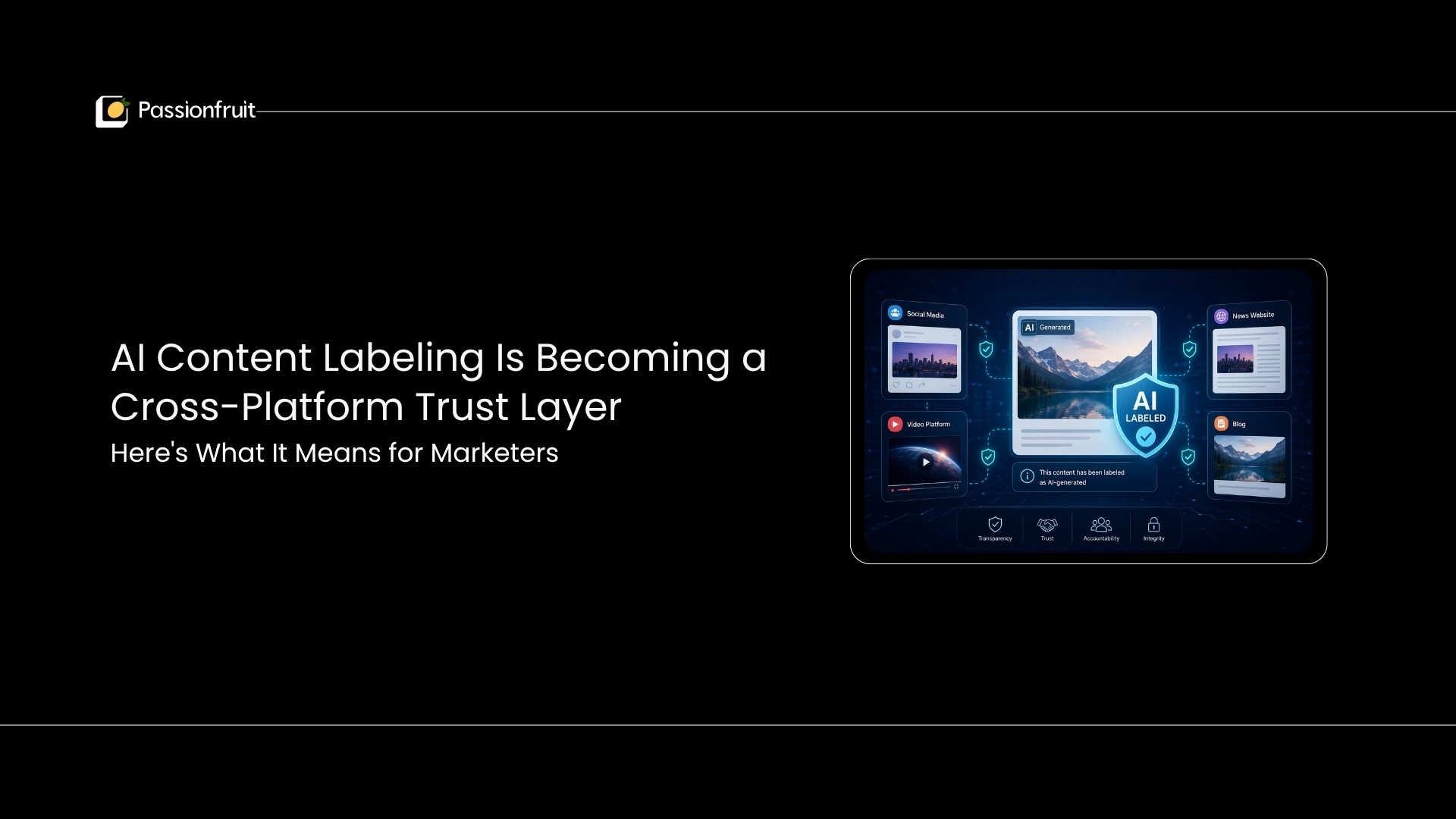
The reason this is a marketer story, not just a creator story, is that YouTube is the latest platform to make AI-generated content visibly detectable. Combined with Google's SynthID expansion, C2PA Content Credentials, and a growing detection layer across the major platforms, AI provenance is becoming a cross-platform trust signal. That changes the value of the content brands publish.
Our piece below covers what YouTube actually changed, why it connects to a broader provenance trend, and what the shift means for content and AI search strategy.
What YouTube changed
YouTube made two updates to how it handles AI-generated content, both announced in its official blog post on May 27, 2026.
The first update is placement. The AI disclosure label now appears directly below the video player on long-form videos, above the description, and as an overlay on the video itself for Shorts. Previously, labels sat inside the expanded description, where viewers had to click to see them, and only showed on the player for sensitive topics like health, news, elections, or finance.
The second update is automatic detection. Creators are still required to manually disclose realistic AI use, but YouTube now adds its own detection layer on top. When its systems detect significant photorealistic AI in an undisclosed video, the platform applies the label automatically.
Three details matter for how this plays out:
Creators can dispute a label they believe is wrong through YouTube Studio.
Some labels are permanent, including content made with YouTube's own AI tools (Veo, Dream Screen) and content carrying C2PA metadata showing it was fully AI-generated.
YouTube confirmed the label alone does not change how a video is recommended or whether it can earn money.
The last point is worth holding onto, because it contains a subtlety covered later in this piece.
Why this is part of a bigger provenance shift
YouTube is not acting alone. AI content provenance is becoming a layer that operates across the platforms marketers depend on.
At Google I/O 2026, Google expanded SynthID verification to Search, letting users check whether an image was made with AI through Lens, AI Mode, and Circle to Search. Google also added C2PA Content Credentials verification rolling out across the Gemini app, Search, and Chrome, and launched an AI Content Detection API on Google Cloud. Our Google I/O 2026 recap covers the full provenance thread.
The pattern across YouTube and Google is consistent. Detection is moving from a specialized, opt-in tool into the everyday surfaces where people encounter content, and the standards behind it (SynthID watermarks, C2PA Content Credentials) are being adopted by more companies, including OpenAI, Meta, and others.
The honest limit is worth stating. Detection is still patchy. SynthID only detects content watermarked with SynthID, C2PA metadata is often stripped when content moves between platforms, and no detection system catches everything. The trend is real, but the implementation is uneven, and any marketer planning around it should treat it as a direction rather than a finished system.
The direction still matters. Provenance signals are accumulating across platforms, and the cost of publishing undisclosed AI content is shifting from zero toward a visible label that audiences can see.
What the labeling layer means for content strategy
The strategic implication is not about compliance. The real shift is what happens to the value of content when AI origin becomes visible.
When AI-generated content was indistinguishable from human content, the flood of AI output competed on equal footing with everything else. A visible provenance layer changes that. Audiences can increasingly see which content was machine-made, and the early evidence suggests at least some of them factor it into what they choose to engage with.
YouTube was explicit that the label itself carries no algorithmic penalty. The platform does not downrank a video for being labeled. But viewer behavior is a different matter. If viewers see an AI disclosure and choose not to click, or watch for less time, those engagement signals can affect how the video performs in recommendations. The label does not penalize. Audience response to the label might.
The same logic extends well beyond YouTube. As provenance signals spread across search, social, and video, the brands that lean entirely on undisclosed AI content face a slow shift in how that content is received. Disclosed AI content is fine and increasingly normal. Content that depends on hiding its AI origin is the exposed position.
The pressure connects directly to a pattern we have written about before. AI-generated content already struggles to earn AI citations, because AI engines cite what they cannot generate themselves, and synthesized content converges on the un-citable average. Our analysis of the citation paradox explains the mechanism, and our research on why brands show up differently on every AI platform shows how unstable citation already is without adding a provenance disadvantage on top. The provenance layer adds a second pressure on the same content: not only does generic AI content struggle to get cited, a growing share of it now gets visibly labeled as machine-made.
What marketers should actually do
The labeling shift does not call for fear of AI. The shift calls for the same discipline that good AI-search strategy already requires.
The first move is to audit where AI-generated visual content appears in your owned channels, and decide your disclosure approach for each. Disclosed AI content carries no penalty on YouTube and is increasingly expected. Undisclosed AI content that gets auto-labeled later is the worse outcome, because it removes your control over the framing.
The second move is to invest human effort in what provenance layers cannot flatten: original data, first-hand testing, named expertise, and genuine point of view. Content with verifiable human originality is the content that both earns AI citations and holds up when audiences can see what was machine-made. Our breakdown of how to increase brand mentions in AI search covers the originality signals that matter.
The third move is to treat AI as a production tool layered on top of original substance, rather than the source of the substance. AI that drafts, edits, and scales around a core of genuine human insight produces content that survives both the citation filter and the provenance filter. AI that generates the substance itself produces content increasingly exposed by both.
YouTube specifically is also a citation surface worth tracking, since AI engines cite YouTube content when answering questions, and the platform is one of the consensus signals AI search engines weigh. How your brand shows up there, labeled or not, feeds the broader AI visibility picture.
Get ahead of the provenance layer before it hardens
AI content labeling is early and uneven, but the direction is set. Detection is moving into the everyday surfaces where audiences and AI engines encounter content, and the cost of publishing undisclosed AI content is rising from nothing toward a visible label.
The brands that win the next two years are the ones treating this as a prompt to double down on genuine human originality, not as a compliance headache. Original content is what earns citations, what survives provenance labeling, and what audiences increasingly choose when they can see the difference.
The cleanest first step is a clear view of how your brand shows up across AI search and which of your content earns citations on its own merit. See how Passionfruit's GEO service builds a citation strategy on original signal on top of a solid SEO foundation, look at the cross-platform citation tracking inside Passionfruit Labs, review the case studies of brands that built durable AI visibility on original content, and talk to the team about where your content stands.
Frequently asked questions
What did YouTube change about AI content labels?
YouTube made two updates announced on May 27, 2026. The platform moved the AI disclosure label to a more visible position, directly below the video player on long-form videos and as an overlay on Shorts, instead of inside the description. And it added automatic detection: when YouTube's systems detect significant photorealistic AI in an undisclosed video, the platform now applies the label automatically. Manual disclosure is still required, and creators can dispute incorrect labels in YouTube Studio.
Does an AI label hurt a video's reach or revenue on YouTube?
YouTube confirmed the label itself does not change how a video is recommended or whether it can earn money. There is no direct algorithmic penalty for carrying the label. However, viewer behavior can have an indirect effect. If audiences see an AI disclosure and choose not to click or watch less, those engagement signals can influence how the video performs in recommendations over time. The label does not penalize, but audience response to it can.
How does YouTube detect AI-generated content?
YouTube uses internal detection signals to identify significant photorealistic AI use, layered on top of the manual disclosure creators are still required to provide. Certain content is labeled permanently, including videos made with YouTube's own AI tools like Veo and Dream Screen, and content carrying C2PA metadata indicating it was fully AI-generated. Detection is not comprehensive, since it focuses on photorealistic AI and depends on signals that are still maturing.
Why does AI content labeling matter for marketers, not just creators?
AI content labeling is part of a broader provenance trend across platforms. Google expanded SynthID verification to Search and added C2PA Content Credentials and an AI detection API at I/O 2026, and YouTube has now added auto-detection. As AI origin becomes visible across search, social, and video, the value of content shifts toward verifiable human originality, which is also what earns AI citations. Provenance labeling and AI citation pressure push brands in the same direction.
Is it bad to use AI to make marketing content now?
No. Disclosed AI content carries no penalty on YouTube and is increasingly normal across platforms. The exposed position is undisclosed AI content that gets auto-labeled later, and generic AI content that adds nothing original. The durable approach is to use AI as a production tool layered on top of original substance, such as first-hand data, testing, and named expertise, which survives both provenance labeling and the AI citation filter.
What is C2PA metadata?
C2PA Content Credentials is an industry standard that records how a piece of media was created and modified, including whether AI was involved. Platforms like YouTube and Google use C2PA metadata as one signal for labeling AI content, and content carrying C2PA data showing it was fully AI-generated is labeled permanently on YouTube. The standard's main weakness is that the metadata is often stripped when content moves between platforms, which is part of why automatic detection is being added on top of it.