SEO
Join 500+ brands growing with Passionfruit!
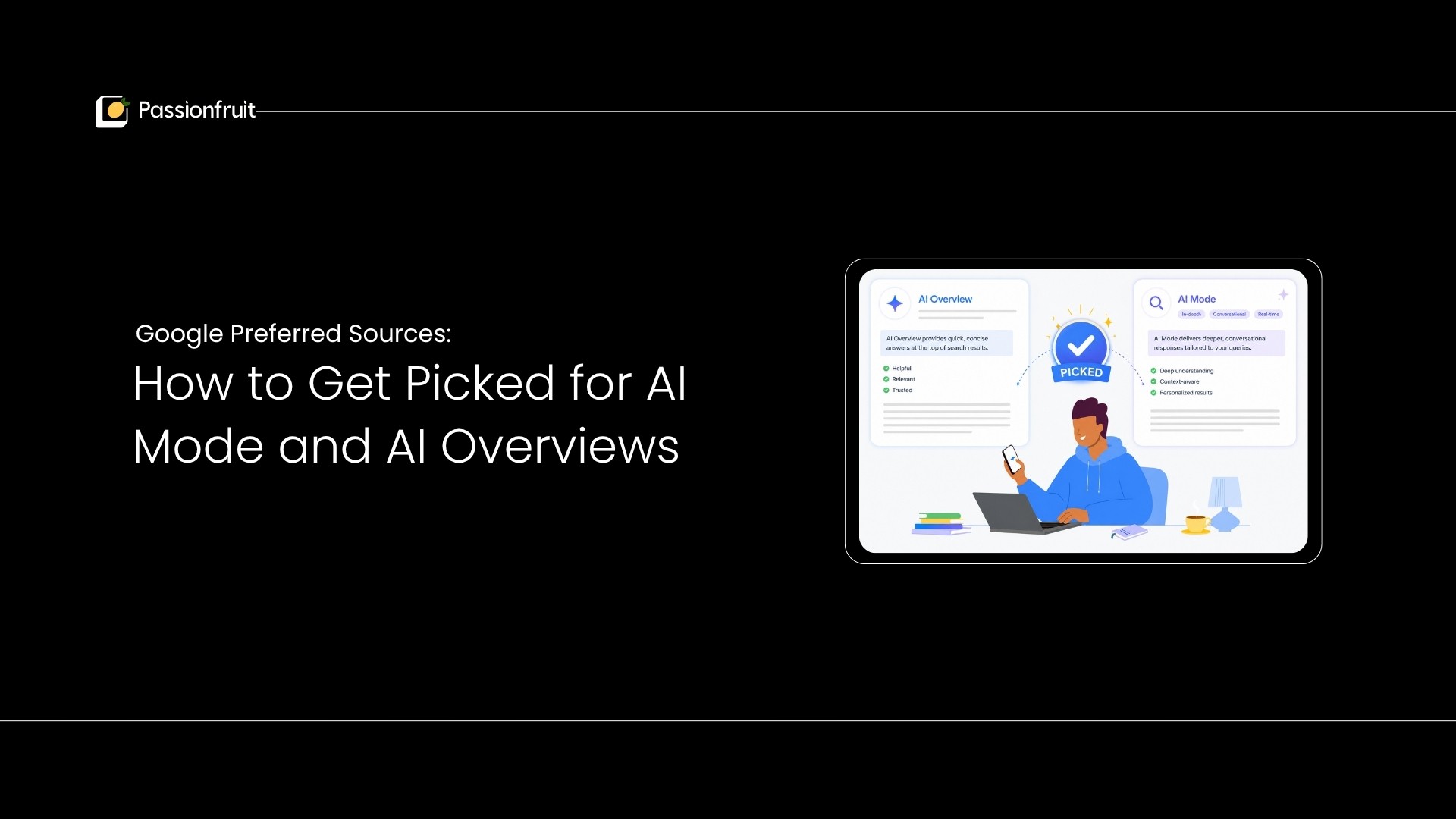
Google preferred sources now appear inside AI Mode and AI Overviews, not just Top Stories.
As of May 27, 2026, when a user has selected your site as a preferred source, your content can show up with a visible "Preferred" badge inside AI-generated answers. The feature was already global in Top Stories; the May update extends it into Google's AI search surfaces.
The part most coverage misses: this is the one citation lever in AI search that a user controls directly, not an algorithm. You cannot structure or schema your way into being a preferred source. A reader has to actively choose your site. That makes it an audience-loyalty play that intersects with AI search visibility, which is a different kind of work than technical SEO.
Our piece below covers how preferred sources work, what changed in the AI surfaces, who is eligible, and the concrete steps to get readers to select your site.
What Google preferred sources actually does
Preferred sources lets a Google user designate specific websites they want to see more of, and Google then favors those sites for that user across several surfaces.
The feature first appeared as a Search Labs experiment in June 2025, rolled out globally across all supported languages by April 2026, and was concentrated in Top Stories. The May 27, 2026 update extended it into AI Mode and AI Overviews.
When a user has selected your site, two things happen:
In Top Stories, your content is more likely to appear, highlighted with a "Preferred" badge.
In AI Mode and AI Overviews, when your site appears in a response, it can carry the same "Preferred" badge for that user.
Google reports that people are twice as likely to click through to a preferred source, and that users have already selected more than 345,000 unique sources. Our research on why brands show up differently on every AI platform explains why a user-controlled signal like this matters in a landscape where citation otherwise rotates heavily month to month.
One forward-looking detail from Google: the company has said it is working toward using preferred sources as a ranking signal across its AI features, so selected sites appear more often, not only with a badge. Today the badge appears when your site already shows up in a response. The future direction is influence over whether it shows up at all.
What changed for AI Mode and AI Overviews
The mechanic in the AI surfaces is currently a highlight, not a ranking boost, and the distinction matters.
Right now, the "Preferred" badge appears in AI Mode and AI Overviews when your selected site happens to appear in the generated response. Selection does not yet force your site into more answers. The badge marks your site when it is already cited.
Google has signaled that the next step is to use preferred-source selection as an actual ranking input inside AI features. If that ships, a user who has selected your site would see your content cited more often in their AI answers, not just badged when it appears.
For now, the practical value is twofold. The badge builds trust and recognition for users who already chose you, and the growing pool of users who select you positions your site for the ranking-signal phase Google has described. Building the preferred-source audience now is the work that pays off when selection becomes a stronger signal.
Who is eligible to be a preferred source
Eligibility is broad, with one structural rule worth knowing.
Any website that publishes fresh content is eligible to appear as a preferred source. The feature is not limited to large news publishers, despite its Top Stories origins. Niche blogs, local sites, and B2B publications all qualify.
The structural rule is about URL level. Only domain-level and subdomain-level sites are eligible in the source preferences tool. A domain like example.com qualifies, and a subdomain like blog.example.com qualifies, but a subdirectory like example.com/blog does not.
The practical implication for content strategy: if your publication lives on a subdirectory, you cannot be selected as a preferred source for that section alone. Users select the whole domain. For most brands this is fine. For brands running a content hub on a subdirectory who want it selectable on its own, a subdomain structure is the only path, and that is a meaningful architecture decision rather than a quick fix.
To check whether your site currently appears in the tool, enter your domain in the source preferences tool's search box at google.com/preferences/source.
How to get readers to select your site
Because selection is user-driven, the work is audience activation, not technical optimization. Five concrete moves, all drawn from how the feature is designed to be promoted.
1. Use the direct deeplink
Google provides a URL format that takes a user straight to your site in the source preferences tool, pre-filled. The format is:
https://google.com/preferences/source?q=Your_Websites_URL
For a site at example.com, the link is https://google.com/preferences/source?q=example.com. Sharing this link removes the friction of a reader having to find the setting themselves, which is the single biggest barrier to selection.
2. Add a button to your site
Google publishes downloadable button assets in sixteen languages (including English, Spanish, French, German, Hindi, Japanese, Korean, Portuguese, and more) that you can place alongside your other follow and subscribe calls to action. Treat it like a newsletter signup or a social follow button: a standing, visible prompt on high-traffic pages.
3. Promote it through your owned channels
Add the deeplink to social posts, your newsletter, and on-site promotions. The audiences most likely to select you are the ones who already engage with you, so the highest-converting placements are your email list, your most loyal social followers, and your top-trafficked pages.
4. Anchor the ask to a reason
A reader selects a source they trust and want more of. The brands that earn selections give a reason: original reporting, proprietary data, consistent coverage of a niche the reader cares about. The ask works best paired with the value you already deliver, not as a generic "add us" request. The brands that have grown AI visibility, like the ones in our case studies, built that loyal-audience foundation first.
5. Keep publishing fresh, relevant content
Preferred-source selection does not override relevance. Google has been explicit that a selected site must still publish fresh content aligned with the user's interest to appear. Selection raises your odds; it does not guarantee placement for a stale or off-topic page. Freshness and relevance remain the foundation underneath the selection.
Why this matters more for AI search than it looks
Preferred sources is one of the only user-controlled inputs into AI search visibility, and that scarcity is what makes it strategically interesting.
Most GEO work is indirect. You structure content for extraction, earn third-party mentions, and build entity consistency, then hope the engines cite you. Preferred sources is different. A user makes an explicit, durable choice to favor your site, and that choice follows them across Top Stories, AI Mode, and AI Overviews.
For brands with a genuinely loyal audience, this converts that loyalty into a direct AI-search advantage that competitors cannot replicate through content tactics alone. A competitor can match your schema and your answer structure. A competitor cannot easily make your readers choose them instead of you.
The honest caveat is the same one Google states. Selection currently highlights rather than ranks in AI surfaces, and even in Top Stories it works alongside relevance rather than overriding it. The play is to build the selected-audience base now, so the advantage compounds if and when Google makes selection a stronger ranking signal across AI features, which it has said it is working toward. Our research on why AI citations may not be the best single visibility metric is a useful companion here, because preferred-source loyalty is exactly the kind of durable signal that outlasts the monthly citation churn.
Build the audience that picks you before selection becomes a ranking signal
Google has told the market where this is heading: preferred sources moving from a badge toward a ranking input across AI features. The brands that build a base of readers who have selected them now are the ones positioned to benefit when that shift lands.
The work is not technical. The work is the audience-loyalty work that good brands already do, pointed at a specific, durable action: getting your readers to select you in Google's source preferences. Add the button, share the deeplink, and give people a reason rooted in the original, trustworthy content you publish.
The cleanest first step is a clear view of how your brand currently shows up across AI Mode, AI Overviews, and the other major AI surfaces, so you know where preferred-source loyalty would move the needle. See how Passionfruit's GEO service builds AI search visibility on top of a solid SEO foundation, look at the cross-platform citation tracking inside Passionfruit Labs, review the case studies of brands that built durable AI visibility, and talk to the team about your AI search strategy.
Frequently asked questions
What are Google preferred sources?
Google preferred sources is a feature that lets a Search user designate specific websites they want to see more of. Selected sites are favored for that user in Top Stories and, as of May 27, 2026, can appear with a "Preferred" badge in AI Mode and AI Overviews. The feature is user-controlled, which means a reader actively chooses your site rather than an algorithm selecting it.
How do preferred sources work in AI Mode and AI Overviews?
When a user has selected your site and your content appears in an AI Mode or AI Overviews response, it can carry a "Preferred" badge for that user. Currently the badge highlights your site when it already appears in a response rather than forcing it into more answers. Google has said it is working toward using preferred-source selection as a ranking signal across its AI features in the future.
How do I become a Google preferred source?
You cannot optimize your way in technically, because selection is user-driven. To check eligibility, enter your domain in the source preferences tool at google.com/preferences/source. Then drive readers to select you using the direct deeplink (google.com/preferences/source?q=yoursite.com), the downloadable button assets Google provides in sixteen languages, and promotion through your newsletter, social channels, and high-traffic pages. Any site that publishes fresh content is eligible.
Is my whole site eligible or just my blog?
Only domain-level and subdomain-level sites are eligible. A domain like example.com and a subdomain like blog.example.com qualify, but a subdirectory like example.com/blog does not. If your content hub lives on a subdirectory and you want it selectable on its own, the only path is moving it to a subdomain, which is a meaningful site-architecture decision.
Does being a preferred source guarantee I will rank or get cited?
No. Preferred-source selection does not override relevance. Google has been explicit that a selected site must still publish fresh content aligned with the user's interest to appear. Selection raises your odds and adds a "Preferred" badge, but freshness and relevance remain the foundation. In AI surfaces today, selection highlights your site when it appears rather than guaranteeing it appears.
Why does preferred sources matter for AI search strategy?
Preferred sources is one of the only user-controlled inputs into AI search visibility. Most GEO work is indirect, structuring content and earning mentions in the hope of citation. Preferred sources lets a loyal reader make an explicit, durable choice to favor your site across Top Stories, AI Mode, and AI Overviews. For brands with a genuinely loyal audience, it converts that loyalty into an AI-search advantage competitors cannot replicate through content tactics alone, and it positions the brand for the ranking-signal phase Google has said it is building.