SEO
Join 500+ brands growing with Passionfruit!
Google Search Console is finally getting native AI search performance reporting.
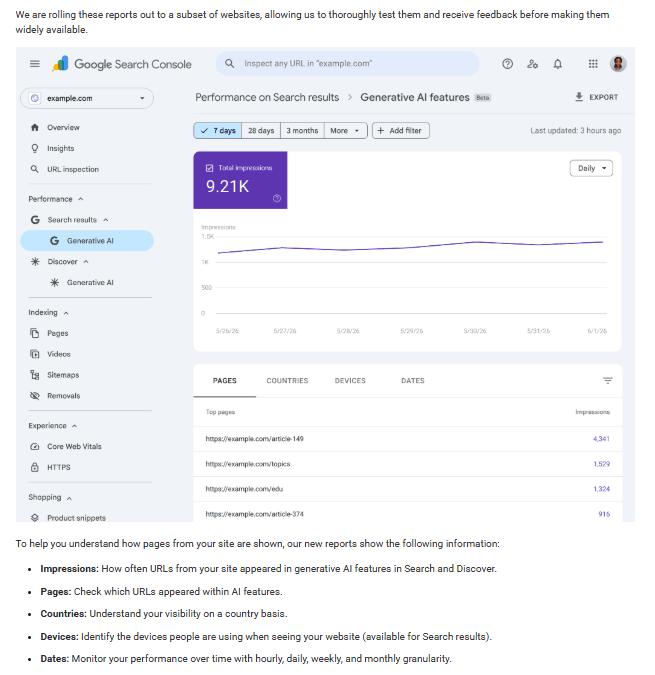
The new Search Generative AI performance report shows how your pages appear inside AI Mode and AI Overviews, with dedicated views for both Search and Discover. The launch was announced June 3, 2026, and is rolling out first to a subset of UK site owners before expanding globally.
The data inside the report covers impressions, pages, countries, devices, and dates at hourly, daily, weekly, and monthly granularity. The single biggest detail Google did not highlight in the announcement: there is no click data, and no average position. Google can now tell you how often your pages appeared in AI search responses. The report cannot tell you whether anyone clicked through to your site from them.
That gap matters, because click data is the metric that turns visibility into a business case. The piece below covers what the new report actually shows, the missing click question and Google's response on it, why this launch arrived now, and how to use the data alongside GA4 and dedicated citation tracking to fill the gaps Google left.
What the new report actually includes
The Search Generative AI performance report, available in Search Console for participating site owners, sits alongside the existing Performance report and surfaces a defined set of metrics for AI search surfaces specifically.
The metrics included:
Impressions, defined as how often your URLs appeared in generative AI features inside Search and Discover
Pages, so you can see which URLs appeared in AI features
Countries, for geographic breakdown of where your pages were shown
Devices, available for the Search results report
Dates, with hourly, daily, weekly, and monthly granularity
There are dedicated reports for Search and for Discover, which means a site can see its AI-feature performance separately by surface.
The metrics omitted are the meaningful ones for connecting visibility to outcome:
No click data
No average position
No CTR
No query-level breakdown comparable to the existing Performance report
Search Engine Land's coverage of the launch includes a Google spokesperson statement that the team is "continuing to work with website owners to understand what insights will be most helpful to inform their strategies, and we'll introduce additional metrics over time." Click data may come. Clicks are not in the launch.
Why this is being shipped now
The report did not arrive in a vacuum. Passionfruit's own research, in our analysis of how Search Console data has been wrong for a year, documented two overlapping integrity issues that made AI search invisible inside Search Console for nearly twelve months: AI Mode data was merged into the existing "Web" search type with no segmentation starting June 17, 2025, and a logging error inflated impression data from May 13, 2025 onward, which Google disclosed in April 2026.
Glenn Gabe, an independent SEO consultant, summed it up earlier this year: "We now have the 10-blue links, featured snippets, AIOs, and now AI Mode all grouped together in the performance reporting under Web Search. Good luck trying to figure this out in GSC."
The new report is the partial fix. AI search activity now has its own dedicated reporting surface inside Search Console, separated from traditional search. That solves the segmentation problem the industry has been asking about for almost a year.
What it does not solve is the click question, which has been the second half of the same complaint. AI Mode and AI Overviews intercept many queries before they produce a click, and without click data per AI surface, the report tells you when you appeared without telling you whether anyone arrived. The visibility-versus-traffic gap is exactly the one our case studies of brands building durable AI visibility had to solve through external tracking, because the native data did not exist.
What "no click data" means in practice
The most consequential decision Google made in this launch is the absence of click counts in the AI search report. Three implications follow.
First, this report cannot be used in isolation to calculate AI search CTR or to prove revenue contribution from AI visibility. Impressions are leading indicators of visibility; clicks are the converting metric. A report that shows impressions only is a half-measurement.
Second, the report is most useful as a relative measurement over time, not as a top-line conversion metric. If your impressions in AI features rise after a content update, that is a useful signal that your visibility moved. The report just cannot tell you whether the rise translated into traffic, signups, or revenue without help from another tool.
Third, and this is the part most coverage will miss: even without click data, the report has real value once paired correctly. Google has finally exposed which of your pages are appearing in AI surfaces, in which countries, on which devices, over which timeframes. That is information you previously had to infer from regex hacks, third-party tools, or just guess at. The data has a job, the job is just narrower than what marketers initially hoped for.
How to actually use the new report
The right move is to treat the new report as one of three layers in a complete AI search measurement stack, not as a standalone visibility scorecard.
Layer 1: Search Console's AI report for surface-level visibility
Use the new report to track which of your pages are showing up in AI Mode and AI Overviews, where geographically, and on which devices. Watch the page list and the country breakdown closely, because these reveal both which content earns AI feature inclusion and which markets are showing it. Date granularity at the hourly level makes it useful for catching sudden shifts after a content change or a Google update.
Layer 2: GA4 AI Assistant channel for traffic and conversion
Google Analytics 4 added a native AI Assistant default channel group on May 13, 2026, which automatically separates traffic from recognized AI chatbots like ChatGPT, Gemini, and Claude. Pair the GSC AI report's impressions with the GA4 AI Assistant channel's sessions and conversions to reconstruct the click side Google left out. The match is not perfect (GSC AI covers Google's AI features specifically; GA4 AI Assistant covers cross-platform AI referrers including non-Google ones), but together they answer the question "we appeared and people came" for the AI surfaces that matter most.
Layer 3: Dedicated AI citation tracking for the rest of the picture
Search Console only covers Google's surfaces. The report will not tell you whether ChatGPT, Perplexity, or Claude are citing you, and our research on why brands show up differently on every AI platform shows that the same brand can see citation volumes differ by orders of magnitude across platforms. Cross-platform citation tracking inside a tool like Passionfruit Labs covers the AI surfaces Google's report never will, and connects citation patterns to the GA4 traffic data so the full funnel is visible.
The combined picture: Google's new report tells you where you appeared in Google's AI features, GA4's channel tells you when AI referrals converted, and citation tracking tells you the rest of the AI landscape that Google does not report on.
The opt-out toggle and what it actually means
Alongside the performance report, Google began testing a toggle in Search Console that lets site owners block their content from appearing in AI Mode and AI Overviews. The toggle is currently rolling out to a subset of UK site owners only, in response to publisher pressure that intensified through 2025 and 2026.
The mechanics matter. Opting out means no traffic or impressions from AI features. Google has explicitly stated the opt-out signal will not be used as a ranking factor for traditional web search results, so it should not negatively impact core organic visibility.
Early survey data suggests roughly one-third of SEOs would block Google from showing their content in AI search features if given the option. The honest analysis is more nuanced. Most brands lose less by being cited (with the upstream traffic, brand exposure, and consideration that come with it) than by opting out and disappearing entirely from the AI surfaces where increasing share of buying-intent search is happening. The strong case for opting out is narrow: publishers whose business model genuinely depends on direct page reads (subscription content, ad-funded long-form), where summarization is replacing the click rather than supplementing it.
For most brands, the right answer is to stay in and focus on earning the citations that produce branded recognition, not to opt out and lose the surface entirely. The toggle exists because it has to. That does not mean it is the right move for most operators.
What to do this week
Five concrete moves while the rollout expands.
If you are a UK site owner, check whether the new report is available in your Search Console. Beta access is being granted in waves.
Set a baseline. Pull the first available data on which pages appear, where, and on which devices, so you have a reference point before any changes you make.
Pair the GSC AI report with GA4's AI Assistant channel from the start. The two together replace some of the missing click data and give you a working AI-funnel view.
Do not let GSC become your only AI search measurement layer. The report does not cover ChatGPT, Perplexity, Gemini, or Claude visibility, and 40 to 60% of AI citations rotate month to month, so single-surface tracking will mislead.
Decide your opt-out position deliberately. If you do not have a clear reason to block AI features, the default should be to stay in, since AI visibility now precedes the click for a growing share of high-intent searches.
Don't let the report shape the strategy
The new report is the most important Search Console update for AI search since AI Mode data started getting reported a year ago, and it directly addresses a measurement gap Passionfruit and others have been documenting for months. That is the good news.
The honest read is that it is also a half-fix. Without click data, the report tells you when you appeared but not whether anyone came. Without coverage of ChatGPT, Perplexity, Claude, or Gemini, it shows one slice of the AI search surface. Used alone, it will undercount the value of AI visibility and overcount the importance of Google's specific surfaces. Used as one of three layers, with GA4 AI Assistant data for traffic and dedicated citation tracking for cross-platform coverage, it becomes a real measurement asset.
The cleanest first step is a complete view of where your brand earns AI visibility today, separated by surface, so the new Search Console data has context to sit inside. See how Passionfruit's GEO service builds that view on top of a solid SEO foundation, look at the cross-platform citation tracking inside Passionfruit Labs, and talk to the team about pairing the new Google data with what Google does not report on.
Frequently asked questions
What does Google's new Search Console AI search report show?
The Search Generative AI performance report shows how your pages appear in AI Mode and AI Overviews, with dedicated views for Search and Discover. Metrics include impressions, pages, countries, devices (for Search), and dates at hourly, daily, weekly, and monthly granularity. The report is rolling out to a subset of UK site owners first and will expand globally over time. The report does not yet include click data, average position, or CTR.
Why doesn't the new report include click data?
Google has not explained the omission directly. A Google spokesperson told Search Engine Land the team is "continuing to work with website owners to understand what insights will be most helpful to inform their strategies, and we'll introduce additional metrics over time." Click data may be added in a future update. Until then, the report is a visibility metric only, and clicks from AI features have to be inferred from other sources like GA4's AI Assistant channel.
How is this different from GA4's AI Assistant channel?
The two cover different surfaces and different parts of the funnel. Google Search Console's new AI report covers Google-owned surfaces specifically (AI Mode and AI Overviews) and reports impressions, not clicks. GA4's AI Assistant default channel group, added on May 13, 2026, captures referral traffic from recognized AI chatbots including ChatGPT, Gemini, and Claude, and reports sessions and conversions. Paired, GSC tells you where you appeared in Google's AI features and GA4 tells you which AI referrals produced traffic and revenue.
Should I opt out of having my content shown in Google's AI features?
For most brands, no. The opt-out toggle, currently in test rollout to a subset of UK site owners, lets you block content from AI Mode and AI Overviews without affecting traditional organic rankings. The strong case for opting out is narrow: publishers whose business model depends on direct page reads, where summarization is replacing the click rather than supplementing it. For most operators, the upstream brand exposure and consideration earned by being cited in AI features outweigh the click loss, and opting out removes you from a growing share of high-intent search.
Does the new GSC report cover ChatGPT or Perplexity?
No. The Search Generative AI performance report covers Google's own AI features only, specifically AI Mode and AI Overviews in Search and Discover. ChatGPT, Perplexity, Gemini, and Claude are entirely outside its scope. For brands that need cross-platform AI search visibility, the GSC report needs to be paired with a dedicated AI citation tracking tool, since the same brand can see citation volumes differ by orders of magnitude across platforms.
How accurate is Search Console data for AI search now?
The new report should be the most accurate AI-specific data Google has published in Search Console to date, because it isolates AI search activity into its own surface for the first time. Until this launch, AI Mode data was merged into the existing "Web" search type with no segmentation since June 17, 2025, and a logging error inflated impressions across the Performance report from May 13, 2025 onward. The new report and the impression-bug fix together address the two biggest known measurement issues, though the absence of click data leaves a third gap unresolved.