SEO
Join 500+ brands growing with Passionfruit!
Structure content that ranks, builds authority, and converts — tailored to your business model.
Most websites don't have a content problem. They have a structural problem.
You've published 80, maybe 120 blog posts. Some rank on page two. A few pull decent traffic but don't convert. Most sit in a content graveyard, collecting single-digit impressions. The issue isn't quality — it's that none of it is connected. Search engines see a pile of disconnected pages and have zero reason to treat your site as an authority on anything. (If this sounds familiar, our guide on why your site is losing organic traffic explains the mechanics behind it.)
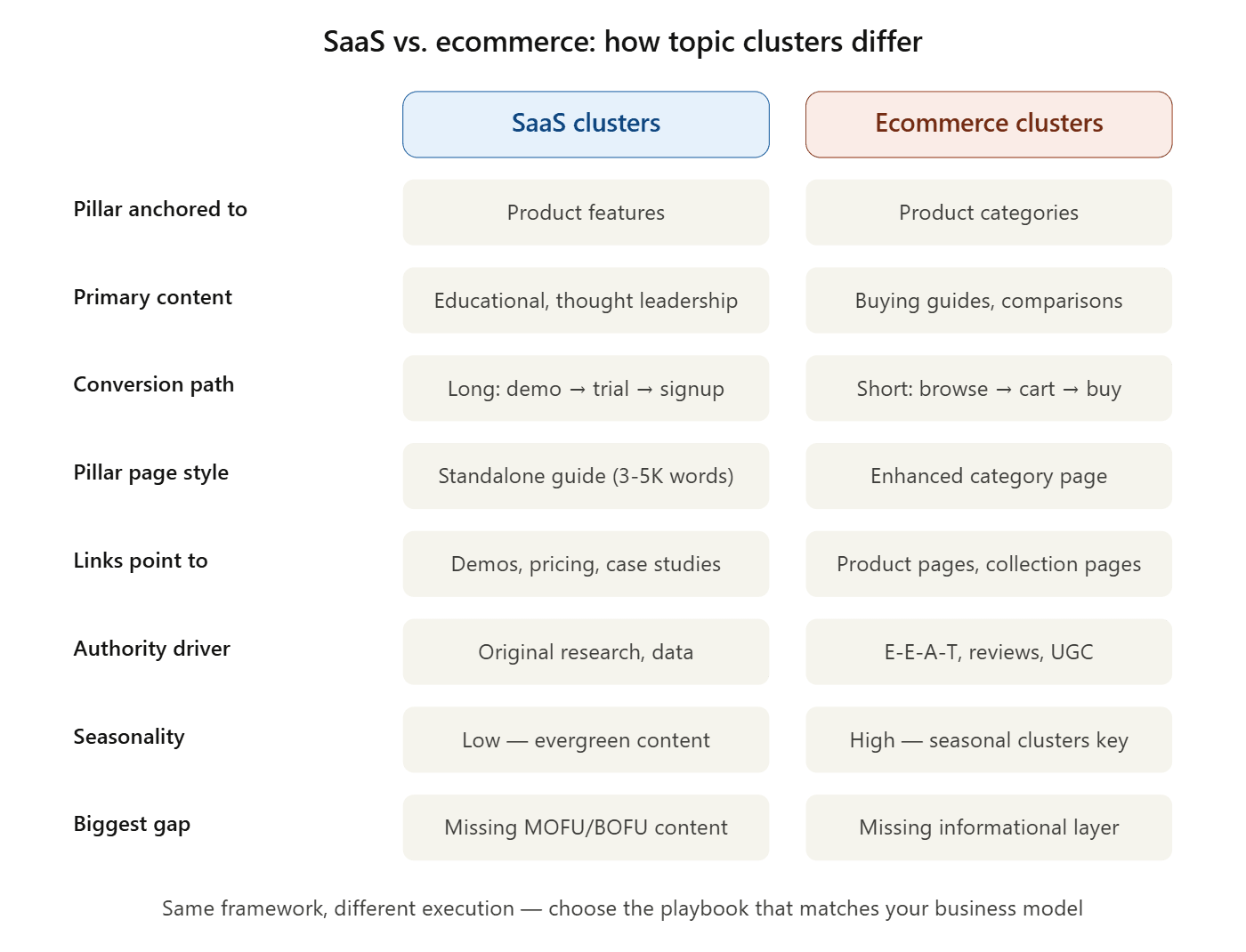
Topic clusters fix this. But the way you cluster content for a SaaS product is fundamentally different from how you cluster for an ecommerce store. The buyer journeys diverge, the content types differ, and the internal linking logic follows separate rules. This post gives you the execution playbook for both plus the structural frameworks, real examples, and measurement systems you need to make clusters actually work. For a broader view of how these tactics fit into the SEO landscape, see our complete SEO 101 guide for startups.
What Is a Topic Cluster in SEO?
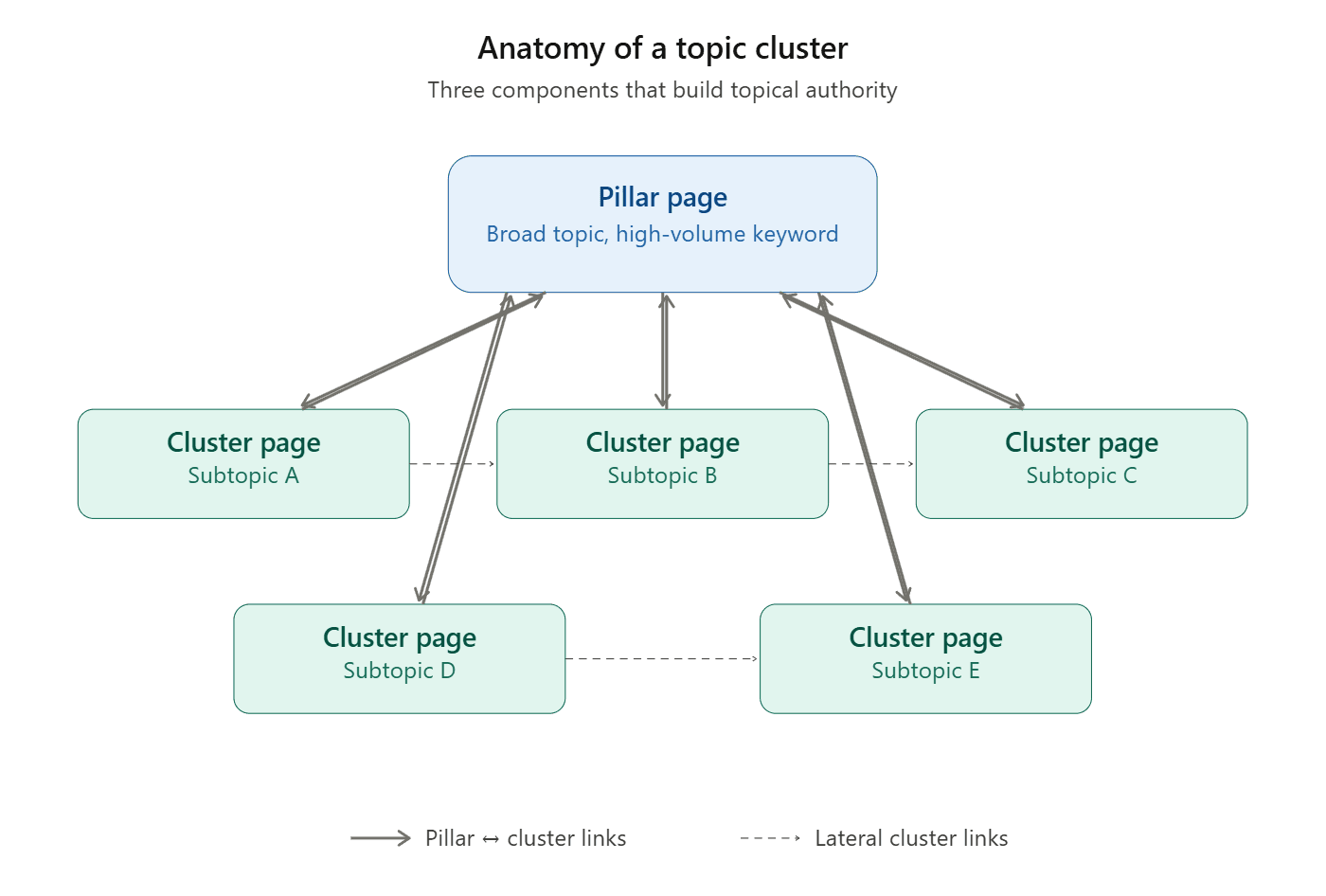
A topic cluster is a group of interlinked pages organized around a central theme. Every cluster has exactly three components:
01 — Pillar Page A comprehensive resource covering a broad topic — typically targeting a high-volume, competitive keyword. For a project management SaaS: "The Complete Guide to Project Management." For an ecommerce running shoe store: "How to Choose Running Shoes." The pillar is your hub, and it should target semantically rich keywords that capture the full breadth of what buyers search for.
02 — Cluster Pages Deep-dive articles on specific subtopics. Each targets a narrower, long-tail keyword. In SaaS: "Agile vs. Waterfall Methodology" or "How to Run Sprint Retrospectives." In ecommerce: "Best Trail Running Shoes for Beginners" or "Running Shoe Cushioning Types Explained." Use keyword research tools to surface these subtopic opportunities.
03 — Internal Links The connective tissue. Every cluster page links back to the pillar. Related cluster pages link to each other. This signals Google that your site comprehensively covers the topic. Your URL structure should reinforce this hierarchy — clean paths like /skincare/organic-serums rather than /blog/post-347.
Don't confuse a topic cluster with a content cluster. A content cluster is an inventory exercise — do we have a data sheet, pricing page, and blog post that mention this? A topic cluster is a depth exercise — have we covered every meaningful subtopic and search intent? One checks boxes. The other builds authority.
What Are the 4 Types of Topic Clustering?
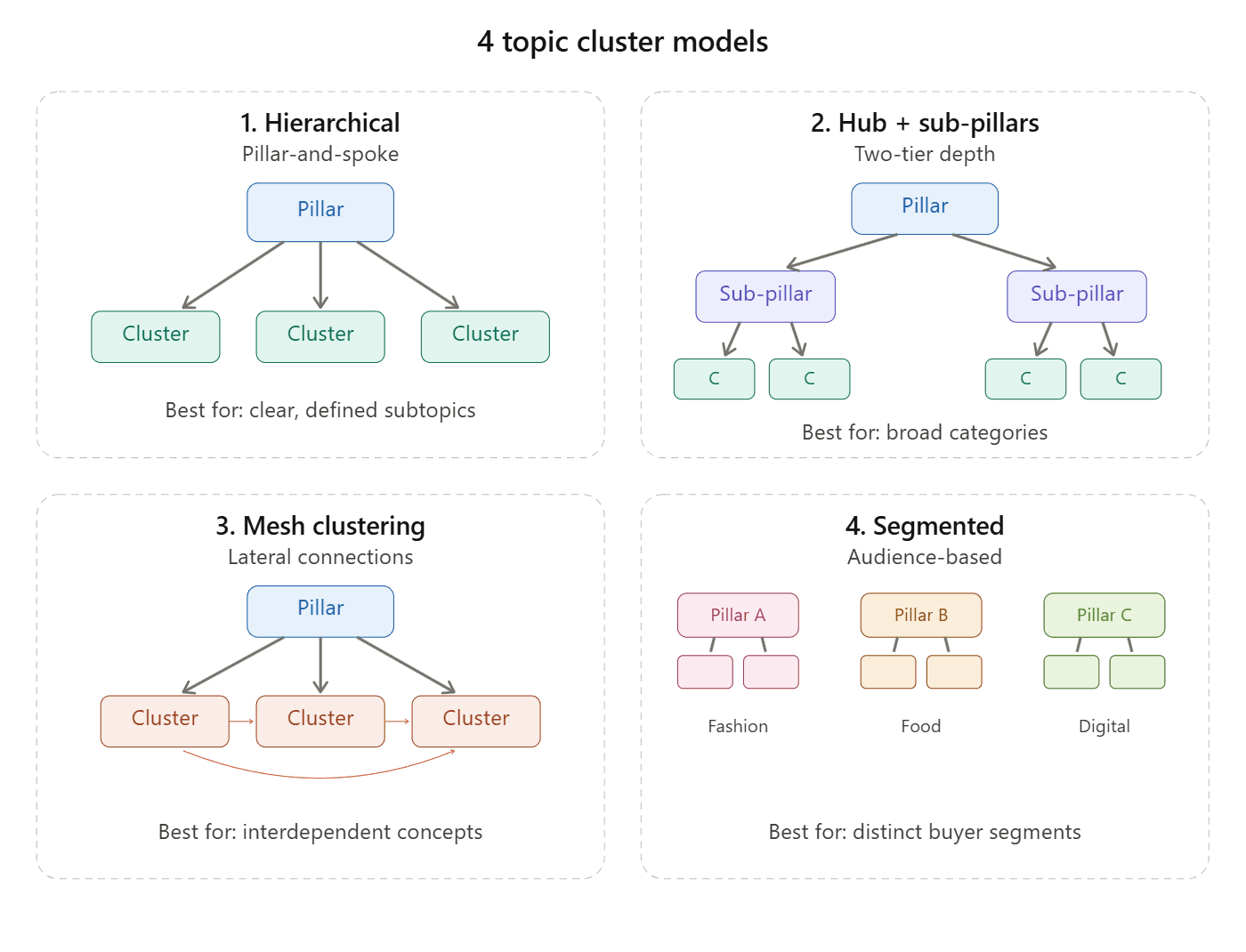
Not all clusters share the same architecture. The model you pick shapes how content connects, how authority flows, and how easily you can scale.
1. Hierarchical Clustering (Pillar-and-Spoke)
One pillar at the top, cluster pages branching off beneath, everything linking back to the hub. The most common model and the easiest to implement.
Best for: Clear parent topics with well-defined subtopics.
Example: A SaaS CRM with a pillar on "Sales Pipeline Management" and clusters on lead scoring, deal stages, forecasting, and pipeline velocity.
Limitation: Breaks down when a topic is too broad for a single pillar to cover meaningfully.
2. Hub-and-Spoke Clustering with Sub-Pillars
Adds a second tier. The main pillar links to sub-pillar pages, each of which each anchor their own mini-cluster. Reach for this when a single pillar can't carry the weight.
Best for: Broad categories that naturally break into sub-categories.
Example: An outdoor ecommerce retailer with a main pillar on "Hiking Gear," sub-pillars for "Hiking Boots," "Hiking Backpacks," and "Hiking Clothing" — each with their own cluster pages.
Limitation: Requires a larger content library. Premature sub-pillaring creates thin layers.
3. Mesh Clustering (Lateral Linking)
Cluster pages connect to each other laterally, not just vertically to the pillar. This creates a web of relationships rather than a tree. For a deeper look at how this relates to SEO architecture, see our breakdown of the four pillars of SEO.
Best for: Technical or analytical topics where readers move between related concepts.
Example: A SaaS analytics platform where "Funnel Analysis" links to "Cohort Analysis" and "Attribution Modeling" because a reader learning one concept needs the others.
Limitation: Can become unwieldy without a clear linking strategy. More links ≠ better — each link needs purpose.
4. Segmented Clustering (Audience-Based)
Organizes clusters not by subtopic but by audience, vertical, or use case. The same core topic gets separate structures for each segment.
Best for: Businesses serving multiple distinct buyer personas or industries.
Example: An ecommerce platform with separate clusters for "Ecommerce for Fashion Brands," "Ecommerce for Food & Beverage," and "Ecommerce for Digital Products."
Limitation: Risk of content overlap if segments aren't sufficiently distinct.
Most businesses start with hierarchical clustering and graduate to hub-and-spoke or mesh as their content matures. Don't over-engineer the architecture before you have the content to fill it.
Why Do Topic Clusters Fail? 3 Common Mistakes to Avoid
The majority of clusters underperform. Understanding these failure patterns saves months of wasted effort.
Mistake #1: Clustering Around Keywords Instead of Problems
If your cluster is organized around what a keyword tool told you to write, you'll produce six articles covering the same ground from slightly different angles. Instead, cluster around the questions and problems your buyer faces at each stage. Our guide on quality vs. quantity in content strategy explores this trade-off in detail. Keywords are the targeting mechanism — not the organizing principle.
Mistake #2: Building Thin Pillar Pages That Don't Rank
A 1,200-word pillar that skims the surface won't earn authority. Effective pillar pages typically run 3,000–5,000 words — broad enough to cover the full topic, focused enough to leave room for cluster pages to go deep. A thin pillar undermines the entire cluster's authority signal.
Mistake #3: Publishing Once and Never Updating
A cluster is a system, not a deliverable. Content decays. New subtopics emerge. Competitors publish better pages. If you're not auditing, updating, and expanding clusters quarterly, your authority erodes in slow motion. We've covered the mechanics of this in our analysis of why blog rankings drop after Google core updates and how to recover from pages getting de-indexed. The compounding effect that makes clusters powerful requires ongoing investment.
How to Build Topic Clusters for SaaS: Step-by-Step Strategy
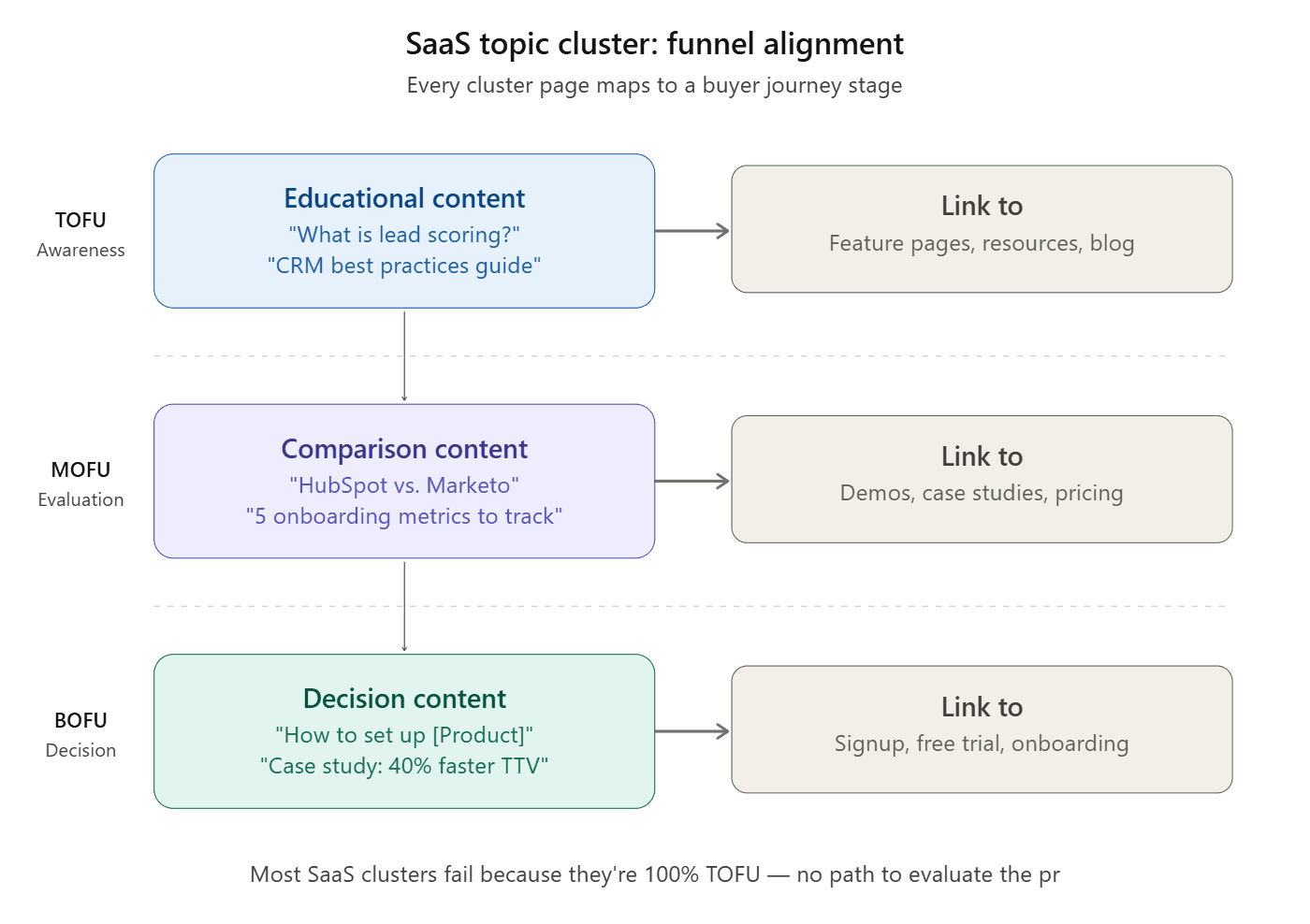
SaaS has a clustering challenge ecommerce doesn't: you're selling a product that requires education before purchase. Your buyer needs to understand not just what your product does, but why the underlying approach matters. That makes your cluster strategy as much about thought leadership as SEO.
Step 1: Anchor Clusters to Product Features, Not Blog Categories
Every major feature should anchor its own cluster. A marketing automation platform might cluster around: Email Marketing, Lead Scoring, Marketing Analytics, Campaign Management, and Customer Segmentation. Each becomes a pillar page. Use a comprehensive keyword research process to identify the broad keywords buyers search when evaluating solutions in each category.
The pillar page shouldn't read like a product page. It should be a comprehensive, educational resource that naturally demonstrates expertise. TripleDart's pillar page for SaaS SEO links to cluster content on keyword research, technical SEO, and content strategy — each reinforcing the pillar's authority while moving readers toward the product.
Step 2: Align Every Cluster Page to the Buyer's Journey
Every cluster page should map to a stage of the buyer's journey — and your internal links should follow the same logic:
Stage | What They Need | Content Example | Link To |
TOFU | Understand the problem | "What Is Lead Scoring & Why It Matters?" | Educational resources, feature explainers |
MOFU | Compare solutions | "HubSpot vs. Marketo for Mid-Market Teams" | Demos, case studies, pricing pages |
BOFU | Validate and buy | "How to Set Up Lead Nurturing in [Product]" | Signup, free trial, onboarding guides |
The #1 SaaS clustering mistake: Building clusters that are entirely TOFU. You get traffic but no conversions because you never gave readers a path to evaluate your product.
Step 3: Make Internal Links Drive Revenue, Not Just SEO
In SaaS, internal links serve double duty — they pass PageRank and guide buyers through the funnel:
TOFU content: Link to educational resources and feature pages.
MOFU content: Link to product demos, case studies, and pricing.
BOFU content: Link directly to signups, free trials, and onboarding.
Use action-oriented anchor text. "See a live demo of [feature]" converts better than "click here." For tips on structuring content that guides readers toward action, see our guide on writing listicles that rank and engage readers.
Step 4: Win Authority With Data Only You Have
The SaaS companies that dominate clusters produce original research and proprietary data no competitor can replicate. If you have product usage data, anonymize and aggregate it. "We analyzed 10,000 onboarding flows and found companies with a dedicated email sequence see 34% lower churn." That kind of insight gets cited, earns backlinks, and makes your cluster the definitive source. For amplifying this into AI search engines, our guide on how to show up on ChatGPT and Perplexity covers the citation mechanics.
SaaS Cluster Blueprint: Customer Onboarding
Page Title | Funnel Stage | Type | Priority |
SaaS Customer Onboarding — Complete Guide | All stages | Pillar | ⭐ High |
Best Practices for SaaS Onboarding Emails | TOFU | Cluster | Medium |
How to Reduce Churn with Optimized Onboarding | TOFU / MOFU | Cluster | High |
5 SaaS Onboarding Metrics You Should Track | MOFU | Cluster | Medium |
[Competitor] vs. [Product]: Onboarding Compared | MOFU | Cluster | High |
How to Set Up Automated Onboarding in [Product] | BOFU | Cluster | ⭐ High |
Case Study: How [Customer] Cut Time-to-Value 40% | BOFU | Cluster | High |
How to Build Topic Clusters for Ecommerce: Step-by-Step Strategy
Ecommerce operates under different constraints. Buyers aren't researching abstract concepts — they're shopping. Clusters revolve around product categories, and the conversion path is shorter and more transactional. For the full foundation, see our complete ecommerce SEO guide for beginners.
Step 1: Cluster Around Product Categories, Not Individual SKUs
Individual products rarely warrant clusters. Product categories do. If you sell skincare, your clusters are built around "Vitamin C Skincare," "Anti-Aging Skincare," "Skincare for Sensitive Skin," and "Korean Skincare Routine." Each category becomes a pillar page. For execution details, see our guide on how to optimize category pages for ecommerce SEO.
Structural advantage unique to ecommerce: Your pillar page can be your category page itself. The content doing the SEO work is also the page doing the selling. Our guide on high-converting collection pages shows exactly how to build these.
Step 2: Fill the Informational Content Gap That Kills Ecommerce Rankings
The biggest hole in most ecommerce strategies: zero informational content. Category and product pages target transactional intent. If that's all you have, you're invisible to buyers still in research mode.
For a running shoe store, the transactional layer is category pages for trail shoes, road shoes, and racing flats. The informational layer of your cluster content answers the questions buyers have before they're ready to buy:
"How to Pick Running Shoes for Flat Feet"
"Pronation Types Explained: Overpronation, Neutral, and Supination"
"When to Replace Your Running Shoes (And How to Tell)"
"How to Break In New Running Shoes Without Blisters"
This informational layer captures top-of-funnel traffic from future buyers and builds the topical authority that helps transactional pages rank. To ensure your ecommerce site signals credibility at every level, read our guide on how to optimize your ecommerce site for E-E-A-T.
Step 3: Segment Ecommerce Clusters by Buyer Persona
Ecommerce audiences are split by experience level, use case, and demographic. Your clusters should mirror those segments.
Pillar Topic | Cluster Content | Target Persona |
Beginner Camping | Tent types for beginners, budget checklists, first-trip tips | First-time campers, families |
Backpacking Gear | Ultralight tents, pack weight calculators, and multi-day food planning | Experienced hikers, thru-hikers |
Car Camping | Family tents, camping kitchen setups, campsite comfort | Casual campers, glampers |
Step 4: Weave Product Links Into Content Without Breaking Trust
Every piece of cluster content should include natural product references — contextual links that serve the reader. If your cluster page explains "How to Choose a Hiking Backpack by Volume," link to products at each tier. This turns informational content into a shopping tool. Our guide on optimizing product pages for AI search engines like ChatGPT covers how to structure these for both humans and AI crawlers.
Step 5: How to Use Seasonal Topic Clusters for Ecommerce Growth
Ecommerce has seasonal demand spikes that SaaS doesn't. Build clusters around buying patterns and publish 30–60 days before peak demand. "Winter Running Gear" is a pillar with cluster pages on cold-weather tights, reflective vests, and layering guides. Publish in September. Update annually. For scaling this kind of content production, explore programmatic SEO tools for ecommerce.
Ecommerce Cluster Blueprint: Organic Skincare
Page Title | Search Intent | Role |
The Complete Guide to Organic Skincare | Mixed | ⭐ Pillar Page |
Best Organic Face Serums for Every Skin Type | Commercial | Cluster → Product links |
Chemical-Free Moisturizers: What to Look For | Informational | Cluster → Authority |
Organic Skincare Routine for Beginners | Informational | Cluster → New buyers |
[Brand A] vs. [Brand B]: Organic Skincare | Commercial | Cluster → Comparison |
How to Read Skincare Ingredient Labels | Informational | Cluster → Trust |
Best Organic Skincare Products Under $30 | Transactional | Cluster → Revenue |
What Are the 4 Types of SEO? (And How Clusters Connect Them)
Topic clusters aren't a standalone tactic. They sit at the intersection of four SEO disciplines. For a deep dive into each one, see our guide on the four pillars of SEO strategy.
SEO Type | How Clusters Contribute | What to Get Right |
On-Page | Each page targets its own keyword. Cluster pages use semantic terms. Optimize title tags per page. | Keyword mapping, semantic coverage, and content depth |
Technical | Clean URLs, crawlable links, fast load. Google indexing must discover your cluster efficiently. | Site architecture, page speed, Core Web Vitals |
Off-Page | Original research attracts high-quality backlinks. Interlinked pages distribute authority across the cluster. | Linkable assets, outreach, digital PR |
Content | Clusters are the structural output of content strategy. AI-assisted writing can help scale cluster production. | Topic selection, gap analysis, and editorial calendar |
Clusters also strengthen your visibility in AI search engines. Well-structured, authoritative content is what LLMs cite in their answers. See our complete GEO guide and learn why AI citations lean on the top 10 organic results.
How to Measure Topic Cluster Performance: 5 Key Metrics
Track keyword performance at the cluster level, not just the page level. Group all target keywords under each cluster and monitor aggregate trends. For the conversion side, our guide on organic traffic vs. organic conversions explains why traffic alone is a misleading metric.
01 — Cluster Keyword Coverage: What percentage of relevant keywords for your topic does your cluster rank for? If competitors rank for 150 terms and you cover 40, you have content gaps to close.
02 — Pillar Page Ranking Trajectory: Your pillar should climb for its primary keyword over 3–6 months. Stagnation signals thin content, weak internal links, or underperforming cluster pages. Track this alongside SERP features to see if you're losing real estate to featured snippets or AI Overviews.
03 — Cluster-Level Organic Traffic: Don't judge cluster pages in isolation. Measure total organic sessions across the entire cluster. A rising tide lifts all pages in a well-linked group.
04 — Conversion Rate by Funnel Stage: Track how many cluster visitors convert to trials, demos, or purchases. If MOFU and BOFU pages aren't converting, you have a CTA problem, a product-positioning problem, or a content-intent mismatch.
05 — AI Search Visibility: In 2026, clusters don't just rank on Google they get cited by AI engines. Use tools that track LLM brand visibility and citations to measure whether your cluster content is referenced by ChatGPT, Perplexity, and Gemini. You can also track AI referral traffic in GA4 to see how much of your cluster's traffic comes from AI search.
How to Maintain and Update Topic Clusters Over Time
Publishing a cluster is the start, not the finish. Content performance degrades as information becomes outdated, competitors publish better versions, and algorithms shift. If you've experienced this, our analysis of why rankings dropped after Google's core update explains what's happening. Here's the quarterly maintenance cycle:
Situation | Action | Priority |
Keyword relevant; content outdated | Update with fresh data, examples, screenshots | High — fastest ROI |
Two pages competing for same keyword | Consolidate weaker into stronger; redirect | High — fixes cannibalization |
Keyword no longer fits; page has backlinks | 301 redirect to the most relevant page | Medium — preserves link equity |
New subtopic emerging in space | Create new cluster page; link from pillar | Medium — expands coverage |
Cluster page ranks but doesn't convert | Add/reposition CTAs; test anchor text | High — revenue impact |
A useful rule: Noindex is reversible; deletion is not. When in doubt about a declining page, deindex before you delete.
Your Next Move
Pick one topic where your business should be the undisputed authority.
Audit what you have: pillar page, cluster pages, internal links, funnel alignment. Identify the gaps. Missing MOFU content? Cluster pages that don't link back to the pillar? Broad coverage with no depth?
Then build the missing pieces, starting with the highest-intent content and working outward. One well-built cluster covering a topic from every angle will outperform fifty disconnected blog posts. If you want expert help building this for your business, Passionfruit's SEO team works with SaaS and ecommerce brands to architect content systems that compound — see our case studies for real results.
Your content doesn't need to be louder. It needs to be organized.
FAQs
What is a topic cluster in SEO?
A topic cluster is a group of interlinked web pages organized around a central theme. It consists of a pillar page that broadly covers a topic, cluster pages that dive deep into specific subtopics, and internal links connecting them all. This structure signals to search engines that your site comprehensively covers a subject, which builds topical authority and improves rankings across the entire cluster. For the full SEO foundation, see our SEO principles guide.
What are the main components of a topic cluster?
Every topic cluster has exactly three components: (1) a pillar page that serves as the central hub and targets a broad, high-volume keyword; (2) cluster pages that cover specific subtopics in depth, each targeting narrower long-tail keywords; and (3) internal links that connect every cluster page back to the pillar and to each other, distributing authority and helping search engines understand the relationships between your content.
What are the 4 types of topic clustering?
The four types are: Hierarchical (classic pillar-and-spoke), Hub-and-spoke with sub-pillars (adds a second tier for broad topics), Mesh clustering (lateral links between cluster pages), and Segmented clustering (separate structures per audience or vertical). The right model depends on your content volume, topic complexity, and how distinct your buyer segments are.
How do topic clusters improve search engine rankings?
Topic clusters improve rankings through three mechanisms. First, they build topical authority by demonstrating comprehensive coverage — Google's Helpful Content system evaluates depth and breadth. Second, internal linking distributes PageRank across all pages in the cluster, lifting weaker pages. Third, the structure helps search engines understand semantic relationships between your content. This is also increasingly important for AI search visibility, where LLMs cite authoritative sources.
How is a topic cluster different from a content cluster?
A content cluster is an inventory exercise — it checks whether you have a blog post, data sheet, pricing page, and webinar that mention a topic. A topic cluster is a depth exercise — it evaluates whether you've covered every meaningful subtopic, user question, and search intent related to that subject. Content clusters check boxes; topic clusters build authority. This distinction matters because having twelve pages that mention a topic isn't the same as comprehensively covering it.
How many cluster pages should a topic cluster have?
There's no fixed number, but effective clusters typically have 8–20 cluster pages supporting each pillar. The right count depends on the topic's breadth and the number of distinct subtopics with real search demand. Start with the 5–8 highest-intent subtopics and expand as you see results. Avoid padding with thin content — every page should cover a genuinely distinct subtopic. For help identifying which subtopics to prioritize, our keyword research guide walks through the process.
How long does it take for topic clusters to show SEO results?
Expect initial movement within 8–12 weeks as Google indexes and starts ranking cluster pages. Meaningful authority-building typically takes 6–12 months. Research consistently shows that sites sustaining cluster publishing for 12+ months see significantly higher organic traffic compared to isolated content strategies. The key is consistency — clusters compound over time as internal links pass equity and new pages expand your topical coverage. Track progress using the right metrics so you can measure cluster-level impact, not just individual page rankings.