SEO
Join 500+ brands growing with Passionfruit!
Turn search traffic into revenue by aligning keywords, content, and internal links to each funnel stage for both traditional and AI search.
Most SEO strategies stop at traffic. They rank pages, celebrate impressions, and wonder why leads don't follow.
The problem isn't rankings. It's that your content doesn't guide anyone anywhere. A visitor lands on your educational blog post, reads it, and leaves because nothing connects that moment of curiosity to your product, your pricing page, or even the next logical piece of content they need.
An SEO funnel fixes this. It maps every keyword, every page, and every internal link to a specific stage of the buyer's journey awareness, consideration, or decision so that your content doesn't just attract visitors but moves them toward conversion.
Here's what most guides on this topic miss: the funnel has fundamentally changed. Buyers don't move through it linearly anymore. Google's own research on the "messy middle" shows that people loop between exploration and evaluation unpredictably. And now, AI search engines like ChatGPT and Perplexity have added an entirely new entry point to the funnel one most businesses aren't optimizing for at all.
Our blog gives you the complete framework: what content belongs at each funnel stage, how to map keywords to intent, how to structure internal links that guide buyers forward, and how to measure whether your funnel is actually converting including from AI search referrals. For the broader SEO foundation this sits on, see our complete SEO 101 guide.

What Is an SEO Funnel and Why Does It Matter?
An SEO funnel is the structured path a user takes from their first search query to becoming a customer — guided entirely by your organic content. Unlike a general marketing funnel that spans paid ads, email, social, and events, an SEO funnel focuses specifically on how people discover, engage with, and convert through search.
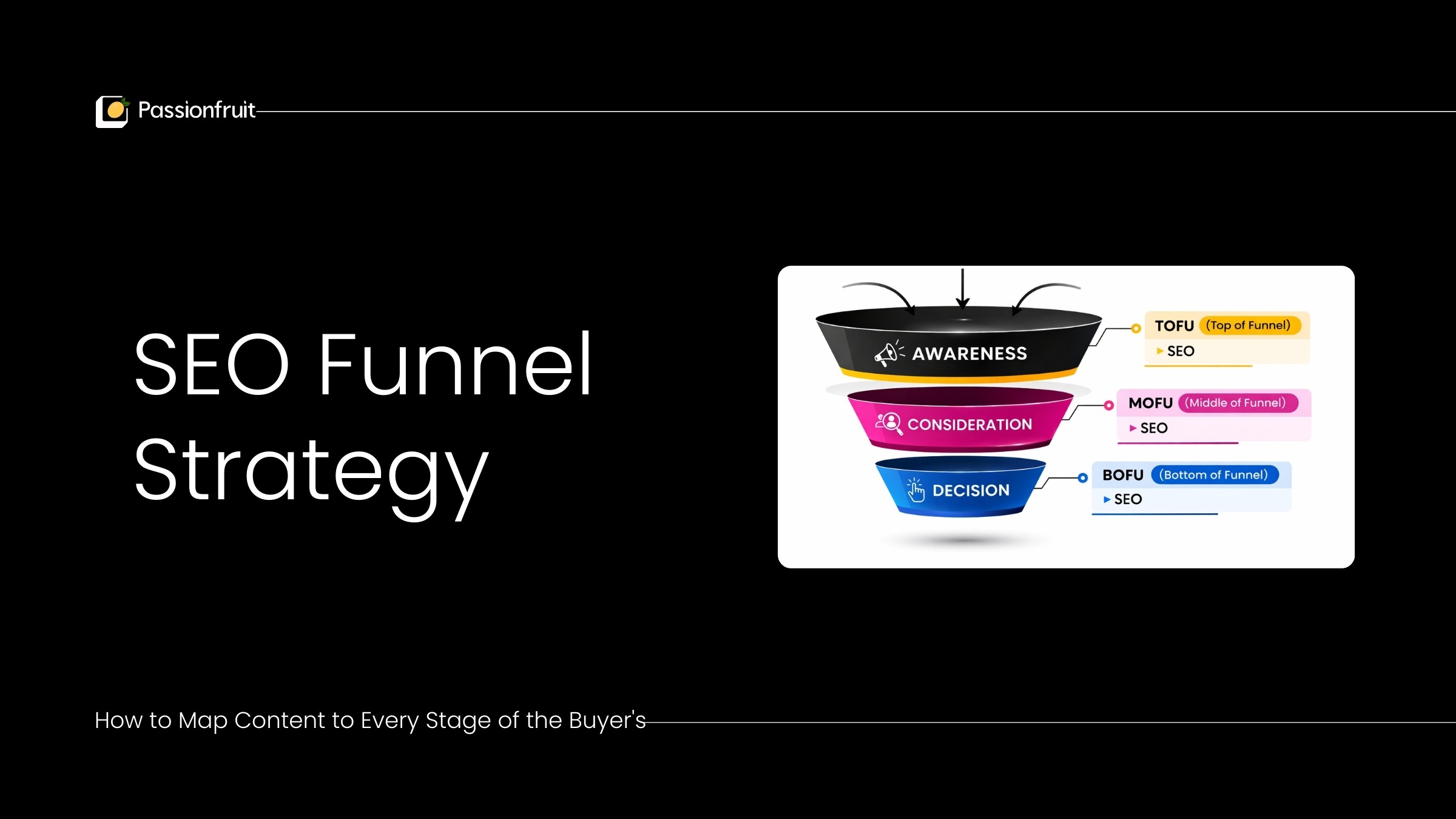
The funnel has three core stages, each tied to a different type of search intent:
Top of Funnel (TOFU): Awareness. The user has a problem or question but doesn't know the solution yet. They're searching with broad, informational queries like "what is project management software" or "how to reduce cart abandonment." Your job here is to educate, build trust, and get on their radar.
Middle of Funnel (MOFU): Consideration. The user knows their problem and is evaluating solutions. They're comparing options, reading reviews, and searching queries like "HubSpot vs. Salesforce CRM" or "best running shoes for flat feet." Your job is to help them evaluate — and position your product as a strong contender.
Bottom of Funnel (BOFU): Decision. The user is ready to act. They're searching for pricing, demos, specific product names, or "near me" queries. Your job is to remove friction and make conversion effortless.
The purpose of mapping content to these stages isn't just organizational — it directly impacts revenue. When content matches intent at every stage, visitors stay longer, engage deeper, and convert at higher rates. When it doesn't, you get the classic symptom: lots of traffic, almost no leads.
For a deeper look at how search results are structured and why they matter, see our guide on what is a SERP and why it matters for SEO.
How an SEO Funnel Differs From a Traditional Marketing Funnel
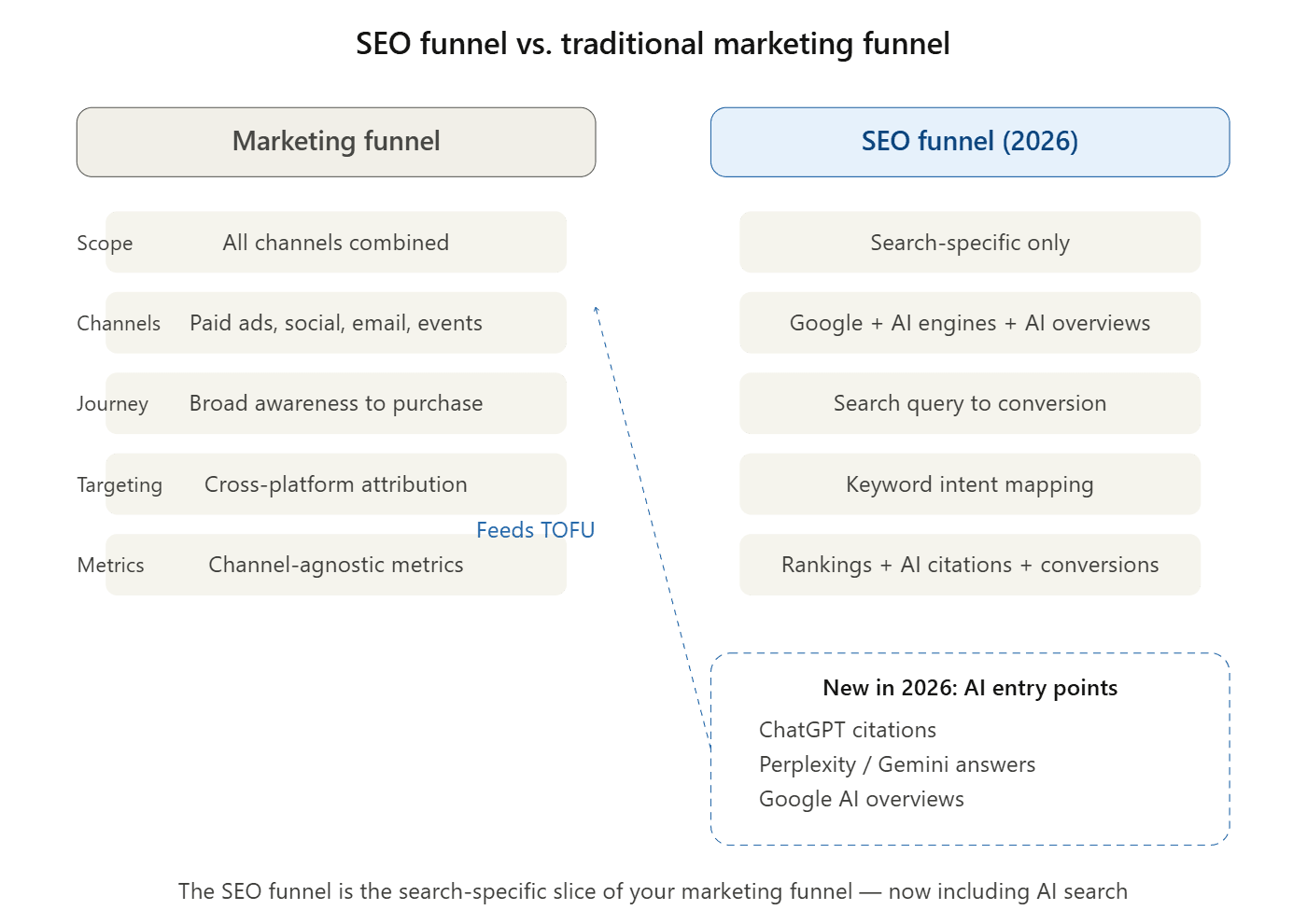
The traditional marketing funnel tracks the buyer's journey across all channels — social media, email, events, paid ads, and organic search. It's a broad framework for how awareness turns into revenue regardless of touchpoint.
An SEO funnel zooms in on one channel: search. But in 2026, "search" itself has expanded. It no longer means just Google. An SEO funnel now includes:
Traditional organic search — Google, Bing, and other search engines where you rank pages for keywords.
AI search engines — ChatGPT, Perplexity, Gemini, and Copilot, where AI-generated answers cite authoritative sources and send referral traffic.
AI Overviews — Google's own AI-generated summaries at the top of SERPs, which are reshaping click-through rates and changing what "ranking #1" actually means.
This expansion matters because each entry point feeds a different part of the funnel. A user might first encounter your brand through a ChatGPT citation (TOFU), then search your company name on Google (MOFU), then visit your pricing page directly (BOFU). If you're only optimizing for traditional Google rankings, you're missing the first touchpoint entirely.
For understanding how to optimize for both traditional and AI search simultaneously, our guide on SEO vs. GEO vs. AEO breaks down the differences and overlaps.
How to Create an SEO Funnel: The Step-by-Step Process
Building an effective SEO funnel isn't about creating random content and hoping visitors find their way. It's a systematic process of mapping keywords to intent, creating content for each stage, and linking it all together.
Step 1: Map Your Buyer's Questions to Funnel Stages
Before touching a keyword tool, brain-dump every question your buyer asks on their journey from "I have a problem" to "I'm ready to buy." Talk to your sales team. Read support tickets. Browse Reddit threads and forum discussions in your niche.
Then sort those questions into three buckets:
Awareness questions — "What is...?", "Why does...?", "How do I...?" These are educational. The buyer doesn't know the solution exists yet.
Consideration questions — "Which is better...?", "What's the difference between...?", "Best [solution] for [use case]?" The buyer knows solutions exist and is comparing.
Decision questions — "[Product] pricing," "[Product] vs. [Competitor]," "[Product] reviews," "buy [product] near me." The buyer is ready to act.
This exercise gives you a content roadmap grounded in real buyer behavior — not keyword volume alone.
Step 2: Conduct Keyword Research by Funnel Stage
Now take your question map and validate it with data. Use keyword research tools to find the actual search terms people use at each stage. Our ultimate guide to keyword research walks through this process in detail, but here's the funnel-specific approach:
For TOFU keywords, look for:
High volume, informational intent
"What is," "how to," "guide to," "benefits of" modifiers
Broad topics your audience researches before they know they need your product
For MOFU keywords, look for:
Moderate volume, commercial investigation intent
"Best," "vs.," "comparison," "review," "alternatives" modifiers
Queries where the user is evaluating solutions in your category
For BOFU keywords, look for:
Lower volume but high conversion intent
"[Brand] pricing," "buy [product]," "free trial," "[product] demo," "near me" modifiers
Queries where the user is one step from purchasing
For small businesses working with limited budgets, our list of free keyword research tools covers the best options.
Step 3: Create Content Matched to Each Stage
Each funnel stage demands different content types. Here's what works:
Funnel Stage | Content Types | Goal | CTA Approach |
TOFU | Blog posts, guides, how-to tutorials, educational videos, infographics | Educate and build trust | Subtle — newsletter signup, related reading |
MOFU | Comparison articles, buyer's guides, case studies, webinars, expert roundups | Help evaluate options | Moderate — demo request, free tool, gated content |
BOFU | Product/service pages, pricing pages, testimonials, free trial pages, location pages | Remove friction and convert | Direct — "Start free trial," "Book a demo," "Buy now" |
The most important rule: match your CTA intensity to the funnel stage. Pushing "Buy Now" on a TOFU educational post destroys trust. Burying your signup link at the bottom of a BOFU pricing page loses ready-to-convert visitors.
For guidance on writing content that ranks at each stage, see our guides on writing SEO-optimized articles with Claude and crafting effective AI prompts for content.
Step 4: Build Internal Links That Guide the Journey
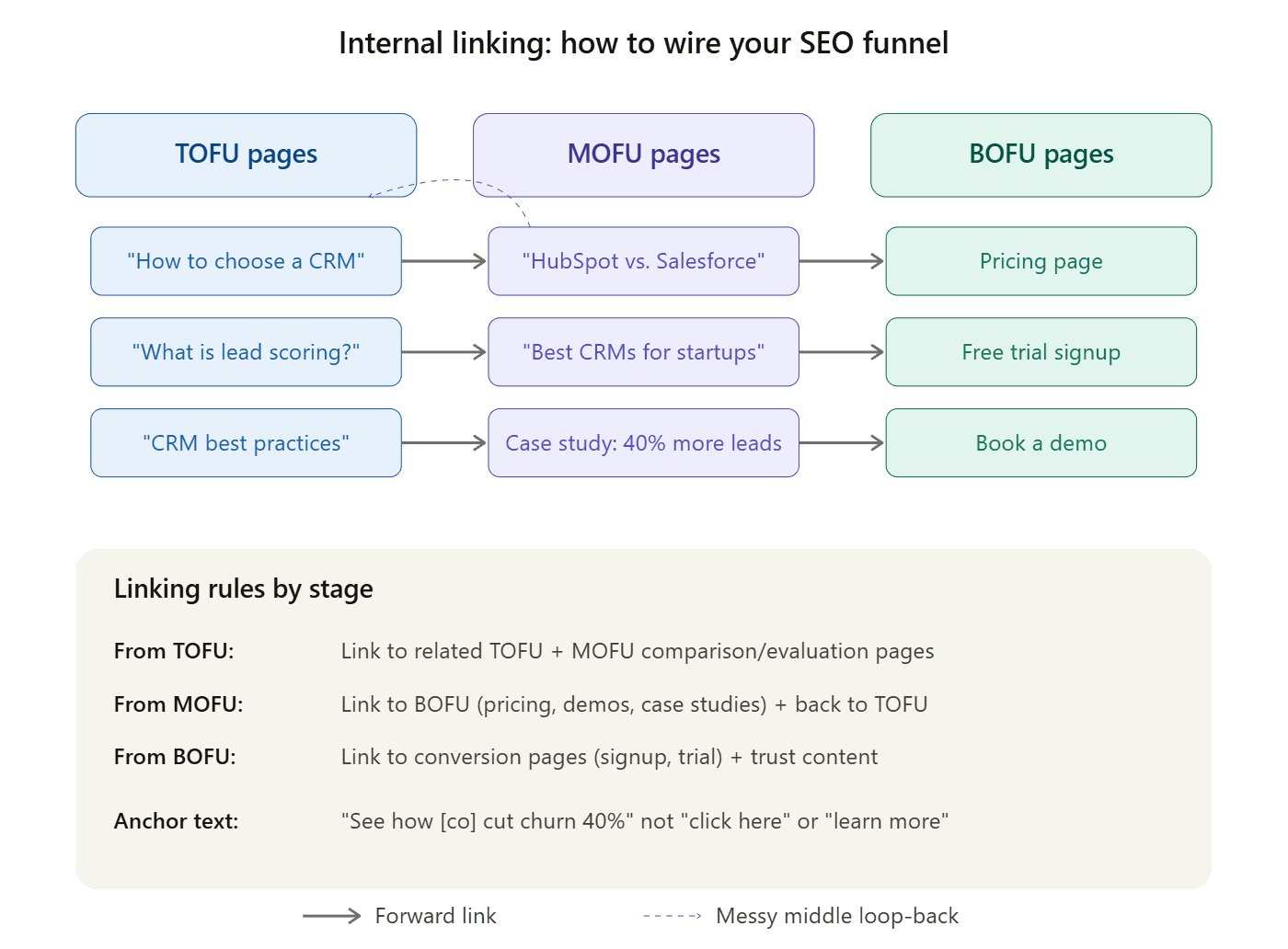
Internal linking is what transforms disconnected pages into a funnel. Without it, every page is a dead end. Here's the linking logic for each stage:
From TOFU content, link to:
Other related TOFU content (keeps reader exploring)
MOFU content where natural ("If you're evaluating options, see our comparison of...")
Feature or product pages only where genuinely relevant
From MOFU content, link to:
BOFU pages like pricing, demos, and case studies
TOFU content that provides background context
Product-specific pages that answer "how does this actually work?"
From BOFU content, link to:
Conversion pages (signup, free trial, contact)
Trust-building content (case studies, testimonials)
Onboarding or getting-started resources
Use descriptive, action-oriented anchor text — not "click here." Phrases like "see how [Company] reduced churn by 40%" or "compare pricing plans" give readers a reason to click and give search engines semantic context.
Step 5: Optimize for AI Search Entry Points
In 2026, your funnel has a new top: AI search engines. When someone asks ChatGPT "what's the best CRM for small businesses?" and your brand appears in the response, that's a TOFU touchpoint you need to plan for.
To optimize for AI search entry points:
Ensure your content is comprehensive, well-structured, and answers questions directly — this is what LLMs cite. Our complete GEO guide covers the full optimization framework.
Use structured data and schema markup to help AI crawlers understand your content's context.
Implement FAQ schema on key pages so your answers surface in AI-generated responses.
Track AI referral traffic separately in GA4 so you can measure which funnel stage these visitors enter.
The brands that treat AI search as a funnel entry point — not an afterthought — will capture demand that competitors don't even see.
SEO Funnel for SaaS: How B2B Funnels Differ
SaaS funnels are longer, involve multiple decision-makers, and require more educational content before conversion. Here's what changes:
TOFU content serves thought leadership, not just traffic. A SaaS buyer doesn't just want answers — they want to trust that you understand their industry deeply. Blog posts need to demonstrate genuine expertise, not just target keywords. Original research, proprietary data, and opinionated analysis outperform generic "What is X?" posts.
MOFU is where SaaS funnels win or lose. Most SaaS companies over-invest in TOFU blog content and under-invest in the comparison and evaluation content that actually moves buyers forward. Prioritize content like "[Competitor A] vs. [Your Product]," "How to choose a [category] platform," and case studies that show ROI with real numbers.
BOFU for SaaS means reducing decision anxiety. Free trials, interactive product tours, transparent pricing, and implementation guides matter more than hard-sell landing pages. The buyer has already decided they need a solution — they need reassurance that yours is the right one and that onboarding won't be painful.
The post-purchase stage matters more in SaaS. Unlike ecommerce where the transaction is the endpoint, SaaS revenue depends on retention. Onboarding guides, knowledge bases, and feature adoption content keep customers engaged and reduce churn. Think of post-purchase content as the bottom of the funnel that feeds the next cycle.
For SaaS companies exploring how AI search is changing visibility, our AEO and GEO tracking tools guide for B2B SaaS covers the measurement stack you need.
SEO Funnel for Ecommerce: How D2C and Retail Funnels Differ
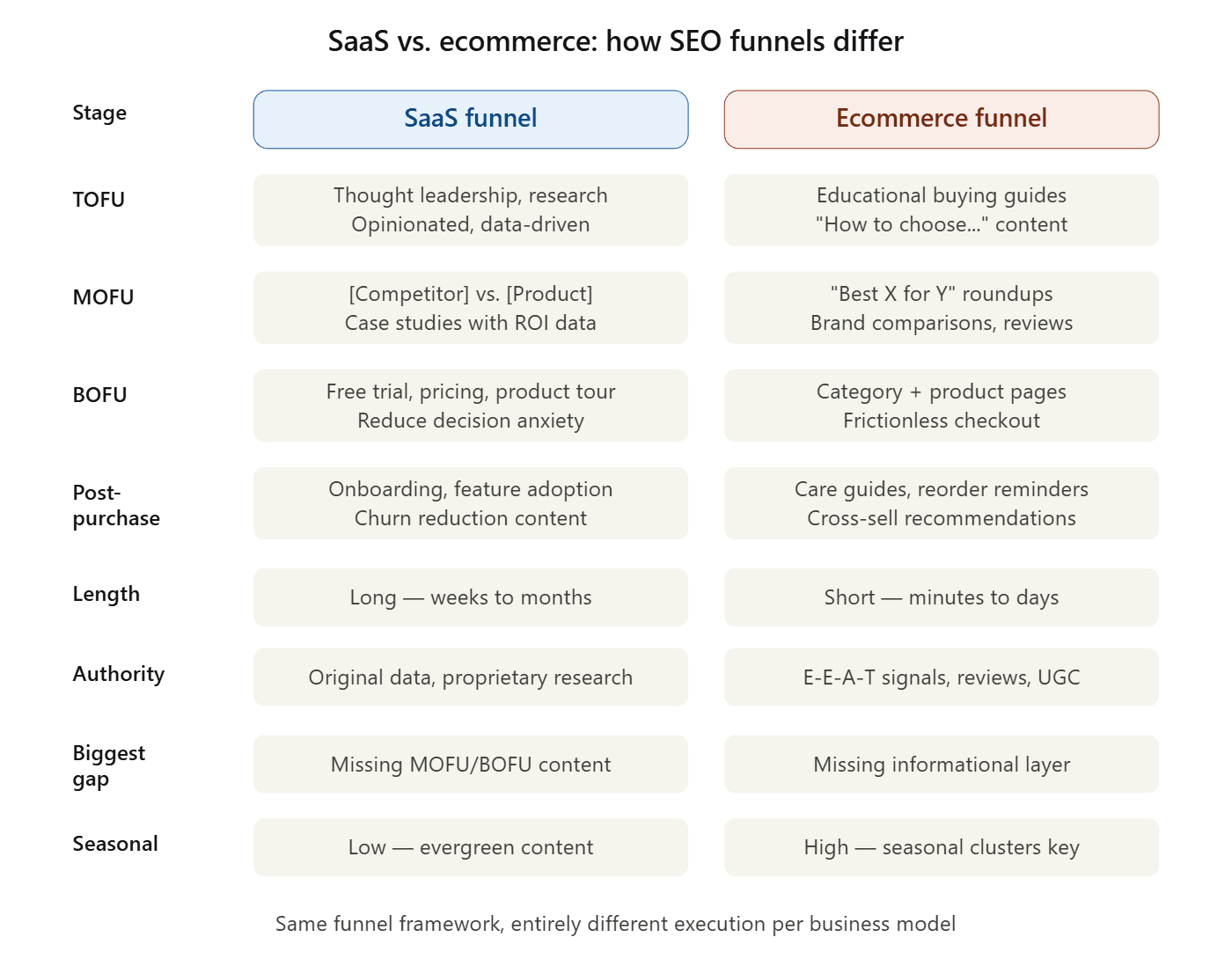
Ecommerce funnels are shorter, more transactional, and heavily influenced by visual search, seasonal demand, and product-level optimization. Here's the ecommerce-specific playbook:
TOFU for ecommerce means capturing research-stage shoppers. "How to choose running shoes for flat feet" is a TOFU query from someone who will eventually buy running shoes. Most ecommerce sites skip this entirely and only have category and product pages — which means they're invisible to the 60-70% of shoppers who start with informational queries. Our complete ecommerce SEO guide covers how to build this layer.
MOFU for ecommerce is comparison and curation content. "Best organic face serums for sensitive skin" or "Nike vs. Adidas running shoes" — these are queries where a buyer is narrowing their options. Roundup posts, buyer's guides, and "best of" lists that link directly to your product pages bridge the gap between research and purchase.
BOFU for ecommerce means frictionless product and category pages. Optimize your category pages to target commercial keywords, ensure product pages have proper schema markup, and remove every unnecessary step between "add to cart" and checkout. For AI search visibility, see our guide on optimizing product pages for ChatGPT and Perplexity.
Seasonal funnels are an ecommerce superpower. Build dedicated funnel paths for seasonal demand spikes — "Valentine's Day gift guides" (TOFU) → "best jewelry under $100" (MOFU) → category and product pages (BOFU). Publish 30-60 days before peak demand and update annually. These seasonal funnels compound in authority over multiple cycles.
E-E-A-T signals matter more for ecommerce than most sites realize. Google evaluates whether your site is a credible place to buy. Reviews, return policies, secure checkout, and transparent shipping information all feed into this. Our guide on optimizing ecommerce sites for E-E-A-T covers the full checklist.
How to Measure SEO Funnel Performance at Every Stage
Measuring an SEO funnel requires different metrics at each stage. Traffic alone tells you almost nothing about funnel health. Here's the measurement framework:
TOFU Metrics: Are You Attracting the Right Audience?
Organic impressions and clicks — Track in Google Search Console. Are your awareness-stage keywords getting visibility?
Time on page and scroll depth — Longer engagement signals that your educational content is genuinely useful.
New user percentage — TOFU content should attract predominantly new visitors. If it's mostly returning visitors, your awareness net isn't wide enough.
AI search visibility — Use tools that track LLM brand mentions to see if your TOFU content is being cited by AI engines.
MOFU Metrics: Are Visitors Evaluating You?
Pages per session from TOFU entry points — Are visitors who land on educational content clicking through to comparison or product pages?
Email signups, content downloads, and webinar registrations — These are the conversion events that indicate someone is moving from awareness to evaluation.
Internal link click-through rate — Use heatmap tools to see whether readers follow your MOFU-to-BOFU links.
Return visit rate — MOFU content should bring people back. If visitors read a comparison post and never return, your content didn't create enough interest.
BOFU Metrics: Are You Converting?
Conversion rate on BOFU pages — The most direct metric. What percentage of visitors to pricing, product, or signup pages actually convert?
Revenue per visit — Especially for ecommerce, measure the dollar value each BOFU page visit generates.
Assisted conversions — Use GA4 to track multi-touch attribution. Which TOFU and MOFU pages appear in the conversion path before a BOFU conversion?
AI referral conversions — Track AI search referral traffic in GA4 and measure whether it converts differently from organic Google traffic.
For a deeper dive into why traffic metrics alone are misleading, our analysis of organic traffic vs. organic conversions explains the distinction and how to measure what matters.
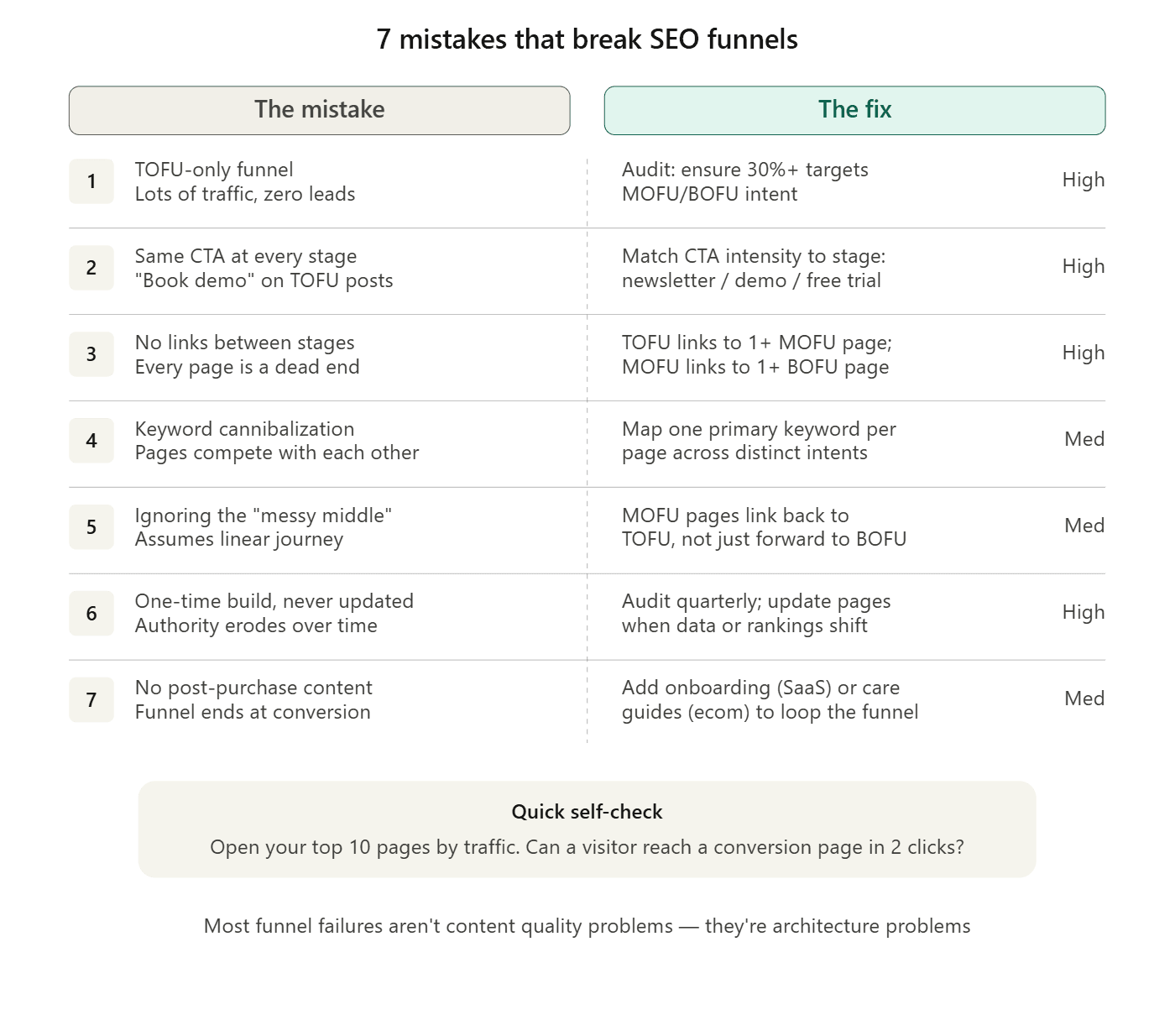
7 Mistakes That Break SEO Funnels (And How to Fix Them)
1. Building a TOFU-Only Funnel
The most common mistake. You publish 50 blog posts targeting informational keywords, get decent traffic, and wonder why leads don't materialize. The fix: audit your content library and ensure at least 30% targets MOFU/BOFU intent. If you're light on comparison content, case studies, and product pages, that's your gap.
2. Using the Same CTA at Every Stage
A "Book a Demo" button on a "What Is CRM?" blog post is mismatched intent. Match CTA intensity to funnel stage — newsletter at TOFU, demo at MOFU, free trial at BOFU.
3. No Internal Links Between Stages
Content without internal links is a collection of dead ends. Every TOFU page should link to at least one MOFU page. Every MOFU page should link to at least one BOFU page. This is the minimum viable funnel.
4. Ignoring Keyword Cannibalization Across Stages
When multiple pages target similar keywords at different funnel stages, they compete against each other in search results. Map one primary keyword per page and ensure your TOFU, MOFU, and BOFU pages target distinct queries — even within the same topic.
5. Not Optimizing for the "Messy Middle"
Google's research shows buyers don't move linearly through the funnel. They loop between exploration (TOFU) and evaluation (MOFU) multiple times before deciding. Your content needs to support this looping behavior — which means MOFU pages should link back to relevant TOFU content, not just forward to BOFU.
6. Treating the Funnel as a One-Time Build
Your funnel is a living system. Keywords change, competitors publish better content, and Google algorithm updates shift rankings. Audit your funnel quarterly. Update underperforming pages. Fill gaps where competitors have content you don't.
7. Forgetting the Post-Purchase Stage
A customer who just bought is your highest-intent audience for upsells, referrals, and retention content. SaaS companies need onboarding sequences. Ecommerce stores need care guides and reorder reminders. The funnel doesn't end at conversion — it loops.
How SEO Funnels and Topic Clusters Work Together
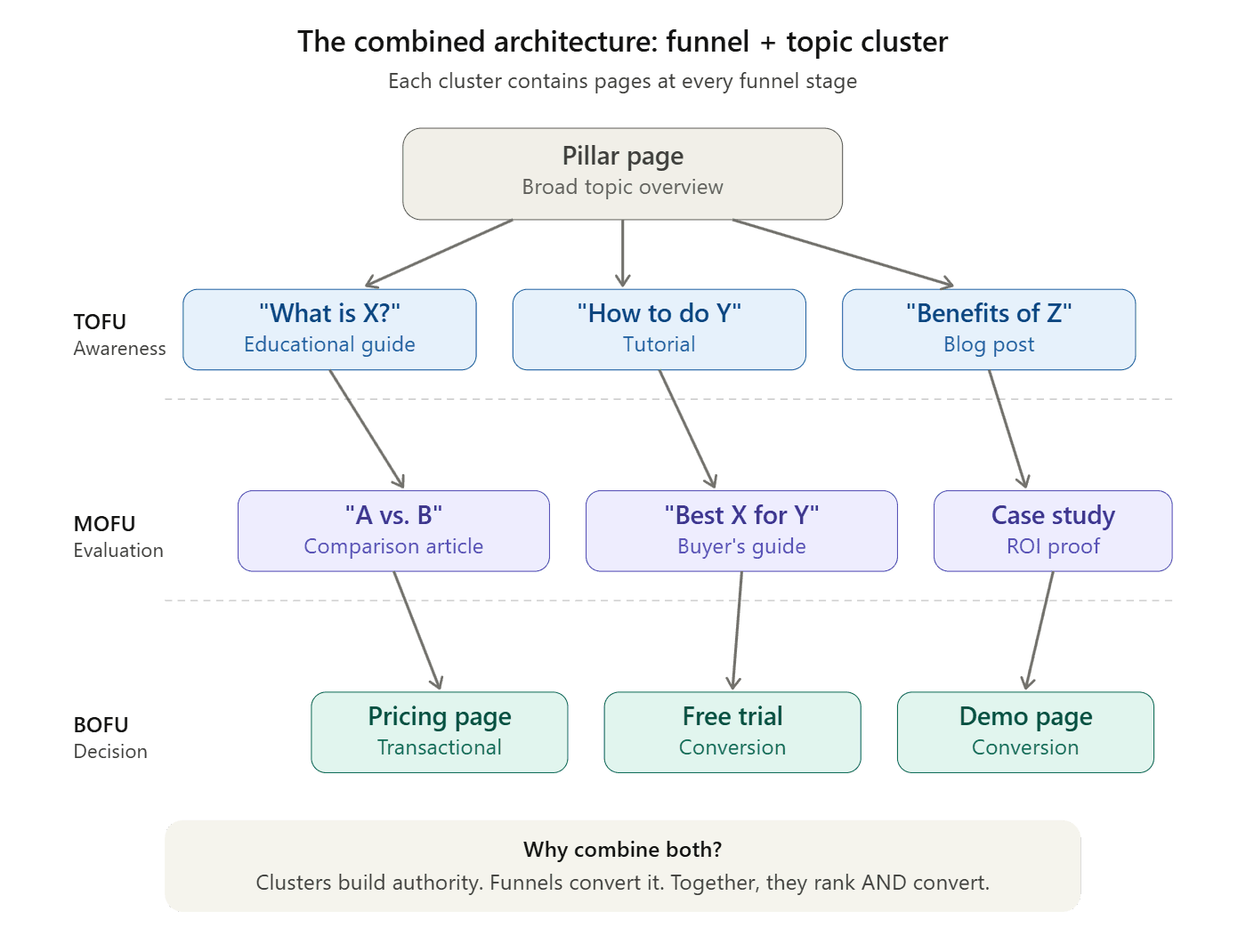
If you've read our guide on topic clusters for SaaS and ecommerce, you already understand how content should be organized into pillar-and-cluster structures. The SEO funnel adds another dimension: it tells you what type of content belongs at each position in the cluster.
A topic cluster without funnel mapping is a collection of pages covering a subject from every angle — but with no commercial intent woven in. You build authority but don't convert.
A funnel without topic clustering is a set of pages at different intent levels — but with no topical structure connecting them. You might convert individuals but you don't build the authority that compounds rankings over time.
The strongest SEO architecture combines both. Each topic cluster includes pages at every funnel stage — TOFU educational content, MOFU comparison content, and BOFU conversion content — all interlinked and organized under a pillar page. This is how you build a content system that ranks, educates, and converts simultaneously.
For a complete walkthrough of how to build these combined structures, explore our guides on SEO management and increasing organic traffic with proven strategies.
Your Next Move
Open your analytics and answer one question: what happens after someone lands on your most-trafficked blog post?
If the answer is "they leave," your content is working as a destination, not a funnel. The fix isn't more content — it's connecting what you already have into a path that moves readers forward.
Start with your top 10 pages by traffic. Identify the funnel stage of each one. Add internal links from each TOFU page to one MOFU page, and from each MOFU page to one BOFU page. That single exercise — one afternoon of work — will do more for your conversion rate than publishing ten new blog posts.
If you want expert help building a complete SEO funnel for your business, Passionfruit's SEO team works with SaaS and ecommerce brands to architect content systems that don't just attract traffic but convert it. See our case studies for real results, or explore how we achieved 120% organic traffic growth in 3 months using this approach.
Your best content is already published. It just needs a funnel to flow through.
FAQs
What is an SEO funnel?
An SEO funnel is the structured path users follow from their first search query to conversion, guided entirely by organic content. It maps keywords, content, and internal links to three buyer journey stages — awareness (TOFU), consideration (MOFU), and decision (BOFU) — so that each piece of content moves visitors closer to becoming customers. Unlike a general marketing funnel, an SEO funnel focuses specifically on search as the channel, which in 2026 includes both traditional search engines and AI search platforms.
What are the three stages of an SEO funnel?
The three stages are Top of Funnel (TOFU), where users search for educational information and discover your brand; Middle of Funnel (MOFU), where users compare solutions and evaluate whether your offering fits their needs; and Bottom of Funnel (BOFU), where users are ready to buy and search for pricing, reviews, or specific product pages. Each stage requires different keyword targeting, content types, and CTA strategies. For the foundational SEO principles behind this framework, see our dedicated guide.
How do I know which keywords belong to which funnel stage?
Keyword intent is your primary sorting mechanism. Words like "what is," "how to," and "guide" signal TOFU (informational intent). Words like "best," "vs.," "comparison," and "alternatives" signal MOFU (commercial investigation intent). Words like "pricing," "buy," "demo," "near me," and specific brand names signal BOFU (transactional intent). Use keyword research tools to check intent classifications, and cross-reference with the actual SERP results — if the top results are all blog posts, it's informational; if they're product pages, it's transactional. Our guide to keywords, LSI keywords, and semantic keywords explains how to identify intent types.
How do I optimize my SEO funnel for AI search engines?
AI search engines like ChatGPT, Perplexity, and Gemini are becoming new funnel entry points. To optimize, ensure your content is comprehensive and well-structured — LLMs cite sources that answer questions authoritatively. Use AI-friendly schema markup so crawlers understand your content's context. Build topical authority through topic clusters, since AI citations tend to favor sites that already rank in Google's top 10. And track AI referral traffic separately using GA4 tagging to measure which funnel stage AI visitors enter.
Can I use the same page for multiple funnel stages?
You can, but it dilutes focus and typically underperforms compared to dedicated pages per stage. A page trying to educate (TOFU), compare (MOFU), and convert (BOFU) simultaneously confuses both readers and search engines about its primary intent. The exception is pillar pages within topic clusters, which provide broad overviews and link out to more focused content at each stage. For most content, keeping a clear primary intent per page produces better rankings and higher conversion rates.
How long does it take to see results from an SEO funnel?
BOFU content targeting transactional keywords often shows results within 8-12 weeks, since these pages serve high-intent queries with lower competition. MOFU content typically takes 3-6 months as commercial investigation keywords tend to be more competitive. TOFU content aimed at building broad awareness and topical authority can take 6-12 months to compound meaningfully. The fastest path to revenue: start with BOFU pages that convert existing search demand, then backfill MOFU and TOFU content to expand your funnel's reach over time.
What's the difference between an SEO funnel and a content funnel?
An SEO funnel specifically maps search intent to buyer journey stages — it's about matching keywords, SERP features, and organic rankings to the right content at the right time. A content funnel is broader and includes non-search content like social media posts, email sequences, and paid ad landing pages. An SEO funnel feeds the content funnel with organic traffic, but the content funnel may include additional touchpoints that happen off-search. The SEO funnel is the search-specific slice of your overall content strategy.